We Are Your Friends

We Are Your Friends

Posted on August 27, 2015 at 5:35 pm

Copyright Warner Brothers 2015

Director Max Joseph brings some of the “Catfish” sensibility to “We Are Your Friends,” with an intimate, documentary feel and a storyline about people in their 20’s who have big dreams but not much understanding about how to achieve them or even about the nature of their relationships. Joseph is the quieter co-host of “Catfish,” the MTV series sequel to the film that added its name to the lexicon, meaning an online relationship with someone who is not as described or presented. In “We Are Your Friends” (named for the Justice vs. Simian song) four bros hang out together, trashing each other and everyone else, promoting parties, enjoying easy access to drugs and girls, and reassuring each other that fame and fortune lies ahead. They feel like besties, but it’s just inertia and a shared fear of moving forward. In reality, they are very different.

Cole (Zac Efron) is a talented DJ who knows how to combine “the rhythm of a caveman” with a kickin’ bass line to “get the crowd out of their heads and into their bodies.” His pals are hot-tempered Mason (Jonny Weston), low-key drug dealer and aspiring actor Ollie (Shiloh Fernandez) and quiet but thoughtful Squirrel (Alex Shaffer of “Win Win”). They get jobs facilitating real estate deals (calling people in foreclosure) for a wealthy businessman (Jon Bernthal, all rough charm and menace in an excellent performance). And Cole meets James (Wes Bentley with Wolverine-style facial hair), a big shot DJ who has performed all over the world and who has a girlfriend/assistant named Sophie who looks like a Sports Illustrated swimsuit model, because she is played by Emily Ratajkowski, who is one. Ratajkowski was better in “Gone Girl.” Here she does more posing than acting.

There’s nothing wrong with a coming of age story about a young person with a strong creative drive who needs to learn to develop a singular voice, and Efron is, as always, an appealing actor. But too much of it seems borrowed from other films and the situations and settings (San Fernando Valley, aimless young men who party too much and wear their pants too low, the empty and foreclosed houses and predators who flip them) are washed out and played out. The big lesson for Cole is learning to develop a distinctive sound. But the scene where the scales fall from his eyes — or ears — so that he begins incorporating the sounds around him like that wacky carriage ride scene in “The Great Waltz” is just silly. It never persuades us that EDM is anything but derivative, mostly because the movie is, too.

Parents should know that this film has a lot of adult material including very strong language, crude sexual references and situations, nudity, drinking, smoking, extended drug use and drug dealing including marijuana, PCP, ecstasy, and cocaine, a fatal overdose, and a painful scene of foreclosure.

Family discussion: Why did Squirrel say the best part was before the evening began? What did James mean about the meaning of the word “irreparable?”

If you like this, try: “Magic Mike” and “Echo Park”

Related Tags:


Drama Scene After the Credits
Ricki and the Flash

Ricki and the Flash

Posted on August 6, 2015 at 5:48 pm

Copyright 2015 Walden

“Aren’t you allowed to have two dreams?”

The person asking the question is Ricki (as she is now known), played by Meryl Streep. She has just accused her ex-husband, Pete (Kevin Kline), of not supporting her dream of playing rock music. And he has responded, “I thought we were your dream.” Years ago, Ricki was a suburban housewife named Linda, with a husband and three young children. She left them to be a rocker, and now fronts a cover band called Ricki and the Flash, performing at night for a small group of loyal fans at a bar in Tarzana, California. During the day, she is a cashier for a warehouse store. Neither job pays well; she is about to declare bankruptcy.

But first she has to go home. Her daughter Julie (Streep’s real-life daughter Mamie Gummer) is having a breakdown because her husband is in love with someone else. Pete’s wife is away, caring for her ailing father. So Pete calls Ricki and asks her to come home and help him take care of Julie. She arrives, with her guitar and dressed in 70’s rocker drag, at his gracious gated community and enters Pete’s grand and elegant home, where everything seems effortlessly comfortable. And where Ricki, with her stringy braids and kohl-rimmed eyes and tattoo is very out of place.

Screenwriter Diablo Cody (“Juno”) gives Ricki some unexpected characteristics and of course Streep brings her to life. Linda/Ricki loves to perform and loves the look and shock-the-bourgeois attitude of a rock musician, even at her other job. But she is not the stereotype anarchist/liberal. The tattoo on her back is a proudly waving American flag and she calls out “Support the troops!” from the stage. We learn a little bit more about where that comes from in one of the movie’s highlights, when Pete’s second wife, played with depth, heart, and resolve by Broadway star Audra McDonald, returns home and the two women have a conversation about what is best for Julie. It is couched in the kind of “we don’t have to like each other but we need to get along” terms of two very different women who share the experience of having been married to the same man and, in their own ways, mothering his children.

Streep clearly loves being back with her “Sophie’s Choice” co-star, and she and Kline create a palpable sense of history with each other in some touching moments, especially when they join forces to confront Julie’s ex. And it is a joy to see Steep and Gummer together. Their trust and connection is so solid that it gives them both the freedom to make their relationship complicated and painful, wanting so much from one another, and still wanting to give to one another, too.
Rick Springfield (yes, that Rick Springfield) is excellent as lead guitar of The Flash and sometime boyfriend for Ricki.

The film is awkwardly constructed, and the ending, while sweet, is abrupt and unrealistic. It makes sense for the storyline that Ricki is not a great singer or musician, with a dozen cover songs on the soundtrack, director Jonathan Demme’s commitment to using the live performances without any studio sweetening is questionable. But the musical performances are joyous, tender-hearted and true. And it explores essential questions: How do we love the people who cannot love us back the way we want them to? What do you do when your dreams do not fit together? What will you give up for someone you love?

Parents should know that this movie includes tense and unhappy family confrontations, discussion of a suicide attempt, strong language, drinking, marijuana, and sexual references and situations.

Family discussion: Can you have two dreams? How does Pete feel about Ricki? How can you tell? Why does Ricki hurt Greg?

If you like this, try: “The Rocker” and “Juno” and see Streep and Kline together in “Sophie’s Choice”

Related Tags:


Drama Family Issues
Southpaw

Southpaw

Posted on July 23, 2015 at 5:58 pm

B
Lowest Recommended Age: Mature High Schooler
MPAA Rating: Rated R for language throughout, and some violence
Profanity: Constant very strong language
Alcohol/ Drugs: Drinking, drugs
Violence/ Scariness: Intense boxing scenes with disturbing images, gun violence, murder, suicidal behavior, child removed from her family
Diversity Issues: Diverse characters
Date Released to Theaters: July 25, 2105
Date Released to DVD: October 26, 2015
Amazon.com ASIN: B012BPM536
Copyright 2015 Weinstein Company

Didactic and unabashedly manipulative, “Southpaw” borrows from almost every boxing movie ever made. It telegraphs every development and then, in case we missed it, tells us what just happened. The dialogue is purplish and melodramatic. The filmmaking is self-consciously arty, with shadows and reflections — or smoke and mirrors. The storyline is so soapy it almost slides off the screen. As Thelma Ritter says in “All About Eve,” “Everything but the bloodhounds snappin’ at her rear end.” Scriptwriter Kurt Sutter (“Sons of Anarchy”) has to learn to trust his audience.

Heartfelt performances by Jake Gyllenhaal, Rachel McAdams, and Forest Whitaker give the story more weight than it deserves, and director Antoine Fuqua knows how to film the boxing scenes so that each is a drama of its own.

A movie hero generally has to start with nothing and get something or start with everything, lose it all, and then get it back. Gyllenhaal plays Billy Hope (this film really does hit every point home with a sledgehammer), who had nothing and now, as the movie begins, has it all, so we know he has to lose it. Hope grew up in what we used to call orphanages. All he had was a girl named Maureen who believed in him and guided him and an anger so powerful that he could use it in the ring the way Popeye uses spinach.

We see him before a title fight, his hands getting wrapped in pristine gauze under the supervision of the referees, who literally sign off on them before the gloves go on. Billy has a moment alone with Maureen (Rachel McAdams, in a richly observed performance). And then there is the fight. He gets hit until he gets furious enough to battle back with everything he has, and then he wins. He and Maureen return to their mansion, kiss their adorable daughter Leila (Oona Laurence), and go to bed. And then it is all gone, and he has to literally fight his way back, mopping floors at a dingy, inner-city gym and being trained by a crusty old pro (Burgess Meredith, no, I mean Forest Whitaker). He has to learn boxing all over again.

Gyllenhaal’s physical transformation, so soon after his skeletal appearance in “Nightcrawler,” could be stunt-ish — or just a chance for him to get back in shape. But he makes us feel the almost feral elements of Billy’s understanding of the world around him, and he shows us the way his growing understanding of himself as he has to take responsibility for his choices is reflected in the ring. His scenes with McAdams are deeply felt, tender, and sexy. The movie gets a split decision, but Gyllenhaal and McAdams are a knockout.

Parents should know that this film has constant very strong language, sexual references and a non-explicit situation, brutal and bloody boxing matches, gun violence, drinking and drugs, sad deaths of a parent and a young teen, references to domestic abuse and prostitution, child removed from family, suicidal behavior and assault.

Family discussion: Why did Tick make Billy clean the gym? Was the judge right to take Leila away? Why did Billy need to change his style of fighting?

If you like this, try: “Rocky,” “Warriors,” and “Body and Soul”

Related Tags:


Drama DVD/Blu-Ray Pick of the Week Sports
Self/Less

Self/Less

Posted on July 9, 2015 at 5:08 pm

B
Lowest Recommended Age: High School
MPAA Rating: Rated PG-13 for sequences of violence, some sexuality, and language
Profanity: Some strong language
Alcohol/ Drugs: Drinking
Violence/ Scariness: Perils and violence, intense themes of encouraging people to die so that wealth people can live longer
Diversity Issues: Diverse characters
Date Released to Theaters: July 10, 2015
Copyright 2015 Endgame Entertainment

The longing for eternal life has inspired many stories, maybe most of them. What is creating a story itself if not a kind of search for immortality? Anne Rice created her series of books about vampires because the death of her young child made her imagine characters who would not die. The story of Orpheus and Eurydice, with a man entering Hades to bring back woman he loves, has been told in many forms, last year in the animated film “The Book of Life.” This year alone, films like “Ex Machina,” “Terminator Genisys,” “The Age of Adaline,” “The Moon and the Sun,” and this film, “Self/Less” are just some of the films that explore the idea of a consciousness that can survive a human lifespan.

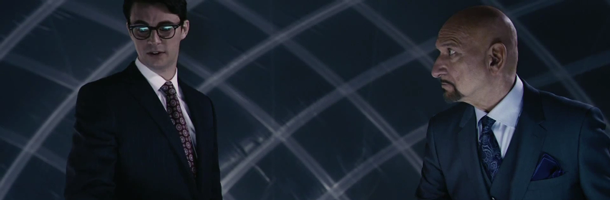
In this case, there is a very rich man, still, near death, relishing the chance to demolish a young, ambitious competitor in as public and humiliating a fashion as he can devise. His name is Damian (Sir Ben Kingsley), and he lives in a Manhattan apartment of an opulence so gaudy it would make Marie Antoinette blush. Everything is covered in gold or marble except for the bubbling indoor fountain and the window with a view of Central Park. Damian has money and power. He also has a community activist daughter (“Downton Abbey’s” Michelle Dockery), presumably trying to prevent everything he is building, who is not speaking to him. He has a furious will to live, but his body is dying.

And then he gets a card with a phone number and a message that this could help. The impeccably elegant Dr. Albright (Matthew Goode of “The Good Wife” with his authentic British accent) offers a very pricy special service. For a quarter of a billion dollars, he will transfer a dying person’s consciousness to a fresh, new body.  And for that amount, you can bet it will be top quality.  Damian is going to come out of this process looking like Ryan Reynolds.

That’s pretty much like getting the keys to a Lamborghini.  So, of course first of all, Damian wants to take it out for a wild test drive, in the greatest city in America for living it up, New Orleans. We have almost as much fun as Damian does because director Tarsem Singh has a flair for striking, kinetic visuals and dynamic edits that make this part of the movie so vibrant we can feel the testosterone and adrenaline — and whatever other drug Dr. Albright is giving him — pounding through his system.

But Damien starts getting flashes of images and people he does not recognize. Are they hallucinations? Or are the memories of that handsome body breaking through? And if the memories can seep through into Damian’s consciousness, can the personality, the spirit, the feelings, the skills be there, too?

Singh is big on visuals but not much on storylines (“The Cell,” “The Fall,” “Mirror Mirror”). So, while this has more story than his previous films, it is still less than we are entitled to expect. You would have to be as impaired as Damian not to figure out what is happening, or to believe everything Dr. Albright says. But there are some nice twists, and some good fight scenes (Damian’s new body has mad skillz). And somewhere in there are some provocative concepts about life, death, memory, identity, and, well, karma.

Parents should know that this film has some violence, including shoot-outs, with characters injured and killed, and some disturbing themes about re-animating corpses and wiping memories. There are sexual references and situations, drinking, drugs, and some strong words.

Family discussion: Why does what Damian learns about the body make him think differently about what he has done? Who should decide how scientific discoveries like these are applied?

If you like this, try: some other films on this theme including “Seconds” with Rock Hudson, “Never Let Me Go” with Keira Knightley, and “All of Me” with Steve Martin and Lily Tomlin, and a very funny brief segment in the Woody Allen film, “Stardust Memories”

Related Tags:


Drama Fantasy Movies -- format Science-Fiction
THE MOVIE MOM® is a registered trademark of Nell Minow. Use of the mark without express consent from Nell Minow constitutes trademark infringement and unfair competition in violation of federal and state laws. All material © Nell Minow 1995-2026, all rights reserved, and no use or republication is permitted without explicit permission. This site hosts Nell Minow’s Movie Mom® archive, with material that originally appeared on Yahoo! Movies, Beliefnet, and other sources. Much of her new material can be found at Rogerebert.com, Huffington Post, and WheretoWatch. Her books include The Movie Mom’s Guide to Family Movies and 101 Must-See Movie Moments, and she can be heard each week on radio stations across the country.

Website Designed by Max LaZebnik