
Hello, Dolly!

Posted on December 13, 2002 at 5:17 am

Plot: Dolly Levi (Barbra Streisand) is a matchmaker in turn of the century Yonkers, outside of New York. She is hired by Horace Vandergelder (Walter Matthau) to find him a wife. He also hires her to take his niece Ermengarde (Joyce Ames) to New York City, to encourage her to forget about marrying her artist beau, Ambrose (long-legged Tommy Tune). Instead, Dolly makes matches for his two clerks (Michael Crawford and Danny Lockin), advises them on how to get promotions from Horace, and helps Ermengarde get permission to marry Ambrose. Finally, after a series of intricate maneuvers, Dolly makes a match for herself, with Horace.

Discussion: This is one of the last of the big-time, old-fashioned musicals, with lavish production values and a dozen hummable tunes. The very slight story is bolstered by terrific singing and dancing — staged by two masters of the genre: Gene Kelly, who directed, and Michael Kidd, who choreographed. The elaborate sets, costumes, and musical numbers make this movie a treat for the eyes and ears.

Dolly is almost a magical figure, with business cards for every purpose. When she tells Ermengarde and Ambrose they can earn the money they need by winning the dance contest at Harmonia Gardens, she produces one that says “Artists Taught to Dance.” With all the confidence it takes to transform the lives of everyone around her, she still hesitates when it comes to herself. She still mourns her late husband Ephraim, but she wants more out of life “Before the Parade Passes By.” Yet when Horace finally proposes, she waits for a sign of Ephraim’s approval. What she gets is a sign that Horace has the qualities she is looking for, that, as she suspected all along, his gruff exterior conceals a warm heart and a wish to help others.

Questions for Kids:

· Why doesn’t Dolly just tell Horace the truth about what she thinks is right for him and for Ermengarde?

· How does she help the people in the movie to think differently about themselves, and how does that help them change?

· What does Dolly mean when she sings “Before the Parade Passes By”?

· When the young couples sing “We’ve Got Elegance,” do they really think they are fancy?

· What would you do if you were Barnaby and Cornelius at the Harmonia Gardens?

· What is the difference between Dolly’s view of money and Horace’s view?

Connections: Michael Crawford went on from male ingenue parts (“A Funny Thing Happened on the Way to the Forum”) to star in the title role of “Phantom of the Opera.” This story, originally a German play, has been produced in a number of forms, including “The Matchmaker,” a non- musical play written by Thornton Wilder (of “Our Town”), filmed with Shirley Booth, and most recently redone by avant-garde playwright Tom Stoppard from the perspective of the two clerks as “On the Razzle.”

Activities: Take the kids to a parade, preferably one where they can march along. They might also enjoy making some hats inspired by the spectacular creations in the movie.
Related Tags:


For the Whole Family Musical Romance

I Love You Again

Posted on December 13, 2002 at 5:17 am

Prissy, stingy Larry Wilson (William Powell) bores everyone aboard ship on his way back to the United States from a business trip. When Ryan, a fellow passenger, falls overboard, Larry is accidentally knocked overboard trying to save him. Hit on the head, he comes to as George Carey, a smooth con man whose last memory is of a train ride nine years before, when someone stole the money he was taking to bet on a fight. He has no recollection of his life as Larry, in a small town called Habersville. When he finds “Larry’s” bank book with a substantial balance, he and Ryan decide to visit Habersville to get as much of it as they can.

At the dock, they are met by Larry’s wife, Kay (Myrna Loy). Carey is smitten with her, but she has come to get him to agree to a divorce. They go back to Habersville together, where Carey and Ryan plan an elaborate swindle, with the help of Carey’s former partner, Duke. Constantly confronted with people and questions he cannot remember, Carey manages to fake his way through, even on a hilarious hike with a Scout-like troop of boys. Kay begins to warm to him, and, when she finds out the truth from Ryan, she remains loyal. Carey tries to call off the swindle, and when that does not work, resolves everything with his last con job, happily looking forward to staying in Habersville with Kay.

Powell and Loy appeared in more films together than any screen couple since the silents, and this delightful romantic comedy is one of their best films. Carey’s horror as he finds out more and more about his life as “Larry” is balanced by Powell with smooth maneuvering to keep everyone from finding out that he can’t remember anything about his life in Habersville. Loy is, as always, “the perfect wife,” witty, wise and loyal — she sees the essence of the truth and is adorably charmed by it.

Amnesia of this kind occurs only in the movies (and in soap operas). Even though it makes no sense medically, it does make sense dramatically. When Carey was hit on the head in a robbery nine years before, he became Larry, the boring businessman. It had to be because, at some level, a part of him wanted a “respectable life.” At the end, he is neither Carey nor Larry, but a synthesis of both, ready to stay in Habersville with Kay and live happily ever after. Kay’s motives are also justified. She married a bore like Larry because, as she says, she saw something exciting behind his eyes. She was the only one who glimpsed Carey inside of the stiff and proper Larry. And she also sees Carey at his best. When she says he is noble and honest, she turns out to be right.

Questions for Kids:

· What does Carey do to convince everyone that he is Larry, and that he remembers his life in Habersville?

· When is he closest to being found out, and how does he handle it?

· How does he con Duke into letting him out of the swindle?

· What do you think will happen after Duke leaves with the money?

· Will Carey be at all like Larry in the future? How?

Connections: As in “The Music Man,” this is a story about a con man who comes to a small town and is redeemed by love. Another movie with a funny scene involving a counterfeit Scout leader is “It’s a Wonderful World,” with Jimmy Stewart and Claudette Colbert, and also directed by W.S. Van Dyke. A romantic drama about amnesia is “Random Harvest,” in which Greer Garson marries Ronald Coleman, who has forgotten his past, and loses him when he remembers it.

Any of the Powell and Loy movies are a pleasure to watch, especially “The Thin Man” series and “Libeled Lady.” Harkspur, Jr. is played by Carl “Alfalfa” Switzer of “Our Gang.”

Related Tags:


Comedy For the Whole Family Romance

Lady and the Tramp

Posted on December 13, 2002 at 5:17 am

A+
Lowest Recommended Age: Kindergarten - 3rd Grade
MPAA Rating: NR
Profanity: None
Alcohol/ Drugs: None
Violence/ Scariness: Characters in peril
Diversity Issues: A theme of the movie
Date Released to Theaters: 1955
Date Released to DVD: February 6, 2012
Amazon.com ASIN: B0061QD82E

Perfectly timed for Valentine’s Day, Disney’s romantic animated classic “Lady and the Tramp” is out this week for the first time in a Diamond DBD/Blu-Ray combo.

Lady is the pampered cocker spaniel of a couple she knows as “Jim Dear” and “Darling.” Her best friends are Jock (a Scottie) and Trusty (a basset hound who has no sense of smell). They ignore a stray named Tramp. When Darling has a baby, Lady is apprehensive, but Jim Dear and Darling assure her that she is still important to them. The couple has to go away, though, and Aunt Sarah arrives, with her nasty Siamese cats, to care for the baby. The cats make a mess of the living room and Lady gets the blame. Aunt Sarah puts Lady in a muzzle, and Lady, hurt and humiliated, runs away.

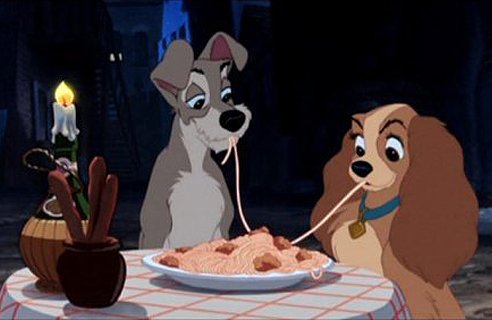
She meets Tramp, who finds a way to get the muzzle off with the help of an obliging beaver (Stan Freberg). Then Tramp takes Lady out on the town, ending with a romantic spaghetti dinner at Tony’s restaurant. The next morning, on her way home, she is captured by the dogcatcher. At the pound, she hears from Peg (Peggy Lee) that Tramp is a rogue with many lady friends, and she is disillusioned.

Aunt Sarah gets Lady and takes her home, banishing her to the doghouse. But with Tramp’s help Lady gets inside to save the baby from a rat. The crib is knocked over, and Aunt Sarah blames Tramp. She calls the dogcatcher to take him away. Just in time, Jim Dear and Darling return, and understand what has happened. With the help of Jock and Trusty, they get Tramp back. Trusty is hurt, but not badly, and he and Jock go to visit on Christmas to see Lady and Tramp and meet their new puppies.

This is one of Disney’s best animated films, with an appealing story and memorable music by Peggy Lee and Sonny Burke. Kids with new (or expected) siblings may like to talk about Lady’s concerns about the new baby. The way the story is told from the dogs’ perspective may be of interest to younger kids, who are just learning that not everyone sees the same things exactly the same way. And many kids will identify with Lady’s sense of frustration when the adored Siamese cats frame her for destroying the living room.

Parents should know that there are some tense moments and mild peril.

Family Discussion:  Why does Lady think her owners’ names are “Jim Dear” and “Darling?”  Why was Lady worried about what would happen when the baby came?  How did Lady feel when Aunt Sarah blamed her for what the cats did? Why didn’t Lady like Tramp at first? What made her change her mind?

Activities: Make up a story about what might happen with the puppies after the movie ends. And have a spaghetti dinner!

If you like this, try: other Disney animated classics like “Pinocchio” and “101 Dalmatians”

Related Tags:


Animation Based on a book Classic DVD/Blu-Ray Pick of the Week For the Whole Family For Your Netflix Queue Movie Mom’s Top Picks for Families Musical Romance Talking animals

Lili

Posted on December 13, 2002 at 5:17 am

Plot: Lili (Leslie Caron), a French orphan, is dazzled by a handsome carnival magician named Marcus (Jean Pierre Aumont) when he speaks kindly to her, and she follows him back to the carnival. She gets a job as a waitress there, but is fired for spending too much time watching his act. Lonely and sad, she thinks of suicide, but a puppet called Carrot Top calls out to her kindly, and she starts to talk to him and the other puppets: Golo, the simple giant who is shy with girls; Margurite, the vain beauty; and Renaldo, the sly, crafty fox.

Paul (Mel Ferrar) the puppeteer, a bitter, angry man, offers her a job in the act. His assistant, Yacov (Kurt Kaszner) explains that he had once been a great dancer but was wounded in the war. Paul, drunk, refers to himself as “half man, half mountebank.”

Audiences love Lili’s conversations with the puppets because she is so sincere, and the show is very successful. She spends the money she makes on foolish games and knicknacks, and Paul angrily asks if there isn’t something she really wants. At the show, the puppets gently ask the same thing, and we see Paul’s face as he has the puppets tell Lili that what she wants is to be loved, and that he cares for her.

Marcus gets an offer from a hotel, and leaves the carnival. It turns out he was secretly married to his assistant (Zsa Zsa Gabor). When Lili runs after Marcus to give him the ring he dropped in her trailer, Paul thinks she is running after him because she loves him, and he slaps her.

Paul is offered a wonderful opportunity to take his act to Paris. When asked if Lili is a superb actress or if he is a Svengali, he says, “She’s like a little bell that gives off a pure sound no matter how you strike it, because she is in herself so good and true and pure.” When he finds that the men did not know he had been crippled, he is deeply moved. He has succeeded in transcending his disability and no longer sees himself as less than a complete man.<p.

But Lili has decided to leave. She tells Marcus, “I’ve been living in a dream like a little girl, not seeing what I didn’t want to see,” and that sometimes a person outgrows dreams like a girl outgrows her dresses.

As she leaves, Carrot Top calls her back again, and asks to go with her. As each of the puppets tells her how much they care, we see Paul speaking through them. At first very touched, she thrusts back the curtain to see Paul. All he can do is speak harshly to her about the new offer, and she thinks he has been pretending to be nice to her just to get her to stay with the show.

He tells her that the puppets are the parts of him he cannot show any other way. But she runs away. On the road, she dreams of dancing with the puppets, each one transforming itself into Paul. Understanding that all of the characters she loves are really him, she runs back to him.

Discussion: This is a charming story with a lovely theme song, simply told but with a great deal of psychological insight. Lili believes what she sees on the surface. She believes the shopkeeper who offers her a job, but it turns out that he is just making a pass at her. She believes Marcus’ easy charm and small tricks. She believes Paul is unfeeling. But that same naiveté is what makes her interaction with the puppets so endearingly believable. As she says, she always forgets that they are not real. Just as Paul can only open up through them, she only opens up to them.

Paul is attracted to Lili because she is such a contrast to him — she is direct, completely clear about her feelings. His leg is not as crippled as his heart. He has closed himself off, and yet his spirit needs to express itself; he needs to relate to people. So he does it through the puppets, and through them he has a freedom he could not otherwise have. When the act becomes successful, he can for the first time since his injury begin to develop the self-confidence he needs to be able to open himself up to a relationship without going through the puppets as his intermediaries. Questions for Kids:

· Why is it easier for Paul to say what he is thinking through the puppets?

· What does he mean when he says, “I am the puppets?”

· What does Lili mean when she says that people outgrow dreams?

· Why is it so important to Paul that the men who made him the offer didn’t know he had a limp?

Connections: The story for this movie was by Paul Gallico, who was inspired by Burr Tillstrom and his television show, “Kukla, Fran, and Ollie.” Gallico was a prolific writer who enjoyed writing in a variety of genres, and films made from his work include, “Pride of the Yankees,” “The Three Lives of Thomasina,” and “The Poseidon Adventure.”

Activities: Put on a puppet show. Let the kids try to make puppets that express different parts of themselves or behave in ways they cannot.

Related Tags:


Drama For the Whole Family Romance

Old Yeller

Posted on December 13, 2002 at 5:17 am

Plot: In 1869 Texas, Jim Coates (Fess Parker) says goodbye to his family, as he leaves for three months to sell their cattle. He tells his older son, Travis (Tommy Kirk) to take care of his mother, Katie (Dorothy McGuire) and his younger brother, Arliss (Kevin Corcoran). Travis asks his father to bring him back a horse. His father says that what he needs is a dog, but Travis does not want one. “Not a dog in this world like old Belle was.”

A stray dog comes to their farm and scares the horse, knocking over Travis and knocking down the fence. Travis throws rocks at the dog, saying, “That dog better not come around here while I got a gun.” But the dog comes back and Arliss “claims” him, over Travis’ objections. Later, Old Yeller saves Arliss from a bear. Travis admits, “He’s a heap more dog than I ever figured him for.” Yeller turns out to be an outstanding dog for farming and hunting.

Old Yeller fights a wolf that was about to attack Katie. She insists he be tied up, because the wolf would not have attacked unless he had hydrophobia, and Yeller may have been infected. When Yeller becomes vicious, Travis knows he must shoot him.

Jim returns, as Travis and his friend Elsbeth are burying Old Yeller. Jim tells him that the loss of Yeller is “not a thing you can forget. Maybe not a thing you want to forget…Now and then, for no good reason a man can figure out, life will just haul off and knock him flat. Slam him agin’ the ground so hard it seems like all his insides is busted. It’s not all like that. A lot of it’s mighty fine. You can’t afford to waste the good part worrying about the bad. That makes it all bad…Sayin’ it’s one thing and feelin’ it’s another. I’ll tell you a trick that’s sometimes a big help. Start looking around for something good to take the place of the bad. As a general rule, you can find it.” Jim has brought the horse Travis wanted, but says, “Reckon you ain’t in no shape to take pleasure in him yet.” Travis goes back to the house, where he sees Yeller’s pup, and knows that he won’t replace Old Yeller, but will be as good a friend as his father was.

Discussion: Jim’s talk with Travis is a model of parental wisdom, understanding, and patience. He accepts and validates Travis’ feelings completely, and does not try to minimize or talk him out of them. (Contrast that with Elsbeth, who tries to comfort Travis by encouraging him to “come to like the pup.”) Instead of telling him what to do, he says, “I’ll tell you a trick that’s sometimes a big help,” letting him decide for himself whether to take the advice and, if he does, letting him decide whether this is one of the times that it is a big help or not. By saying that Travis is not “in shape to take pleasure from the horse” yet, Jim is again letting him know that he respects his feelings of loss and sorrow, and that there will be time for him to feel happy about the horse later.

Travis is not just reluctant to adopt Old Yeller at first — he is downright hostile. The reason is his sense of loss over his first dog, Belle. His ability to accept Young Yeller more easily shows how much he has grown up.

This is one of the finest of the early Disney dramas. The fight scenes are exciting and the family scenes are sensitive and evocative. It is a classic of loss, and an excellent way to begin a discussion of those issues.

Questions for Kids:

· Why doesn’t Travis want Old Yeller at first? Why doesn’t he want the pup?

· How does he hurt Elsbeth’s feelings?

· Why does Katie say “No wonder they didn’t want him on no cow drive” about Elsbeth’s father?

· Why did Sanderson trade Old Yeller for the toad and a meal?

· Why did Sanderson say “that’s the way a man talks” when Travis told him that he was a little scared but would take Sanderson’s advice? What made that “manly”?

Connections: McGuire, Kirk, and Corcoran appeared together in “Swiss Family Robinson.”

Activities: Kids who like animal stories may enjoy the book by Fred Gipson, who co-wrote the screenplay.

Related Tags:


Classic Drama Epic/Historical Family Issues For the Whole Family Tragedy
THE MOVIE MOM® is a registered trademark of Nell Minow. Use of the mark without express consent from Nell Minow constitutes trademark infringement and unfair competition in violation of federal and state laws. All material © Nell Minow 1995-2026, all rights reserved, and no use or republication is permitted without explicit permission. This site hosts Nell Minow’s Movie Mom® archive, with material that originally appeared on Yahoo! Movies, Beliefnet, and other sources. Much of her new material can be found at Rogerebert.com, Huffington Post, and WheretoWatch. Her books include The Movie Mom’s Guide to Family Movies and 101 Must-See Movie Moments, and she can be heard each week on radio stations across the country.

Website Designed by Max LaZebnik