The Infiltrator

The Infiltrator

Posted on July 12, 2016 at 5:25 pm

B
Lowest Recommended Age: Mature High Schooler
MPAA Rating: Rated R for strong violence, language throughout, some sexual content and drug material
Profanity: Very strong language, homophobic slurs
Alcohol/ Drugs: Drugs and drug dealing, alcohol, smoking
Violence/ Scariness: Extensive and graphic violence, guns, car crash, mob executions, disturbing images
Diversity Issues: Diverse characters
Date Released to Theaters: July 12, 2016
Copyright 2016 Broad Green

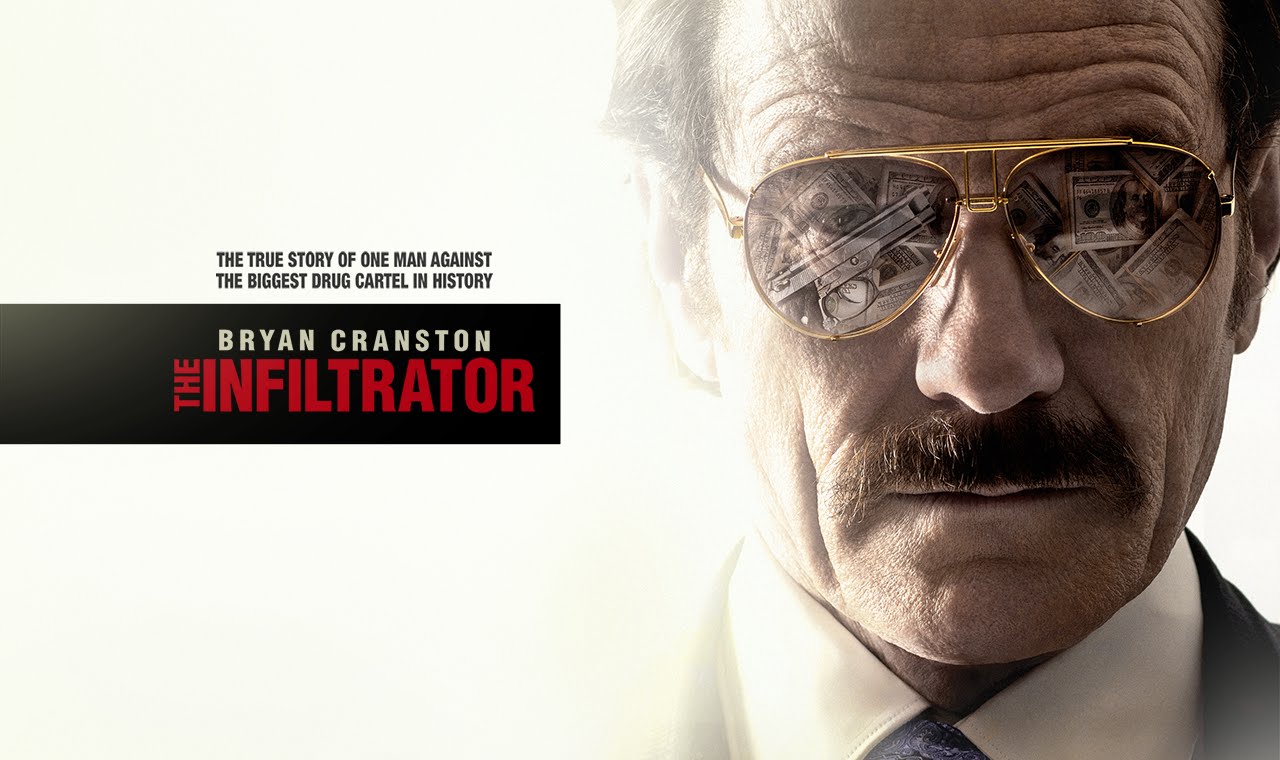
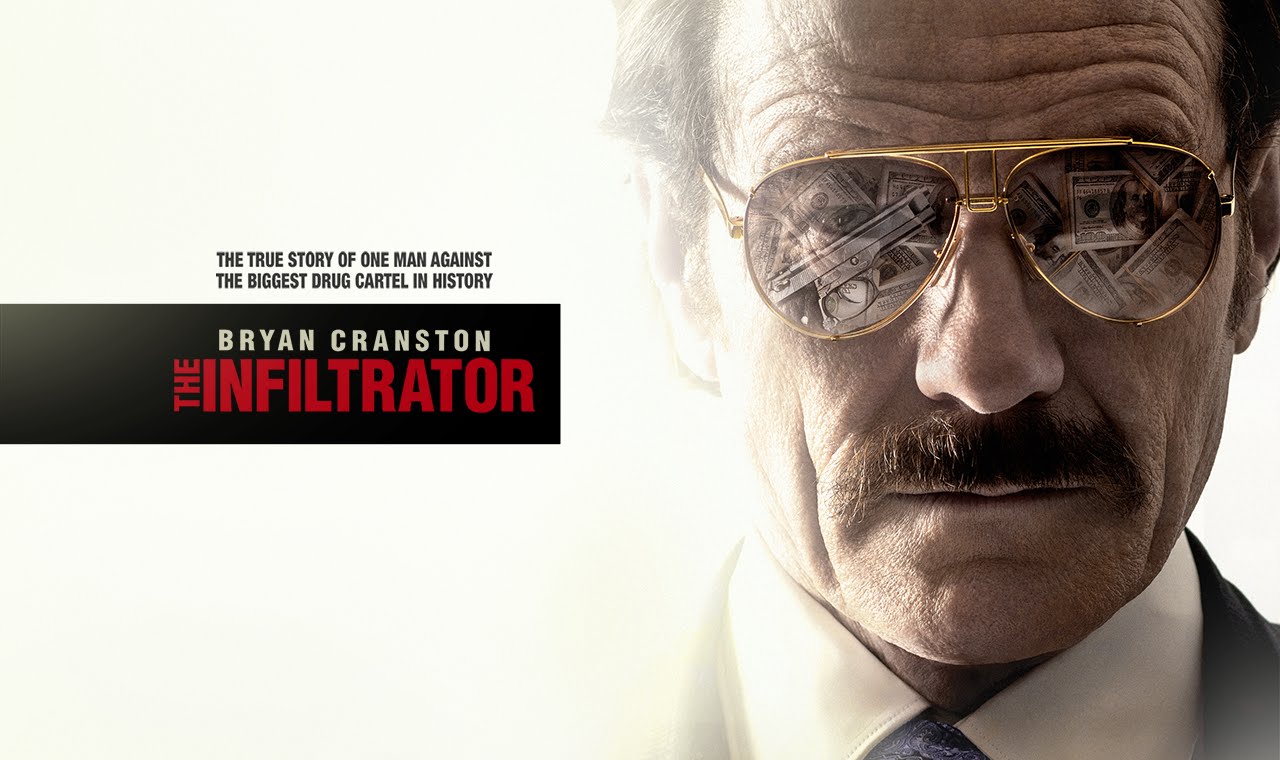
“We’ve been following the drugs to get to the bad guys. What if we follow the money?” That simple suggestion from FBI undercover agent Bob Mazur (Bryan Cranston) led to an unprecedented massive series of arrests that brought down key members of Pablo Escobar’s cocaine operations — and the world’s 11th biggest bank. Based on Bob Mazur’s book, and with Mazur as a producer, it is set in 1980’s Florida, where Excobar was smuggling in literally tons of cocaine. Getting it into the country was easy. Selling it was easy. Paying off, threatening, and torturing anyone who tried to stop them was easy. The biggest challenge they faced was moving the money between countries.

Mazur, trained as an accountant, went undercover and offered money laundering services to Escobar’s lieutenants, funnelling their stacks of cash through “legitimate” companies and criminal-friendly jurisdictions like Panama, then led by Manuel Noriega. He was able to gain the trust of the drug dealers. It was even easier to get the cooperation of bankers, including the prestigious international financial institution BCCI.

This movie, directed by “The Lincoln Lawyer’s” Brad Furman is sincere, diligent, a little corny, and for better and worse exactly what you expect from a fact-based story of an FBI undercover operative. There is the anxious and at times impatient wife. “Promise me this is the last one.” “I’m just wondering where my little Bobby the accountant went?” She has the thankless task of sighing, getting upset when their anniversary celebration is ruined when he has to go into character because they run into one of his criminal buddies, being jealous of his relationship with a beautiful female agent posing as his fiancee (Diane Kruger) and telling him he should have taken the chance for early retirement.

For a tense crime drama, it is surprisingly inert. We learn very little about what is involved in laundering money to prove himself to the bad guys or how the investigation proceeded or what goes into a long-term undercover operation. Mazur shows up in a Rolls Royce and has access to a mansion. Both were confiscated from drug dealers, but we do not learn that from the movie. What we do see is Mazur going home at night to his modest suburban house and his wife and children and jogging through his neighborhood. Presumably Escobar, one of the most ruthless criminals in history, would not turn over hundreds of millions of dollars to someone without making sure he was who he said he was. Mazur comes across as near-saintly, so even Cranston cannot give the character much by way of depth. The conflicts he feels about betraying a man who trusts him are confusing. Even when he is played by the elegant Benjamin Bratt, he is still a barbaric thug. The “Red Wedding”-style climax is synthetic, which, come to think of it, is the problem throughout. This is a movie about a faker that never feels real.

Parents should know that this film has very intense peril and violence, very disturbing and graphic images, guns, car crash, mob executions, characters injured and killed, very strong and crude language throughout with some homophobic slurs, some nudity, sexual references, drinking, smoking, and drugs and drug dealing.

Family discussion: Do you agree with the sentences received by the people who went to jail in this film? What makes someone good at undercover work?

If you like this, try: “Donnie Brasco,” “American Hustle,” and “Kill the Messenger”

Related Tags:


Based on a book Based on a true story Crime Drama Movies -- format

Indie Movies Reach Older Audiences

Posted on July 10, 2016 at 3:55 pm

Summer is the season for sequels, superheroes, special effects, chases, and explosions, with some slob comedies and animated family films added to the mix. But The Guardian points out that while Hollywood has been ignoring older audiences, indie films have showcased more mature performers and more mature storylines. While Glenn Close was barely recognizable in a brief, highly CGI’d performance in the video-game inspired sword and sorcery film “Warcraft,” her contemporaries Susan Sarandon, Maggie Smith, Helen Mirren, Sally Field, and Meryl Streep have had starring roles in first-rate independent films this year.

Faced with such few worthwhile options in the multiplex, older moviegoers have opted to flock to the arthouse theaters instead, making their presence known in a big way. Of the top 10 most profitable independent films to play in cinemas in 2016 so far, seven are aimed strictly at adults, many of them centered on characters age 60 and over.

Related Tags:


Independent Movies for Grown-Ups

Hidden Figures Will Tell The Story of Three Black Women at NASA

Posted on July 10, 2016 at 8:00 am

Three of my favorite performers will star in a new film called “Hidden Figures,” the true story three African- American women who worked for NASA during the 1960s space race.  of Janelle Monae, Octavia Spencer and Taraji P. Henson will star as Katherine Johnson, Dorothy Vaughan, and Mary Jackson, who are a crucial part of NASA’s history.

Here’s Katherine Johnson.

And the cast congratulates her.

Related Tags:


Based on a true story Behind the Scenes Gender and Diversity Race and Diversity

Owen Suskind and His Parents Talk About the Autism Documentary “Life, Animated”

Posted on July 8, 2016 at 8:00 am

Owen Suskind tells me, “It feels interesting to be on the autism spectrum and fascinating.” His parents remember what he has said to them about how it feels to have autism. Ron Suskind reminds him, “Remember you said you see everything at once and you can remember all the moments in your life, maybe too many moments, but you go across them and you get a sense of what?”

“My place in the world,” Owen answers.

Cornelia Suskind adds, “And sometimes it’s a little overwhelming having all the stimulation coming in to you at once. You need to create a quiet space around you. When you were younger it was hard to communicate, language was really hard.”

The Suskinds were there to talk about their new documentary, “Life, Animated,” based on Ron’s best-selling book about Owen and how he taught himself about the world through Disney films. The movie is about Owen and autism and the scary and exciting adventure of leaving home, but most of all it is about family. The Suskinds are one of the most loving, devoted, and compassionate families ever to appear on screen. It is a joy to spend time with them, whether through the book, the film, or an interview.

Owen has regressive autism, meaning that he developed along typical milestones until about age 2½, and then lost his ability to communicate and continue to develop. He loved to watch Disney animated films but barely spoke until age 6, when he suddenly told his parents that his brother Walt did not want to grow up, “like Peter Pan and Mowgli.” Owen was using Disney films to teach himself how people feel, behave, and communicate.

“They helped me communicate to find my place in the world and get my speech back,” Owen said.

Cornelia explained, “Movies are always the same. Every time you pop it in, every time you put in a VHS it will always be the same movie and the same language and the same characters instead of constantly changing, the way it does with people, even my expressions, with you and me sitting here. it’s always the same, very, very exaggerated, very colorful. And I think the combination of the music and animation together activating those parts of the brain were really key in tapping into how Owen was feeling but not able to express.”

When Owen was younger, he preferred hand-drawn animation “because it does expressions and feelings.” Now, he likes computer animation as well, perhaps because it has come closer to hand-drawn in its expressiveness and richness of detail. He has very strong views about sequels: “The only four theatrical animated sequels I love are ‘The Rescuers Down Under,’ ‘Fievel Goes West,’ ‘Toy Story II’ and ‘Fantasia 2000’ and the only direct-to-video animated sequels I love are after the very first film of ‘The Land Before Time’ the animated film theatrical in 1988 were ‘The Land Before Time’ direct to video animated sequels. I would go all the way until the 10th one from late 2003, early 2004 and then conclude right there.” He loves to draw the sidekick characters, who have special meaning for him. His favorites are Sebastian from “The little Mermaid,” Iago from “Aladdin,” and Lucky Jack from “Home On The Range.”

Owen has his own YouTube channel, Owen’s Disney Club, where he discusses his favorite movies, displays Disney paraphernalia currently available for bid on eBay in a weekly “Finds of the Week” screencast, tours his personal collection of rare and hard-to-find Disney items, and interviews special guests.

Owen may be the only fan whose favorite Jimmy Stewart role is in “Fievel Goes West,” where his character says, “Just remember Fievel, one man’s sunset is another man’s dawn. I don’t know what’s out there beyond those hills but if you ride yonder, eyes steady, head up and heart open, I think one day that you’ll find that you are the hero that you’ve been looking for.”

Owen pointed out that Stewart, like a surprising list of other stars, made his last performance in an animated film. Another favorite is Mary Wickes, whose last performance was as a gargoyle in “Hunchback of Notre Dame.” Owen quoted her: “Life’s not a spectator sport. If watchin’ is all you’re gonna do, then you’re gonna watch your life go by without ya.”

Cornelia’s hopes for the movie are equally inspiring: “If we could share a little bit of a positive experience, not that obviously every minute in the film is a positive and our every minute has not been positive, but just the reality of it for people to get another image of what a person on the spectrum is like instead of ‘Rain Man,’ to see how fully realized Owen’s life is and that his wants and desires are every bit exactly the same as ours. I mean it’s extraordinary, it really is. So we’ve guided him for sure and try to teach him but he teaches us a lot more in a profound way.” And in this movie, they teach us all.

Related Tags:


Disabilities and Different Abilities Documentary Interview

Alex Gibney on the Stuxnet Documentary “Zero Days”

Posted on July 8, 2016 at 7:00 am

You will not see a more purely terrifying movie this year than “Zero Days,” a documentary from Alex Gibney (“Enron: The Smartest Guys in the Room,” “Going Clear,” “We Steal Secrets”), one of my favorite filmmakers. He spoke to journalists along with Eric Chien and Liam O’Murchu, two of the film’s most important figures, the men who discovered what they dubbed the Stuxnet computer virus, which turned out to have been developed by the Unites States and Israeli governments to unleash on the nuclear facilities in Iran. As an expert in the film explains, for centuries countries had armies and navies, and then in the 20th century they had to have air force capacities. But now, in the 21st century, wars will be fought through computer networks, probably more frequently and more devastatingly than on battlefields.

As a filmmaker, Gibney had a challenge to present a non-cinematic story in a dynamic visual medium. “It was mostly men sitting in rooms with suits on. The main character was a piece of computer code. Talk about challenging. You’ve seen ‘Enron.’ Back then I broke rule number 1A of the filmmaking manual which is never make a film about accounting.” He worked with a special effects company to “design a code, with the help of Eric and Liam, to be able to make it both accurate and also make it feel like it’s a living breathing thing. So it really was like entering the Matrix or something like that. That was key — it was to come up with a visual design for the film and then also a narrative design for what is basically a detective story. It’s kind of a spy thriller and Eric and Liam were the detectives.”

Chien provided some historical context. “I think the internet itself sort of changed how we function, our economy, a lot of growth, and the ‘internet of things’ will grow equally as well…It is very insecure and a bit worrisome and I think we fear that we will repeat mistakes that we made in the past. When we started computing it was quite open and free which was great and you could hack the computer in the old traditional sense of hacking the computer and that allowed the sort of insecurity where we are at today. We did not design computer and networking with security in mind at the start. We designed it so anyone can use it and it would be completely free. We sort of learned a lesson that you needed some level of security and that lesson currently is not being applied to the internet of things. That’s what worries us the most the right now. There is a lot of push right now to get internet of things on board with some sort of standard with some sort of default security.”

In the film, Chien and O’Murchu, in evaluating the Stuxnet virus to protect their commercial customers, quickly realized that the code was vastly more powerful and robust than anything they had seen before. The obvious conclusion was that it came from a government. But that does not mean they stop trying to find a way to stop it because it may be coming from “the good guys.” O’Murchu said, “It’s funny when you say bad guys can do this, how do you define that? The whole problem is that there are no good guys and bad guys here.” “In our world the good guys are us and the bad guys are anyone else,” Chien added, “anyone who is writing malicious codes to get unauthorized access to a computer that ultimately we normally are in charge of protecting. That is our view so we don’t ignore code because it looks super sophisticated or might be from a nation state. We have customers all over the world in countries like Germany and Belgium that Western countries have attacked equally as well and we’re responsible for protecting those computers. I would say in some sense fortunately code doesn’t come with a marker that says this is from this particular country and even if it did you can’t say that anyone would put in their code ‘Welcome from so and so.'”

The film begins with a sequence of witnesses saying some variation of “I can’t talk about it.” So how can Gibney be sure of what he is reporting? “Obviously, there are false flags. People lie to you all the time but over time you develop patterns and you try to convince yourself that actually you got the story right.”

The most candid (to a point) and compelling witness in the film is an unidentified (until the end) insider portrayed as a disembodied face made of cascading pieces of code, created for the film by a company called Scatter. “We wanted to create a character that would be in the kind of code world of the film but would also be a means of protection. So what we did was, we shot an interview with a woman, and we shot it in a way that was very much straight on but it was like we were mapping her in a 3-D space. And then it allows you to go in after the fact and both render camera moves and also break down the image into points, lines and flesh and recombine them in different ways so that they both mask the identity but also create that kind of interesting sort of hacked computer look of the character. And as you move around to the side because they were mapping only 180° in space, suddenly it starts to trail or get messy and if you go all the way around actually in the first rendering of the character we were able to literally jump outside the room and then track in, that was all after-the-fact. So it was really a wonderful device and it also helped us in terms of convincing sources to come forward that we would have a device that would be so otherworldly that it would mask identity.”

In this movie about secrets, Gibney was especially careful to protect his sources. “One of the things we did for protection was the combined testimony of a number of different people. While the New York times would frown on that technique within the context of the film I think it’s perfectly appropriate and also frankly it was key to persuading the sources to come forward and that was very important to us.” He believes that in documentaries “form follows content.” Some stories require more narrative shaping and commentary. With his Lance Armstrong film, “The Armstrong Lie,” “we hung out with Lance, we follow Lance, we don’t comment in addition I did interviews but we film for 21 days at the Tour de France. So it depends. In a lot of the films that I do tend to look back at recent events and understand them in a different way. Usually knowledge narratives get built around them and then I go in after the fact and say is this really what happened. It’s like cold cases. Is this really what happened or actually is it different than we thought it was? Is very hard to use cinéma vérité in the past, impossible in fact. I’ve got nothing against it; for the right film I love it.”

This movie can be seen as a companion piece to Gibney’s documentary about Wikileaks, “We Steal Secrets.” “It’s a matter of momentum. So far the momentum on the side of the government has been to make more and more things clasified. It becomes almost a default policy and to read more and more people into these secrets so that they are unable to talk about this. Well if you create a mountain of secrets and a huge number of people who hold these secrets it shouldn’t be surprising that there are leaks. Despite the Obama administration’s insistence on prosecuting people who leak more than all other administrations combined, you continue to get these big leaks in part, I think, because there is a belief that what the government is doing is hiding either misguided, immoral, or illegal behavior behind those secrets and therefore not being held to account. You are seeing that in the torture debate, you are seeing that in the drone debate and now you are seeing it with Stuxnet. So at some point they’ve got to wake up and understand that if they are misusing secrets James Harper lied before the Senate regarding the operations of the NSA, there’s going to be blowback and the blowback is more leaks.” Chien called it “rough justice.”

The movie calls for some international negotiations on the use of cyber-weapons. “I think the point is if we start then we’ve got a shot at it. To just throw up our hands and say ‘well, it’s impossible so let’s not worry about it,’ I think that’s just the wrong answer. We have to embark on that and part of it also is that these technologies that these weapons exist because then all of us as citizens can say well is this what we want, a complete Wild West world where everybody is launching weapons at each other all the time and we don’t know when they might launch or who might launch them, not a good thing. Someone in the film says, ‘Right now the norm is do whatever you can get away with,’ not a very good norm.”

Related Tags:


Directors Documentary Interview
THE MOVIE MOM® is a registered trademark of Nell Minow. Use of the mark without express consent from Nell Minow constitutes trademark infringement and unfair competition in violation of federal and state laws. All material © Nell Minow 1995-2026, all rights reserved, and no use or republication is permitted without explicit permission. This site hosts Nell Minow’s Movie Mom® archive, with material that originally appeared on Yahoo! Movies, Beliefnet, and other sources. Much of her new material can be found at Rogerebert.com, Huffington Post, and WheretoWatch. Her books include The Movie Mom’s Guide to Family Movies and 101 Must-See Movie Moments, and she can be heard each week on radio stations across the country.

Website Designed by Max LaZebnik