The American

The American

Posted on December 28, 2010 at 8:00 am

There’s a reason so many movies give us a character who has just one last job to do before he (it’s almost always a he) can get free. It is because we can sympathize with someone despite even the most reprehensible past if what he wants is to escape from it. Our heads may want justice but in our hearts we can understand the dream of breaking away.
Especially in a romantic location, with the possibility of new and unquestioning love. “The American” may be the story of an assassin but it is not a chases-and-explosions movie. It is an almost elegiac meditation on choice, fate, trust, and purpose, punctuated by shoot-outs.
We know him as Jack (George Clooney, who also produced). But two women call him “Mr. Butterfly” for two different reasons. One is a professional colleague, who sees his appreciation for a butterfly that rests, briefly, on her when they are out in the woods. The other is a prostitute he visits, who sees the butterfly tattoo between his shoulder blades. Both women indicate an interest in him beyond their professional relationship. One of them will make him think about it.
We know he is all business. In the very first scene, we watch him coolly execute someone he cares about only because she saw too much. In the scene where he is briefly bewitched by the butterfly he takes out a bottle of wine he had taken the time to chill for verisimilitude because they were pretending to be on a picnic. His colleague is clearly willing to make it into a picnic but he pours it out, again a stickler for plausible deniability and staying on point.
“Above all, don’t make any friends,” he is told by the only person he seems to trust, the man he goes to when people are trying to kill him and he needs to find out who they are. But he finds a place to stay in a breathtakingly picturesque Italian town and finds himself talking to the local priest (a warmly sympathetic Paolo Bonacelli) and a pretty prostitute (Violante Placido). He jumps at backfiring Vespas and dropped books but he is right to be suspicious more often than not. The priest tells him, “You’re American. You think you can escape history.” But Jack knows that it is not an individual adversary who is cornering him, but his past.
Audiences can see this as a metaphor of American actions abroad, as the British put it, a question of how much crockery is broken at the end of the day. Or it can be seen as the story of an individual who did something because he was good at it and now wonders if that was enough of a reason.

(more…)

Related Tags:


Based on a book Drama Thriller

The Concert

Posted on December 27, 2010 at 8:00 am

A Russian conductor, demoted to symphony hall janitor, intercepts an invitation to perform in Paris and decides that he will accept. Andreï Filipov (Aleksei Guskov) was once a celebrated conductor of the Bolshoi orchestra. But during the antisemitism of the Breshnev era, he was ordered to dismiss all of the Jewish musicians and he refused. He now sweeps up in the concert hall.

One day, while the conductor-turned-janitor is cleaning the orchestra director’s office, a fax arrives, inviting the Bolshoi to perform. And Flilipov is determined to accept, even if it means not just hiding the truth from his employer but having to put on a full-scale performance with a group of musicians who have not played together — or in some cases played at all — in decades. Even more of a challenge is enlisting the help of the man he blames for destroying his career. Ivan Gavrilov (Valeriy Barinov) a staunch Communist party loyalist, was the man who interrupted his last performance to tell Filipov he was fired. But now, he is the only one who can help them because he can speak French and negotiate the terms of the appearance. He does not like Filipov, either, but he has his own reasons for wanting to get to Paris, so he agrees.

Filipov has one more requirement. He will only play Tchaikovsky’s Violin Concerto and the soloist must be the beautiful young French musician (Mélanie Laurent of “Inglourious Basterds”). This leads to many complications and a few revelations and some thrillingly gorgeous music.

The story’s mix of comedy and tragedy is clumsy at times, lurching from farce (ethnic humor, mangled French) to stories of oppression. And there are some local references that will be lost on even cosmopolitan Americans. But Laurent is enormously appealing as the young violinist who never played Tchaikovsky and the music itself is every bit as transcendent as Filipov and writer-director Radu Mihaileanu promise it will be.

Related Tags:


Comedy Drama Inspired by a true story Music

Follow that Bird

Posted on December 26, 2010 at 8:00 am

B+
Lowest Recommended Age: All Ages
MPAA Rating: G
Profanity: None
Alcohol/ Drugs: None
Violence/ Scariness: None
Diversity Issues: Diverse characters
Date Released to Theaters: 1985
Date Released to DVD: 2009
Amazon.com ASIN: B001MYIQMW

Celebrate the birthday of Caroll Spinney, the man behind (or, I should say, inside) Big Bird. 1985’s “Follow That Bird,” features all of the show’s favorite characters and an array of guest stars but focuses more on gentle humor and lessons of tolerance than letters and numbers.

A well-meaning social worker decides that Big Bird needs to be with “his own kind’ and packs him off to live with the Dodo family. But while they may have feathers and wings, they are not really “his own kind,” and he feels lost and alone. He decides to go back home where he can be with the friends who are his real family and has adventures along the way, including an encounter with the Sleaze Brothers, who want to paint him blue and put him on stage as the “Blue Bird of Happiness.” But all ends happily as he is reunited with the people who love him, who are truly “his own kind.”

Families who see this movie will want to talk about the many ways that families are created and about how we decide what “our own kind” really means.

Related Tags:


Based on a television show DVD/Blu-Ray Pick of the Week For the Whole Family
Rabbit Hole

Rabbit Hole

Posted on December 23, 2010 at 7:43 am

B+
Lowest Recommended Age: Mature High Schooler
MPAA Rating: Rated PG-13 for mature thematic material, some drug use and language
Profanity: Strong language
Alcohol/ Drugs: Drinking, marijuana
Violence/ Scariness: References to tragic deaths, tense and unhappy confrontations
Diversity Issues: Diverse characters
Date Released to Theaters: December 17, 2010

When you suffer a devastating loss, there is the pain of missing what you once had. But there is pain that goes beyond the space circumscribed by the person who is gone. Grief is its own planet and everyone who goes there lives alone.
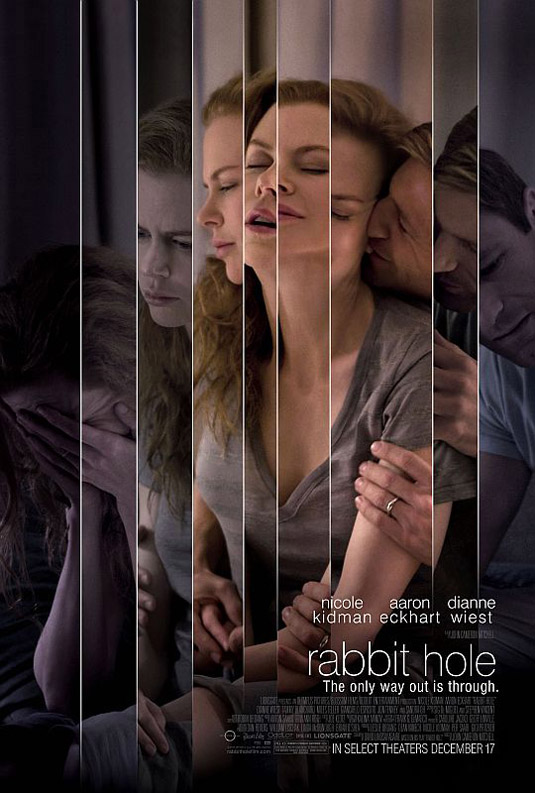
“Rabbit Hole” begins eight months after the death of a little boy. His parents move like highly functional but very fragile zombies through their lives. Some of those around them, think and even use words like “closure” and “move on” and even “try again,” mostly out of their own discomfort at the way this loss has threatened their own sense of the rightness of the world. Others just stay away, paralyzed by their inability to think of anything to say in this most unthinkable of moments. And Becca (Nicole Kidman) and Howie (Aaron Eckhart) are still being confronted with horrifically painful decisions — should they keep or get rid of their child’s things? — and even more painful reminders that for others life goes on (Becca’s careless sister is pregnant). Rabbit-Hole-Poster.jpg
David Lindsay-Abaire has sensitively adapted his award-winning play by to the screen and with director John Cameron Mitchell (“Hedwig and the Angry Inch,” “Shortbus”) has filled the story with privileged moments, beautifully performed by Nicole Kidman (Becca) and Aaron Eckhart (Howie). Both of them have to find a way to re-invent their interaction with the world or perhaps to re-invent their understanding of what world they live in. Her response is to hold everything inside, to try to maintain control. She affects an almost grotesque normality. When he comes up behind her for a hug as she is at the stove, she is bright but brittle as she shoos him away. She rolls her eyes at the support group for bereaved parents and will not return. But Howie wants to hold on to his memories and process his pain; he needs that kind of contact. He stays in the group. He keeps watching a video of their son — until Becca erases it.
They cannot reach out to each other, but each reaches out to someone else who is uniquely understanding. Howie becomes close to the leader of the bereavement group (Sandra Oh). And Becca watches and then begins to talk to the teenager who was driving the car that killed her son. It is heart-wrenching to see how he is able to reach her instincts as a mother, feelings for which she no longer has any other place.
This is a touching, insightful film with exquisite performances. If we all grieve on our own planet, it is art like this that illuminates the way home.

(more…)

Related Tags:


Based on a play Drama Movies -- format
THE MOVIE MOM® is a registered trademark of Nell Minow. Use of the mark without express consent from Nell Minow constitutes trademark infringement and unfair competition in violation of federal and state laws. All material © Nell Minow 1995-2026, all rights reserved, and no use or republication is permitted without explicit permission. This site hosts Nell Minow’s Movie Mom® archive, with material that originally appeared on Yahoo! Movies, Beliefnet, and other sources. Much of her new material can be found at Rogerebert.com, Huffington Post, and WheretoWatch. Her books include The Movie Mom’s Guide to Family Movies and 101 Must-See Movie Moments, and she can be heard each week on radio stations across the country.

Website Designed by Max LaZebnik