Think “Taming of the Shrew Wears Prada.” Book editor Margaret (Sandra Bullock) is whip-smart and whippet-thin, ferociously competent, ruthlessly demanding, and just plain scary. When she strides into the office in her spike Christian Louboutin heels, IMs radiate through the company: “The witch is on her broom!” And everyone switches into high-productivity mode. She is all-business, ambitious, and ferocious. When we first see her, she is riding her exercise bicycle indoors front of a video of the outdoors but even that does not hold her attention; she is also reading a manuscript.
Andrew (Ryan Reynolds) is her assistant. For three beleaguered years, he has been at her beck and call 24/7, from her morning coffee to midnight runs to giving up his grandmother’s 90th birthday party so he can work all weekend. She treats him like something between a prop and a galley slave. In other words, they’re made for each other and we will have the pleasure of seeing them figure that out.
The structure is familiar — and overly revealed in the trailer — but the comic timing is impeccable, with Betty White adding sparkle as Andrew’s 90-year-old “Gammy.” Bullock is just the actress to show us the vulnerability that makes Margaret hold on so tightly and Reynolds is strong enough (he was the bad guy in “Wolverine” after all) to keep Andrew from seeming henpecked and deft enough to make us see why he is up to Margaret’s level. The Alaskan scenery is like a commercial for Sarah Palin’s travel bureau and it is spicy without being smarmy, an increasingly rare achievement for date movies these days.
Everything that made the adorable “My Big Fat Greek Wedding” so winning is missing from this tired and formulaic sitcom of a movie about an American tour guide in Greece. “My Big Fat Greek Wedding,” with writer/star Nia Vardalos, was filled with charm, heart, originality, and vivid detail. Now Vardalos stars — but did not write — “My Life in Ruins.” It is as tired as its title, a drawn-out sitcom of a movie that tries to charm us with thin jokes about ignorant tourists who travel around the world but don’t want to see anything.
Vardalos plays Georgia, an American of Greek heritage who went to Greece to teach but lost her job and is now stuck working for a small company with two tour buses. The other guide gets the one with the good air conditioning and the happy, easy-going customers. Georgia gets the bad bus, the bad hotels, and the cranky tourists. Plus the guy who is always making corny jokes (Richard Dreyfuss) — not that they are any better than the rest of the jokes in the movie — and some Australians who appear to be cheerful but whom no one can understand. Georgia sees this as a way to teach the visitors about the glory and history of Greece, to have them “bask in history” and “to be a part of the birth of civilization.” But they think they are on vacation and what she has in mind feels too much like work. All they want to do is eat ice cream and buy souvenirs.
And the new tour bus driver has a name that sounds like a bad word and a huge fuzzy beard. You think she’ll be surprised when she finds out that he speaks English and understands what she’s been saying? You’re right! You think it will be funny when it happens? You’re wrong. You think the tour bus driver will shave and turn out to be handsome so that Georgia can recover her “kefi” (Greek for mojo)? You’re right! You think it will make the movie entertaining? You’re wrong!
Vardalos looks uncomfortably skinny and as though she knows she could have written a better script. “Saturday Night Live’s” Rachel Dratch is wasted as the kind of tourist who is always looking for the Hard Rock Cafe or an international branch of Curves. And then there is the warring couple with the mopey teenage daughter who — here’s a surprise — won’t take the earbuds out of her ears. The stereotypes are not awful because they are predictable. After all, they become stereotypes because they happen so often. They are awful because they are so thin and superficial and phony. It is ironic that while Georgia is whining about how tourists do not appreciate the grandeur and history of the ancient ruins, the movie itself feels as though it is the cinematic equivalent of a chintzy souvenir. It is a shame to spoil the beautiful scenery with these vaudeville-era jokes. Georgia may find her kefi in this film, but the script never does.
Passive female heroine dreams of being rescued by prince
Date Released to Theaters:
1937
Date Released to DVD:
February 2, 2016
Amazon.com ASIN:
B01711CIF0
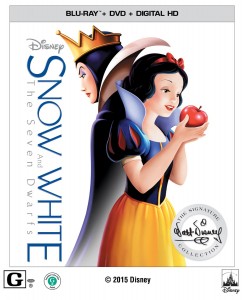
Copyright Disney Studios 2016Disney’s new Signature Collection release of its first animated feature film on Blu-Ray is gorgeously restored and filled with behind-the-scene extras and a wonderful opportunity to catch up with the one that is still “the fairest of them all.”
Snow White (voice of Adriana Caselotti) is a sweet girl whose step-mother, the Queen (voice of Lucille LaVerne), is vain and cruel. Snow White dreams of a prince to love, and meets the Prince of her dreams when she is fetching water for the castle. Meanwhile, each night, the Queen looks into a magic mirror and asks who is the fairest one of all. The mirror tells her that it is she, and she is satisfied. But one night, the mirror tells her that Snow White has become more fair, and the Queen, consumed with jealousy, tells her huntsman to take Snow White to the forest and kill her.
The tender-hearted huntsman cannot kill her and instead tells her to run away. Racing through the forest terrified, she collapses in tears. But she makes friends with the animals, who live in the woods and they lead her to a small cottage. Once inside, she cleans up the mess, singing “Whistle While You Work.” She thought, when she saw the small beds, that children lived in the house, but it turns out that it is the home of seven dwarfs, who work each day digging jewels from a mine.
When they come home, they are surprised to find her stretched out across their beds, sound asleep. But they soon make friends and are delighted to have her stay and take care of them.
Eventually, the Queen discovers that Snow White is still alive. The Queen makes a poisoned apple and turns herself into an old hag so she can deliver it to her. Snow White at first follows the dwarfs’ advice not to speak to strangers, but finally takes a bite of the apple and collapses. The Queen runs away and falls into a steep ravine.
The dwarfs are heartbroken and create a beautiful crystal bier for her to lie on. The prince discovers her there and gives her a kiss, which awakens her, whereupon he carries her off to live happily ever after.
Children used to today’s Disney stories may be surprised by a more passive heroine and by a score more classical than pop. But in addition to its historical value as the first animated feature, it is still a delight, with memorable songs and characters. It is hard to remember that before Disney the dwarfs in the Snow White story had no names and no individual characters. Sneezy, Sleepy, Grumpy, Dopey, Doc, Happy, and Bashful are all vivid characters, and their dance number with Snow White is a highlight.
This movie provides a good opportunity to discuss jealousy, and how to handle it. And, of course, it raises issues about women and beauty, about women’s role in the home, and about finding happiness only through dreams of “Someday My Prince Will Come.” Blended families are often sensitive about the traditional fairy tale villain being the “wicked stepmother,” and some children will need reassurance.
Extras in this edition include Disney’s own comments about the film and a feature about the influence of this groundbreaking animated feature, plus never-before-released storyboards of a deleted scene where the prince meets Snow White.
Talk to kids about how characters like Snow White might be different if they were created today, and make sure that they see a range of alternative role models. Note: The movie is very scary when Snow White is running through the forest (though reassuring when the animals turn out to be friendly) and when she bites the apple; the Queen is especially scary when she turns into the old hag. By today’s standards, Dopey might well be considered an insensitive stereotype of a developmentally disabled person.
Families who see this movie should discuss these questions: Why is the Queen jealous of Snow White? Why is being beautiful so important to her? Why did Snow White stay at the castle? Why did the huntsman disobey the Queen’s orders? Why did the dwarfs love Snow White so much?
Families who enjoy this movie should watch some of the other versions of the Snow White story, including the Faerie Tale Theatre production with Elizabeth McGovern.
“Ghosts of Girlfriends Past” feels like ghosts of movies past, with a been-there, seen-that feeling that goes far beyond its familiar appropriation of the structure of “A Christmas Carol.” It is not as deep as Matthew McConaughey’s dimples. He plays Connor Mead, a photographer so fabulously successful that he captures a magazine cover with one click of the shutter, while he mesmerizes every female in a mile radius into doing all but levitating out of their clothes every time he looks at them.
At his brother’s wedding, Connor is visited by the ghost of their guardian, world-class womanizer Uncle Wayne (Michael Douglas), who tells him he will be visited by three ghosts to help him learn about what he needs to change in his life. The first is Allison, played by”Superbad’s” very gifted Emma Stone, with a frizz of hair, a mouthful of braces, and some serious 80’s fashion victim attire. She takes him from his childhood love Jenny to the early lessons from Uncle Wayne in (1) picking up as many women as possible and (2) feeling as little for them as possible.” He relives his conquests and liaisons and his romance with Jenny (Jennifer Garner). Meanwhile, he manages to wreck havoc on the wedding plans.
The primary problem here is that the movie wants to have Connor both ways, a heartless but irresistible lady-killer who is callously offensive, breaking up with three girls at once via conference call and telling everyone at the wedding that marriage is a disaster. He’s less an emotional Ebenezer Scrooge than he is a throwback to those cads-just-waiting-to-be-tamed ring-a-ding-ding movies Frank Sinatra used to make like The Tender Trap and “Come Blow Your Horn.”
But we’ve come a long way, baby, since then, and the idea of the love ’em and leave ’em Lothario is neither as charming or as believable as it once was. Even McConaughey’s dimples can’t keep Connor from seeming more creepy than magnetic. The endless rows of women who are ready, willing, and able to do anything but act with any semblance of intelligence or dignity come across as embarrassing and sadly in need of some “he’s just not that into you” lessons. We cannot connect to the movie because it is impossible to feel any sympathy for Connor or root for his happiness. Fred Ward is nicely flinty as the prospective father-in-law but poor Lacey Chabert can’t help sounding shrill as the kind of bride who freaks out about every detail. Even the divine Anne Archer can’t do much with a cougar-role that gives her little do do but murmur knowingly. The highlights of the film are Stone’s teenage ghost and especially Garner. Her grace, elegance, and authenticity make us wish for her to do a lot better than the guy with the ghosts. And a lot better than this lackluster and formulaic script.
Somewhere deep inside this movie, like the little tiny pea in the bed of the princess, is an idea that could have been an interesting movie. Unfortunately, as with that bed of the princess, it is smothered in 20 mattresses of awful and 20 more mattresses of just plain dumb. Warning: the screenplay is by Kim Barker, who was also responsible for the execrable “License to Wed.” Two strikes and Barker should be out for good.
Sandra Bullock produced, so she is responsible for both Barker and casting herself in the lead role, plays Mary Magdalene Horowitz, a cruciverbalist (constructor of crossword puzzles) who has gone way past endearingly quirky and well into the land of the annoying oddball. It could be kind of goofily charming that she wears the same red boots all the time. It could be sort of intriguing that she has some of that Adam-style social dyslexia. But instead she is the kind of person who recites endless random arcana and then, when told to be quiet, lists several entirely audible synonyms for silence. As happens so often in this movie, she gets the letter but not the spirit of what people are saying to her.
So, when she sees Bradley Cooper (the title Steve), a news station cameraman, she immediately jumps on him, which he quickly realizes is too good to be true. He scrapes her off like gum off the bottom of his shoe, and she then commits career suicide and follows him to a series of increasingly un-funny news stories he is covering. Even the always-welcome appearances of top character actors like Beth Grant (glammed up for once), Thomas Haden Church (as a cliched self-centered television correspondent), Ken Jeong (relatively calm for once), D.J. Qualls (bringing class to a barely-written role), and the delightful Katy Mixon (doing more than I would have thought humanly possible as a cliched hick) cannot breathe any life into this soggy story. The best that can be said about Cooper is that he escapes unscathed, a tribute to his true talent and star power.
Bullock is producer, too, and once again she seems to gravitate toward roles that run contrary to conventions of romantic comedy, and I respect that. She likes to play characters who are socially clumsy (“Miss Congeniality”) or incapable in relationships (“Forces of Nature”) and she does not always go for the happily ever after pairing off at the end of the movie. But here the story spirals past edgy into disturbing, with comic references to an infant’s deformity (and the idiocy of the public response) and an accident involving deaf children. While the film is making fun of the media circus about the rescue, it commits the same crime it is satirizing in its treatment of one of the children. The problem with this movie is not the cluelessness of Bullock’s character; it is the cluelessness of the script.



 and “Come Blow Your Horn.”