Step Up

Posted on August 9, 2006 at 12:17 pm

B
Lowest Recommended Age: Middle School
MPAA Rating: Rated PG-13 for thematic elements, brief violence and innuendo.
Profanity: Some strong language
Alcohol/ Drugs: None
Violence/ Scariness: Character is shot and killed, some additional peril and violence
Diversity Issues: Diverse characters have strong, loyal relationships
Date Released to Theaters: 2006
Date Released to DVD: 2006
Amazon.com ASIN: B000J3OTSM

A ballet dancer needs a partner for the biggest show of the year. She sees a boy working off his community service time at her school showing some of his dance moves off to a friend. Could he do? Will he do it? Will they learn a great deal from each other and about themselves as they work together and will there be an issue right up until showtime about whether the big dance number will happen?

Yes to all of the above, and yes, too, to the really big question, which is: will it be fun to watch? Imagine a hip-hop version of High School Musical, some juvenile delinquency and a drive-by shooting added in to provide some street cred, but still a Disney-fied world where kisses are important and happy endings are guaranteed.

Ever since the days when Judy Garland and Mickey Rooney decided to put on a show, movies about kids working hard on song and dance numbers for the big night that will decide their futures have been a staple for showing off young talent to an appreciative young audience. Like the recent Save the Last Dance, this is the story of a mash-up, as the ballet dancer learns to loosen up and the boy from the streets learns discipline and technique.

Jenna Dewan is Nora, a senior at a Maryland high school for the arts. Tyler (Channing Tatum) is assigned 200 hours of community service at the school for vandalism. Nora is preparing for the big showcase that will determine whether she gets offered a job as a dancer. When her partner Andrew is injured, she asks Tyler if he will practice with her until Andrew is better.

The screenplay is so formulaic that it seems not just predictable but inevitable. The dialogue struggles mightily under its exposition-heavy burden until it collapses completely. Tatum and Dewan are about 10 years too old to be playing high school kids. These kids are about as “street” as a commercial for Target. But the dance numbers are energetically filmed and the underlying sweetness is impossible to resist. It’s been a long time since I’ve heard applause in a movie theater just because of a kiss. And it’s been an even longer time since I wanted to join in.

Parents should know that this movie has brief but disturbing violence. A young character is shot and killed. There are some other moments of peril and threatened violence. Characters use some strong language and engage in vandalism and car theft. A strength of the movie is its portrayal of committed and loyal friendships between diverse characters. And another is its portrayals of teenagers who are not sexually promiscuous and take kissing seriously. SPOILER ALERT: A young boy is killed because he wants to imitate and impress his older brother, who engages in risky and illegal behavior. The brother is told not to feel responsible, but in reality he is in part responsible for what happened and parents will want to discuss this issue with young teens who see the movie.

Families who see this movie should talk about why Tyler and Mac did not dare to dream of more for themselves and why that changed. What is likely to happen to them next? The characters in this movie talk about loyalty — who shows it? How do Nora’s, Tyler’s, and Mac’s home situations affect their perspectives?

Families who enjoy this movie will also enjoy High School Musical (suitable for all ages). There are many popular films about dancers who develop romantic relationships, from Dirty Dancing and Save the Last Dance (mature material) to the more family-friendly Shall We Dance and Strictly Ballroom.

Related Tags:


Drama Movies -- format Musical Romance

My Super Ex-Girlfriend

Posted on July 19, 2006 at 4:09 pm

B-
Lowest Recommended Age: High School
MPAA Rating: Rated PG-13 for sexual content, crude humor, language and brief nudity.
Profanity: Some repeated crude language for comic effect
Alcohol/ Drugs: Social drinking
Violence/ Scariness: Action-style violence
Diversity Issues: Some homophobic and sexist humor
Date Released to Theaters: 2006
Date Released to DVD: 2006
Amazon.com ASIN: B000J4QW8Q

Even with a face contorted with rage and vengeance and a voice echoing through the streets of New York as well as the theater, it’s difficult not to like Uma Thurman as the needy, controlling and manipulative Jenny Johnson/G-girl. The odd sensation of not disliking someone that, well, dislikable seems to stem from the movie’s greatest asset: its understanding that evil can be a misguided outlet of the chronically insecure.


As she tells her story to Matt Saunders (Luke Wilson) – our good-natured protagonist with the requisite New York apartment, reluctance to believe beautiful women might dig him and sex-obsessed, super-vocal best friend – we are introduced to a Jenny Johnson who only wants to be liked and accepted. An outcast in high school, Jenny and her best friend, a schoolmate named Barry, are fooling around in a car when Jenny hears something. Rushing to the site, Jenny and Barry discover a meteor that explodes violently when Jenny touches it, thereafter imparting her with the super powers that turn her into G-girl, an indestructible protector of Gotham and savior to the seriously put-out.


In her story, Jenny becomes more confident at school, and blossoms with her new-found poise. She claims that she and her friend Barry simply grew apart. What we see, however, is a best friend left behind to fend for himself, which explains why in adulthood, Barry has become Professor Bedlam, G-girl’s arch-nemesis played by Eddie Izzard. The catch is that G-girl’s saving grace in high school has become her burden in the real world – her super power secret seems to have kept her from getting truly close to anyone and when she finds Saunders, she’s so hungry for human affection and acceptance that she fumbles and foils her way through a whirlwind relationship that quickly sours as Saunders realizes he can’t handle her neediness and that he is, in fact, in love with a coworker. The main plot of the movie takes us through Saunders’ relationship and breakup with G-girl.


So now you see the problem. We have a needy, whining, guilt-tripping girlfriend with a rage problem, and a weasel-ly, conniving evildoer for a nemesis, and we can’t help but try to collect our melting hearts while wishing both of them the best. (The best, in the form of a “happily-ever-after-ending,” does come, by the way.) Add to this pair our “everyman” Saunders, a role custom-made for likeability and played very well by Luke Wilson, and the raunchy best friend who dishes out bad advice aplenty with comic irreverence, played by Rainn Wilson of television’s The Office fame, and we have a movie with characters you like being allowed to like (despite their imperfections).


Parents should know that although the film is sweet and somewhat cheesy, it contains very adult-targeted sexual references and humor, including brief scenes with implied sex but little nudity, as well as direct references to masturbation and oral sex. The characters have sex without knowing each other well or establishing a caring relationship. Crude language is used abundantly and mostly for comic effect, but includes Thurman’s character referring to another woman as a “slut.” There is some action-style and comic violence, most in the form of Jenny/G-girl attempting to exact revenge on Saunders, including throwing a thrashing, gnawing shark through the window at him and targeting her laser eyes on his pet goldfish.


Families who see this movie should talk about the effects of alienation at school and changes in close relationships. They should also talk about Jenny’s actions as they discuss revenge and jealously, and appropriate ways for addressing insecurities. Effective communication and honesty in relationships are also relevant, and families might explore how Saunders and G-girl could have better handled their breakup.


Families who enjoy this movie will also enjoy The 40 Year Old Virgin, which has similar adult-oriented humor and the same “everyman with the raunchy friends” feel, and Office Space.

Thanks to guest critic AB.

Related Tags:


Comedy Crime Drama Movies -- format Romance Science-Fiction Thriller
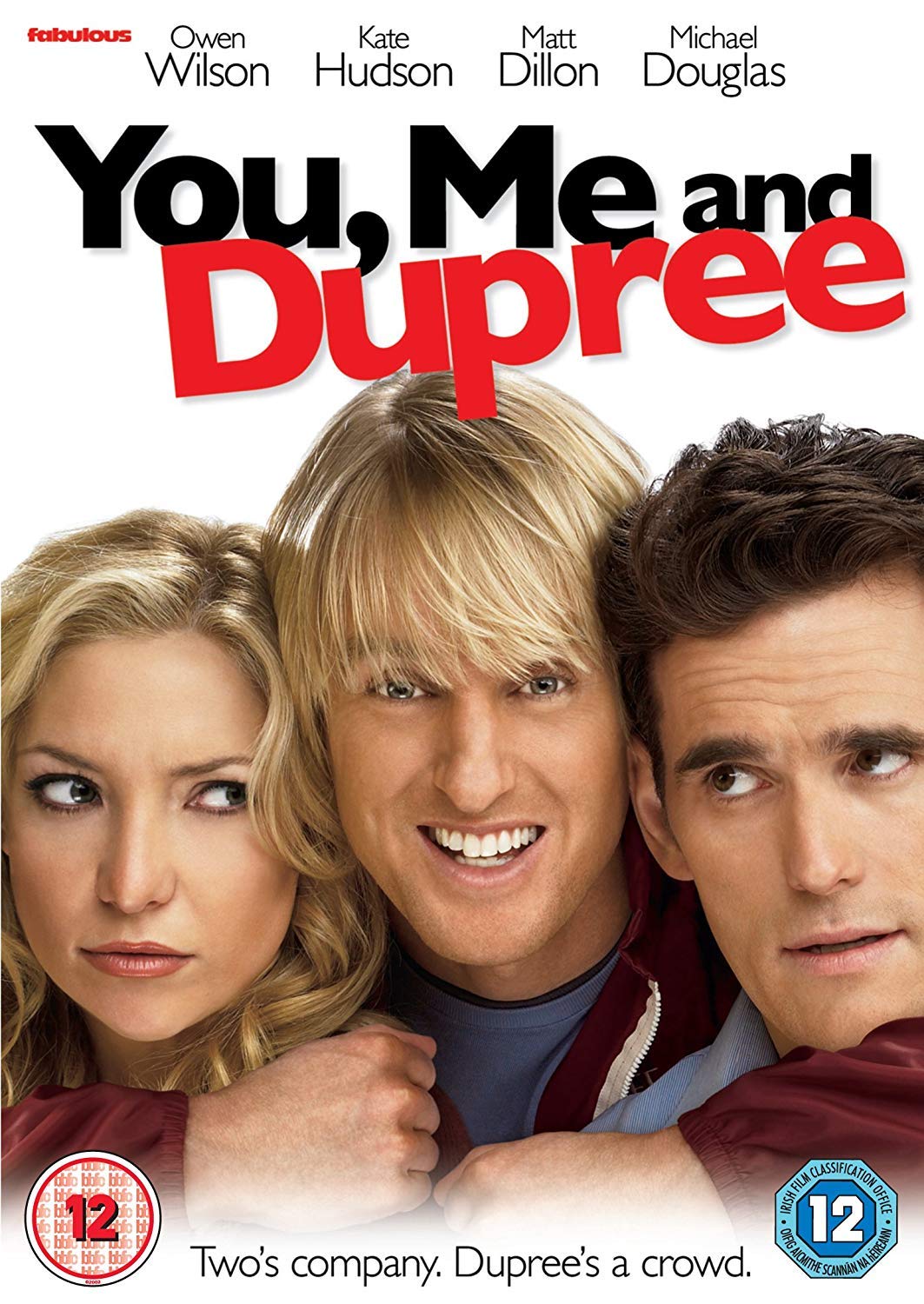
You, Me and Dupree

You, Me and Dupree

Posted on July 11, 2006 at 11:10 am

C-
Lowest Recommended Age: Mature High Schooler
MPAA Rating: Rated PG-13 for sexual content, brief nudity, crude humor, language and a drug reference.
Profanity: Some strong and crude language
Alcohol/ Drugs: Drinking and smoking, characters drink when under stress
Violence/ Scariness: Some violence, mostly comic, some characters injured
Diversity Issues: Some may be offended by reference to a Mormon character
Date Released to Theaters: January 1, 1970
Date Released to DVD: January 1, 1970
Amazon.com ASIN: B000ICM5X0

Copyright Universal 2006
Remember the classic comedy The Odd Couple? This is sort of the same movie, only it’s the odd triple and it isn’t very funny.

Adorable newlyweds Molly (Kate Hudson) and Carl (Matt Dillon) are just back from their honeymoon when Carl’s best friend Dupree (Owen Wilson) loses his job and his apartment. So, Carl invites him to stay with them for a few days.

But Dupree is a case of arrested development crossed with poor impulse control who somehow missed that train to grown-up-ville. He breaks things. He intrudes. He creates chaos. He seems hurt that he isn’t Carl’s top priority anymore, even jealous. So, he does what has always worked at getting Carl’s attention. He listens and supports Carl and he encourages him to go back to a carefree bachelor life.

While this is going on, in what appears to be a plot from another movie, Carl is having problems with Molly’s over-attached and highly competitive father (Michael Douglas), who happens to be his boss, and gives him a big promotion while urging Carl to change his last name and get a vasectomy.

There have been many memorable, touching, and very funny movies about free-wheeling character who shake up the lives of sober, responsible people, but this is not one. It is unpleasantly misogynistic, the women all prudes and scolds, the men all terrified of what might happen if they break the rules.

Wilson, who also produced, switches directions mid-movie. Dupree starts out as an immature clod and then turns into a supposedly-loveable Lost Boy who was somehow left behind and serves as an innocent inspiration until he is lucky enough to find his own path to growing up. That’s where the movie goes off the rails. Wilson makes the same mistake the character does of assuming that he is irresistibly forgiveable, a crime in itself unforgiveable. He wears out his welcome even faster than Dupree does.

Parents should know that this has some very strong material for a PG-13, including some strong and crude language and sexual references. A character is called a slut, characters talk about porn and discuss titles of various Asian porn movies, and a character masturbates to porn, there is discussion of vascectomies with a diagram showing what is done. The movie has some violence, mostly comic, with minor injuries. For no reason whatsoever, a minor character is supposed to be Mormon and therefore straight-laced.

Families who see this movie should talk about friends who are not always accepted by their families and how sometimes we can be close to people and then grow in different directions or have to rethink the relationship when the other person does not grow. They should also talk about why it was hard for Carl to talk about his feelings and why Molly and Carl liked different things about Dupree.

Families who enjoy this movie will also enjoy The Odd Couple and The Man Who Came to Dinner. A slyly spicy movie about a three-way relationship is Noel Coward’s Design for Living. Families will also enjoy some of the cast’s earlier work, including Dillon’s My Bodyguard and Wilson’s Bottle Rocket. Charles Dickens wrote about Dupree-like characters Mr. Dick in David Copperfield and Harold Skimpole in Bleak House.

Related Tags:


Comedy Movies -- format Romance

The Lake House

Posted on June 19, 2006 at 8:00 am

B
Lowest Recommended Age: 4th - 6th Grades
MPAA Rating: Rated PG for some language and a disturbing image.
Profanity: None
Alcohol/ Drugs: Drinking, scenes in bar
Violence/ Scariness: Non-graphic injuries, deaths, scenes in hospital
Diversity Issues: Diverse characters
Date Released to Theaters: 2006
Date Released to DVD: 2006
Amazon.com ASIN: B000HEWEE4

In honor of Sandra Bullock’s best all-time movie opening with “The Proposal,” this week’s DVD pick is another Bullock favorite.

Movie romances must have two things: an obstacle to keep the apart and a reason to root for them to get together. This has both. Keanu Reeves and Sandra Bullock have so much chemistry (perhaps based in part on our fond memories of Speed) that we can feel it even though this story gives them only one real scene together. And the obstacle is a nice one. They live in two different time zones. And by that I don’t mean EST and PST. They both live in CST — they’re in Chicago. I mean that Alex (Reeves) is an architect living 2004 and Kate (Bullock) is a doctor living in 2006.

Yeah. Don’t try to think it through too thoroughly. Just go with it. The tenderness of the story just might make it worthwhile.


Alex and Kate are connected by the title residence. It is a house on the lake, and by that I mean ON the lake. It is on stilts, made all of glass. The view is breathtaking but it is isolated. Kate moves out, leaving a note for the new occupant about forwarding her mail. But he is confused. As he moves in, no one has lived there for years. She refers to pawprints and a box that he can’t see. And the date on her note is two years in the future.


It seems the mailbox is a time/space continuum wormhole. Or maybe it is enchanted. The movie does not waste any time with explanations. It just shows us Kate and Alex, revealing themselves to each other through their letters and to us through their interactions with their friends, family, and colleagues. We see them grow toward each other, the very distance and strangness of the connection creating a place for each of them to thaw a part of them that has been isolated and frozen. We realize how — and why — destiny is bringing them together, and when it does, it is sweet and satisfying.


Bullock lowers the pilot light on her usual twinkle and allows herself to be vulnerable and even a little aloof. Reeves turns up the pilot light a little bit, giving us more than his usual blankness, letting us feel how much he wants to be with Kate and what he is willing to do to make it happen. If the two elements are there, a romantic story has an essential rightness that makes is possible, even a pleasure, to let ourselves believe in it. So, don’t ask whether there could be a house made of glass on top of a lake or whether Kate kept driving back to the mailbox. Just enjoy it.

Parents should know that characters drink (scenes in a bar). A boyfriend and girlfriend break up when she kisses someone else. A character is hit by a bus (offscreen) and dies and there is another sad death. Characters use some mild language.

Families who see this film should talk about how the lake house was a metaphor for Kate and Alex, giving them a view of great beauty but separating them from it.

Families who enjoy this movie will also enjoy other time-travel fantasies like Frequency and Somewhere In Time and another kind of story about love through letters, 84 Charing Cross Road. They will also enjoy Portrait of Jennie and the book that inspired it by Robert Nathan. And they will enjoy Jane Austen’s wonderful book Persuasion and the excellent movie version
.

Related Tags:


Drama DVD/Blu-Ray Pick of the Week Fantasy Romance

The Break-Up

Posted on June 2, 2006 at 3:23 pm

F+
Lowest Recommended Age: High School
MPAA Rating: Rated PG-13 for sexual content, some nudity and language.
Profanity: Some strong and crude language
Alcohol/ Drugs: Drinking and smoking, references to drunkenness
Violence/ Scariness: Tense and sad emotional scenes
Diversity Issues: None
Date Released to Theaters: 2006
Date Released to DVD: 2006
Amazon.com ASIN: B000HCPS94

Someone should file a complaint with the Federal Trade Commission about false advertising for this film. The trailer and the ads indicate that it is a romantic comedy. But it is, in fact, neither romantic nor a comedy; it’s more like an episode of Dr. Phil. Of course the trailer and the ads also indicate that it is enjoyable, and that, too, turns out not to be true, but if the FTC filed complaints every time that happened it would need more employees than the Defense Department.


The title says it all. Before the credits, we meet Brooke (Jennifer Anniston) and Gary (Vince Vaughn, who wrote the original story and produced the film) as they meet each other at a Cubs game. The next thing we see are those essential if overly familiar incidica of movie love: pictures showing our lovebirds making funny faces in a picture-taking booth, feeding each other, and decorating their new condo.

But then Gary and Brooke have their families over for dinner and get into a dispute about cleaning up. Brooke takes a stand and breaks up with Gary, hoping to make him realize how much he cares about her. But Gary, either because he takes her at her word or because his feelings are hurt, does not respond. So she raises the ante, trying to make him jealous, and he raises the ante, trying to prove he doesn’t care.


So, the whole movie is a game of one-upsmanship, as each one tries to make the other more miserable. It gets increasingly ugly and painful. Then it ends.


What is so disconcerting about all of this is that the performers seem to think they’re in a comedy and their performances have a comedy, even a sit-comedy rhythm. Anniston can be a fine dramatic actress (see the underrated The Object of My Affection) and has some of the best comic timing aound. Vaughn’s oddball ticcy rhythms, like Michael Keaton’s, work surprisingly well to convey either vulnerability or menace, sometimes both (see his underrated Clay Pigeons). But both of them are off here, as though they are lost in a script that does not match the tempo of its characters or story. The situations that are supposed to be funny are so mean-spirited and juvenile that they come across as creepy and nasty. We never believe they were a couple or that they should be a couple. they have nothing in common, no affection, no tenderness, no connection, no enjoyment of each other. They just get annoying; if we cared more, we would ask why they couldn’t just talk to each other instead of resorting to power games and indirection. But we don’t, so all we want is for them to shut up. And it seems to suggest that the problem was all Gary’s fault. Brooke talks about all she did and how under-appreciated she felt. Gary never suggests that she should have tried to find out if what she did was what he wanted and needed; he didn’t appreciate it because — he didn’t appreciate it.

The only way this story could possibly work is if it was set in a high school. We can forgive teenagers — and identify with them — for being so immature and clumsy. But having people in their 30’s say things like “Now I have him where I want him” and “Why didn’t you ever tell me?” induces not sympathy, not identification, just impatience and misery.

We keep hoping for more from the exceptional supporting cast, including Judy Davis as Brooke’s domineering boss, Ann-Margret as her mother, John Michael Higgins as her a capella-loving brother, and Jason Bateman and Jon Favreau as friends. Whenever the camera turns back to Gary and Brooke again, we sigh in resignation.


As for the ending, all I can say that at the screening I attended it literally provoked gasps of disappointment. Forget Dr. Phil; what Brooke and Gary need is a script doctor.

Parents should know that this film has some very raunchy material for a PG-13 (including a “Telly Savalas” bikini wax and two hooker jokes in the first ten minutes); as usual, the MPAA takes this material far less seriously when it is in a comedy than if it occured in a drama. There is some strong language (one f-word) and some crude language. Characters drink and smoke and there are sexual references and some nudity (bare male and female tushes, strip poker) and some implied nudity. Overall, the movie concerns some mean, dysfunctional, and petty behavior and it includes some tense and unhappy interactions.


Families who see this movie should talk about why it was so hard for Brooke and Gary to speak directly to each other about their feelings and concerns. What did they learn?


Families who enjoy this movie will also enjoy The War of the Roses, Ruthless People, and another movie set in Chicago, About Last Night. They might enjoy some of the classic comedies about battling couples who find each other again like The Awful Truth and Move Over Darling.

Related Tags:


Comedy Drama Movies -- format Romance
THE MOVIE MOM® is a registered trademark of Nell Minow. Use of the mark without express consent from Nell Minow constitutes trademark infringement and unfair competition in violation of federal and state laws. All material © Nell Minow 1995-2025, all rights reserved, and no use or republication is permitted without explicit permission. This site hosts Nell Minow’s Movie Mom® archive, with material that originally appeared on Yahoo! Movies, Beliefnet, and other sources. Much of her new material can be found at Rogerebert.com, Huffington Post, and WheretoWatch. Her books include The Movie Mom’s Guide to Family Movies and 101 Must-See Movie Moments, and she can be heard each week on radio stations across the country.

Website Designed by Max LaZebnik