Black Nativity

Posted on November 26, 2013 at 5:00 pm

B+
Lowest Recommended Age: Middle School
MPAA Rating: Rated PG for thematic material, language, and a menacing situation
Profanity: Some strong language
Alcohol/ Drugs: References to substance abuse
Violence/ Scariness: Teenager threatens someone with a gun, references to violence
Diversity Issues: A theme of the movie
Date Released to Theaters: November 27, 2013

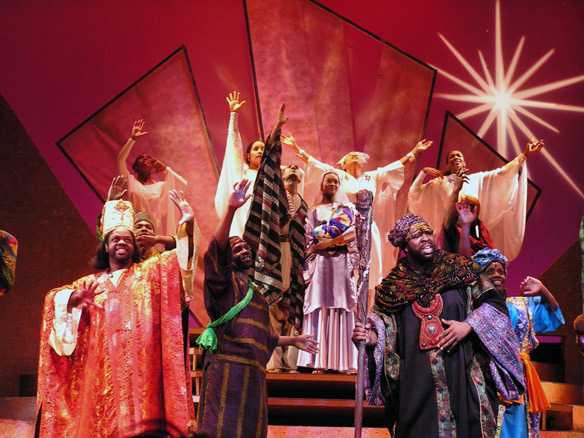
Black-Nativity-by-true-Colors-Theatre-Company-photo-courtesy-of-Soul-of-AmericaThe poet Langston Hughes wrote a play called “Black Nativity,” a joyous African-American retelling of the story of the birth of Jesus with gospel music, and it has become a holiday perennial. Now it has been adapted by writer/director Kasi Lemmons (“Eve’s Bayou”) with a framing present-day story of a prodigal daughter, estranged from her parents for 16 years, brought back home at Christmas as “Black Nativity” is being performed in her father’s church.

Oscar-winner Jennifer Hudson plays Naima, a single mother in Baltimore who has lost her job and is trying everything she can think of to keep her home.  But even with two jobs, she and her 15-year-old son Langston (17-year-old Jacob Latimore), named for the poet, are about to be evicted.  Niama has no other options left.  She puts Langston on a bus to New York to see the grandparents he has never met, knowing nothing about them or the cause of their estrangement.

Langston is hurt, lost, and angry.  He is frustrated that he cannot do more to help his mother and determined to find a way to get her the money she needs to keep their home.  Things go badly when his bag is taken by a kid as soon as he gets off the bus and he is arrested trying to return a man’s wallet because the police think he is trying to steal it.  In jail, he meets Loot (Tyrese Gibson), who jeeringly calls him “Lunch Money” and makes Langston feel powerless and disrespected.

His grandfather, Reverend Cornell Cobbs (Forest Whitaker), is formal and reserved.  His grandmother, Aretha (Angela Bassett) is affectionate but clearly in pain over the past and afraid of being hurt again.  Langston will do anything to feel that he is taking control of what is happening to him so he can return home.

Impressionistically told, with songs that serve as monologues, the movie becomes more powerful when Cornell’s church stages a gorgeous production of “Black Nativity” and Langston nods off to have a gospel-inspired dream that features Nas and, as an angel with white hair sticking up like a dandelion ready to make a wish, Mary J. Blige.  When Langston sneaks out of the service in a desperate attempt to get the money, it leads to a confrontation revealing in ways he could not anticipate.  The concluding scenes of redemption and reunion are tender and transcendent.  

Parents should know that the storyline concerns foreclosure and eviction, family estrangement, law-breaking, teen pregnancy, and abandonment.  A teenager uses a gun.

Family discussion:  Why didn’t Langston’s family want to tell him the truth? What did the watch symbolize to Cornell?  What did we learn from Langston’s dream?

If you like this, try: the poetry of Langston Hughes
Related Tags:


Based on a play Drama Family Issues Holidays Movies -- format Musical Stories about Teens

Frozen

Posted on November 26, 2013 at 5:00 pm

A-
Lowest Recommended Age: Kindergarten - 3rd Grade
MPAA Rating: Rated PG for some action and mild rude humor
Profanity: Brief schoolyard language
Alcohol/ Drugs: None
Violence/ Scariness: Scary wolves, snow monster, peril, sad death of parents
Diversity Issues: Strong female characters
Date Released to Theaters: November 27, 2013
Date Released to DVD: March 17, 2014
Amazon.com ASIN: B00G5G7K7O

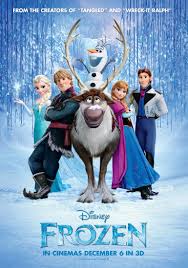
frozen poster

Smart, exciting, funny, sweet, tuneful, and gorgeously animated, the Oscar-winning “Frozen” adapts Hans Christian Andersen’s classic fairy tale into a story of two sisters kept apart by a scary secret.  Scary wolves, an enormous snow monster, a perilous journey, a warm (yes)-hearted snowman, a loyal reindeer, a sleigh ride, a sensational ice castle, and a little romance keep things moving briskly, but it is the relationship of the sisters that makes this movie something special.  There’s a surprisingly strong emotional connection.

The king and queen of Arendelle love their two daughters, Elsa and Anna, and the girls are best friends.  Anna loves to ask her big sister to “do the magic,” because Ilsa was born with the special power to create snow and ice.  But an accident almost becomes a tragedy, and the trolls who heal Anna remove her memory of her sister’s gift.

Their parents lock the gates around the castle and keep the girls apart.  They tell Elsa to “conceal it, don’t feel it.”  They want to protect her from those who might be afraid of her ability and protect those she might hurt as she grows up and her gift becomes more powerful.  She wears gloves all the time and stays in her room.  Anna wanders the castle alone, singing to the paintings, with no one to talk to.  Although she no longer remembers the details of their former closeness and the time they spent together, she is devastated that her sister will not see her.

Their parents are lost at sea, and three years later Elsa (Broadway star Idina Menzel) is about to be crowned queen.  Anna (Kristen Bell of “Veronica Mars”) is overjoyed to be seeing her sister and excited about meeting the people who will come through the gates that are opened at last.  She is charmingly awkward, having had no opportunity to learn any social skills, but that does not seem to matter to the very handsome Prince Hans (Santino Fontana), who proposes just a few hours after they meet.  Anna is overjoyed.

But Elsa forbids the marriage and when Anna objects, her frustration and  fury explodes, turning the balmy summer into a frozen winter.  Elsa runs away, locking herself into a dazzling palace made of ice in the mountains.  Anna follows, sure that she can make things right if she can just talk to Elsa about what is going on.  And that is where the adventure begins.  She meets a rough-hewn ice harvester named Kristoff (Jonathan Groff of “Glee”) and his reindeer Sven and a sunny-spirited, warm-hearted, and familiar-looking snowman named Olaf (Josh Gad of “Thank You for Sharing”).  And when they get to the ice palace, things do not turn out the way she expects.

Human animated characters tend to be bland-looking, but the voice talents have enormous spirit that gives them a lot of life.  Broadway stars Menzel, Groff (“Spring Awakening”), Bell (“The Adventures of Tom Sawyer”), and Gad (“The Book of Mormon”) make the most of a tuneful score featuring the Oscar-winning “Let It Go.”  The songs are beautifully acted as well as sung.  Highlights include an adorable ode to summer from Olaf, who is not quite clear on the physical properties of snow as temperatures rise, Kristoff’s “duetted” ode to reindeer with Sven (he sings both parts), and Menzel’s powerful “Let it Go.”  Bell’s sweet voice is lovely as she sings to the paintings in the castle about her longing for people and then exalts in her love for Prince Hans.  There is also a charming ensemble with trolls singing about how we’re all in our own way “fixer-uppers.”

The animation is everything we hope for from Disney, one “how did they do that?” after another, with ice and snow so real and so touchable you may find yourself zipping up your parka in the theater.   But the effects and action are all in service of the story, with a contemporary twist that is as welcome as summer’s return.

NOTE: Be sure to get to the theater in time as one of the highlights is the pre-feature short, starring a vintage Mickey Mouse voiced by Walt Disney himself.  It is a masterpiece of wit and technology that must be seen a couple of times to fully appreciate.  And be sure to stay through the end of the credits for an extra scene re-visiting one of the film’s most powerful characters.

Parents should know that this film include characters in peril, some injuries and action-style scares, monster, the sad deaths of a mother and father, some potty humor, and kissing.

Family discussion:  What’s a fixer-upper?  Why did Elsa’s parents tell her not to feel?  Why was she afraid of her power?  Why didn’t her parents want anyone to know the truth, and how did that make Elsa and Anna feel?  Who do you think is a love expert?

If you like this, try: “Tangled,” “Brave,” and “The Princess and the Frog”

Related Tags:


3D Action/Adventure Animation Based on a book DVD/Blu-Ray Pick of the Week Family Issues Fantasy For the Whole Family Movies -- format Scene After the Credits

Delivery Man

Posted on November 21, 2013 at 6:00 pm

B
Lowest Recommended Age: Mature High Schooler
MPAA Rating: Rated PG-13 for thematic elements, sexual content, some drug material, brief violence and language
Profanity: Very strong and crude language
Alcohol/ Drugs: Character grows marijuana, alcohol, hard drug abuse treated seriously but irresponsibly
Violence/ Scariness: Fight, drug abuse
Diversity Issues: Diverse characters
Date Released to Theaters: November 22, 2013
Amazon.com ASIN: B00GEKO51U

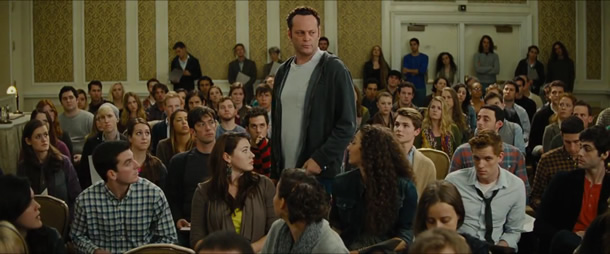
delivery-man-vaughnThe undeniable sweetness of “Delivery Man” makes its inherent silliness just about forgivable.  Or, it just might be the sense of relief that Vince Vaughn is finally making a movie that is just silly instead of crass and stupid like “Couples Retreat,” “Four Christmases,” “Fred Claus,” and pretty much most of what he’s done since “Wedding Crashers.”

Vaughn plays his usual likeable shlub, this time Dave, the son of a butcher.  His brothers work in the store with their father, but all Dave can do is drive the delivery truck, and he does not even do that very well.  “It’s like every day you find some new way to push the limits of incompetence.”

He also has the usual long-suffering girlfriend, a cop named Emma (Cobie Smulders), who, like all girlfriends in these arrested development movies, has only one responsibility in the story, which is to look beautiful when she tells him that it’s time for him to grow up.  It turns out that she is pregnant, and she does not believe he has it in him to be responsible enough to be a dad.

In the midst of all this, he discovers that he already is a dad, at least in the strictly biological  sense.  Some time ago, he was a “very, very frequent donor” at a sperm bank, which carelessly made it available to many more women than its guidelines allowed.  A lawyer shows up in Dave’s apartment to tell him that he is the biological father of 533 children, and 142 of them have sued the facility to find out the identity of the mysterious “Starbuck” whose genetic heritage they carry.  Starbuck is not related to the coffee shops or the Moby Dick character who inspired their name.  It is the name of the French-Canadian film adapted by its writer-director for this remake, and the name of a legendarily productive stud bull.

Dave is known only as “Starbuck” to the progeny, and his anonymity is guaranteed by the terms of his donor agreement.  His best friend is Brett (Chris Pratt, a highlight of the movie and quickly becoming one of our most indispensible comic actors), a lawyer who is beleaguered by his four young children.  “My children cannot pick up the frequency of my voice,” he explains, exhausted.  Brett gives Dave the folder of information on the 142 plaintiffs and tells him not to open it.  What was he thinking?

Dave reads just one file, and is thrilled with his connection to a very accomplished young man.  So he takes out another one, and then another, and finds that many of them need help.  And he finds that helping them gives him a great sense of satisfaction and purpose.  Most don’t need much help.  Dave covers a would-be actor’s day job (badly) so he can go on an audition.  He warns off catcallers harassing a young woman in a short skirt.  He helps an inebriated kid get home.  These are in the trailer and are fairly cute.

Some have serious problems.  One is a drug addict.  One is severely disabled and cannot communicate.  These are handled superficially at best and downright irresponsibly at worst.

It’s all just a matter of time before everyone finds out, generally in the most awkward of ways.  Cue the fake Jay Leno monologue.  But babies are heart-tugging, even twenty years later, and the longing for family from both the children and their bio-dad is so touching that even the most preposterous resolution somehow seems just fine.

Parents should know that the film is about a man who fathered more than 500 children through a series of donations to a fertility clinic and it includes explicit references and crude jokes about producing samples and fertility treatments.  Characters use strong and crude language, drink, grow marijuana and abuse harder drugs (the movie implies that addicts can quit easily without any help), and there is some brief violence.

Family discussion: How should Dave prove that he “deserves” to be the baby’s father?  What did the children want from the lawsuit?  How did he help them?

If you like this, try: “Baby Mama”

Related Tags:


Comedy Courtroom Family Issues Movies -- format

The Christmas Candle

Posted on November 21, 2013 at 9:58 am

B-
Lowest Recommended Age: 4th - 6th Grades
MPAA Rating: Rated PG for mild thematic elements
Profanity: None
Alcohol/ Drugs: None
Violence/ Scariness: Mild peril, sad stories, tense confrontations
Diversity Issues: None
Date Released to Theaters: November 22, 2013

Former Presidential candidate Rick Santorum is now in the faith-based movie business and his first film is based on christmascandleThe Christmas Candle by Max Lucado.

Just before the holidays, a progressive young clergyman named David (Hans Matheson) takes over a church in a small village called Gladbury in late 19th century England.  The town is known for its miracle — every 25 years an angel appears to touch one of the candle maker’s Christmas candles.  Whoever lights that candle receives a miracle.  This year, there is tremendous anticipation and there are many in the town who want the miracle for themselves, including the candle maker and his wife.  David encourages his parishioners not to wait for a miracle but to help each other through kindness, generosity, humility, and love.  And soon the village creates a more connected community and a more welcoming environment.

The evident sincerity of the production is appealing but it cannot disguise a not-ready-for-prime-time amateurish quality in the superficiality of the writing and pedestrian direction.  It is awkward and uneven, but it is also a little less sugary than most faith-based family fare.  Lesley Manville gives a subtle and touching performance that transcends the clunky dialogue and over-constructed plot and Susan Boyle looks very natural in 19th century garb and sings beautifully.  The emphasis on helping others rather than wishing for a selfish miracle is most welcome, though disappointingly undercut in the final half hour.

Parents should know that there are some mature themes, including an out of wedlock pregnancy and family estrangement.

Family discussion:  What would you wish for?  Who can you help?

If you like this, try: “Christmas with a Capital C”

Related Tags:


Fantasy Holidays Movies -- format Spiritual films

Paradise

Posted on November 14, 2013 at 11:06 pm

B
Lowest Recommended Age: High School
MPAA Rating: Rated PG-13 for sexual material, substance abuse, some language, and thematic elements
Profanity: Very strong and explicit language
Alcohol/ Drugs: Drinking, drugs
Violence/ Scariness: Some peril, references to a tragic accident.
Diversity Issues: Diverse characters
Date Released to Theaters: November 15, 2013
Amazon.com ASIN: B00FJVCERC

movies-paradise-julianne-hough-russell-brandOscar-winning screenwriter Diablo Cody (“Juno”) tries directing for the first time with “Paradise,” based on her own script about a girl from a very conservative religious background whose faith is challenged after a terrible accident.  Even she acknowledges that she is better as a writer than a director — she has already said she does not plan to direct again.  It isn’t that it is poorly directed.  It is more like barely directed.  She met the first task of a director exceptionally well, picking an excellent cast and giving them roles that allow them to make some surprising choices.  It would be nice to see a version of this story where the director made some surprising choices, too.

Julianne Hough plays Lamb (as in “lamb of God”), a sheltered young woman from a devout Christian community.  After a devastating plane crash that left her with burn and skin graft scars over much of her body she feels that everything she thought she understood about the world no longer applies.  So, instead of donating the money she received in compensation for her injuries to her church, she decides to go as far in the opposite direction as possible.  She goes to Las Vegas.

Some people do not have the gift for sin.  There is a lot of charm in some of the film’s early scenes, as Lamb checks transgressions off her list that include rhythmic moving to music and getting a microscopic tattoo.  Lamb meets a British bartender (Russell Brand, raffishly engaging) and a singer (Octavia Spencer) who take her out in part to enjoy seeing her reaction to the debaucheries of Las Vegas and in part to protect her from them.

Cody tweaks or avoids the usual Vegas tropes.  She gets nicely meta, with Spencer explaining why she is not going to be the “magical Negro” stereotype minority character whose purpose in the story is to bring a greater humanity to a white person.  And Brand gets to add a bit more depth to his usual persona.  Lamb is an endearing character.  It is fun to see her get a little wild and satisfying when all three characters and some unexpected others show that they already have the greater humanity they need.

Parents should know that this movie is about a young woman who wants to explore sin and it is set in Las Vegas.  There is more discussion of sin than portrayal of it, however.  The movie includes some strong language and risky behavior and discussion of tragedy and a sad death.  A character is a prostitute and characters drink to deal with stress.

Family discussion:  Which character changes the most?  If you had Lamb’s money, what would you do with it?

If you like this, try: Hough’s remake of “Footloose”

Related Tags:


Comedy Drama Movies -- format
THE MOVIE MOM® is a registered trademark of Nell Minow. Use of the mark without express consent from Nell Minow constitutes trademark infringement and unfair competition in violation of federal and state laws. All material © Nell Minow 1995-2026, all rights reserved, and no use or republication is permitted without explicit permission. This site hosts Nell Minow’s Movie Mom® archive, with material that originally appeared on Yahoo! Movies, Beliefnet, and other sources. Much of her new material can be found at Rogerebert.com, Huffington Post, and WheretoWatch. Her books include The Movie Mom’s Guide to Family Movies and 101 Must-See Movie Moments, and she can be heard each week on radio stations across the country.

Website Designed by Max LaZebnik