What kind of movie do you feel like?

Ask Movie Mom

Find the Perfect Movie

Dads

Posted on June 18, 2020 at 8:00 am

B +
Lowest Recommended Age: Middle School
MPAA Rating: TV-14
Profanity: None
Nudity/ Sex: None
Alcohol/ Drugs: None
Violence/ Scariness: Family issues
Diversity Issues: Diverse characters
Date Released to Theaters: June 19, 2020
Copyright 2020 Imagine Documentaries

Bryce Dallas Howard’s loving tribute to the men in our families is personal. It features her father, actor/director Ron Howard, his father, the late actor Rance Howard, who tells a beautiful and very meaningful story about then-Ronny Howard’s first day of filming on “The Andy Griffith Show,” and her brother, a soon-to-be father as the documentary begins and a happy but exhausted new dad at the end. The movie also features celebrities like Jimmy Kimmel, Conan O’Brien, and Will Smith with their own comments on being dads, and visits to the homes of “ordinary” but extraordinary dads, in the US and other countries, including a couple of fathers who adopted four special needs kids in six months and a stay-at-home father of four small children. Plus clips of various child and teen meltdowns that are hilarious if they are not yours. So yeah, I cried through the whole thing. My dad is awesome. So is my husband, a magnificent dad to our two children.

The celebrities are fun but the heart of the movie in every way are the dads no one outside their families may know but who are heroes in what they do every day. There have been fathers since there have been people, but the idea of what a father can and should be has changed, and this movie shows us how dads are inspired by, influenced by, and reacting to the fathering they received. The variety of dads includes not just racial, cultural, and nationality diversity but diversity in family connections, some parents still together, some not.

Today’s dads may be more involved in the moment-to-moment details of their children’s lives than some traditional briefcase or lunchbox toting dads who went to work all day and came home to dinner on the table and kids bathed and ready for bed in the old days. One of the movie’s subtle themes is the combination of what is eternal and what is changing or what can change and is decided by each of us as we grope toward our own parenting styles and how to use that style to communicate unconditional love while urging our children toward independence, gratitude, empathy, and finding a way to use their own strengths to determine their paths. This film is a heartwarming tribute to the dads who give us so much and in return get a tie, and a smudgy hand-made card. I’d just like to end this with thanks to my wonderful dad, who told me the coffee I made for his breakfast in bed on Father’s Day was so delicious he was going to bring it into the bathroom with him while he shaved. I was so proud of myself. Now, I’m proud of him.

Parents should know that this film includes depiction of special needs and health challenges and some bodily function moments.

Family discussion: Which of these dads is most like your father? Most like the father you’d like to be? How was being a father different from what these men expected? If you were creating a user guide for parents, what would it say?

If you like this, try: “The Other F Word”

My Ebook on the Best Movie Fathers Free for Father’s Day

Posted on June 17, 2020 at 5:00 am

In honor of Father’s Day, my eBook, 50 Must-See Movies: Fathers is FREE today through Father’s Day, this weekend, June 17-21, 2020.

What do “Wall Street” and the “Star Wars” saga and, seemingly, about half the movies ever made have in common? They are about fathers. In “Wall Street,” Charlie Sheen plays the ambitious Bud, who respects the integrity of his blue-collar father, played by his real-life father, Martin Sheen. But Bud is dazzled by the money and power and energy of Gordon Gekko (Michael Douglas). The movie will up the ante with Bud’s father’s heart attack as we see him struggle between the examples and guidance of these two male role models.
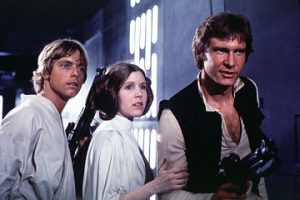

Copyright 20th Century Fox 1977

In “Star Wars,” Luke (Mark Hamill) does not know until halfway through the original trilogy that (spoiler alert) the evil Darth Vader is his father. He was raised by his aunt and uncle, who are killed very early in the first film, but the father figures who are most meaningful in his life are the Jedi masters Obi-Wan Kenobi and Yoda. Like Bud in “Wall Street,” Luke must choose between the good and bad father figures. Like Luke, Harry Potter is raised by an aunt and uncle, but he finds a true father figure later. For Harry, it is headmaster Albus Dumbledore. In opposition is He Who Must Not Be Named. Like Luke, Harry has the opportunity for great power on the dark side, but he lives up to the example set for him by Dumbledore.

The first stories ever recorded are about fathers. The central human struggle to reconcile the need for a father’s approval and the need to out-do him is reflected in the “hero of a thousand faces” myths that occur in every culture. In Greek mythology, Zeus is the son of a god who swallowed his children to prevent them from besting him. Zeus, hidden by his mother, grows up to defeat his father and become the king of the gods. Ancient Greece also produced the story of Oedipus, who killed his father and married his mother, and The Odyssey, whose narrator tells us “it is a wise man who knows his own father.”

These themes continue to be reflected in contemporary storytelling, including films that explore every aspect of the relationship between fathers and their children. There are kind, understanding fathers whose guidance and example is foundation for the way their children see the world. There are cruel, withholding fathers who leave scars and pain that their children spend the rest of their lives trying to heal. There are movies that reflect the off-screen real-life father-child relationships. Martin Sheen not only played his son’s father in “Wall Street;” he played the father of his other son, Emilio Estevez, in “The Way,” which was written and directed by Estevez, and which is about a father’s loss of his son. Will Smith has appeared with his son Jaden in “The Pursuit of Happyness” and “After Earth.” John Mills appeared with his daughter Hayley in “Tiger Bay,” “The Truth About Spring,” and “The Chalk Garden.” Ryan and Tatum O’Neill memorably appeared together in “Paper Moon.” Jane Fonda produced and starred in “On Golden Pond” and cast her father Henry as the estranged father of her character. Jon Voight played the father of his real-life daughter Angelina Jolie in “Tomb Raider.” And Mario Van Peebles, whose father cast him as the younger version of the character he played in “Sweet Sweetback’s Badasssss Song” made a movie about the making of that film when he grew up. It is called “Badasssss!” In the role of Melvin Van Peebles he cast himself.

Director John Huston deserves some sort of “Father’s Day” award. He directed both his father and his daughter in Oscar-winning performances, Walter Huston in “The Treasure of the Sierra Madre” and Anjelica Huston in “Prizzi’s Honor.”

Some actors known for very non-paternal roles have delivered very touching performances as fathers. Edward G. Robinson is best remembered for playing tough guys, but in “Our Vines Have Tender Grapes” he gave a beautiful performance as a farmer who loves his daughter (Margaret O’Brien) deeply. Cary Grant, known for sophisticated romance, played loving – if often frustrated — fathers in “Houseboat” and “Room for One More.” “Batman” and “Beetlejuice” star Michael Keaton was also “Mr. Mom.” Comedian Albert Brooks is a devoted father in “Finding Nemo” and “Finding Dory.”

There are memorable movie fathers in comedies (“Austin Powers,” “A Christmas Story”) and dramas (“To Kill a Mockingbird,” “Boyz N the Hood”), in classics (“Gone With the Wind”), documentaries (“Chimpanzee,” “The Other F Word”), and animation (“The Lion King,” “The Incredibles”). There are great fathers (“Andy Hardy,” “Call Me By Your Name”) and terrible fathers (“The Shining,” “Winter’s Bone,” “The Spectacular Now,” “The Barretts of Wimpole Street”). There are fathers who take care of us, as well as they can (“John Q,” “Toni Erdnmann,” “Lorenzo’s Oil,” “Leave No Trace,” “The Road,” “Extraordinary Measures”) and fathers we have to take care of (“I Never Sang for My Father,” “Nothing in Common”). All of these stories are ways to try to understand, to reconcile, and to pay tribute to the men who, for better or worse, set our first example of how to decide who we are and what we will mean in the world.

Movies for the Homebound XII: Great Movie Dads

Posted on June 16, 2020 at 8:00 am

In honor of Father’s Day, here are some of my favorite movie dads, many of them based on the real-life fathers of the filmmakers.  Extra love to the two great dads in my life, my father and my husband. Give the dad in your life an extra hug and ask who his favorite movie father is!

Spencer Tracy in the original “Father of the Bride” may be befuddled by the planning for his daughter’s wedding, but when she is distraught because her fiance’s plan to go to Nova Scotia for their honeymoon is making her question her decision to marry him, we see one of the all-time great father moments in movies. Elizabeth Taylor, who played the young bride, always called Tracy “Pops” because of their time together on this film.

Clifton Webb plays real-life efficiency and safety pioneer Frank Gilbreth in “Cheaper by the Dozen,” with Myrna Loy as his partner and wife Lillian, based on the memoir by two of the twelve Gilbreth children (well worth reading).

“The Pursuit of Happyness” stars Will Smith as real-life Christopher Gardner, who went from being homeless to being a successful stockbroker, all the time caring for his son, played here by Smith’s own son Jaden, adding depth and authenticity to this inspiring story.

The classic play “Life With Father,” based on the book by Clarence Day, Jr. about his bombastic but affectionate father is a delightful movie starring William Powell, Irene Dunne, and Elizabeth Taylor.

In “The Lion King,” Mufasa is a wise ruler and a loving and devoted father who knows he must teach his young son that being king is more than just doing whatever you want.

Atticus Finch teaches his daughter Scout to read, and he teaches her that courtesy is the foundation of empathy and recognizing the humanity in others in “To Kill a Mockingbird,” based on Harper Lee’s memories of her own father.

“Parenthood” was inspired by the real-life experiences of its writers and directors and it shows. A wide variety of parental challenges are presented with warmth and understanding and Steve Martin excels as a dad struggling to be what his own father (Jason Robards) was not.

Laurence Fishburne plays Furious Styles in “Boyz N the Hood,” a father determined to teach his son, with his example and with their conversations, what it means to be a man in a world that can lead him into danger.

We don’t see much of Fess Parker in “Old Yeller,” but when he comes home near the end of the film, he is in one of the all-time great father-son scenes, giving his son room to mourn the dog who died but giving him some perspective about how he will not always feel so devastated.

A clownfish father voiced by Albert Brooks spends a whole movie searching for his son in “Finding Nemo,” and he learns some important lessons along the way about how to help his son become more independent.


Artemis Fowl

Posted on June 11, 2020 at 5:16 pm

B +
Lowest Recommended Age: 4th - 6th Grade
Profanity: Some schoolyard language
Nudity/ Sex: None
Alcohol/ Drugs: None
Violence/ Scariness: Extended fantasy-action style violence and peril, reference to death of a parent
Diversity Issues: Diverse characters
Date Released to Theaters: June 12, 2020
Copyright 2020 Disney

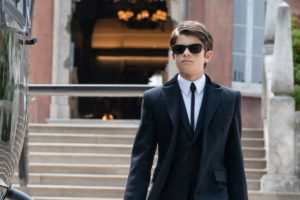
The twelve-year-old criminal mastermind of the Artemis Fowl series of books by Eoin Colfer is, as one might suspect, slightly nice-ified in this Disney version originally intended for the big screen but now coming to DisneyPlus. One might also suspect that Disney would call on the most spectacularly talented visual artists they could find to make this a family-friendly, gorgeously designed action fantasy.

Fans of the book will need to keep an open mind, as the storyline and characters have been re-aligned. As in the original, Artemis Fowl (Ferdia Shaw) is a prodigy. He defeats a chess master in five moves and spots his therapist’s treasured family heirloom as a fake. He is alone most of the time because his adored father (Colin Farrell) travels a lot on urgent but mysterious business trips. When they are together, Artemis loves listening to his father’s stories of Irish myths, filled with magical creatures and enchanted objects.

And then Artemis senior is kidnapped by the mysterious Opal Koboi, who gives Artemis three days to retrieve a powerful artifact, or his father will be killed. Artemis learns that the stories his father told him were not just fairy tales. And that the Irish blessing poem he recited was a clue in case of just exactly the kind of emergency that he now faces.

Copyright 2020 Disney

The shift to give Artemis a less criminal motive makes sense, especially since the character’s personality is cool and adult-ish at all times. At one point, he is asked if he is scared since, as through the entire movie, he is hyper-rational and shows very little emotion. His calm response is that he is, but it is better to be scared than dead. Knowing that he is doing everything to get his father back and, not incidentally, save the world, keeps us on his side.

As in the book, the film also balances out his quiet demeanor by surrounding him with colorful characters whose skills come in handy in searching for the mysterious weapon. Josh Gad is nearly unrecognizable and a lot of fun as a giant dwarf with exceptional skills at digging and hair that can pick a lock. Dame Judi Dench is a hoot as Commander Root, who is kind of the CEO of the land of magical creatures, barking out orders when it is necessary to stop time or wipe the memories of some humans who have had an unexpected encounter with magic. Basically, she is M with Spock ears. Loyal elf Holly Short (Lara McDonnell with the requisite spark and sparkle) is one of Commander Root’s must trusted aides.

Production designer Jim Clay had a dream job and got a dream result. Who wouldn’t want to dream up a fabulous mansion on the coast of Ireland, filled with Victorian furnishings and wonderful curios, not to mention an entire magical land? And who would not want to spend 90 minutes luxuriating in all of the fabulous details? The world of the film is truly magical, and the adventure looming ahead is deliciously enticing.

Parents should know that this film includes extended fantasy/action peril and violence with weapons including guns. Characters use some schoolyard language. There are references to the death of a parent and another parent is threatened.

Family discussion: Would you rather be a goblin, a fairy, or a troll? How did Artemis get Holly to trust him?

If you like this, try: the Artemis Fowl books and the book and movie series about Percy Jackson and Harry Potter

The King of Staten Island

Posted on June 11, 2020 at 3:13 pm

B-
Lowest Recommended Age: Mature High Schooler
MPAA Rating: Rated R for language and drug use throughout, sexual content and some violence/bloody images
Profanity: Constant very strong and crude language
Nudity/ Sex: Explicit and crude sexual references and situations
Alcohol/ Drugs: Drinking, drugs
Violence/ Scariness: Some violence, fires, sad death, suicide attempt
Diversity Issues: None
Date Released to Theaters: June 12, 2020

Copyright 2020 Universal Pictures
Here we go again. Another too-long Judd Apatow movie about an arrested development, failure to launch man-child we are expected to find far more endearing than we do. “The King of Staten Island” shares these essential ingredients with earlier films like “The 40-year-old Virgin” and “Knocked Up,” and one more: the main character played by a charismatic comedian or comic actor. In Apatow’s earlier films, those actors have included Paul Rudd, Steve Carell, and Seth Rogen. This time, it is stand-up comedian and SNL cast member Pete Davidson.

But there are a couple of significant differences between the sunny sensibility of those glossy Hollywood confections and “The King of Staten Island,” with the significance of its setting reflected in the title. It’s not sunny. It’s dingy and gritty, with the help of superb cinematography from Robert Elswit, and very little music on the soundtrack. And the reasons that the main character is stuck in a perpetual directionless funk of helplessness, sorrow, self-pity, resentment, self-harm, numbness, and weed, are darker, much darker because we know the story is semi-autobiographical.

Normally, I might describe a film like this as the co-writer/star working through some issues (as, say, in Shia LeBoeuf’s “Honey Boy,” where he played his own abusive father). But it is not clear that Pete Davidson is working through much here, except to the extent he is re-enacting some of what has happened to him. Davidson is currently living at home with his mother, as we see (literally) in his appearances, some with her, in the videos he shoots for the pandemic-era SNL episodes. Davidson was seven when his fireman father was killed on 9/11. In this film, his character’s name is Scott, after his real-life father, to whom the film is dedicated. Scott’s father, also named Scott, was a fireman who died trying to rescue someone. As the film begins, Scott’s sister (played by Apatow’s daughter Maude) is leaving for college. And his mother (Marisa Tomei, in another wonderfully warm and radiant performance), 17 years after his father’s death, is beginning to date someone new, also a fireman (Bill Burr). Seeing the people closest to him taking chances, moving on, and accepting responsibility are deeply unsettling. But what he is most threatened by is allowing himself to feel the feeling he has numbed with weed, denial, and tattoos that are more like self-mutilation, mortification of the flesh, and self-inflicted pain to reduce feelings of worthlessness than aesthetics or self-expression. He says he wants to be a tattoo artist and practices on his friends (and briefly on a child). He says his dream is to have a combined restaurant/tattoo parlor. What he really wants to do is erase himself.

Davidson is an exceptionally appealing performer, and it is clear he is trying to blend art and life here, using the film itself to become more vulnerable and more present. But there is a reason one of the most frequent characters he plays on SNL (other than himself) is a teenager whose only reaction is a shrug. He is still operating within a pretty narrow range, in contrast to Tomei and Burr, and Pamela Adlon, who briefly appears as a bitter ex-wife, all excellent. Making the most of an even briefer appearance is Steve Buscemi, a real-life fireman playing one on screen.

There are touching moments, and some scenes have a satisfyingly authentic impact, especially those with a group of guys showing their ride or die support for each other by ragging each other mercilessly, an Apatow speciality. It could have been half an hour longer, first by cutting the weird scenes where restaurant waiters and bus staff literally fight for tips. But we keep rooting for Scott, and especially for Pete.

Parents should know that this movie includes constant very strong, explicit, and crude language, sexual references and situations, alcohol and drugs, including the use of both to numb pain, risky and foolish behavior, including a possible suicide attempt, criminal activity, a gun, and discussions of the death of a parent and divorce.

Family discussion: Why did Scott and his sister respond to the loss of their father differently? Why was it so difficult for Scott when he mother dated another fireman? What made him decide to change?

If you like this, try: Pete Davidson’s stand-up special, “Alive from New York”