Did anyone need a reboot of “Saved by the Bell?” Pretty sure the answer is no, but I have to say, this looks better than the original. Coming to Peacock.
References to sad offscreen death, divorce, family conflict
Diversity Issues:
None
Date Released to Theaters:
August 8, 2020
Date Released to DVD:
December 7, 2020
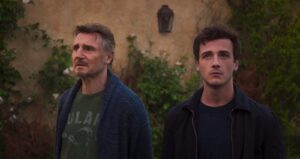
Copyright 2020 IFC“Made in Italy” is a labor of love starring a real-life father and son playing a father and son. And it is about a labor of love in the most literal terms as the estranged father and son have to work together on the house in Tuscany they jointly own so that it can be sold.
Like the characters they play, Liam Neeson (Robert) and his son Micheál Richardson (Jack) experienced the devastating loss of a wife and mother, actress Natasha Richardson (Micheál uses her last name as a tribute). This adds an overlay of intimacy to the film would not be supported by the script alone, a first-time feature written and directed by actor James D’Arcy. It is perhaps for that reason that a climactic scene of grief is truncated and underplayed. Maybe it is because it was just too painful. Or the shifting and uncertain tone of the film, which wants to be warm-hearted, romantic, comic, and dramatically emotional at the same time.
Jack manages an art gallery owned by the family of the wife who is divorcing him. When she tells him they are going to sell the gallery, he insists he will buy it. “The gallery is my home,” he says. He cannot let it go. But to get the money he needs he will have to sell his late mother’s home in Tuscany, deserted for twenty years because it was too painful to return. And he will have to get his father to agree. They are barely on speaking terms. Jack has contempt for his father’s failure to produce any new artwork in years and for his irresponsible attitude. Jack arrives to take him on the trip and Robert has not packed (“I thought it was tomorrow”) and, in one of the movie’s most regrettable cliches, cannot remember the name of the woman who spent the night. Robert does not respect Jack. Again, regrettably, he puts it this way: “Those who can, do. Those who can’t run their wive’s galleries.”
The house is a beautiful mess. The landscape around it is breathtaking. Robert calls it “one of the most fabulous convergences of nature ever,” and dismisses Jack’s referring to it as “the view.” And they disagree about a mural Robert painted on one of the walls, which he calls his tribute to abstract expressionist Franz Kline, but looks more like a tribute to the blood-tsunami elevator in “The Shining.”
There is a brisk British real estate agent with a severe haircut (Lindsay Duncan), who brings a delightful mix of disdain and saleswomanship to every scene she’s in, at least until her character has to soften up when she is charmed by Robert. There’s a warmhearted local woman (Valeria Bilello) who is there to soften up Jack. These women and the experience of living in and working with the home of the woman they are still grieving makes it possible for them to do what they have never done before: talk about their loss in a scene that is not as emotionally resonant as the film sets us up to expect. Maybe it is just be British reticence.
But then we return to the real heart of the film, the spectacularly gorgeous Tuscan scenery and oh, that food. That setting, and the genuine affection between Neeson and Richardson, makes up for the predictability of the script. What do you think, with the potential buyers be kind, considerate people who deeply appreciate the house as it is or a poor copy of the self-centered boors Kristen Wiig and Jason Sudeikis used to play on “Saturday Night Live?” It’s the fabulous convergence of nature and the almost-fabulous convergence of the actors that makes it worth a watch.
Parents should know that this movie concerns a tragic death, survivor guilt, and family estrangement. Characters use strong language and there is a mild sexual situation.
Family discussion: Why wouldn’t Jack sign the divorce papers? Why was the gallery so important to him? Why couldn’t Jack and Robert be honest with one another?
If you like this, try: “Under the Tuscan Sun,” “Life as a House,” and “Enchanted April”
Rated PG for thematic elements and some mild peril
Profanity:
None
Nudity/ Sex:
None
Alcohol/ Drugs:
None
Violence/ Scariness:
Sad offscreen deaths of parents, illness, depression, fire
Diversity Issues:
None
Date Released to Theaters:
August 8, 2020
Copyright STX 2020Most of the time I was beguiled by the gorgeously designed latest version of “The Secret Garden,” Frances Hodgson Burnett’s classic 1911 story of the orphan girl named Mary Lennox sent to live with her uncle in a vast castle-like home on the moors. She discovers a locked, hidden garden — and some family secrets. But there were moments when I was as cross as Mary herself, the book version that is.
What I loved most about the book when I first read it as a child and then when I read it aloud to my own children was that Mary is that rare heroine in a classic children’s book who is unapologetically imperious, outspoken, and, until the secret garden works its magic, selfish. Anne Shirley, Pollyanna, Alice, Caddie Woodlawn, and Burnett’s unfailingly saint-like Sara Crewe, Mary Lennox had a sour disposition and yet, she was the heroine of the story. This fifth movie version begins with Mary comforting her doll. The book’s Mary would never do anything so empathetic.
So, it took me a while to let go of my version of Mary and warm to the softer version from screenwriter Jack Thorne (“Wonder”), enjoying the movie within its own conception of the story. As in the book, Mary (Dixie Egerickx) is raised in colonial-era India (here set in 1947), then sent to live with the uncle she does not remember ever having met (Colin Firth as Archibald Craven), in an enormous house called Misselthwaite Manor, on the windy, misty moors of Yorkshire.
She discovers a secret garden and two boys, one who seems to be a part of the moors, and a relative who is as removed from the natural world — even other humans — as it is possible to be. She discovers some important understanding about herself, in part through evidence that helps her reframe her past.
Sumptuously imagined and lovingly presented, this is a fine family film, and a good reminder that even being stuck at home can be an adventure.
Parents should know that this film features three children mourning lost parents and a grief-stricken father/uncle. A character has severe depression, which her daughter interprets as not caring about her. There is some mild peril and a fire.
Family discussion: Grief is expressed in many different ways in this film. What are some of them? What did Mary and Colin learn from the letters that made a difference to them? What would be in your secret garden?
If you like this, try: the book and the earlier versions of the story, especially the 1987 version directed by Agnieszka Holland.
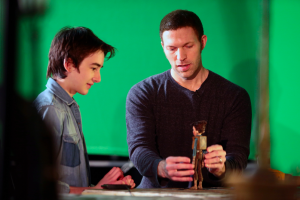
I love LAIKA! Their movies are astounding, gorgeous, complex, and brilliant. I’ve been lucky enough to visit the studio twice and hope to go back again some day.
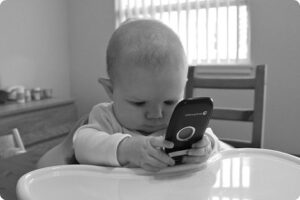
We have just begun to explore the complexities and wide range of differences in the way individuals watch and respond to what we see on screens. A new study about babies shows that these differences are present at birth. While these study results are illuminating, it does not change my firm position of no screen time before age three and no more than an hour a day and no theatrical screens before age five.
Children’s own temperament could be driving the amount of TV they watch – according to new research from the University of East Anglia and Birkbeck, University of London.
Copyright 2009 Carolien Dekeersmaeker
New findings published today show that the brain responses of 10-month-old babies could predict whether they would enjoy watching fast-paced TV shows six months later.
The research team says that the findings are important for the ongoing debate around early TV exposure.
Lead researcher Dr Teodora Gliga, from UEA’s School of Psychology, said: “The sensory environment surrounding babies and young children is really complex and cluttered, but the ability to pay attention to something is one of the first developmental milestones in babies.
“Even before they can ask questions, children vary greatly in how driven they are to explore their surroundings and engage with new sights or sounds.
“We wanted to find out why babies appear to be so different in the way that they seek out new visual sensory stimulation – such as being attracted to shiny objects, bright colours or moving images on TV.
“There have been various theories to explain these differences, with some suggesting that infants who are less sensitive will seek less stimulation, others suggesting that some infants are simply faster at processing information – an ability which could drive them to seek out new stimulation more frequently.
“In this study we bring support for a third theory by showing that a preference for novelty makes some infants seek more varied stimulation.”
Using a brain imaging method known as electroencephalography (EEG), the research team studied brain activity in 48 10-month old babies while they watched a 40-second clip from the Disney movie Fantasia on repeat.
They studied how the children’s brain waves responded to random interruptions to the movie – in the form of a black and white chequerboard suddenly flashing on screen.
Dr Gliga said: “As the babies watched the repeated video clip, EEG responses told us that they learned its content. We expected that, as the video became less novel and therefore engaged their attention less, they would start noticing the checkerboard.
“But some of the babies started responding to the checkerboard earlier on while still learning about the video – suggesting that these children had had enough of the old information.
“Conversely, others remained engaged with the video even when there was not much to learn from it,” she added.
Parents and carers were also asked to fill in a questionnaire about their babies’ sensory behaviours – including whether they enjoyed watching fast-paced brightly-coloured TV shows. This was followed up with a second similar questionnaire six months later.
Dr Gliga said: “It was very interesting to find that brain responses at 10 months, indicating how quickly infants switched their attention from the repeated video to the checkerboard, predicted whether they would enjoy watching fast-paced TV shows six months later.
“These findings are important for the ongoing debate on early TV exposure since they suggest that children’s temperament may drive differences in TV exposure.
“It is unlikely that our findings are explained by early TV exposure since parents reported that only a small proportion of 10-month-olds were watching TV shows,” she added.
Elena Serena Piccardi, from Birkbeck, University of London, said: “The next part of our research will aim to understand exactly what drives these individual differences in attention to novelty, including the role that early environments may have.
“Exploration and discovery are essential for children’s learning and cognitive development. Yet, different children may benefit from different environments for their learning. As such, this research will help us understand how individualized environments may nurture children’s learning, promote their cognitive development and, ultimately, support achievement of their full potential.
The research was led by UEA in collaboration with Birkbeck, University of London and Cambridge University. It was funded by the Medical Research Council.
‘Individual differences in infant visual sensory seeking’ is published in the journal Infancy on August 5, 2020.