
Wild Horse Nine
Posted on November 6, 2026 at 12:08 pm
B +| Lowest Recommended Age: | Mature High Schooler |
| MPAA Rating: | Rated R for pervasice language, some strong language, drug use, and sexual references |
| Profanity: | Constant very strong and profane language |
| Alcohol/ Drugs: | Alcohol and narcotics |
| Violence/ Scariness: | Very strong and graphic violence, characters injured and killed, references to suicide |
| Diversity Issues: | None |
| Date Released to Theaters: | November 6, 2026 |
Writer/director Martin McDonagh’s “Wild Horse Nine” is his latest variation on his favorite themes around masculinity. They include male friendship and its expression in conversations that are often philosophical but elliptical, and a callousness, even casualness about extreme violence.
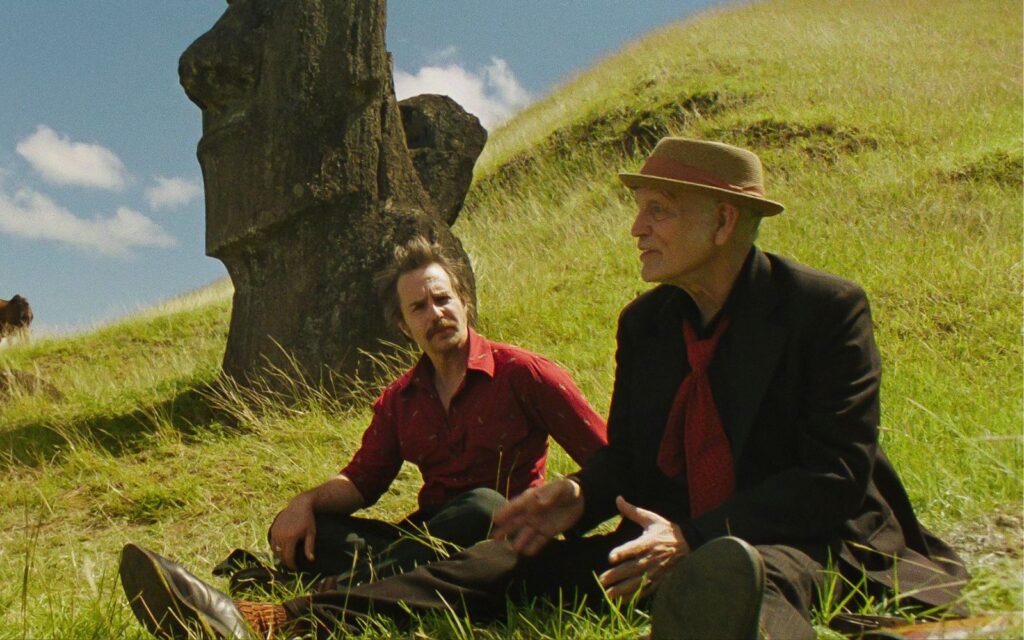
It plays like a remix of McDonagh’s “In Bruges.” Both are about two men, one older and something of a mentor, longtime partners and friends in professions that include murder, who are away from home on a vacation. And in both their boss, a brutal man with lethal intentions, arrives. And in both films the men show some interest in classic works of art. But nothing about this film feels anything but fresh and engaging.
Chris (John Malkovich) and Lee (Sam Rockwell) are CIA operatives with what James Bond could call a license to kill. But in their case, there is nothing glamorous about it, no tuxedos or martinis, no fancy cars or gadgets, no impossibly beautiful and pliant women. We first see them in Chile. It is mid-1973, and many will realize that it is just before Augusto Pinochet led a military junta that overthrew the socialist government of Pres. Salvador Allende. Chris and Lee are about to take a vacation to what was then called Easter Island (now Rapa Nui), a special territory of Chile. Its famous and mysterious huge head sculptures are now a World Heritage site.
Like David Mamet, McDonagh is a master of banterish guy-talk, a hilarious mixture of indirect one-upsmanship and direct insult, liberally flavored with the f-word and somehow playing like music. It is playful and competitive and outrageous and it somehow conveys to the characters and to us a lot of information beneath the words. We learn that this is a trip Chris has wanted to take for a long time. And we learn that he is intemperate and forgetful.
This is a huge problem for someone whose entire job is a secret. In the airport and on the plane, Chris won’t stop talking, accusing their boss MJ (Steve Buscemi) of being a junkie and providing details to anyone nearby about his connection to the CIA and various covert operations, with references to the Bay of Pigs and the assassination of President John F. Kennedy.
Rapa Nui is a bucket list trip. Chris is very ill, with perhaps weeks to live. It is a race to see whether he will die of natural causes before someone kills him, either to stop him from spilling secrets or to get from him a key piece of evidence he has been hiding as protection and, perhaps, trophy. Is he talking because he is losing his ability to keep secrets from illness or the morphine he takes for pain, or because as he faces death they just don’t seem important anymore and he wants to, in some sense, come clean before he dies? Or is he just trying to impress two pretty Chilean girls, Monica (Mariana di Girolamo) and Alicia (Ailín Salas)? Whatever the reason, his superiors are very concerned about the stories he is telling and one way or another they want to stop him.
The context of some of America’s murkiest, darkest, and most complicated, and real-life actions (some documented, some speculative) take this to a deeper, more immediate level than the “In Bruge” mob guys and the members of a small Irish community in “Banshees of Inishirin.”
As Samuel Johnson said, “Depend upon it, sir, when a man knows he is to be hanged in a fortnight, it concentrates his mind wonderfully.” Chris is confronting his past as his future is measured in days. His professional and personal past come together as he reaches out to his long-estranged brother (Tom Waits) for one last conversation. Chris says, “You start to question s–t, regret s–t.” He casually brags about the number of people he killed — “I was killing people before you were born. I’ve killed people in countries you can’t spell.” He has suddenly become gentle with moths in his closet, “escorting” them out to fly free.
As Chris thinks about the memoir he wants to write, he feels the need to go back to the dinosaurs to begin. The themes of the past catching up with you can also be seen as commentary on the current moment in American politics. “Sometimes you gotta do a bad thing for the greater good,” someone says. But who decides what the greater good is? Who should know about that decision? And what if it’s wrong? This is a twisty tale that works on every level, with superb performances, including Waits and Parker Posey as Lee’s wife, and a script that engages with big thoughts and invites us to consider our own choices more deeply.
Parents should know that this has extreme and sometimes graphic violence with many characters injured and killed. A character is dying of a terminal disease. The issue of assisted death is raised. Characters use constant very strong language, drink, smoke, drink, and use prescription and street drugs.
Family discussion: Why did Chris ask Lee for that favor? Why did he want to see the moai statues? What did we learn from Chris’s call to his brother?
If you like this, try: “In Bruges” and “Banshees of Inishirin”