
What kind of movie do you feel like?

Ask Movie Mom

Find the Perfect Movie

Luca

Posted on June 16, 2021 at 1:55 pm

A-
Lowest Recommended Age: Kindergarten - 3rd Grade
MPAA Rating: Rated PG for rude humor, language, some thematic elements and brief violence
Profanity: Mild language
Nudity/ Sex: None
Alcohol/ Drugs: None
Violence/ Scariness: Some peril and violence
Diversity Issues: Disability issues, diversity a theme of the film
Date Released to Theaters: June 18, 2021

Copyright Disney Pixar 2021
I’ll get to the details in a moment, the story, the characters, the music, the themes, and of course the inevitable Pixar movie question — Will it make you cry? But first, maybe because of the whole cooped up inside the house for more than a year thing, I have to tell you about the sunlight on the water in “Luca,” Pixar’s film set on the coast of Italy. As Carlos Saldanha did with Brazil in “Rio,” director Enrico Casarosa brings us his deep love for the place he grew up, and every moment brims with tender affection for the Mediterranean setting. This movie may not make you cry but for sure it will make you sigh in appreciation. And it has a spit take for the ages.

Luca, voiced by Jacob Tremblay of “Room” and “Wonder,” lives under the sea off the coast of a fishing village called Portorosso. This is not the underwater place of Nemo or Ariel, but its own very distinctive and fully-imagined world. Luca is not a merman or a fish, exactly. He is a young sea monster, the son of loving parents Daniela (Maya Rudolph) and Lorenzo (Jim Gaffigan). He is responsible and well-behaved, herding a school of fish. But like Ariel, he is curious about the world outside the water and wants to learn more about what his family calls “land monster town.” His mother cautions him that it is dangerous. But he meets Alberto (Jack Dylan Grazer of “Shazam”), who shows him that sea monsters turn human when they are out of the water and introduces him to some of the wonders of the human world: sunlight, gravity, music, gelato, and…Vespas. Alberto’s dream is to have a Vespa and explore the world.

The — I’m just going to call them boys — try to build a Vespa on their own. But when they meet a spirited human girl named Giulia (Emma Berman) who tells them about a three-part race with a Vespa as the prize, they join forces. This being Italy, the three parts are: swimming, biking, and eating pasta.

But the five-time previous champion, a bully named Ercole (Saverio Raimondo) will do whatever it takes to win again. A single drop of water turns the boys back into their sea monster form, so when the sky starts leaking, I mean when it rains….well, it’s a challenge. Luca’s parents have taken human form to find him, tossing water on every boy they see.

The voice talent is exceptional, with Tremblay, Grazer, and Berman creating distinctive, endearing characters. A brief betrayal is shocking and dismaying because we are invested in their friendship. The film manages to weave in a number of themes with subtlety and insight as the character navigate their differences, as parents learn to love and let go and friends discover that you can stay friends even if you take different directions. Now excuse me while I put on some Puccini and cook pasta for dinner.

NOTE: Watch the credits for some sketches that continue the story and an extra scene with a character voiced by Sasha Baron Cohen.

Parents should know that this film includes peril and some violence. A disabled character is presented as strong, confident, and capable. A character has divorced parents and divides her time between their homes and another child is abandoned by his parents. Differences and acceptance are a theme of he movie. And while underwater Luca is a protective guardian of fish, somehow on land he has no problem helping Giulia’s father catch a boatful so he can sell them.

Family discussion: When should you say, “Silencio, Bruno!” and when should you listen to “Bruno?” Who in your life is an underdog? What do you do when friends want different things? Why did Alberto tell Luca to leave?

If you like this, try: “Finding Nemo” and “Finding Dory”
12 Mighty Orphans

Posted on June 15, 2021 at 8:13 pm

B
Lowest Recommended Age: Middle School
MPAA Rating: Rated PG-13 for some suggestive references, brief teen drinking, smoking, language, and violence
Profanity: Some strong and crude language
Nudity/ Sex: Crude sexual references
Alcohol/ Drugs: Reference to alcoholic parent, alcoholic character, teen drinking
Violence/ Scariness: WWI battle flashbacks and reference to sad deaths, brutal corporal punishment, beatings, injuries, some graphic images
Diversity Issues: Class issues
Date Released to Theaters: June 18, 2021

Copyright 2021 Sony Pictures Classics
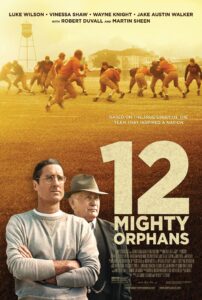
In the Texas dust bowl of the Depression era, the most under- of underdog football teams captured the hearts of people across the state, across the country, and even one fan in the White House. For them, the team of teenagers from a Fort Worth orphanage was a symbol of hope and courage. Oh, and along the way, they came up with an innovation that transformed the game of football.

Director/co-screenwriter Ty Roberts follows his previous two Texas-based films, “This Side of the Dirt” and “The Iron Orchard” with “12 Mighty Orphans,” based on a fact-based novel by Jim Dent.

Teachers Rusty Russell (a subdued but solid Luke Wilson) and his wife Juanita (Vinessa Shaw) arrive at the Masonic Home and School for orphans. They are committed and admittedly optimistic about giving the residents hope, opportunity, and a sense of belonging. That includes setting up a football team, even though the boys are smaller than the other players in the league, have no practice field or equipment, and literally have never held a football before. As we learn in brief flashbacks over the course of the film, Rusty is suffering from PTSD due to his experiences in WWI, including the death of the brother he promised to protect.

At he Masonic Home, there is a kind-hearted doctor with an alcohol dependency (Martin Sheen) and a brutal, angry man named Frank (Wayne Knight), who sees the boys only as free labor for his print shop. Frank beats the boys for the slightest infraction and considers every moment away from the shop for school or football, as stealing from him. He, by the way, is stealing from them, skimming money from the shop.

Rusty and Doc start working with the boys. And the boys start winning games. When the other teams find they cannot beat them on the field, some of them start trying to beat them in other ways. Rusty has to make up for the smaller size of his players with a new strategy called the spread defense that would change the game of football at the most fundamental level.

Cinematographer David McFarland uses muted tones to evoke the era, a nod to the sepia images we associate with the era but also providing a context of dust, depression, and deprivation. Even though there are moments of intense emotion and struggle, Roberts maintains a quiet, deliberate tone that adds dignity to the storytelling, though it slows sections of the film, particularly when characters and incidents and issues start to pile up in a distracting manner. Sheen gives some wry sweetness to a thinly conceived role that balances Wilson’s subtle decency. The real triumph of the story is not in the goals scored but in the way that dedication, attention, and a good example can transform not just those who are inspired directly, but those who see in them possibilities not previously imagined.

Parents should know that this film includes some strong language, crude sexual references, alcohol abuse, scenes of combat, and injuries with some graphic images.

Family discussion: Why did Rusty think football was so important for the boys? How do we treat parentless children differently now?

If you like this, try: “Remember the Titans” and the book that inspired this film.

The Hitman’s Wife’s Bodyguard

Posted on June 15, 2021 at 7:40 pm

B-
Lowest Recommended Age: Mature High Schooler
Profanity: Very strong language
Nudity/ Sex: Sexual references and explicit situations
Alcohol/ Drugs: Alcohol and drugs
Violence/ Scariness: Extended action-style violence with guns, knives, many characters injured and killed, disturbing images
Diversity Issues: None
Date Released to Theaters: June 16, 2021

Copyright Lionsgate 2021
The reunion that meant the most to me in “The Hitman’s Wife’s Bodyguard” was not Ryan Reynolds and Samuel L. Jackson reprising their roles from the 2017 original but the re-uniting of Desperado stars Selma Hayek and Antonio Banderas. They are still two of the most sizzlingly combustible actors in the world, and it is a delight to see them together again, if a reminder that their micro-budgeted first film together had more electrifying energy than this macro-budget extravaganza.

But the focus of the story is on Reynolds, who returns as by-the-book, triple-A rated, fasten-your-seatbelt bodyguard Michael Bryce, and Jackson as Darius Kinkaid, a “rules, what rules?”-type hitman, plus Hayek as his even more out-of-control wife Sonia. In other words, the usual superego vs. id match-up in action comedies featuring a lot of chases and explosions and quippy banter.

In the first film Bryce was in disgrace for failing to protect a world leader, and reduced to protecting wealthy businessmen when he was assigned to Kinkaid, on his way to testify against a ruthless dictator in exchange for getting Sonia out of prison. This time, we see that experience has severely traumatized Bryce, as his therapist exasperatedly tells him to go off on a vacation somewhere far away from bodyguarding and especially far away from guns and killing.

But no one would buy a ticket and go back into a theater for the first time in more than a year to see that. So of course as soon as Bryce settles into a beach chair, Sonia arrives, guns blazing (a lot of killing of innocent bystanders in this movie) to get Bryce to help her free her husband from some kidnappers.

After that, it’s just pretty much bang/bang/banter (“Capri? Like the pants?”), bang/chase/explosion/wisecrack (“Your mouth needs an exorcism”) in a variety of colorful locations. There are some references and cameos from the original film that only the most devoted fans will find of interest. What there is of plot is unlikely to be of much interest beyond an engine to get us to the next shoot-out or capture. Frank Grillo and Caroline Goodall are underused as American operatives who decide to use the Kinkaids for their own purposes and even Banderas cannot make much of his generic bad guy. Rebecca Front is terrific in a brief opening scene as Bryce’s frustrated therapist, but then disappears for the rest of the film. The action scenes are serviceably staged but what works best here, unsurprisingly, is the fun that Reynolds and Jackson have with their roles. Jackson could probably bark out profanities better than just about anyone while doing a backflip and knitting a sweater, but the cool thing is that he never brings anything less than his top game to it and it is never less than delicious. And Reynolds has the very rare ability to make vulnerability funny. Pass the popcorn. Summer movies are back.

Parents should know that this is an intense and gory action comedy with chases, explosions, guns, and knives. Many characters are injured and killed with some graphic images. Reynolds spends much of the movie covered in blood spatter. There are family issues, and there is constant very strong language. The portrayal of mental illness is insensitive a best, but this is not a movie that worries about sensitivity. There are sexual references and explicit (humorous) situations and discussions of fertility.

Family discussion: How did Bryce’s conflicts with his father affect his view of himself? What would you say to your future self?

If you like this, try: the first film in the series and other action comedies like “Spy” and “Mr. Right”

In the Heights

Posted on June 8, 2021 at 2:27 pm

A-
Lowest Recommended Age: Middle School
MPAA Rating: Rated PG-13 or some suggestive references and strong language
Profanity: Some strong language
Nudity/ Sex: Some suggestive references
Alcohol/ Drugs: Some social drinking, some substance abuse
Violence/ Scariness: Sad death, emotional confrontations
Diversity Issues: A theme of the movie
Date Released to Theaters: June 9, 2021
Copyright 2021 Warner Brothers

Love, loss, hope, dreams, family, community, hope, darkness, purpose, dancing. Very, very specific and ultimately universal. “In the Heights,” based on what will always be known as the play Lin-Manuel Miranda did before “Hamilton,” has been gently streamlined and updated into a joyous post-pandemic welcome back into the world after a year postponement due to the coronavirus. It is touching, ebullient, timely and timeless with an irresistible cast of young performers filled with screen chemistry.

It began in the dorm room of Wesleyan student Miranda, who has said if he did not see roles he could play in the theater, he would write his own. After an award-winning run off-Broadway, with a book by Quiara Alegría Hudes, it moved to Broadway itself, with Miranda in a lead role, and was awarded Best Musical, Best Score, Best Choreography, and Best Orchestrations and was a finalist for the Pulitzer Prize for Drama.

Like the original, the movie takes place over three hot summer days on and around one block of the predominantly Latino community of Washington Heights. It is a place where “You can’t walk two steps without bumping into someone’s big plans.”

There is a little bodega run by Usnavi (named after the letters his Dominican parents saw on a military ship when they first came to the United States) is played by the endlessly appealing Anthony Ramos (also seen this summer on “In Treatment”). He gets help from his teenage cousin Sonny (Gregory Diaz IV), who likes to tease Navi about his crush on aspiring fashion designer Vanessa (Melissa Barrera). They get a lot of support from their honorary Abuela Claudia (grandmother), played by Olga Merediz in her Tony-nominated role. Claudia is like everyone’s grandmother, doling out good food and good advice to everyone.

Also on the block is the car service owned by Kevin Rosario (Jimmy Smits), whose one goal is to give his brilliant daughter Nina (Leslie Grace), a student at Stanford, every opportunity to achieve success. Nina is loved by her ex, Benny (Corey Hawkins), a dispatcher in her father’s company. She does not want anyone to know what a difficult time she has been having because she is afraid of letting them down.

Both businesses are at risk as the neighborhood is gentrified and ask their owners consider other priorities. Navi wants to return to the Dominican Republic he dreams of as an idyllic paradise. We first see him on a beach like the one he dreamed of, telling children “the story of a clock that was disappearing in a faraway land called New York.”

Kevin will make any sacrifice to keep Nina in school, even though Nina is not sure she wants to stay, and she feels guilty about taking anything more from him.

Someone, we don’t know who, has purchased a winning lottery ticket for the bodega. It is worth $96,000, enough to make any of the dreams of the characters come true, or at least come closer. And, there is a blackout. All of the power goes out.

The story is told with songs and dance that are never less than glorious, especially a number at the local pool that harks back to the days of Esther Williams and Busby Berkeley, and a fair with all of the different nationalities showing off their dances. The beauty parlor estheticians form a Latina Greek chorus, and their musical number is pure delight. The vibrant energy of the film (and I do recommend seeing it in IMAX) is like a burst of sunshine.

That does not mean there aren’t struggles and losses and not all dreams come true. But that is life, and it is the life that shines through this movie that makes it one of the year’s deepest pleasures.

Parents should know that this film includes a sad death and references to other losses and struggles, some suggestive references, substance abuse, and some strong language.

Family discussion: What are the dreams of you and your family? What little details help you assert your dignity? How can we make sure no one feels invisible?

If you like this, try: “Hamilton” and “West Side Story”