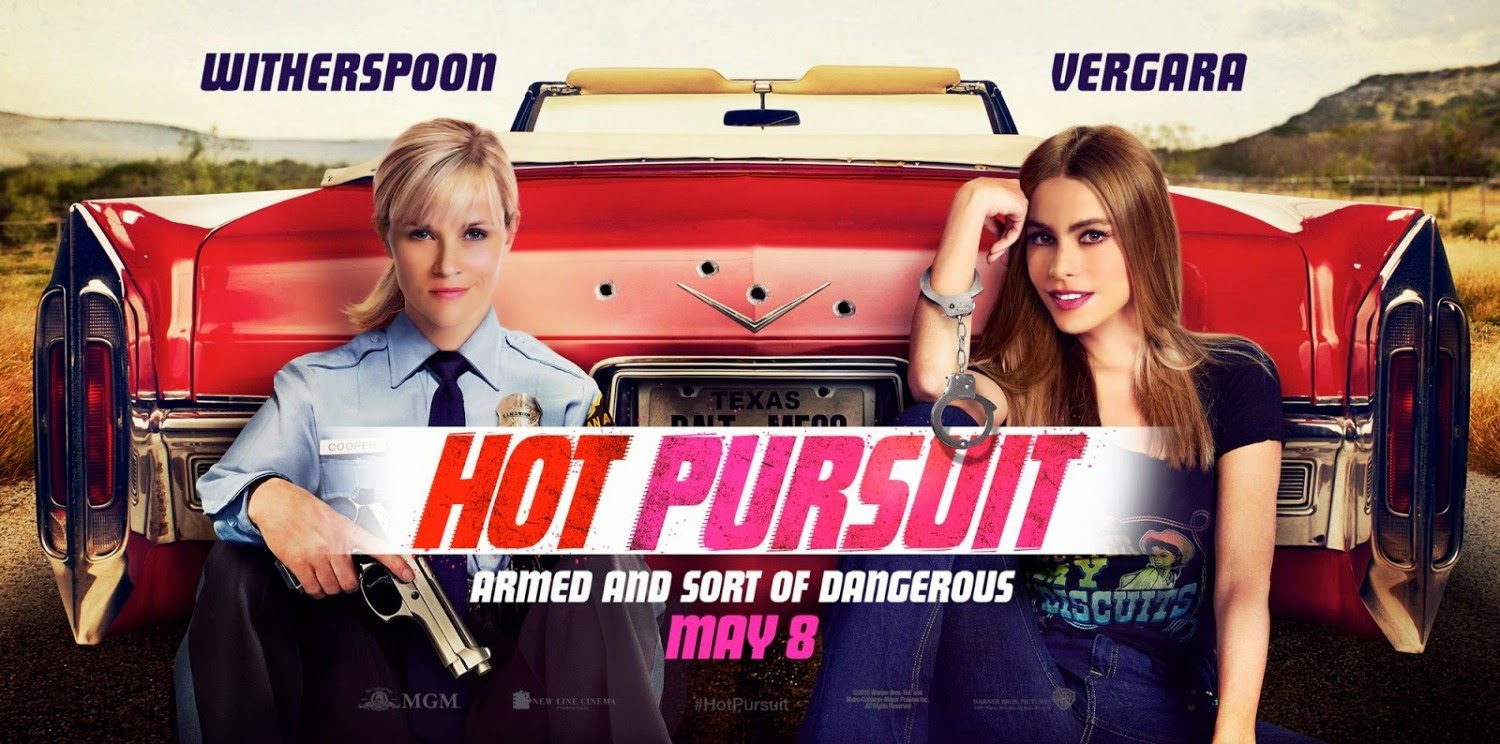
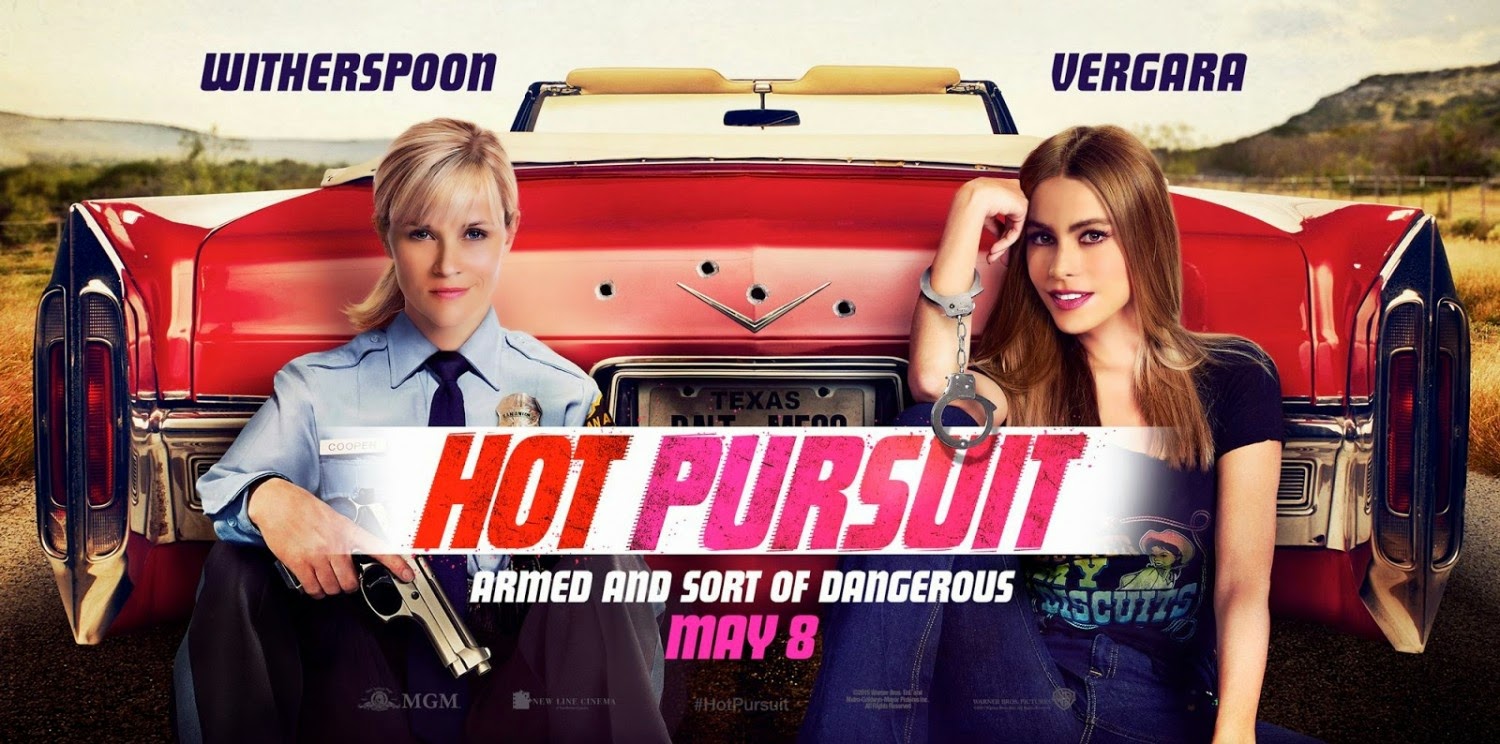
Sofia Vergara and Reese Witherspoon are both talented, beautiful actresses with savvy business acumen and strong entrepreneurial energy. Witherspoon’s accolades in 2014 included more than a Best Actress Oscar nomination for “Wild.” She also produced it, and another Oscar-nominated film, “Gone Girl.” Both Witherspoon and Vergara produced the vastly less ambitious “Hot Pursuit,” a high-concept, low-octane road movie filled with chases and shrieking that cannot disguise the soul-numbing vacuousness of its screenplay.
Our fun couple consists of Cooper (her first name is a who-cares third act reveal), a by-the-book, second-generation cop played by Witherspoon, and Mrs. Riva, the wife (and very quickly, widow) of a Colombian drug dealer, with ethnic attributes less subtle than Charo crossed with the Frito Bandito. She keeps hanging on to her roller bag filled with sparkly stilettos.
Cooper has a lot to prove when she gets her first chance in the field after a mishap involving the tasering of a teenager who yelled “Shotgun” because he wanted the front passenger seat in a car. When Riva and her husband need police escorts to court so they can testify against the big drug kingpin, Cooper gets assigned to Mrs. Riva. But before they can leave the Riva’s home, two different sets of assassins show up, one pair masked.
I wonder if they will turn out to be people Cooper did not realize were untrustworthy! We haven’t seen that before!
Cooper and Mrs. Riva are very different people with very different views of the world and very different goals. The one goal that they share is not getting killed. After an APB is issued for their capture, they go on the run, arguing, hiding out, stealing, abandoning, and crashing vehicles, and all kinds of exhausting and unfunny hijinks.
It is particularly disappointing that this movie was produced and directed by women. If men foisted so many lazy jokes about Vergara’s lush figure on an audience looking for a little light entertainment, we’d decry them for sexism. Well, if the sparkly shoe fits….
Parents should know that this film includes crime and law enforcement violence, with characters injured and killed, peril, chases, explosions, drugs and drug dealing, strong language, sexual references, and some gender and sexual humor.
Family discussion: Does this movie make fun of stereotypes or perpetuate them? When did the characters’ views about each other change?
If you like this, try: “Outrageous Fortune” and “Midnight Run”
Be careful what you wish for. You think it would be great to stay 29 forever? Adaline (Blake Lively) finds out that it is not great to become unstuck from time, to watch everyone you love grow old and die, to hurt those you care about because you cannot be honest about who you are. It is as though the whole world is on a conveyer belt moving everyone inexorably forward, and just one person has stepped off, rooted in one spot and left all alone. Life becomes a series of goodbyes.
Copyright 2015 Lakeshore Entertainment
Adaline made headlines as the first baby born in 1908 San Francisco. She lived a normal life, with an engineer husband and a baby girl. But her husband was killed in an accident when he was working on the Golden Gate Bridge. And then, when a very rare snowfall came to San Francisco, her car went off the road and into a pond. She was at the same time frozen and shocked by lightning. And, we are told by the narrator, as scientists will discover in 2015, the effect of these two forces on her DNA somehow stops the aging process. At first, she is able to get away with explaining that she eats right and uses a very good face cream. But as more than a decade goes by and she does not change, she begins to unsettle people and attract the attention of government investigators. So, she has to say goodbye to her now-teenage daughter and come up with a plan where she changes identities and locations every ten years, and never gets close to anyone.
Adaline is living in San Francisco as Jenny and working at a library, but is about to switch identities again and move to Oregon. She has just bought a new fake passport and drivers license and arranged for her new identity to have access to her bank account (one thing perpetual youth is very good for is accumulating capital) when she meets Ellis (Dutch “Game of Thrones” dreamboat Michiel Huisman). He is handsome, wealthy, philanthropic, nuts about her, and knows how to give swooningly romantic gifts and cook charming and delicious dinners in his aw-shucks-I’m-just-living-in-a-zillion-dollar-fixer-upper. Doesn’t Adaline have the right to take a chance on love?
She agrees to spend the weekend with Ellis’ parents for their 40th anniversary party. But as soon as they arrive, Ellis’ father, William (Harrison Ford) says “Adaline!” They were “very close” in the 1960’s. “Jenny” explains that Adaline was her mother. But William remembers Adaline too well to be fooled for long.
The script and story were both co-written by first-time screenwriter Salvador Paskowitz, whose own unconventional life was documented in Surfwise.
It has a conceptual delicacy that translates unevenly on screen, with an overly ponderous omniscient narrator and underwritten romantic scenes. But Lively gives a thoughtful, complex performance, with undertones of melancholy and a yearning for connection that struggles with her determination to stay isolated. And she looks sensational in the costumes from Angus Strathie, which show a consistency of style throughout the century that shows us how strong and determined Adaline’s well-defined persona is, despite the various aliases and disguises and changes in fashion.
The romanticism of the storyline was thrown off course for me by the idea that Adaline was involved with both father and son, even decades apart. But if that does not create too much of an ick factor, the bittersweet fantasy of eternal youth and the just-sweet fantasy of the perfect boyfriend make it work.
Parents should know that this film includes sexual references and non-explicit situations, some mature themes of loss and disappointment, and drinking.
Family discussion: What did the comet signify? If you could stay the same age forever, what age would you pick? Is there a “just-miss” in your life?
If you like this, try: “The Curious Case of Benjamin Button,” “Passion of Mind,” and “Tuck Everlasting”
Disneynature’s annual wild kingdom-style nature documentary is predictably adorable but surprisingly absorbing. The toque macaque monkeys of Sri Lanka live in the 12th century ruins of Polonnaruwa in a society as rigidly structured and ruthlessly enforced as a high school cafeteria run by the mob.
After a chipper rendition of “Hey Hey We’re the Monkees” with an extra verse from former Monkee Micky Dolenz, Tina Fey’s warm and reassuring narration takes over, explaining the literal hierarchy of the monkeys, whose status is reflected by their position on their castle rock. “An intricate society of 50 monkeys band together in a strict social order.”
At the top is the alpha male, Raja, and under him are his male lieutenants/enforcers and three females known as the sisters, whose primary occupations are eating the best food and caring for Raja. Every element of the society — where the monkeys sit and sleep, what they may eat, who they may interact with — is clearly established and strictly enforced.
After we get the sense of the social structure, Fey introduces us to Maya, a young female at the bottom of the hierarchy who will be our hero throughout the story. She is a single mom with a son named Kip and since she is precluded from the literal easy pickings of the fruit tree reserved for the elite only, she has to be adventuresome and imaginative in finding food for them. Kip’s father Kumar is an outcast from his original tribe and, for showing interest in Maya and showing no fealty to Raja, from this one as well.
When a rival tribe invades, Raja’s luxurious lifestyle has left him unprepared to win a battle. The entire group is homeless. Maya and Kumar, who has returned, have skills that are suddenly valuable, even vital, for the survival of the monkeys. Maya helps them get food from the nearby town. Can Kumar help them reclaim Castle Rock?
Like all of the series, this is filled with “how in the world did that get that?” moments of extraordinary intimacy and power, like Maya’s tenderness with Kip, her harvesting of the termites who fly in just one day a year, and the monkeys’ interaction with other species, including a mongoose, a langur monkey, a monitor lizard, and, to their utter and hilarious mystification, a dog. Children will enjoy the hijinks, especially the monkey invasion of an empty school, where they discover snacks and a birthday cake. The predators and perils are gently presented and the issues of status and power are described in a manner that is open and accessible. Once the cheery but corny introductory song is over, this chapter avoids some of the cutesiness that marred previous releases. And the drama of the social structure is so intricate and abashedly familiar it will remind all of us to be a little kinder to those we consider beneath us and a little more willing to challenge the Rajas in our lives.
Parents should know that there are scenes of confrontation and predators, with some minor characters injured and killed and brief, discreet images of dead animal bodies.
Family discussion: What skills did Maya and Kumar have that were important to their group? How are the monkeys like and not like humans? How many ways did you see the monkeys communicate with each other and the other animals? How should Maya treat the Sisterhood and the lower-status monkeys?
If you like this try: the other Disneynature films, including “Chimpanzee,” “African Cats,” and “Bears”
A reporter in disgrace for fabricating details of a story sits across the table from an orange-jumpsuited prisoner, accused of murdering his wife and three children. They have more in common than either of them expected. They are both outcasts. They are both unable or unwilling to explain their actions.
And they both used the name Michael Finkel. The reporter was given that name at birth and it appeared on the byline of his stories in the New York Times Magazine, including the one that cost him his job and his reputation. The man who murdered his family used that name when he fled to Mexico to escape capture. The real Michael Finkel, in seclusion at his home in Montana following his humiliating dismissal, got a phone call when the murderer was arrested, asking him for comment. With nothing else to do, and with the thought that this might be the kind of big story that get him back to a job in journalism, the real Michael Finkel, or as real as sometime just fired for lying can be (Jonah Hill), drove to Oregon to visit the man who was accused of killing his family. His real name, by the way, was Chris Longo (James Franco).
Co-writer/director Rupert Goold has a lot of ideas to explore in this film, and some work much better than others. The focus should be on the parallels between the two men, what links them, the ways they tried to use each other, and the resentments and differences that separate them. But Goold wastes Felicity Jones (“The Theory of Everything”) as Finkel’s girlfriend, with distracting diversions like an ominous shot of her running (for exercise) through the woods. She does as well as possible with a scene where her character confronts Longo, but it is artificial and stagey.
Franco perfectly captures the superficial charm that occasionally slips to reveal fierce underlying anger and self-justification. Hill is a bit out of his depth, or more likely the Finkel character is underwritten. We should be able to see his anger and self-justification, too. And he is lost in the scene where he is grappling with a moral dilemma or trying to consider the rights of anyone but himself. He is better at showing us Finkel’s arrogance and his need for approval. When Longo says he took Finkel’s name because he was a fan, Finkel is unabashedly complimented. After his humiliating dismissal, he gravitates toward approval like a moth toward a flame. And we know how that turns out.
The ironic title reminds us that we can never really know the true story; there are always too many conflicting versions, too much that is just unknowable. And yet the difference between Finkel, who violated the most fundamental principles of journalism by combining the details of the Africans he met to tell it as a story about one individual, and the movie of his own story is that fiction is supposed to convey larger truths. It is not at all clear that this one does.
Parents should know that this film concerns the murder of a wife and children. There are some disturbing and grisly images, as well as child slavery and discussion of beatings, deception, some strong language, and drinking.
Family discussion: Why did Jill visit Chris? How did Chris and Mike try to con one another and who was most successful?
I don’t mind (much) that they are so rigidly formulaic. Every one of them centers on (1) water, (2) letters, and (3) somebody dying. All genre films follow some sort of formula, and we buy tickets because we want to see what we expect to see.
Copyright 2014 Twentieth Century Fox
I don’t mind (much) the paper-thin characters and corny dialog. I don’t mind the preposterous plot turns. Much. Or the soft-focus romp on the beach and the cinematography that looks like the camera lens was dipped in honey. And okay, yes, I had to pull out my handkerchief.
Here’s what I do mind: the unrelenting generic blandness of “The Longest Ride.” And what I really mind: the unrelenting length of “The Longest Ride,” which makes its title unfortunately apt.
Scott Eastwood, the look-alike but even handsomer son of Clint Eastwood, plays Luke, a 21st century cowboy who grew up on a ranch is making a return to a career of competitive bull-riding, following serious injuries a year before. Britt Robertson (who is pretty much the only one in the cast with no famous relatives) is Sophia, the studious art student with a prestigious internship at a New York art gallery starting in two months. They meet sorta cute when her sorority sister drags her away from her books to see the bull-riding and Luke’s hat falls more or less into her lap. Later, when he asks her on a date, she is all but unfamiliar with this quaint custom. What, you mean he wants to pick her up? And have plans? And not just text here “Wanna hang out?” Ladies, he even arrives with flowers, to the collective sighs of the entire sorority house.
But the dream date gets even better after that. Not only is the dinner another wildly romantic gesture (yes, involving a body of water — this is a very wet movie, even by Sparks standards), but Luke actually rescues an old guy from a car wreck just before it explodes in flames, thus completing the trifecta of movie-boyfriend perfection. The ladies in the audience sighed even more happily than the sorority girls. The guy he rescues turns out to be Ira (Alan Alda, son of Broadway legend Robert Alda). And, ding, ding, ding, there are letters! Sophia rescues a basket of old letters from the car just before it blows up, and when Ira starts to recover she begins to read them to him. These are letters he wrote to his beloved late wife, Ruth, even when they were actually together. Sparks really, really, really likes to get letters into the story, even if it does not make much sense. Cue the flashbacks. Sparks loooves parallel love stories.
Ira (now Jack Huston, of the multiply-Oscared Huston family) falls for Viennese immigrant Ruth (Oona Chaplin, who wins the gene pool lottery with both Charlie Chaplin and Eugene O’Neill in her family tree). The conflict they face is that she wants to have a lot of children and he is wounded in WWII risking his life to save another soldier and cannot father children. (Sparks finds a way to let us know that the problem relates to fertility only, not the Jake Barnes/Sun Also Rises problem.)
This section is mildly interesting though too reminiscent of the vastly better portrayal of the life of a marriage in the first ten minutes of “Up.”
Listening to Ira’s letters helps Sophia think about what it takes to make a relationship work, blah blah. Blah.
Oh, it’s okay. It does the job. It doesn’t kill off the wrong person like some Sparks stories or Gothika rule the ending like “Safe Haven.” It is good to see Sparks include characters who are not imaginarily typical middle-class white Christians — there’s even a consultant in Jewish culture listed in the credits. There are no obvious mistakes, but unsurprisingly the portrayal feels no more authentic than the rest of the film.
But as it drags on, it is impossible to overlook the fact that there is more of interest outside the frame than inside. Sophia’s friend Marcia (Melissa Benoist, “Whiplash,” “Danny Collins,” and the soon-to-be Supergirl) would have been much better as the lead than Robertson, whose most frequent response is a cute little laugh, with a couple of slight brow wrinkles thrown in to show concern or confusion. The briefly referenced story of Black Mountain College’s famous experiment in art is much more intriguing than Ruth’s purchases of paintings and the twist at the end, while it will not surprise most people, requires some unjustifiable misdirection.
Sparks has a formula that is safe in its predictability. There’s always a place for movies about pretty people kissing. But it is time for Sparks to try something new, and maybe time for audiences to try something new, too.
Parents should know that this film has some strong language, a WWII battle, bull-riding peril, characters injured, sad deaths, nudity and sexual situations.
Family discussion: Were you surprised at what Ira said to Ruth when she left? Was Luke’s mother right about the reasons he would not quit?
If you like this, try: “Dear John,” “The Notebook,” and “Nights in Rodanthe”


 .
. 


 is much more intriguing than Ruth’s purchases of paintings and the twist at the end, while it will not surprise most people, requires some unjustifiable misdirection.