
Interview: Joshua Oppenheimer of “The Look of Silence”

Interview: Joshua Oppenheimer of “The Look of Silence”

Posted on July 30, 2015 at 11:40 am
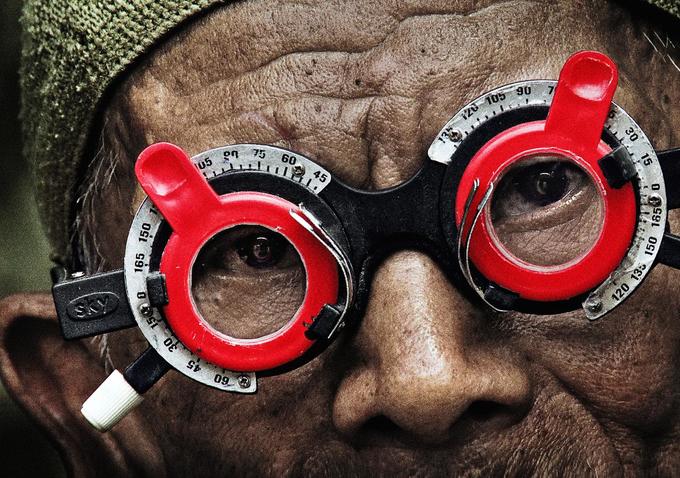
Copyright Drafthouse Films 2015

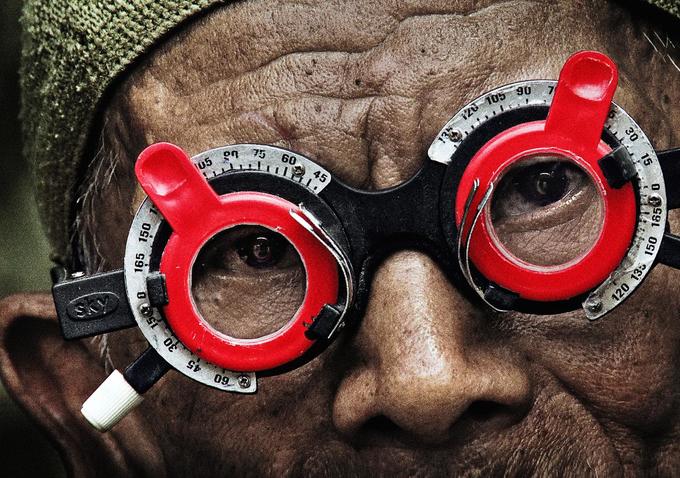
Joshua Oppenheimer has made “a companion piece” to his stunning documentary about government-sanctioned gangster killings of more than a million Indonesians in the mid-1960’s, “The Act of Killing.” In “The Look of Silence,” we see Adi, the brother of one of the men who was killed sit with the people who participated in the genocide and ask them about what they did. It was a pleasure to speak with him again, and I look forward to our Q&A tomorrow at the E Street Theater in Washington, D.C.

Your images are so gorgeous and so striking; they could be in a very different kind of film, like a lyrical romance. Why is it so important that your visuals be so beautiful?

There are two things that those kind of images do in the film. I think first of all I am trying to create the sense of the hauntedness of the space in which Adi’s family, his mother, his father have to live, the presence of ghosts. And I don’t think the images are beautiful in a postcard way. I think they are haunting, and I think that’s achieved through a certain kind of enchantment, there’s a sense of something beyond just a picture but a swarming, a presence of ghosts that have never been properly buried, the dead that have never been properly buried, that has never even been properly mourned.

I hope the tender way in which I tried to film the family and the precision with which I tried to look for the traces of fear and decades and decades of living with fear on their faces, in their bodies and also created a space for the grace and the love that they have managed to find and to live despite having to leave in fear, surrounded by the perpetrators who killed their loved ones. In general I felt that my task with this film was to create a kind of backward-looking poem in memoriam for all that’s been destroyed, not just the dead who obviously can never be wakened, those who were killed but also the lives that have been broken by a half a century of fear that can never be made whole again because in some way whatever justice, truth and reconciliation, whatever form of justice might in the future occur in part perhaps as a result of these two films, it will never make whole what’s been broken.

The film tries to honor and do justice for all that’s been destroyed, and for all that’s been destroyed not just during the genocide but in the years after. It doesn’t end with the killings if the perpetrators remain in power because people’s life continue to damaged, wrecked by fear and trauma that they can’t work through.

I thought it was very meaningful that in this case your lead character wasn’t even born when his brother was killed and that shows how the trauma goes on to the next and the next and the next generation.

That’s right and it also is a source of hope in the sense that first of all he has the courage to confront the perpetrators. That is in part because unlike the rest of his family he’s not traumatized by the actual events of the killing itself, yet he is trying to understand what happened to his parents, to his family, to his village, to his country to make them the way they are and in a sense make him who he is. He is born into a situation that didn’t know and understand and that is what gives him the courage to do what he does. He finds this one person who was able to give him what he is hoping for, which is an acknowledgment that what happened was wrong and an apology. It’s also someone born too young to remember the killings or born after the killings, the daughter of one of the perpetrators who hears for the first time the details of what her father did. And we see her realize that he is not the hero she hoped he was and we see her face collapse in that moment and realize that she’ll have to spend the rest of his life caring for a man who is in some terrible way a stranger now. And yet instead of doing what any guy would do in that moment which is panicking and kicking the film crew out of the house and needing to collect herself she becomes very quiet and listens to herself and her conscience and takes the extraordinary step of apologizing on her father’s behalf and saying to Adi, “Let’s be family,” trying to reach across this abyss of fear and guilt that divides everybody in Indonesia.

Sadly, throughout the world we have seen many genocides there have been many many different ways of responding and moving forward from it. We’ve seen the Truth and Reconciliation Commission model and the Nuremberg and Rwanda models. I guess you could even include the Indians and the United States. What do you think is the best way for a community to respond and to find some kind of meaning and healing from an experience like that?

You need an acknowledgment of what happened in the past. You need a thorough recognition that this is a wrong. I think although we the efforts in postwar Germany were incomplete I think the effort by the next generation, the generation born by the end of the war in the late 60’s to actually demand a kind of honesty from their parents, the reconciliation of the past in the late 60’s and 70’s going forward is the best human beings have come, the closest human beings have come to acknowledging their past. All the examples you gave with the exception of the Native American genocide ended with the perpetrators being removed from power and whether it’s the Truth and Reconciliation Commission process in South Africa or Nuremberg trials or a tribunal in Rwanda, these steps happen after perpetrators were removed from power. The Americans genocide of the Native Americans is surely the closest and we can see how the effects of that linger today.

People sometimes saw “The Act of Killing” and would say, “Isn’t it tasteless that someone wants to produce West cowboy scenes essentially in a desperate and ultimately doomed attempt to glorify what he’s done?” And my feeling when I would hear that question is “No, I feels it’s absolutely appropriate because after all the whole genre of the cowboy movies, the Western from its outset was to glorify genocide, the native American genocide.” Native Americans families experience living surrounded, living in increasingly small reservations surrounded by the society that destroyed their civilization and are still stigmatized. For decades and decades for hundreds of years except in Indian schools they weren’t allowed to speak their language. That stigma takes a terrible toll. It lasts frpm generation from generation to generation until a society has the courage to acknowledge the past. You see, we can never run away from our past, the past will catch up to us because it is us, it is a part of us, it’s what makes us we are, it’s what delineates the borders of our societies. It’s what gives us here in United State a common language, English. It’s who we are. And so all we can do is find the courage to stand still and to look backwards. Despite our politicians endlessly saying we need to look to the future, actually we need to look backwards and we need to accept our past not in the sense of making excuses for it but truly accepting it and taking responsibility for it, so that we can then turn around again and move forward into the future but knowing ourselves honestly really for the first time.

Are you writing history or are you changing history with these films?

I was asked from the very beginning to do this work by survivors. It was Adi who first encouraged me. When I was first filming the survivors back in 2003, he then encouraged me to film the perpetrators. When the survivors were not allowed to make the film with me, he then watched as much as he could of what I was shooting with the perpetrators. It was Adi who then insisted that he could meet the perpetrators in 2012 when I returned to make “The Look of Silence.” It was the survivors, Adi’s family, the survivors community more broadly, the Indonesian human rights community as a whole, who encouraged me to do this work. I always felt in a funny way that I was not a foreign filmmaker coming in to expose a terrible political situation for the outside world. I felt that I was being entrusted to do a work that they couldn’t in order to intervene in the mechanisms of fear inside Indonesia. I’m humbled by the impact that the two films have made.

“The Act of Killing” has fundamentally transformed the way of Indonesia talking about its past with the mainstream media now talking about the genocide as a genocide and talking honestly about the regime of fear and corruption that the perpetrators have built into that space. There is a sense that the film has come to Indonesia, the second film as well, Like the child in “The Emperor’s New Clothes,” saying look how torn our society is, look at the prison of fear in which we are being asked to raise our children and we can no longer ignore this.

We have to support truth and reconciliation and some form of justice. And with justice, with truth comes a revision of the nation’s history curriculum, so a part of that movement is demanding a change of the national history curriculum which is still being taught in the way that we see in the film. So the teachers around the country until the government changes the curriculum can say, “This is what we’re supposed to teach you and now this movie is the truth.”
Related Tags:


Directors Documentary

Interview: Joshua Oppenheimer of “The Act of Killing”

Posted on March 1, 2014 at 8:00 am

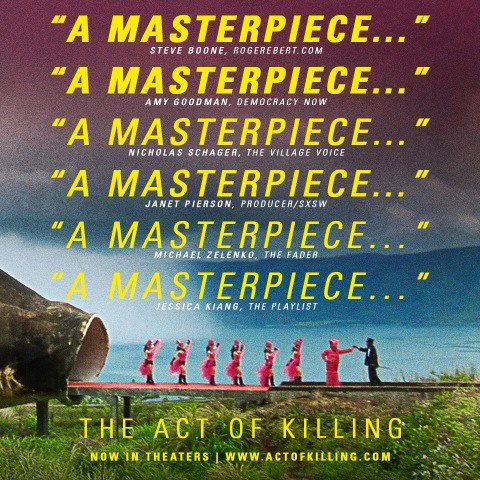
If I were voting, “The Act of Killing” would not only win the Best Documentary Oscar, it would be a contender for Best Picture as well.  Director Joshua Oppenheimer broke through barriers from the secrecy and denial of government-sanctioned gangster killings of more than a million Indonesians in the mid-1960’s to the disaster-fatigue of audiences to tell a riveting story by letting the murders, still living in the community as respected citizens, tell it themselves.  The details that have been repressed individually and institutionally for decades are revealed as the men who killed choose iconic movie genres to re-enact their crimes.  A musical, a western, a gangster movie — these re-enactments allow both the gangsters and their communities to acknowledge the horrors of the genocide for the first time.  The full unabridged version of the film, with scenes not included in the US theatrical release, is now available on iTunes and Amazon.

I spoke to Oppenheimer about the impact that the film has had on Indonesia and the world community and about his biggest regret in making it.joshua-oppenheimer

I’m familiar with the work of the Truth and Reconciliation Commission in South Africa, which sought to provide healing and a sense of justice by documenting the atrocities of apartheid, and it occurred to me that your film is the closest equivalent that Indonesia’s going to get.

You’re right in a sense that before the film came along, there was no chance that the government would implement a truth and reconciliation process.  The president of Indonesia from 1999 to 2000, Abdurrahman Wahid also known as Gus Dur proposed a truth and reconciliation process and apology for what happened in 1965 and he was immediately removed from power as a result.  But it is also my hope that the film has now opened a space where ordinary Indonesians are saying, “This is wrong” where the media is saying, “This is wrong and we have to talk about this not only to right a major historical wrong, not only for the sake of healing but also so that we can beat corruption, fear, and gangsterism that prevent Indonesia from acknowledging what happened.  It’s led the Indonesian media to finally address what had been a 50 years silence about the genocide and talk about the genocide as a genocide and connect the moral catastrophe of the genocide with a moral catastrophe of the regime that the killers have built and presided over ever since.  And it’s emboldened ordinary Indonesians to finally talk about the most painful aspect of Indonesian history and the present for the first time without fear.  It particularly has led Indonesians to say that “We want this country to be the democracy that we would like and that claims to be. We need to address not just the crimes of the past but also how they have terrorized all of us into not holding our leaders into account for corruption and gangsterism in the present.”  So it’s lead to this national discussion which I’m optimistic will eventually be the truth and reconciliation process in Indonesia.

act of killing posterAs you spoke to these admitted killers who seem to feel no regret, did you conclude that they had to be sociopaths before they killed the first person?  Or were they made sociopathic or numb through just the incredible level of atrocity they perpetrated?

Hannah Arendt famously said in her writings in the banality of evil that the killer is an ordinary person.  That doesn’t necessarily mean that every ordinary person is a potential killer. But those of us who haven’t killed are extremely fortunate not to have to find out.  My belief is that there is a moral paradigm that underpins most of the stories we tell, particularly in movies where we divide the world into good guys and bad guys.  According to that paradigm, we tend to believe that because the killer has done something monstrous, the killers are monsters.  And in that sense, we imagine that we’re somehow different from them.   What’s clear is that the killers are human and if we want to have any chance of understanding how human beings do this and then the consequences of their actions, how they tell stories to justify their actions, we have to start from the premise that they’re human and that killing changes them.  So I think that certainly the numbness comes from having killed.   And then because the killers are human, consequently they have to tell themselves stories to justify their actions so that they can live with themselves afterwards.  And then horribly, they impose those stories in the form of victorious history glorifying what they’ve done on their whole society.  Ironically, that of course leads to a downward spiral into further evil and corruption.  If Anwar was to refuse the second time, it’s equivalent to admitting it was wrong the first time.

So further evil is perpetrated not necessarily because the men are monsters but because they’re human and they know what they’ve done is wrong and they don’t have the courage to face that.   So denial has a terrible, terrible cost.

There are so many chilling moments in the movie but, for me, one of the most is the talk show where you see the host speak so cheerfully about the killings.  Denial is so pervasive throughout the entire culture.

I want to also point out that the talk show is as shocking to Indonesians as it is to outsiders.  I think that when Indonesian State Television discovered that the governor of the province or the publisher of the leading newspaper in the province or the head of the paramilitary movement the minister of youth and sport, Anwar who’s famous in North Sumatra — that all of these people were making film scenes, quite ambitious scenes dramatizing what they’ve done, they started to think perhaps we’ve been too tolerant about the killings.  You see the history that talks about the extermination of the communists in general terms as something heroic without ever going into the details of the killings. When the producers at state television saw that they were going into the details of the killings rather than say, “Oh, wait a moment, maybe these  executioners are getting a little carried away and this could make Indonesia look bad,” they thought instead, “maybe we have been too cautious in our representation of what happened and this is a great story, this is a big story, these are the most powerful people in this part of Indonesia, let’s make a talk show about what they’re doing.”  And it sounds more like the individual perpetrators more than it sounds like the mouthpiece of the state which is what State Television is.  And it’s shocking for ordinary Indonesians.  That talk show is an unmasking of the regime by precisely the institution that until now had served to mask the regime.  I guess one other interesting thing is that among the only people in the film who seem to see that the true meaning of what these killers did or the people in the control room while they produced that talk show who start commenting and whispering and saying, “How many people must be haunted?  How do they sleep at night?  They’re greedy.  They’ve been stealing all their lives.  They must have gone crazy from doing this.”  But we have to remember that even if those other people with the same moral perspective that we have, they are also the people who are actually producing that monstrous show.

Another really affecting moment for me was the guy who was smiling when he told the story about how his stepfather was killed. And then, when asked to portray the part of the victim himself, that was not acting, right?  He really was sobbing, wasn’t he?

I think it’s real emotion coming out for sure.  I mean he’s being exactly what he said he wanted to do.  He says that they should stage this story, everybody feeling uncomfortable that suddenly, there’s a survivor in their midst rejects the idea saying it’s too complicated, it would take too long and he responds by saying, “Well we can at least use this story to motivate our acting.”  And that’s what he goes on to do.act of killing

And it’s of course real trauma because it’s his real story but that scene is the one thing of the film that sometimes I really regret.  It’s an error.  It’s an error of omission, not commission but it’s an error.  When we were shooting in the studio which was where he tells that story, we would shoot with two or three units shooting simultaneously because there were many things happening at once.  He doesn’t speak Indonesians, my cinematographer.  He didn’t understand the story and I didn’t hear the story until six months after the shoot.  When I did hear it, I was mortified because if I heard it, I definitely would have pulled him out.  There a principle that there should be no survivors or victims in the film at all, all of the people in the reenactment of the attack on the village, all of the extras are immediate family members of the perpetrators and the paramilitary leaders.  So when I heard this story, I thought, “Oh no.  I would have pulled him out.  I would have taken him aside and said, “Look, you should be behind the camera for the rest of the day and tomorrow.” But when I put the film together, I could see that he had this sort of very painful journey and strange journey through the film because it keeps cropping up during the talk show, he’s acting in the village massacre scene and I wanted to make sure I really understood what was happening there.  Why was he there?  How did he feel about it?  So even though it made me feel guilty, in a way, I called him and his wife answered the phone and said that he’d died 6 months before from complications of untreated diabetes.

I asked her why he was in the film, did he ever talk about it, she said he talked about quite a lot.  He thought that it was the one chance in his life he would have to express the horror of what he’d been through, and somehow felt that even though we were making the film with the perpetrators, this would be the right place to do it.  In a sense, he correctly interpreted what we were doing and sort of infiltrated the film, I was making this film in collaboration with survivors in the Human Rights Community and in constant dialogue with them and much of my Indonesian crew comes from that community.  In a way, that film was an infiltration into the perpetrator’s world.  He kind of infiltrated that.  And in that sense, he wanted to be there.  He went on a mission.  He made the film much more powerful for his presence and if I had pulled him out, he would have failed.

But if I could do it all over again knowing what I know, I would have pulled him out.  I would have pulled him out again.  When you spend so many years looking at what killing means and torture means, the last thing you want to do is somehow be complicit with its currents.

There’s a brief shot where sort of over in the corner, the television’s on with President Obama talking.  Tell me a little bit about what you think that moment means in the film.

Yeah, because Obama grew up partly in Indonesia, Indonesians love Obama and see Obama as the kind of Indonesian in the White House.  There’s a big hit movie called “Young Obama.”  Obama left Indonesia in fact so he says in his book, Dreams from My Father, because his mother was told that the place was haunted and becoming increasingly corrupt because of this recent trauma that has happened.  Genocide was casting a shadow and I put it in the film for the same reason that a lot of the American sort of references are in the film.  The United States supported, participated in, and then ultimately ignored these genocides.

I would have loved to be able to go into the history of that but so much is unknown.  The United States is also not come to terms with this past.  All of the CIA job files from that period remain, covert operations in Indonesia, have been classified.  The documents that have been released were then immediately reclassified.  Luckily, they were made available by National Security Archives in Washington University but they’re heavily redacted, covered with black magic marker.  The US should declassify everything about this.

We want to say that Indonesia ought to apologize, issue a formal apology for what happened and implement a process of justice.  The US needs to set an example and take leadership I think.  We were a part of this.  Fifty years is enough time to get comfortable with what we did.  It’s too long to not call it genocide.  It’s genocide and it’s time that we all accept what happened and our collective role in supporting and participating in those times.  And when I found out that Hammond was watching Obama’s inauguration address as a kind of a victory speech to practice for his own speeches, I immediately felt that it implicates all of us.  And Hammond says his reason to go into politics is to intimidate people and to steal.  And the fact that he’s inspired by Obama somehow evokes the sense that some of it is the unintended or the intended consequences of US policy.

How does the experience of re-enacting these crimes within the context of different film genres make you feel about narrative films?  Does it make you change your idea about how influential they were or about a certain moral quandary of making narrative films?

I think that this is a film about how we tell stories to justify our actions to escape from our most bitter and painful truth, and it’s a film about how we lie to ourselves and it’s a film about those consequences for those lies.  These characters used cinema at that time to distance themselves from the act of killing, coming out of the cinema inspired by whatever movie he’s just seen, waltzing across the street, dancing across the street, he could be intoxicated by his love of the film especially for example, and killing happily.

Cinema is a means of escape.  And this is a film about escapism and the importance also of confronting the most painful truth about who we are and equally in this film, that there’s also I think actually a demonstration of how cinema can equally be a mirror in which we actually look at the most painful aspect of who we are.  Cinema becomes the vehicle with Anwar and all of Indonesia now are looking at the most painful aspect of what it means to be who they are.  I think the film is kind of a manifesto almost of how art ought to be a means by which we invite to do or force our viewers to confront really the most important, painful, mysterious, troubling aspect of what it means to be human.


Related Tags:


Directors Documentary Interview

Eat, Pray, Love

Posted on November 23, 2010 at 2:30 pm

Here’s a word I never thought I would use about Ryan Murphy: safe. The guy behind the twisted pleasures of the television series “Nip/Tuck” and “Glee” has made sensationally entertaining comedy-dramas about ambition, competition, beauty, and self-expression. He has specialized in creating larger-than-life but still very relatable characters and making us care about them. He has taken big risks and made them work. And now, as co-writer and director of a big-budget movie based on an international best-seller and Oprah-certified sensation, he has decided to play it safe. Instead of a story of anguish and struggle and triumph through pain and work, he has made “Eat Pray Love” into an upbeat tale of self-actualization. This is a movie about a self-obsessed woman who seems to learn that the wisdom of the ancients is that she should be even more self-obsessed. Murphy has taken what was messy and heartfelt and made it neat and cute. And dull. And long.

A movie called “Eat Pray Love” about a woman’s spiritual journey of healing through Italy, India, and Bali should get us started on that journey by the time the opening credits have ended. Instead, we get a half hour of unnecessary and distracting backstory that makes our heroine so self-absorbed and annoying that only the unstoppable appeal of Julia Roberts keeps us from reaching for the remote and then remembering this isn’t the Lifetime Movie Channel.

Roberts plays Elizabeth Gilbert, a writer (in the movie, a playwright, in real life, a journalist), and a woman who has so little sense of who she is and what she wants that she loses herself in relationships and then panics and leaps into another passionate romance. She thinks that makes her feel more alive but in reality it makes her feel — less of everything. She leaves her husband (Billy Crudup) even though he wants to stay married. And then she leaves the boyfriend she found as her marriage was ending (James Franco). And then, finally, she leaves the country.

She begins in Italy, where she studies the language and has raptures over the food. Then she goes to India, for a spiritual retreat at an ashram. And then she goes to Bali, where a shaman once told her that she would have two marriages, one long and one short, that she would lose all of her money, and that she should come back to help him learn English and learn from him about his secrets.

But all of this relies on our being on her side and we have lost some of our enthusiasm for her journey during that first half hour. It would have made much more sense to start with the trip and then give us brief illuminating flashbacks as necessary, as the book did. Instead, incidents that are intended to make us sympathetic backfire, making her come across as selfish, superficial, and disloyal. The flashbacks we do get only muddle things more. We’re asked to believe that her new relationships are healthier than the old ones, but none of them are especially credible or appealing.

Even Roberts’ dazzling smile can’t prevent Gilbert from coming across as an insensitive American dilettante, expecting everything to happen when and where she wants it. When the shaman tells her she must hand copy his books, the woman who is supposed to thoroughly understand meditation practice does not realize that the experience of putting in that work is what he wants her to do; she thinks it is fine to run off to the local photocopier. She also thinks it is fine to abandon her commitment to meet with him every day for a two-week frolic. The entire notion of discipline and mindfulness and responsibility never seems to come through to her. Events from the book occur but without any sense of the meaning or context. One of the incidents is unforgivably distorted to make what was in real life a learning experience for Gilbert about the limits of understanding and control into yet another American-saves-the-day story.

And it lurches from safe to soporific with over-used and predictable music choices. How did the man who created a mash-up for “Glee” of “Smile” songs from Charlie Chaplin and Lily Allen think that the moment our heroine starts to feel comfortable on her own should be underscored with the all-but-inevitable “Thank You (Falettinme Be Mice Elf Agin)” from Sly and the Family Stone? And “Heart of Gold,” really? Really? Kool and the Gang and “Celebration?” This is greeting card commercial stuff. And then something that makes no sense at all. You’re in Italy, you want to play some opera, I get it. But why a German opera? You’re in Italy!

Elizabeth (the character) accuses one of the characters of speaking in bumper stickers but that is pretty much what this whole movie is, completely undermining the notion of the real work involved in what she is attempting. The emphasis on forgiving oneself instead of repairing the damage is cringe-inducing. The book allowed Gilbert (the author) to come to grips with failure and ambiguity, but the movie resorts to easy answers and convenient resolutions. At the risk of sounding like a bumper sticker myself, convenient resolutions on screen are inconvenient and unsatisfying for the audience because they don’t ring true.

Related Tags:


Based on a book Based on a true story Date movie Drama Romance
THE MOVIE MOM® is a registered trademark of Nell Minow. Use of the mark without express consent from Nell Minow constitutes trademark infringement and unfair competition in violation of federal and state laws. All material © Nell Minow 1995-2026, all rights reserved, and no use or republication is permitted without explicit permission. This site hosts Nell Minow’s Movie Mom® archive, with material that originally appeared on Yahoo! Movies, Beliefnet, and other sources. Much of her new material can be found at Rogerebert.com, Huffington Post, and WheretoWatch. Her books include The Movie Mom’s Guide to Family Movies and 101 Must-See Movie Moments, and she can be heard each week on radio stations across the country.

Website Designed by Max LaZebnik