A Most Violent Year

Posted on January 15, 2015 at 5:58 pm

B+
Lowest Recommended Age: Mature High Schooler
MPAA Rating: Rated R for language and some violence
Profanity: Very strong language
Alcohol/ Drugs: Drinking, smoking
Violence/ Scariness: Crime and violence including guns, suicide
Diversity Issues: A theme of the movie
Date Released to Theaters: January 16, 2015
Date Released to DVD: April 6, 2015
Amazon.com ASIN: B00RNELG5E
Copyright A24 2014
Copyright A24 2014

After three very different movies, we know two things about writer/director J.C. Chandor. First, he is already one of today’s most original, thought-provoking directors, with a remarkably mature and insightful eye, and second, he is vitally interested in the survival instincts of characters who are under the direst of pressures. His “Margin Call” is the best take we have seen yet from Hollywood on the Wall Street meltdown, taking place in one day as a huge financial firm finds out it is on the wrong side of a bet that will bring down the entire company. It is filled with sharp, smart, character-defining dialogue that all but sizzles. His second film was “All is Lost,” an almost-wordless, one-character story with Robert Redford trying to stay alive a boat that is damaged in a collision, and an ending that viewers are still debating. And now, his third film is his first period piece, set in 1981 New York, one of the most violent years in the city’s history.

Oscar Isaac and Jessica Chastain star as Abel and Anna Morales, husband and wife and ambitious owners of a home heating oil company. The company is doing well and they have the chance to take it to the next level with the purchase of some property on the water that will reduce their delivery costs. But they are under tremendous pressure, moving into an expensive new home, on the hook to come up with the money for the land in 30 days, under investigation by a prosecutor who is equally ambitious (“Selma’s” David Oyelowo), and being pushed hard by cut-throat competition from his competitors, who harass his drivers, hijack his trucks, and steal his oil.

Like Michael Corleone, Abel wants to be strictly legitimate, but he is not there yet.

Both husband and wife are trying to move past their origins into the upper middle class. Abel is an immigrant who began as a driver for the company when it was owned by Anna’s father, a gangster.  They love each other deeply, but each is by nature mistrustful and secretive.  “You won’t like what happens if I get involved,” Anna tells Abel, and they both know he is right.  Anna and Abel may have some trust issues but Isaac and Chastain, who have been friends since they studied together at Juilliard, as actors have a fearlessness with each other that requires complete trust as actors.  Every scene they are in together crackles.

We first see Abel running through the streets.  This was when running first became popular as exercise.  But Abel is running all the time.  Isaac is always calm and reassuring in his manner, but he has a white-hot inner fury.  That is probably what drew Anna to him.  He wants it all — money, respectability, family.  And he knows that in order to get it he will have to deal with some very bad people and some very weak people and that means he might have to do some very bad things and some people might get hurt.

In his first period film, Chandor creates an atmosphere so authentic we can almost taste the smog.  He has been compared to Sidney Lumet for the gritty, layered texture of the settings and the storyline.  He is extraordinarily gifted with actors, starting with the casting.  Alessandro Nivola is superb as a highly civilized gangster who lives in a home so fortified it tells us how thin that veneer of civilization really is.  He creates a complex and fully-realized world that brings home Faulkner’s famous line: “The past isn’t dead.  It isn’t even past.”

Parents should know that this film includes very strong language, and some peril and violence including guns, suicide, and criminal activity, drinking, and smoking.

Family discussion: How would this story be different if it took place today?  Why does the film begin with Abel running?

If you like this, try: “Margin Call” and “All is Lost” from the same director

Related Tags:


Crime Drama DVD/Blu-Ray Pick of the Week
Interview: J.C. Chandor of ‘Margin Call’

Interview: J.C. Chandor of ‘Margin Call’

Posted on October 21, 2011 at 8:00 am

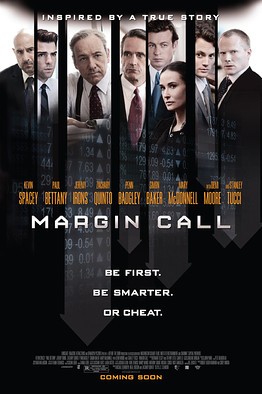
J.C. Chandor wrote and directed “Margin Call,” a sharply-scripted thriller about one night at a never-named Wall Street firm.  The top executives discover that they are at risk of catastrophic failure and have to decide before the markets open in the morning whether they or their clients will take the losses.  The movie stars Jeremy Irons, Keven Spacey, co-producer Zachary Quinto, Stanley Tucci, and Demi Moore.  It is specific enough to make some very pointed commentary on the financial meltdown but universal enough that its themes of betrayal and externalized costs could be set in any industry or indeed in any organization.

How did you come to write about the financial meltdown?

I had written several different things in several different capacities but had never done anything even sort of remotely topical let alone completely topical.  This was being written for myself to direct so it was from a very personal place, not a Hollywood script to go out and sell.  A lot of what has become the strength of the project and drew people to it came from an odd place, from production restraints I placed on myself to keep the budget realistic.

I’m a total real estate junkie and took time off to set up a partnership to renovate an old building and it happened to be on the other side of the real estate bubble.  The godfather of one of my  partners was a very prominent investment banker, a ground-breaker, an intellectual, invented the concept of a real estate hedge fund, a whole new model.  He intervened in his godson’s life and about halfway through our project came to him and said, “Those offers you’ve been getting to buy the project half-completed — take them.  I’ve been leaving millions of dollars in deposits on the table because it is time to get out.”  We took his advice, mostly because we were having trouble with one of the other partners but also because we had the feeling things were not going well in the markets.  We just broke even and felt like a defeat at the time but a year and a half later I felt I had a new lease on life.

As things really started bubbling to the surface I thought back to that man and what it was like to be walking around — you never know for sure, but he felt pretty strongly things were bad enough that he had to take a financial hit to avoid a worse one and warn us.  I thought it was an interesting issue to look at it from the inside, and do a small character-driven story about investment bankers as they see what they thought their lives were about changing in a deep way and what their responsibility was, all those things that were a little bit unsaid in the film but that the actors and I knew were all there.  I have only so much time, so much energy, this skill set, and this is what I’ve used it for.

It has the setting of a drama but it feels like a thriller.

To be there on that day was an interesting limited view into a wide problem.  It’s a ticking time bomb structure, which is a thriller by its very nature.  The one total deviation is that 45 minutes into the movie you know the bomb can’t be defused.  The drama is who will they hand the bomb to?

Do you see them as villains?

What most people would choose to do in this scenario is what these characters do — to look out for themselves.  To look at it in the macro viewpoint, they made the decision when they walked into the door coming out of Harvard or wherever they were to use their time and skills and very intense intelligence and education and have the big majority of those people get siphoned off into this world.   People who have already made that choice when they walk in the door it is unrealistic to expect them five, ten, fifteen years later to make a different choice about who to take care of.

Your father worked on Wall Street, at Merrill Lynch.  Did he guide you at all on the script?

For superstitious reasons I didn’t show the script to anyone in my family.  I’ve had a lot of false starts if you know what I mean!  I didn’t really tell my family I was doing this until we were really at the point of no return.  But what I learned from my father and from friends over the years is the toll that it takes on the people who stay behind and keep their jobs when others are let go.  It’s one of the only businesses that even in their best years still culls 5-10 percent of the workforce every year purely for motivation.  The people who last are the ones who play the game correctly.  For certain characters like Spacey’s it’s not about greed; it’s about survival.  For others like Simon Baker’s and Demi Moore’s it is about ego and the way you define yourself.

I originally wrote the scene when it wasn’t the big dramatic day, yet.  It was supposed to be more run of the mill, but as things developed in real life by the time we shot it, it became too subtle.

The way it was revised though, gets Stanley Tucci’s character out of the building, and that is important for the plot.

The fun thing about Stanley’s character, Eric Dale, is that I have a hard time naming characters and I usually use names from people in my life.  Eric Dale just worked and it is amusing for him because every character says the name through the film as he becomes the symbol of the paranoia that the information will get out.

I won’t give it away, but I wanted to tell you how much I liked your ending — you took something of a risk and it paid off.

The ending and the music are the things most people feel comfortable having an opinion about.  For me, the movie started with the ending and then you figure out how you get there.  Kevin Spacey would say something different but for me the most important thing is what’s behind him, the house.  It became very important to understand that in his mind, he did need the money.  No matter what you make, the way people rationalize their connection with money is almost identical.  As Paul Bettany says in the film, “You learn to spend what’s in your pocket.”


Related Tags:


Directors Interview Writers
THE MOVIE MOM® is a registered trademark of Nell Minow. Use of the mark without express consent from Nell Minow constitutes trademark infringement and unfair competition in violation of federal and state laws. All material © Nell Minow 1995-2026, all rights reserved, and no use or republication is permitted without explicit permission. This site hosts Nell Minow’s Movie Mom® archive, with material that originally appeared on Yahoo! Movies, Beliefnet, and other sources. Much of her new material can be found at Rogerebert.com, Huffington Post, and WheretoWatch. Her books include The Movie Mom’s Guide to Family Movies and 101 Must-See Movie Moments, and she can be heard each week on radio stations across the country.

Website Designed by Max LaZebnik