Gone Girl

Posted on October 2, 2014 at 6:00 pm

gone girl

Amy (Rosamund Pike) is watching television, vitally, even viscerally enthralled by what is happening on screen. The look on her face, mingled fascination and calculation, a hint of tooth and claw under her placid, golden girl beauty, is one of the most mesmerizing sights on screen this year.

Pike gives an extraordinary performance in the title role of David Fincher’s film based on the sensationally popular  thriller by Gillian Flynn that was carried by just about everyone riding public transportation last year, many of whom became so engrossed that they missed their stops.

Ben Affleck is perfectly cast as the once-glamorous and smooth, now just slightly seedy Nick Dunne. His face is still handsome but his jawline is softening, his eyes are beginning to get puffy, and his smile, still calibrated for a face a little bit handsomer than the one he has not quite adjusted to seeing in the mirror.

On their fifth anniversary, Nick’s wife Amy (Pike) disappears, leaving behind some disturbing signs of a struggle and the front door open. Nick calls the police and spends the night with his twin sister, closest confidant, and business partner, Go (Carrie Coon). He sleeps in his clothes and does not clean up the next morning. He knows he will be a more compelling vision of a devastated husband if he looks like a mess.

That is the first indication of one of the story’s key themes: the gulf between the way we present ourselves and the way we are. We learn through flashbacks and Amy’s diary about how they met and fell in love, or a reasonable facsimile. They were buoyed by ease and that made marriage feel easy, too.  They had glamorous writing jobs in those last few moments before print publishing collapsed. They had a charming brownstone, bought with Amy’s money, or, rather, the money her parents earned by publishing a successful series of children’s books inspired by their daughter, the Amazing Amy stories. Her parents set aside the profits for the daughter who inspired them. But then there was the recession. Jobs, gone. Money, gone. The economic downturn eroded the golden couple’s notion of each other, of themselves, of success. It is so easy to be in love when you don’t have to blame each other for everything turning out so badly.

When Nick’s mother became ill, they moved back to the small town in Missouri where he and Go grew up, to help take care of her. With the last of their money, they bought a house and a bar for Nick to run with Go. Amy stayed home and wrote in her diary. And now she’s gone.

If there’s one thing television news loves to cover, it’s a missing blonde woman. The Nancy Grace-ish Ellen Abbott (a dead-on Missi Pyle) is all over the story. Is Nick the tragic young husband, longing for his wife to return? Or, as we have seen too often in this high-profile cases, is he a murderer so heartless that he staged the whole thing?  One detective (“Almost Famous'” Patrick Fugit) thinks the simple answer is usually the right one.  His partner (Kim Dickens, nicely wry) believes in complications.  This case has plenty.

No spoilers here. Either you’ve read the book and already know or you haven’t and deserve to be surprised. I’ll just say there are superb performances by everyone, including Tyler Perry as a celebrity criminal defense lawyer and Neil Patrick Harris and Scoot McNairy as Amy’s former boyfriends.  And Fincher keeps the energy taut and the tone deliciously nasty.

Parents should know that this is a crime story with some bloody violence, as well as sexual references and situations, nudity, strong language, and drinking.

Family discussion: What would have happened if Nick and Amy had kept their jobs and money and stayed in New York? What will happen after the ending of the movie?

If you like this, try: “To Die For” and the novels by Gillian Flynn, including Dark Places, soon to be a movie starring Charlize Theron.
Related Tags:


Based on a book Thriller

The Good Lie

Posted on October 2, 2014 at 5:55 pm

B+
Lowest Recommended Age: Middle School
MPAA Rating: Rated PG-13 for thematic elements, some violence, brief strong language and drug use
Profanity: Brief strong language and some mild language
Alcohol/ Drugs: Drinking, drug use
Violence/ Scariness: Very disturbing violence including mass killings, guns, machetes, many characters injured and killed, some graphic images
Diversity Issues: A theme of the movie
Copyright Warner Brothers 2014

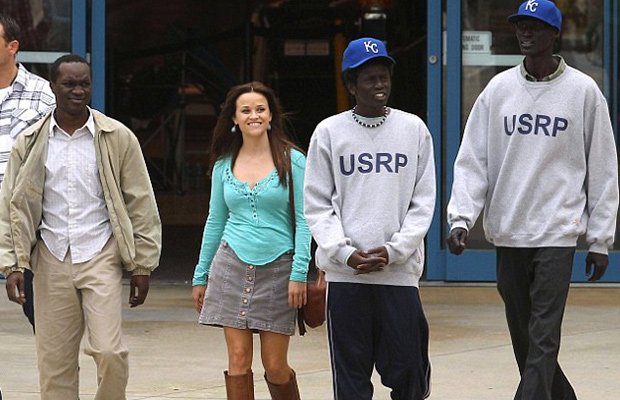
“The Good Lie” wisely casts Reese Witherspoon and Corey Stoll, who are outstanding as always, as sympathetic employment agency representatives helping refugees from Sudan find work in Kansas. And then it even more wisely keeps those characters in the background to allow the heroes of the story to be the refugees themselves and the real-life survivors of genocide in Africa who play the roles. Thankfully, this is one movie that is not about white people being spiritually enriched by saving people of color. And it is not about white people being spiritually enriched by learning important lessons from people of color. It is about people who have survived unimaginable loss who find a way to live with honor, strong connections, and resilience. Reese Witherspoon may be in it to reassure us that it is not a spinach movie, but even without her undeniably appealing role, the film would succeed because it is true-hearted, warm, wise, inspiring, and funny.

When their village is wiped out by genocidal marauders in the Sudanese Civil War of 1983-2005. More than two million were slaughtered and more than 20,000 surviving children, mostly boys, walked for hundreds of miles, many more dying along the way. Those who lived made it to refugee camps that were barely able to take care of them, and where they stayed for a decade or more. A small percentage immigrated to the United States. This story focuses on four survivors, the gentle Manerre (Arnold Oceng), the faithful Jeremiah (Ger Duany), and the angry Paul (Emmanuel Jal), who were sent to Kansas, and their efforts to be reunited with Manerre’s sister Abital (Kuoth Wiel), who was separated from the only family she had ever known because no home in Kansas would take her in.

Witherspoon plays the harried employment agency aide assigned to help them find jobs and has no interest in any further involvement with their lives. Cory Stoll plays her boss, who lives on a small farm, with cattle who give the Africans their first familiar sight since arriving in the United States.

Screenwriter Margaret Nagle and director Philippe Falardeau (who showed great sensitivity to cross-cultural issues faced by immigrants in “Monsieur Lazhar”) deftly avoid the too-easy feel-good conventions like romantic happy endings and the too-easy laughs of cultural differences.  When a well-meaning but not very well-informed greeter welcomes them with a lime green jello mold, the refugees’ bewilderment is a reflection on America’s warmhearted intentions but cultural myopia.  The same with Witherspoon’s character — her failure to learn the most fundamental basics about the skills and knowledge of the people she is trying to place is based on ignorance and lack of empathy in part, but also in a kind of imperishable optimism about the ability of all people to adapt.  There is never a suggestion of making fun of the Africans for being provincial, even when one of them asks tentatively if he needs to be looking out for lions.  They are never reduced to being cute or cuddly.  And while they have strong cultural and familial ties, each is given the respect and dignity of his own temperament and priorities.

In the refugee camp, one of the men wears a donated “Just do it” t-shirt.  When he finds out he is going to America, he says, “We can finally find out what this means.”  It is always going to be fun to see outsiders respond to elements of American life we take for granted, from escalators to airplane food, from shelves with twelve kinds of Cheerios to dumpsters full of edible goods.  The Africans give us a fresh look at our own lives, but what matters here is the way they hold onto what is most precious to them, their heritage, each other, while pursuing the opportunities this great, if imperfect country offers them so imperfectly.

Parents should know that this film includes genocidal violence with guns and knives, entire villages wiped out, many characters killed including parents, some disturbing images, some strong language, drinking, drug use, sexual references and a non-explicit situation.

Family discussion: How did the responses of each of the refugees to living in the US differ and why? What could the Americans have done to be more helpful and understanding? Why was it important for them to name their grandfathers?  Why was courtesy so important?

If you like this, try: the documentaries “The Devil Came on Horseback” and “God Grew Tired of Us” and read more about the Lost Boys both in Africa and in the United States.

Related Tags:


Inspired by a true story Movies -- format

Believe Me

Posted on September 30, 2014 at 11:06 am

B+
Lowest Recommended Age: Middle School
Profanity: Some mild language
Alcohol/ Drugs: Drinking and partying
Violence/ Scariness: None
Diversity Issues: Diverse characters
Date Released to Theaters: September 26, 2014
Amazon.com ASIN: B00MI506MC

Copyright 2014 Riot Studios
Will Bakke has followed his two thought-provoking documentaries on faith with a remarkably smart, funny, brave, and heartfelt first feature film that explores religion and values without ever falling into the easy conventions of many faith-based films. Bakke has a sharp eye but a warm heart and a refreshing honesty that allows him to let us laugh at some of the silliness and hypocrisy he has observed but is always respectful of those who find meaning in the way they engage with God. He is a sharp observer of the craft of filmmaking as well, and the story structure and camera and editing work here show that he is ready for the big leagues. I am looking forward to what he does next.

In his last film, a documentary called “Beware of Christians,” Bakke told the story of his journey with four friends, all from devout Christian families, as they traveled through ten European cities to expand their understanding of what it means to be a person of faith. That experience clearly informs this fictional story of four college fraternity brothers. When one of them discovers that his scholarship has run out with one more tuition payment still due, he persuades his friends to establish a fake Christian charity so they can keep the money. Each of them has a different perspective. Sam (Alex Russell, soon to be seen in Angelina Jolie’s “Unbroken”), is the slick, dimpled operator who thinks this is just the ticket to smooth his path to law school. Pierce (Miles Fisher) is the selfish rich kid who does not want his father to know he is in debt. Baker (Max Adler of “Glee” and “Switched at Birth”) is the party animal who is up for whatever’s going on. And Tyler (Sinqua Walls of “The Secret Life of an American Teenager”) is a nice guy who goes along because they promise he will not have to speak in front of a group and they promise that some of the money will actually go to charity.

Sam is a charismatic speaker and the audience wants to believe. Not only do they raise money quickly for their fake charity (cutely dubbed “Get Wells Soon”), but they attract the attention of a promoter named Ken (Christopher McDonald), who wants to book them on a nationwide tour for Christian audiences. Also on the tour are a singer named Gabriel (“Happy Endings'” Zachary Knighton, with just the right touch of oily smugness) and the tour manager (and Gabriel’s girlfriend) Callie (Johanna Braddy). The guys have to up their game to appear to be more authentic. They don’t just use highlighters and post-its to mark Bible passages, they baptize their Bibles in swimming pool water to give them that thoroughly-thumbed look. In one of the movie’s highlights, Sam explains to the others how to use certain words and poses (like “The Shawshank”) to communicate piety and get more money from believers, and even how to swear just enough but not too much. Can they immerse themselves in the world of faith — and the evidence of true need — without being affected by it, especially with the example of at least one believer who demonstrates true grace?

Bakke and his co-screenwriter Michael B. Allen bring a lot of specificity to these scenes, and a sensitivity that shows he is laughing with the Christians (especially when it comes to Christian entertainment), not at them. They understand that their open-hearted generosity can be unthinking but is almost always kindly meant. And they understand that being a believer does not inoculate anyone from human failings, especially pride. They also understand that true faith requires the full engagement of the spirit. And they respect their characters and the audience enough to make it clear that the answers we value most are never easy.

Parents should know that this film has some drinking and partying and some criminal and unethical behavior.

Family discussion: Which character best fits your idea of what it is to have faith? What should Ken have done when he found out what the boys were doing? What will Sam do next?

If you like this, try: “Beware of Christians” and films like “Elmer Gantry,” “Jesus Camp,” “Marjoe,” “Blue Like Jazz,” and “Leap of Faith”

Related Tags:


Comedy Drama Movies -- format Satire Spiritual films VOD and Streaming

Tracks

Posted on September 25, 2014 at 6:00 pm

B+
Lowest Recommended Age: High School
MPAA Rating: Rated PG-13 for thematic elements, some partial nudity, disturbing images and brief strong language
Profanity: Some strong language, one F-word
Alcohol/ Drugs: Drinking
Violence/ Scariness: Animals and humans in peril, sad animal death, references to suicide
Diversity Issues: Diverse characters
Date Released to Theaters: September 26, 2014

tracks-movie-posterIn 1977, a 27-year-old woman named Robyn Davidson took a dog and four camels and walked 1700 miles across the Australian desert. A National Geographic photographer met up with her four times to cover it for the magazine. That led to a book, the international best-seller Tracks.  And now it is a film, starring Mia Wasikowska, with Adam Driver as photographer Rick Smolan, and directed by John Curran, whose previous films (“The Painted Veil,” “We Don’t Live Here Anymore”) show a gift for letting the environment be an essential part of the story-telling.  The result is a journey set in surroundings of punishing conditions but spectacular beauty that manages to be meditative and internal, and all the more illuminating for it.

This is the first of two movies based on soul-restoring real-life hikes taken by real-life women that we will be seeing this fall, both based on best-selling books, with Reese Witherspoon’s more high-profile “Wild” coming out December 5, 2014.  While there are flashbacks to suggest that Davidson took on the trip to deal with some family losses, in real life Davidson has not just refused to give a reason; she has insisted that it is a foolish question to ask.  She walked across Australia for the same reason that Mallory climbed Mount Everest.  “Because it’s there.”  Her version of a response: “Why not?”  It’s pretty clear why not.  It is very dangerous.  The terrain is blisteringly hot and with very little water.  If she is injured or lost, no one will be there to help her.  But she is determined to go, indenturing herself with camel dealers to learn how to train camels and earn some to take with her.  When the first one cheats her out of what is due to her, she reluctantly agrees to allow National Geographic to sponsor the trip, though it means she will have to allow Smolan to meet up with her four times to take photos.

This is not the usual travelogue, with adventures that include quirky characters, daunting dangers, and lessons learned, though all are there.  Along the way, she meets up with Aboriginal people, including one who serves as a guide for a part of the journey because it includes sacred land which she is not permitted to travel on without him.  She comes across a farmhouse, and the couple who live there welcome her in a beautifully understated manner.

You’d also expect spectacularly gorgeous and exotic scenery, and that is there, too.  And, with just one person on screen much of the time, a lot of voiceover narration, though that’s not too bad.  Most of all, this is a spiritual saga, a pilgrimage.  Davidson wanted to be alone — she admits that she is much more comfortable with animals than with people.  And she wanted to accomplish something difficult by herself.  It almost seems at moments as though we are intruding in her beautiful solitude.  But mostly, we are sharing it, and feel grateful for the privilege.

Parents should know that this film includes sad and disturbing material including suicide of a parent (off-screen) and putting down animals, dangerous activities, peril, animals shot and poisoned, some disturbing images of dead animals, some strong language (one f-word), and non-sexual nudity (female rear).

Family discussion: Why was Robyn happiest away from people? What was the hardest moment of her trip and why?

If you like this, try: other movies set in the Australian desert, including “Walkabout” and “Priscilla, Queen of the Desert”

Related Tags:


Action/Adventure Animals and Nature Based on a book Based on a true story Drama Movies -- format

The Equalizer

Posted on September 25, 2014 at 5:59 pm

B
Lowest Recommended Age: Mature High Schooler
MPAA Rating: Rated R for strong bloody violence and language throughout, including some sexual references
Profanity: Very strong and crude language
Alcohol/ Drugs: Drinking, drugs and drug dealing
Violence/ Scariness: Extended and very graphic violence, with many characters injured and killed and graphic and disturbing images
Diversity Issues: Diverse characters
Date Released to Theaters: September 26, 2014
Date Released to DVD: December 29, 2014
Amazon.com ASIN: B00NX6WZIS
THE-EQUALIZER
Copyright 2014 Columbia Pictures

The only thing nicer than having a real-life friend who could circumvent any obstacle of power or law or, you know, logic to deliver the roughest but most just of rough justice would be to have that friend be Denzel Washington. And that’s the story of “The Equalizer,” very loosely based on television series starring Edward Woodward, but in theme and character closer to a superhero saga.

Washington plays Bob McCall, a kind and quiet inventory clerk at a big box store, but we can tell right away that he has seen some stuff and knows even more stuff.  His alarm clock goes off in a room so spare it might be occupied by a monk.  But the bed has not been slept in.  Bob prepares for the day, serious, precise, and methodical. He does one thing at a time.  At work, he eats his bag lunch and gently but firmly coaches his young colleague Ralphie (Johnny Skourtis) on losing weight and working on the skills he will need to pass the test for security guard. And at night, he brings a book to the diner (Hemingway’s The Old Man and The Sea), sits at a table, unwrapping the tea bag he brought with him, and exchanges a few words with Teri (Chloë Grace Moretz), a young “escort.”  “The old man met his adversary just when he thought that part of his life was over,” Bob tells Teri. “The old man got to be the old man. The fish got to be the fish.  Got to be what you are in this world.”  But what is Bob?  And what is Teri?

We do not know Bob’s past, but we know he has one (especially if we’ve seen the trailer).  If, as Spider-Man learns, with great power comes great responsibility, then with great power come some wrenching conflicts as well.  When Ralphie and Terri get in trouble, Bob will step in, risking escalation, retribution, and blowing whatever cover he has worked very hard to create. On the other hand, if he does not step in, it will not be much of a movie. And if you have any question, his next choice of classic literature will make it clear: Don Quixote, who “lives in a world where knights don’t exist anymore.”  In his own way, Bob is a Knight of Rueful Countenance. But unlike Don Quixote, Bob does not tilt at windmills. He takes on very bad people and he is very, very good at it.  “The two most important days in your life are the day you are born and the day you find out why,” the film tells us at the beginning, quoting Mark Twain.  Bob was not born to haul sacks of gravel.

A superhero movie has to have a character with power, whether it is money plus gymnastics and cool toys (Batman) or extra strength and speed (pretty much all of the Avengers). But we usually like them to have a secret or at least downtime identity — Bruce Wayne, Clark Kent, Tony Stark. There’s a lot of satisfaction in seeing them take down the bad guys. But there is even more satisfaction in what I call the “who is that chef?” moments (a reference to Under Siege). It’s not enough to kick the butt of the bad guy, you have to have the vast, immense, profound satisfaction of letting him know just how massively he has underestimated you. I mean Bob.

We get a lot of both in this film as Bob takes on bigger, meaner, and tougher bad guys in bigger, meaner, tougher confrontations.  Bob likes to set his stopwatch so we know he is setting himself against more than the bad guys; he is still in some competition with, what?  His abilities when he was younger?  Or, as he says, “progress, not perfection” — is he moving toward some goal that is still just out of his reach?

Basically, this is a slow burn movie, with a build-up to introduce us to the characters and then a series of action sequences, all well staged but very, very violent, as to be expected from director Antoine Fuqua (“Training Day”).  The bad guys are very, very, very bad.  The good guy is very, very, very, very good.  Denzel Washington is as good as it gets.  

And a sequel is in the works.

Parents should know that this movie is extremely violent, with many characters injured and killed and many explicit and disturbing images.  Characters use strong language.  Bad guys use every possible kind of weapon and engage in every possible kind of criminal behavior including sex trafficking, extortion and arson, and drug dealing.

Family discussion:  Why did Bob go to see his former colleague? What did he learn from the classic books he read?

If you like this, try: “Training Day”

Related Tags:


Action/Adventure Based on a television show Crime DVD/Blu-Ray Pick of the Week Remake
THE MOVIE MOM® is a registered trademark of Nell Minow. Use of the mark without express consent from Nell Minow constitutes trademark infringement and unfair competition in violation of federal and state laws. All material © Nell Minow 1995-2026, all rights reserved, and no use or republication is permitted without explicit permission. This site hosts Nell Minow’s Movie Mom® archive, with material that originally appeared on Yahoo! Movies, Beliefnet, and other sources. Much of her new material can be found at Rogerebert.com, Huffington Post, and WheretoWatch. Her books include The Movie Mom’s Guide to Family Movies and 101 Must-See Movie Moments, and she can be heard each week on radio stations across the country.

Website Designed by Max LaZebnik