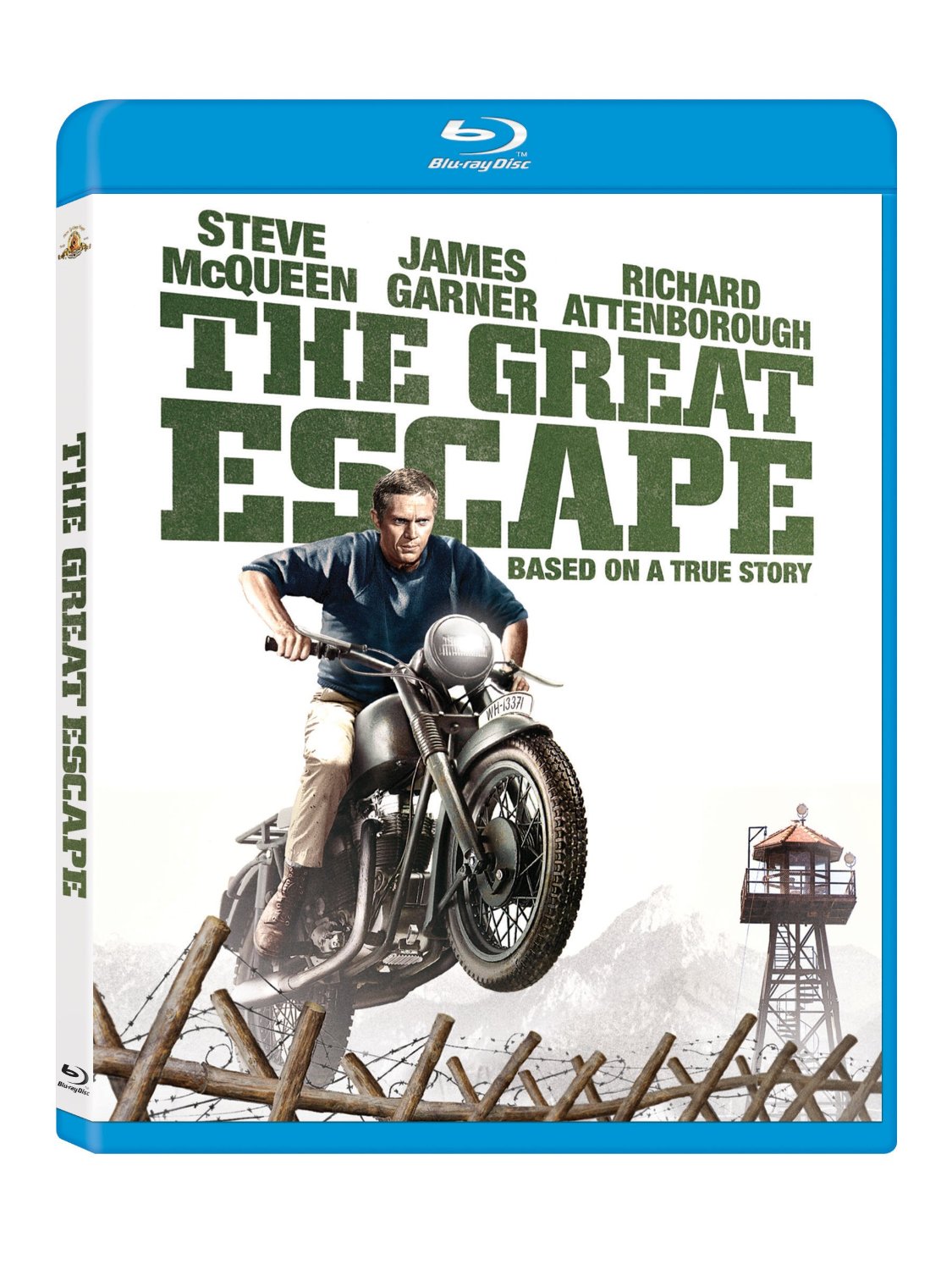
The Great Escape

Posted on December 13, 2002 at 5:17 am

A+
Lowest Recommended Age: Middle School
MPAA Rating: Not rated
Profanity: None
Alcohol/ Drugs: Some drinking, smoking
Violence/ Scariness: Very tense moments, characters in peril and many killed
Diversity Issues: People from a variety of backgrounds and countries work together toward a common goal
Date Released to Theaters: 1963
Date Released to DVD: May 7, 2013
Amazon.com ASIN: B00BN3DUVE

great escape

In honor of the Blu-Ray release of this classic film, it is the Pick of the Week – and I am delighted that I have one Blu-Ray to give away.  Send me an email at moviemom@moviemom.com with Escape in the subject line.  I will pick a winner at random on May 15.  Don’t forget your address!  (US addresses only.)

Towards the end of WWII, the Germans built a special high-security prison camp for Allied prisoners with a record of escape attempts. This is the true story of the extraordinary courage and ingenuity of the men imprisoned there, and of their plans for the greatest escape ever. As the British ranking officer explains, when the camp commandant urges him to relax and “sit out the war as comfortably as possible,” his duty is to escape, or, if escape is impossible, to force the enemy to use as many resources as possible to contain them.

Each man contributes his expertise. There are “tunnel kings” to dig the three tunnels, a “forger king” (Donald Pleasence) to forge the papers the soldiers will need when they escape, a “scrounger” (James Garner) to beg, borrow, steal, or obtain through blackmail the materials they need, and others who work as tailors and manufacturers. An American who is something of a loner, Hilts (Steve McQueen) becomes the “cooler king” for his long stints in solitary confinement, as a result of his independent escape attempts. When “Big X” (Richard Attenborough), the British officer who supervises the escape, asks Hilts to go through the tunnel to get information about the area surrounding the camp, and then allow himself to be recaptured, so he can let them know what he has found, he refuses. But when his friend is killed trying to escape, his spirit broken by the camp, Hilts changes his mind.

Seventy-five of the prisoners are able to escape before the tunnel is discovered. The Germans track almost all of them down, and fifty are killed, including Big X. It is to “the fifty” that the film is dedicated.

As in “Stalag 17” and many other films about prison camp, the prisoners in this story must adapt to the direst of circumstances, and they choose differing approaches. Hilts adapts by working on his own, or with one partner, while others work on a massive group escape. Ives and Danny begin to unravel under the stress, not so much a “choice” as an involuntary response.

Unlike other prison camp movies, this one does not dwell on disputes between prisoners or on the deprivations of the prison camp, which seems almost comfortable. It is about the professionalism, courage, resourcefulness, teamwork, and loyalty of every one of the prisoners.

As in a traditional “heist” film, the story focuses on defining a problem and then solving it. They examine the restrictions imposed by their conditions, change the ones they can, and adapt to the ones they cannot. They must also adapt quickly and calmly when the plan does not go as they expected.

The story gives us an exceptional example of teamwork and loyalty. Note the way that the prisoners protect each other. When Danny (Charles Bronson) cannot take it any more and wants to escape on his own, his friend talks him out of it. When the Forger goes blind, Big X wants to leave him behind, for his own protection. But the Scrounger promises to take care of him.

Point out to kids what factors do — and do not — go into the prisoners’ calculations and strategy. Big X is cautioned not to allow his personal wish for revenge determine their strategy. But pride (in the sense of morale) is permitted to be considered. When asked “Have you thought of what it might cost?” he answers, “I’ve thought of the humiliation if we just tamely submit — knuckle under and crawl.” They also consider the risk of failure, to the extent they can. At the end, when the Scrounger asks whether the escape was worth the price, the best the British Commander can do is answer truthfully, “It depends on your point of view.”

Note: The  screenplay was co-written by blockbuster novelist James Clavell (Tai-Pei, Shogun). His own experiences as a prisoner of war in a Japanese prison camp are the subject of “King Rat.” The outstanding musical score is by Elmer Bernstein (“The Magnificent Seven” and “To Kill a Mockingbird”). Richard Attenborough, who played Big X, became a director in the late 1960s of films such as “Gandhi” and “Shadowlands.” He continues to appear as a performer, and played Dr. Hammond in “Jurassic Park” and Kris Kringle in the 1994 version of “Miracle on 34th Street.”

Family discussion: Why are the experts called “kings”?  What makes Hilts change his mind about getting the information they want? Who was right about taking the Forger out through the tunnel, Big X or the Scrounger? Given the results of their action in this story, should officers who have been taken prisoner feel duty-bound to try to escape?

If you like this, try: “Stalag 17” and “King Rat”


Related Tags:


Based on a true story Classic Drama DVD/Blu-Ray Pick of the Week War

Awakenings

Posted on December 13, 2002 at 5:17 am

Malcolm Sayer, a shy neurologist (Robin Williams), is assigned to work with patients for the first time after his research funding is cut off. His patients, all but catatonic, are in a ward called “the garden,” because their only treatment consists of “watering and feeding.” Ever since an epidemic of encephalitis (“sleeping sickness”) decades before, they have not spoken or appeared to understand anything that was going on around them. Everyone else has given up hope, but Sayer, approaching them as a researcher, notices that they are capable of reflex reactions, and believes that new medication used for patients with Parkinson’s disease may help these patients, too. Over the objections of the doctors in charge, he gets permission to try it on one patient, Leonard Lowe (Robert De Niro).

At first, there is no reaction, but soon Leonard “awakens.” His transformation is so thrilling that Malcolm is easily able to get permission and funding to treat the other patients. They, too, awaken, some more fully than others. A one-time musician does not speak, but plays the piano. Some of them are horrified at the time they have lost. But most are giddy with the pleasures of being alive. Malcolm takes Leonard outside, and Leonard’s embrace of everything around him contrasts sharply with the inhibitions of Malcolm, who hesitates to try anything but his work, and cannot even bring himself to have a cup of coffee with a friendly nurse (Julie Kavner).

Leonard becomes impatient to experience more. He develops a warm friendship with the daughter of another patient in the hospital (Penelope Ann Miller). He asks for permission to leave the hospital on his own. But he becomes hyperactive, angry, and ridden with tics. The medication’s side effects begin to overwhelm him. Malcolm sees that he is losing Leonard, and the other patients know that it must soon happen to them, too.

Soon, all of them are returned to their previous state of catatonia, the only evidence of their brief awakening the greater respect and affection they receive from the staff, and their impact on Malcolm, who heeds Leonard’s call to life by reaching out to the nurse.

Discussion: This movie is based on the book of the same name by neurologist Oliver Sacks, who was the basis for the character Malcolm Sayer. It is a powerful and moving story, brilliantly acted and directed. Like Malcolm, we can all use a reminder to appreciate the pleasures of being alive, including the pleasures that require us to take risks.

Families who see this movie should talk about what the neurologist means when he says, “because the implications of that would be unthinkable?” Why would he prefer to believe that the patients are not aware of what is going on? Were you surprised by the way any of the patients reacted to being “awakened?” Which reaction was most like the way you think you might feel? Why is it hard for Malcolm to interact with other people? How does Leonard change the way Malcolm behaves? Why does the staff treat the patients differently after the awakening, even when they go back the way they were?

Compare this movie to Thornton Wilder’s play “Our Town,” especially Emily’s speech after her death, about what she misses and what she wants the living to be aware of.

Scriptwriter Steven Zaillian also wrote the screenplay for Schindler’s List and wrote and directed Searching for Bobby Fischer. Teens will enjoy reading the Sacks book, and some of his others, especially The Man Who Mistook His Wife For a Hat and An Anthropologist on Mars, with astonishing and compassionate descriptions of some of his neurology patients.

Related Tags:


Not specified

Big Daddy

Posted on December 13, 2002 at 5:16 am

Big Daddy” has all the unavoidable elements of an Adam Sandler film: slapstick humor, gross jokes, bodily functions galore, spectacular pratfalls and more than a sprinkling of sexual innuendo. Yet, the movie is not without its funny moments, it is a welcome return to the sweetness and heart of “The Wedding Singer” after the numbing dopiness of “The Waterboy,” and the tasteless portions (about 90%) are played in such a broad and obvious way that there is little risk that teens will mistake this for acceptable behavior.

It is the story of Sonny Koufax (Adam Sandler), shiftless young man who is wasting his life, much to the chagrin of his parents, friends, and girlfriend. One day, a 5 year old boy (played by twins Cole and Dylan Sprouse) is abandoned on his doorstep through a mixup. Rather than place the boy in an orphanage, Koufax agrees to take care of him for a few days, thinking it will help him win back his ex-girlfriend. At first the two have fun behaving irresponsibly together, but gradually Koufax comes to love the boy and realizes that he wants to keep him. He also recognizes that someone needs to be the grown-up, and it is going to have to be him. If he wants to keep the boy, he will have to begin to accept some responsiblity. He sees the consequences of his slacker lifestyle in the influence he has on the child, and in the risk he runs of losing him. Koufax fights the Department of Social services in court when they come to take the boy back.

This is not a profound movie, but adolescents (and those with adolescent humor) will enjoy it. There are a number of sexual references — some quite vivid — and a range of the usual PG-13 naughty words and potty humor. But this movie is so open, it has no chance to become smarmy (like the new Austin Powers movie). Sandler has a light enough touch that the movie does not become sentimental or lose its sense of humor by adding some heart to the characters. Like the character he plays, Sandler is beginning to learn that you can be responsible and funny at the same time.

For a more sophisticated but also very funny movie on this theme, see “A Thousand Clowns”.

Related Tags:


Comedy Family Issues

The Muse

Posted on December 13, 2002 at 5:16 am

The latest film by writer/director/actor Albert Brooks has him portraying Steven Phillips, a Hollywood screenwriter who is let go by the studio when a young, arrogant executive tells him he has lost his “edge.” On the advice of a friend, he seeks inspiration from a muse (Sharon Stone), the daughter of Zeus, who now lives in Los Angeles under the name “Sarah.”

Sarah does indeed work miracles for Steven, inspiring him to write a successful script. But Sarah is demanding. She insists on lavish gifts and constant attention. And she is frustrating. Steven wants her full- time dedication, but she is busy inspiring his wife to start a cookie business and “Titanic” writer/director James Cameron to make something other than a sequel.

The satire and Hollywood in-jokes will have little appeal to kids, but Stone’s performance as the ravishing, maddening, and truly inspiring muse is wildly funny and can lead to family discussions about art and about relationships. Kids may also want to look up the mythological muses and talk about the costs and benefits of being inspired. Parents should note that there is some suggestion that Sarah is mentally ill, but this is intentionally left vague enough so that each viewer can decide if she really is a muse after all.

Related Tags:


Comedy Fantasy Satire

Life is Beautiful

Posted on December 13, 2002 at 5:16 am

This Oscar-winner for Best Actor and Best Foreign Film is a “fable” is about a father’s love for his wife and son in the midst of the Holocaust. Writer/director Roberto Begnini stars as a Chaplinesque character who charms a beautiful teacher by creating a world of gentle magic around them. The first half of the movie is their sweet love story, with only faint foreshadowing of the tragedies that lie ahead.

But then Begnini and his wife and child are sent to a concentration camp. To protect his son’s life, he teaches him to hide from the guards during the day. To protect his son’s heart, he constructs an elaborate fantasy that they are participating in a very difficult contest to win the ultimate prize, a real tank. And his son finds that this make sense, and he goes along with it.

This movie inspired a lot of controversy from people who said that it was an inaccurate portrayal of the Holocaust, and that it was wrong to set a comedy, even a gentle bittersweet one, in a concentration camp. But the movie is never less than respectful of the suffering during the Holocaust, and of the impossibility of any kind of real portrayal of that experience. Even “Schindler’s List” is not a portrayal of the Holocaust. That experience is fundamentally incomprehensible. The best we can hope for from art is that it gives us glimpses. This movie gives us such a glimpse, but it is really about love, and the indominability of humanity even in the midst of inhumanity.

We often see in life and in movies that people react to extreme adversity by magnifying whatever sense of control they have left — think of Mrs. Van Dam’s focus on her coat in “The Diary of Anne Frank,” absurd in light of the fact that they never go outside, so she has no real need for a coat, but important because somehow she has chosen the coat as a place to locate her sense of herself as not having lost everything. In “Life is Beautiful,” the father focuses on his special talent for creating a feeling of magic to protect his son from the worst reality of the Holocaust, the sense of utter betrayal. Very importantly, he gives his son a sense of control, by letting him think that he has made the choice to participate in the contest. And knowing that he has kept his child’s faith intact gives him a sense of control, and purpose, that keeps him going.

This is an excellent movie for families to watch together, to discuss not just the historical framework but challenges that parents face when they see their children learn about tragedy and unfairness.

Related Tags:


Classic Comedy Drama Family Issues Romance Tragedy
THE MOVIE MOM® is a registered trademark of Nell Minow. Use of the mark without express consent from Nell Minow constitutes trademark infringement and unfair competition in violation of federal and state laws. All material © Nell Minow 1995-2026, all rights reserved, and no use or republication is permitted without explicit permission. This site hosts Nell Minow’s Movie Mom® archive, with material that originally appeared on Yahoo! Movies, Beliefnet, and other sources. Much of her new material can be found at Rogerebert.com, Huffington Post, and WheretoWatch. Her books include The Movie Mom’s Guide to Family Movies and 101 Must-See Movie Moments, and she can be heard each week on radio stations across the country.

Website Designed by Max LaZebnik