
Spider-Man

Posted on December 13, 2002 at 5:17 am
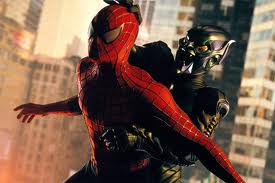
Remember when “Superman” was released with the tagline, “You will believe a man can fly?” Well, “Spider-Man” will not only make you believe that a teenager can swing from the skyscrapers; it will almost make you believe that you are up there swinging with him.

Comics were hugely popular back in the days when they could show us stories that no one else could. But now, movies can show us anything that can be imagined, and a movie like this does it so well it makes you think that this is what imagination is for.

Toby Maguire plays Peter Parker, a brilliant and sensitive high school senior, so deeply in love with his red-headed next door neighbor Mary Jane (Kirsten Dunst) that he can barely bring himself to say hello to her. On a school field trip, he is bitten by a genetically engineered spider and the next morning he wakes up with some distinctly arachnid-like qualities. He can see without his glasses and he has become muscular. He can climb walls, eject webbing with the swinging power of rope and the strength of steel, and anticipate danger.

So, like any teenager, the first thing he does is impress a girl and humiliate a bully. He enters a wrestling match to get money so he can buy a car to impress the girl even more. His decision not to interfere with an armed robber has tragic consequences, and so he learns that his uncle was right in telling him that with great power comes great responsibility. Great risk comes as well — everyone he cares about is put at risk because of who he is.

Meanwhile, Peter’s best friend’s father, industrialist Norman Osborn (Willem Dafoe) has decided to try out his company’s new product on himself. He, too, develops extraordinary power and a mad fury. He is dubbed the Green Goblin for his bizarre armor-like covering.

Maguire is just right as Peter, thoughtful, sensitive, thrilled with his new powers. You can believe that he is the kind of kid who would spend his time a little bit apart from the others, taking photographs that are clear and perceptive. The supporting cast is great, especially stage star Rosemary Harris as Aunt May and J.K. Simmons as Peter’s bombastic editor. The script is excellent, and strikes just the right note of respect and affection for the source material. It has a contemporary feel without being showily post-modern or ironic.

The special effects are thrilling. New York City is brilliantly stylized. Peter’s relationship with MJ is sweetly romantic. And when a bunch of New Yorkers throw things at the Green Goblin, yelling, “This is New York and we fight back!” it is genuinely touching.

The movie’s weakest point is that it fails in the single most important requirement for a comic book-based movie — the villain is not unforgettably crazy or evil or larger-than-life. The best Batman movies featured Jack Nicholson as The Joker and Jim Carrey as The Riddler. Willem Dafoe is a brilliant actor (just take a look at his Oscar-nominated performance in “Shadow of the Vampire”), but the part of Osborn/Green Goblin is just not interesting enough to be truly scary. The flying surfboard he rides around on is very cool, but his exoskeleton costume and mask are just dumb-looking.

Parents should know that the PG-13 rating comes from a couple of mild words, a clingy wet t-shirt, and a great deal of violence. The violence gets very intense, and includes not just fires and explosions but people getting vaporized, shot (off-camera), and impaled. Characters lose people close to them to violent deaths. A group of schoolchildren are in peril. Parents emotionally abuse their children.

For parents who are struggling with whether this movie is appropriate for kids under 13, the best guide I can provide is to say that it is about at the level of X-Men. I recommend caution, especially for children under 10. Keep in mind that just because a child can repeat after you “it’s only pretend” does not mean that he fully understands what that means until he is 10 or even older, and that the terrorist attacks may make some of the material scarier than it would have been before (scenes featuring the World Trade Center have been removed from the movie). Some kids may see the movie and appear to have no problems with it, but may act out in other ways. Be watchful for kids who respond by desensitizing themselves to violence or re-enacting it. And if you are going to let childrn see the movie, make sure that they know that this is an exception and that you will not be permitting them to see any PG-13 just because you allowed this one.

Families who see this movie should talk about the idea that the people we love make us feel good about who we are at the same time they make us see a way to be better. Do you agree that “people love to see a hero fail?” Characters in the movie keep a lot of secrets. What makes them decide not to tell, and who is and is not right in making that choice?

Families who enjoy this movie will also enjoy Superman and Batman. Mature audiences will enjoy Toby Maguire’s outstanding performances in “Wonder Boys,” “The Cider House Rules,” and “The Ice Storm.”

Related Tags:


Action/Adventure Comic book/Comic Strip/Graphic Novel Romance Superhero

The Three Lives of Thomasina

Posted on December 13, 2002 at 5:17 am

Plot: The story takes place in the Scotland of 1912. Mary MacDhui (Karen Dotrice) is a little girl whose mother has died. She loves her cat Thomasina more than anything in the world. Her father Andrew (Patrick McGoohan), a veterinarian, is a very rational man who has trouble communicating and tends to see his animal patients in economic rather than emotional terms. He has a hard time showing Mary how much she means to him, or understanding how much Thomasina means to her. He is unable to cure Thomasina when she is hurt, so he puts her to sleep, a choice that is rational, but insensitive.

Mary’s friends help her plan a funeral with an enthusiastic chief mourner (He says with pride, “I can cry very loud!”). They reassure her that the whole town will understand the magnitude of the loss: “Everyone will say, ‘There goes the poor widow McDouhi a-burying her dear Thomasina, foully done to death, God rest her soul.” The funeral is interrupted by Lori MacGregor (Susan Hampshire), a beautiful and mysterious woman who lives in the forest outside the town. She cures animals with herbs and affection and is thought to be a witch. Lori finds Thomasina, who is not dead; she has just used up one of her nine lives. In a fantasy scene set in Cat Heaven, Thomasina is reborn, with no memory of her previous life.

The people in the town begin to bring their sick animals to Lori, upset because Andrew put his daughter’s cat to sleep. Mary, pining for Thomasina, glimpses her, and runs after her, becoming drenched in a storm. She gets ill, and Andrew, desperate, goes to Lori for help. Lori tells him that his love is what Mary needs. Thomasina appears outside Mary’s window, and Andrew brings her inside. Thomasina has brought them all together, and Andrew and Lori are married.

Discussion: Andrew represents the head, and Lori the heart. In the beginning of the story, both are isolated. Thomasina and Mary bring them together. Children may be interested in the way that the funeral arrangements are such a comfort to Mary. They may also want to know more about why Andrew had such a problem communicating his feelings. WARNING: Some children may be upset over the notion that a cat can die and come back; some who have lost a pet (or a family member) may be upset that they don’t come back.

Questions for Kids:

· What do you think about Mary’s decision not to talk to her father? Was that a good way to solve the problem?

· What was her father’s reaction? Was that a good way to solve the problem?

· Why is it harder for some people to talk about their feelings than others? Is it ever hard for you to talk about yours?

Connections: The children in this movie, Karen Dotrice and Matthew Garber, also appeared in “Mary Poppins,” released the same year, and “The Gnome-mobile,” released in 1967.

Related Tags:


Family Issues Fantasy For the Whole Family

High Noon

Posted on December 13, 2002 at 5:17 am

Plot: Marshal Will Kane (Gary Cooper) marries Amy (Grace Kelly) and turns in his badge. She is a Quaker, and he has promised her to hang up his gun and become a shopkeeper. But they get word that Frank Miller is coming to town on the noon train. Kane arrested Miller and sent him to jail, and Miller swore he would come back and kill him.

Will and Amy leave town quickly. But he cannot run away, and he turns around. He knows that they will never be safe; wherever they go, Miller will follow them. And he has a duty to the town. Their new marshal does not arrive until the next day.

Will seeks help from everyone, finally going to church, where services are in session. But he is turned down, over and over again. Amy says she will leave on the noon train. Will’s former deputy, Harvey (Lloyd Bridges) refuses to help, because he is resentful that Will did not recommend him as the new marshal. Will’s former girlfriend, Helen Ramirez (Katy Jurado), now Harvey’s girlfriend, will not help him, either. She sells her business and leaves town. Others say that it is not their problem, or tell him to run, for the town’s good as well as his own. The previous marshal, Will’s mentor, says he can’t use a gun any more. The one man who promised to help backs out when he finds out that no one else will join them. The only others who offer to help are a disabled man and a young boy. Will must face Miller and his three henchmen alone.

At noon, Frank Miller gets off the train. The four men come into town. Will is able to defeat them, with Amy’s unexpected help. As the townsfolk gather, Will throws his badge in the dust, and they drive away.

Discussion: This outstanding drama ticks by in real time, only 84 tense minutes long. Will gets the message about Frank Miller at 10:40, and we feel the same time pressure he does, as he tries to find someone to help him. We see and hear clocks throughout the movie, and as noon approaches, the clock looms larger and larger, the pendulum swinging like an executioner’s axe. In the brilliant score by Dimitri Tiomkin (sung by Tex Ritter) the sound of the beat suggests both the train’s approach and the passage of time.

This is like a grown-up “Little Red Hen” story. Will cannot find anyone to help him protect the town. Everyone seems to think it is someone else’s problem (or fault). Teenagers may be interested to know that many people consider this film an analogy for the political problems of the McCarthy era. It was written during the height of the Hollywood “red scare.” After completing this screenplay, the writer, an “unfriendly witness” before the House Un-American Activities Committee, was blacklisted. But this unforgettable drama of a man who will not run from his enemy, or his own fears, transcends all times and circumstances.

Questions for Kids:

· Everyone seems to have a different reason for not helping Will. How many can you identify? Which reasons seem the best to you? Which seem the worst? What makes Amy change her mind?

· Why does Will throw his badge in the dirt?

· Do you think the screenwriter chose the name “Will” for any special reason?

· How do you decide when to stay and fight and when to run? How do you evaluate the risks? What should the law be?

Connections: This movie was the first attempt at an “adult” Western, its stark black and white images a contrast to the gorgeous vistas in the Westerns of John Ford and Howard Hawks. It was included in the first list named to the National Film Registry, established by the Library of Congress to identify films that are “culturally, historically, or esthetically important.” It has had tremendous influence, and has inspired many imitations and variations. “Outland,” starring Sean Connery (and rated R) is a not-very-good attempt to transfer this plot to outer space. “Three O’Clock High” moves it to a high school, with a new student challenged by the school bully. Despite some directoral pyrotechnics, it is not very good, either. “The Principal” has another “High Noon”-style confrontation in a school, but this time it is the title character who must show his mettle. “The Baltimore Bullet” moves the confrontation to a pool hall.

Related Tags:


Classic Drama Western

My Life as a Dog

Posted on December 13, 2002 at 5:17 am

Plot: Ingemar is a twelve year old boy growing up in 1950s Sweden who goes to live with his aunt and uncle in Smaland while his mother is dying of tuberculosis. In the small town of Smaland he meets an assortment of eccentric and delightful characters who help him adjust to his new life without his mother, brother, and his beloved dog Sickan (he has never known his father).

He meets an athletic girl who loves to box, but who also develops a crush on Ingemar. Berit, the most beautiful woman in town, befriends Ingemar asks him to chaperon her when she models for the town artist. Ulla and Gunar, his aunt and uncle, adopt Ingemar and help him find family and normalcy during a traumatic period in his life.

Discussion: Told from the perspective of the child, this is an affecting and authentic portrayal of a young boy’s attempt to understand the adult world. The director shows us Ingemar’s world through a child’s eyes, so that the smallest events and the largest are presented as equally important. He does not know enough to be able to distinguish ordinary behavior from eccentricity, or to fully understand why a nude model would want a young boy as a chaperone or why a dying man would be so interested in underwear catalogues. His acceptance of everyone he meets is part of his appeal.

Ingemar does not have enough experience of the world to be able to understand what his mother’s symptoms mean, or to wonder if she will die. Because no one told him how ill she was, he blames himself for her death. He does not have the opportunity to express his grief, which adds to his feeling of disorientation and his identification with a dog who is circling the globe in a space capsule. The only comfort he (and the audience) have is the sense that his ability to form relationships with the new people in his life will be a source of strength and happiness to him in the future.

Questions for Kids:

· Why does Ingemar always say it’s important to “compare”? Why do you think that Ingemar compares himself to Laika the space dog?

· Why does Ingemar tell us that he wishes he told his mom everything? Does he blame himself for not having told her everything?

· Why doesn’t anyone tell Ingemar that Sickan is dead? Do you think that waiting to tell him made it easier or harder to deal with when he did learn the truth?

Related Tags:


Drama Family Issues

Spy Kids

Posted on December 13, 2002 at 5:17 am

B+
Lowest Recommended Age: Kindergarten - 3rd Grade
Profanity: One brief almost-swear word
Alcohol/ Drugs: None
Violence/ Scariness: Some peril, mostly comic
Diversity Issues: Strong female characters, several Latino leads
Date Released to Theaters: 2001
Date Released to DVD: August 15, 2011
Amazon.com ASIN: B004SIPAFK

This week’s release of the fourth in the “Spy Kids” series is a good reason to revisit the original.

Imagine James Bond crossed with “Willy Wonka and the Chocolate Factory” and you might have an idea of what to expect in “Spy Kids,” the best family movie of the spring. It has just the right combination of giddy fantasy, exciting adventure, wonderful special effects, and sly comedy to be ideal for 7-12 year-olds and their families. It is doubly welcome, after the terrible “See Spot Run,” and especially because it features strong females and characters and performers from the Latino culture.

Carmen and Juni Cortez (Alexa Vega and Daryl Sabara) are the children of Gregorio (Antonio Banderas) and Ingrid (Carla Gugino), once the cleverest spies in the world, but now loving parents who make a living as consultants. Or so they say.

It turns out that once the kids go to bed, Gregorio and Ingrid flip a few switches to connect to a command center that keeps them involved in spy missions, though now from a safe distance.

When top secret agents start disappearing, Gregorio and Ingrid call on “Uncle Felix” (Cheech Marin) to watch the kids and climb back into their spy gear to go off and save the world. But then they, too, disappear, and it is up to Carmen and Juni to rescue their parents, and, while they’re at it, the rest of the world, too. But first, they have to learn to respect and trust each other.

They also have to learn how to use a bunch of gadgets that would leave James Bond, Flash Gordon, Dick Tracy, and even Inspector Gadget green with envy. I loved the way that instead of ray guns or other destructive devices the kids use fantasy versions of stuff that kids know best. They fight the bad guys with bubble gum that gives the enemy an electric shock, silly string that turns into cement, and, that ultimate dream, a back-pack-y sort of thing that enables them to fly. Similarly, instead of scary ninjas or soldiers, most of the bad guys are either thumb-shaped robot creatures who are literally all thumbs or a bunch of robot children whose most menacing aspect is glowing eyes and super strength.

Any good adventure story needs a great villain, and this one has the always-great Alan Cummings as Floop, the star of Juni’s favorite television program who is also the mastermind of the plot to create an army of robot children. His sidekick is Minion (Tony Shaloub), who transforms the captured spies into backwards-speaking, silly-looking mutants for Floop’s show. But one of the interesting things about the movie is that nearly everyone turns out to be something different than what they or others thought, even Minion and Floop. The transforming in the movie is not limited to the mutants.

Parents should know that the movie includes a little bit of potty humor (which most kids will find hilarious) and one almost-swear word. Younger children might be frightened by the mutant creatures, but most will find them more silly than scary. Characters are in comic peril and there is a certain amount of head-bonking violence, but no one even gets a scratch except for one villain whose encounter with flames leaves her having a very bad hair day.

Be sure to tell kids that the thumb-robots were inspired by drawings writer/director Robert Rodriguez did when he was 12, and ask them to come up with some pictures of things they’d like to put into a movie someday. Good topics for family discussion include how to know which secrets to share, the challenges of siblinghood (a two-generation challenge in the Cortez family) and the movie’s conclusion that spy work is easy compared to keeping a family together, which is not only more of a challenge, but more important.

Families who enjoy this movie will also enjoy “Willie Wonka and the Chocolate Factory” and “James and the Giant Peach.”

Related Tags:


Action/Adventure DVD/Blu-Ray Pick of the Week Family Issues Series/Sequel Spies Stories About Kids
THE MOVIE MOM® is a registered trademark of Nell Minow. Use of the mark without express consent from Nell Minow constitutes trademark infringement and unfair competition in violation of federal and state laws. All material © Nell Minow 1995-2026, all rights reserved, and no use or republication is permitted without explicit permission. This site hosts Nell Minow’s Movie Mom® archive, with material that originally appeared on Yahoo! Movies, Beliefnet, and other sources. Much of her new material can be found at Rogerebert.com, Huffington Post, and WheretoWatch. Her books include The Movie Mom’s Guide to Family Movies and 101 Must-See Movie Moments, and she can be heard each week on radio stations across the country.

Website Designed by Max LaZebnik