My New Must-See Movies Series Now Available on Kindle and Kindle Apps (And How to Get One for Free)

Posted on October 2, 2012 at 3:59 pm

I’m delighted that the first three books in my new Must-See Movie series are now available as ebooks.  The first is #1 and and all three are in the top 20 of Amazon Kindle’s movie guides and reviews best-seller list.  You don’t need to have a Kindle — the free Kindle app works on just about any computer or tablet or smartphone. If you buy 101 Must-See Movie Moments, email me at moviemom@moviemom.com and tell me the last movie in the book before October 31, 2012 and I will send you either 50 Must-See Movies: Weddings or 50 Must-See Movies: Mothers for free. If you post a review of 101 Must-See Movie Moments, I’ll send you both!

The three books are:

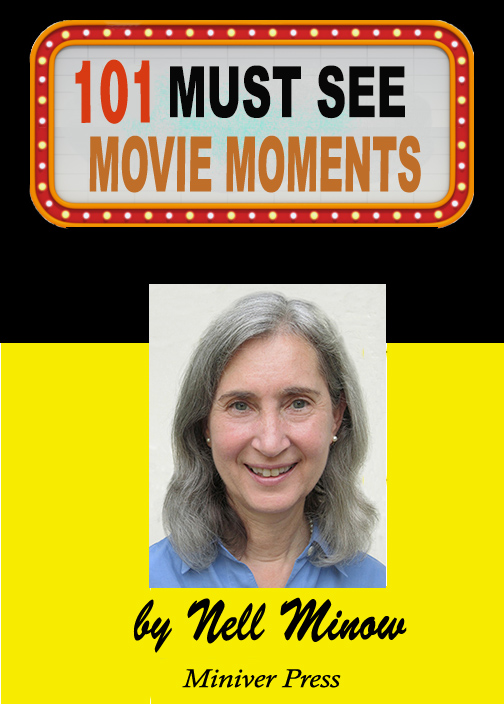
 101 Must-See Movie Moments  101 essays on great moments in neglected films and neglected moments, from the lobster scene in “Annie Hall” to the final moments of “Godfather 2,” to a sandwich in the otherwise forgettable “Wives and Lovers” and the “Coward’s Corner” scene in “Homicidal” and the garbage can lid dance in “It’s Always Fair Weather,” and the “Dead by Third Act” character in “Top Gun,” each illuminates an element of cinematic storytelling that will make you understand and appreciate all movies better. ($1.99)

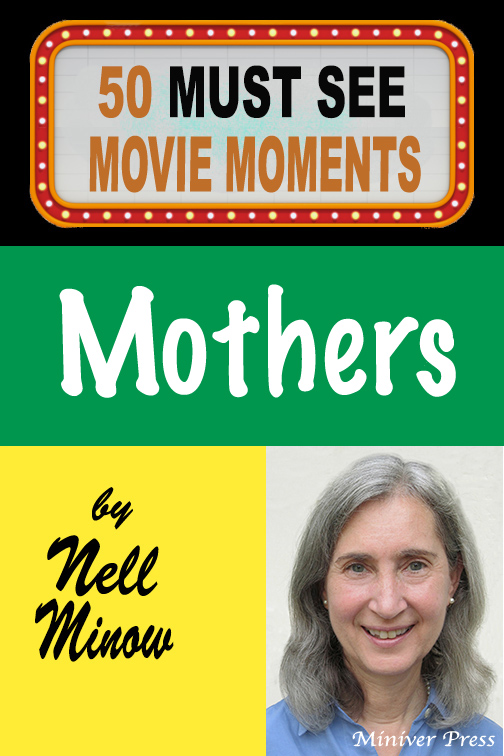
50 Must-See Movies: Mothers  No relationship is more primal, more fraught, more influential, more worried over, more nourishing when good and more devastating when bad that our connection to our mothers. Mom inspires a lot of movies in every possible category, from comedy to romance to drama to crime to animation to horror, from the lowest-budget indie to the biggest-budget prestige film. A lot of women have been nominated for Oscars for playing mothers and just about every actress over age 20 has appeared as a mother in at least one movie. Here are 50 classic movie mothers, the good, the bad, and the downright nightmarish. (99 cents)

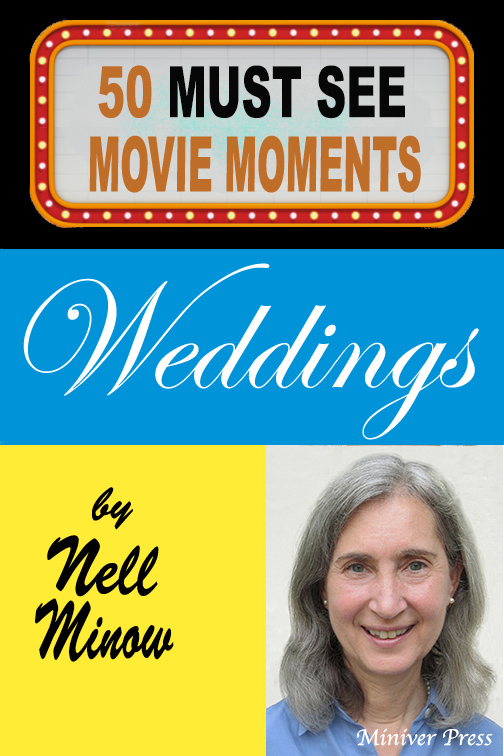
50 Must-See Movies: Weddings  Movies and weddings are — it must be said — a match made in heaven. Here are 50 of the best movies about proposals, engagements, and weddings from classics (“Father of the Bride,” “The Godfather”) to neglected gems like “Confetti” and “The Baxter.” Comedies, romances, dramas, runaway brides and wedding crashers — these are must-see for anyone who has ever planned, dreamed of, or been to a wedding. (99 cents)

Related Tags:


Books Contests and Giveaways

Beliefnet’s Newest Newsletters: Movie Mom Reviews DVDs and Movies

Posted on May 26, 2012 at 8:00 am

Of course I hope you all visit me here every day or at least a couple of times a week, but if you think it is more convenient to get my movie and DVD/Blu-Ray/Streaming/Download/On Demand reviews each week via email, I’m happy to say that Beliefnet has created two newsletters featuring my reviews.  If you’d like to sign up, start with this page, sign in via your email address, and put checkmarks next to the newsletters you want.

Related Tags:


Not specified

My Appearance on the “On Demand” Panel at Ebertfest

Posted on May 13, 2012 at 11:12 pm

Here’s the “On Demand” panel from Ebertfest — it was a thrill to be a part of this lively discussion about the pros and cons of watching films outside a movie theater.  I especially enjoyed meeting Roger Ebert’s wonderful group of Demanders, the wise and witty folks who review non-theatrical releases for his website.


Related Tags:


Festivals Media Appearances

My Interview with Adlai E. Stevenson III About Five Generations of Politicians and Statesmen

Posted on April 26, 2012 at 12:16 pm

I was lucky enough to interview former Illinois senator Adlai E. Stevenson III about his new book collecting the wisdom of five generations of his family for the wonderful Viral History blog from Ken Ackerman.  Here is an excerpt:

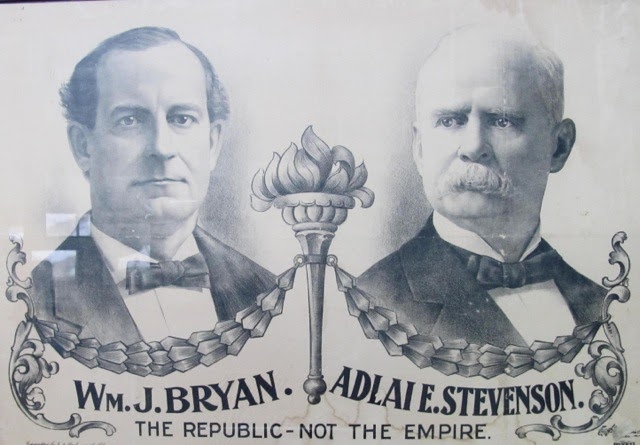
  Illinois has had its problems with elected officials, but it is also the home of Abraham Lincoln and Barack Obama.  In between those two Illinois Presidents, great public servants from the state have included five generations of the Stevenson family.  Most recently, Adlai E. Stevenson III served as United States Senator from 1970 to 1981, following terms as Illinois State Treasurer and representative to the state legislature. His father was Illinois Governor and the Democratic candidate for the presidency in 1952 and 1956, losing both times to Dwight D. Eisenhower.  After that, he served as U.S. Ambassador to the United Nations, memorably confronting the Soviet Union over the Cuban Missile Crisis.
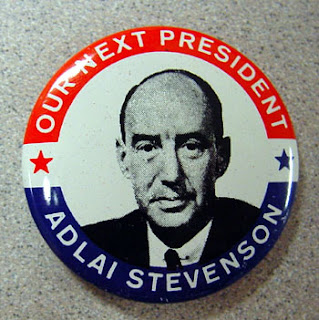
 

Going back further, Senator Stevenson’s grandfather held state office in Illinois and his great-grandfather was a Congressman and Vice President of the United States under Grover Cleveland. His great-great-grandfather, Jesse Fell, was Secretary of the Illinois Republican Party. He proposed the historic Lincoln/Douglas debates and persuaded Lincoln to run for President. He did not run for office himself but set his family an example of citizen statesmanship that still resonates today.

Senator Stevenson is currently active through the Adlai Stevenson Center on Democracy, with an upcoming event on the Presidential Debates featuring my father, Newton Minow, whose work with Governor Stevenson during his Presidential campaigns in the 1950s formed the basis of the current system of Presidential debates.

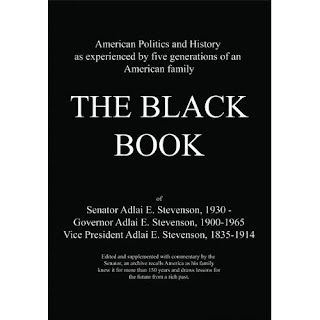
The Stevenson family has a tradition of collecting thoughts and quotations about politics, history, and related topics, and Senator Stevenson has now edited what the family calls The Black Book with 150 years worth of insights and advice.  It is an enthralling compilation, rewarding a quick look at a random page or careful study of chapters on topics from “Congress and the Legislative Process” to “Religion and Politics,” “Lincoln, War, Peace,” and even poetry — a treat for fans of history, politics, and just good reading.
I was delighted to have a chance to interview Senator Stevenson, for whom I worked as an intern in the summer of 1973, when I was in college and the Watergate hearings were underway.   Here is some of what he told me:
The Senate

NM: What has been the biggest change for the worse since you were in the Senate? What has been the biggest change for the better?
AES: In the Senate I entered, there was no partisanship. We worked across the aisle – remember Nixon supported Environmental Protection, product safety, OSHA, even supported wage and price controls. The center was broad. Reason still reigned – and some wise men (yes, mostly men). Nowadays anybody can be elected without sufficient money or notoriety. The process is paralyzed. Civility broke down as ideology and money invaded. Now a handful can stop consideration of measures and paralyze Congress. I haven’t observed any favorable changes.

NM: Do you think there is any way to limit the impact of the Supreme Court’s Citizens Uniteddecision on corporate money in politics?

Campaigns and Politics


AES: Yes. The Court may reconsider the issue. Campaigns could be shortened – and ballots to reduce costs. The Federal Communications Act might again be enforced so licensees of public air waves are held to some public, convenience, and necessity standards as in the past. Partial public financing may be the most doable solution. I am skeptical about a Constitutional amendment and proposals to take limits off contributions to parties and candidates to counter super PACs. We could also fund public TV and radio adequately as other democracies do. We just had an Adlai Stevenson Center program on the subject but I did not hear any easy answers.

NM: There are a lot of wonderful quotes in the book. Did any of the selections collected by your father surprise you? Do you have a favorite?

AES: Remember, the quotations came from everywhere and were added over four generations, probably most by me. As I say, every page uncovers a surprise that I added for illustrative, not so much argumentative, purposes. (The open letter to Santorum was ahead of its time like others). I have many favorites, for example:

  • ” With all the temptations and degradations that beset it, politics is the noblest career; any man can choose. Andrew Oliver, ca 1810.
  • “Ever’ once in a while some feller with no bad habits gits caught,” Will Rogers.
  • And my cardinal rule: A politician owes the public: “his conscience and his best opinion…not his industry only, but his judgment; and he betrays instead of serving you if he sacrifices it to your opinion.” Edmund Burke, 1774

 

Related Tags:


Books Media Appearances

Paulzeye Interviews Me!

Posted on February 25, 2012 at 8:00 am

Many thanks to Paulzeye for the opportunity to answer very thoughtful questions about being a movie critic.  I was very touched by his kind words:

Whether Minow’s busy being a mom or busy being the Movie Mom, one thing is cer­tain: she encom­passes all the qual­i­ties and virtues of the hard-working 21st Cen­tury woman. And her com­men­tary is a reflec­tion of her own per­sona: hon­est, sharp, to the point, and always very insightful.

Here’s an excerpt from the interview:

Paulz­eye:  As a critic, you’ve seen a fair share of good films and bad films. How would you define a mas­ter­ful or good film?  How would you define a bad film?

Nell Minow:  I eval­u­ate every movie accord­ing to its aspi­ra­tions – oth­er­wise, every review will be, “It’s not ‘Cit­i­zen Kane.’”  How well does it meet the expec­ta­tions of its intended audi­ence?  If it is a silly com­edy or a chases and explo­sions film it makes no sense to com­pare it to an Oscar con­tender.  But, at its core, every movie should be grounded in the sin­cere com­mit­ment of the peo­ple who made it to do the best they can for the audi­ence they are try­ing to reach.  The one kind of film I really hate is the kind that con­de­scends to its audience.

Paulz­eye:  What are five films, new or old, that should be on every family’s ‘must-see’ list and why?

Nell Minow:   “To Kill a Mock­ing­bird,” “The Court Jester,” “Some Like it Hot,” “The Mir­a­cle Worker,” and “The Wiz­ard of Oz” are all clas­sics that have some­thing for every age and give fam­i­lies a lot to talk about.

Paulz­eye:  Peo­ple tend to think that being a film critic is an easy pro­fes­sion but surely it must be dif­fi­cult to spend hours in a mul­ti­plex watch­ing sev­eral films back to back and then review­ing them. Talk to us about that process. What’s a day at the movies like for you?

Nell Minow:  Most days, I see only one or two movies.  The inde­pen­dent and foreign films are most often in a lit­tle screen­ing room at the Motion Pic­ture Asso­ci­a­tion build­ing across Lafayette Square from the White House dur­ing the day and the big stu­dio films are in the evening, in movie the­atres with a cou­ple of rows reserved for crit­ics and the rest filled with peo­ple who won tick­ets on radio sta­tions or other giveaways.  I really enjoy the other local crit­ics, who have become friends and colleagues.  They make even the worst movies fun to watch.

Paulz­eye:  As a critic, what do you feel more com­fort­able writ­ing about: a film that you absolutely loved or one that you absolutely loathed?

Nell Minow:  Both are fine because they both inspire a lot of thoughts.  The tough­est ones are the bland and mediocre movies, because it is so hard to think of any­thing to say or any vivid way to say it.

Paulz­eye: You’ve inter­viewed sev­eral impor­tant fig­ures (politi­cians, actors, and direc­tors) over the years. What are some of your most mem­o­rable inter­views and why?

Nell Minow:  I espe­cially like talk­ing to writ­ers and direc­tors, who are not inter­viewed as often as actors and who are more inter­ested in talking.  Some of the most mem­o­rable include John Irv­ing, Jason Reit­man, Ran­dall Wal­lace, Mike Mills, and John Cameron Mitchell.  One of my favorite recent inter­views was with Mar­tin Sheen for “The Way.”  He is an enthralling racon­teur and I could have lis­tened to him all day.  I was also very impressed at how kind he was to the staff in the hotel, intro­duc­ing him­self to every­one and really lis­ten­ing to them.  Another actor I won’t name infu­ri­ated me by being very rude to the wait­ress and maître d’.

Related Tags:


Media Appearances
THE MOVIE MOM® is a registered trademark of Nell Minow. Use of the mark without express consent from Nell Minow constitutes trademark infringement and unfair competition in violation of federal and state laws. All material © Nell Minow 1995-2026, all rights reserved, and no use or republication is permitted without explicit permission. This site hosts Nell Minow’s Movie Mom® archive, with material that originally appeared on Yahoo! Movies, Beliefnet, and other sources. Much of her new material can be found at Rogerebert.com, Huffington Post, and WheretoWatch. Her books include The Movie Mom’s Guide to Family Movies and 101 Must-See Movie Moments, and she can be heard each week on radio stations across the country.

Website Designed by Max LaZebnik