
Trailer: Boychoir with Dustin Hoffman, Debra Winger, and Eddie Izzard
Posted on March 24, 2015 at 9:50 pm
Posted on March 24, 2015 at 9:50 pm
Posted on March 24, 2015 at 8:00 am
Posted on March 20, 2015 at 8:00 am
Brittany Snow (“Pitch Perfect”) and William H. Macy star in “Dial a Prayer,” about a troubled young woman who takes a job praying for and with anyone who calls in.
Posted on March 19, 2015 at 5:52 pm
B-| Lowest Recommended Age: | Middle School |
| MPAA Rating: | Rated PG-13 for intense violence and action throughout, some sensuality, thematic elements and brief language |
| Profanity: | Several strong words, one f-word |
| Alcohol/ Drugs: | Drugs used for suppression and torture |
| Violence/ Scariness: | Extensive peril and violence, disturbing images, many characters injured and killed |
| Diversity Issues: | A theme of the movie |
| Date Released to Theaters: | March 20, 2015 |

This second in the “Divergent” series suffers from sequel-itis. The exuberance of the premise buoyed the first episode, as we and the central character, Tris (Shailene Woodley) explored the post-apocalyptic world that divided all citizens into strictly segregated factions. But now that the foundation has been laid, the next steps are not nearly as exciting.
There is Candor (the honest), Abnegation (the selfless), Dauntless (the brave), Amity (the peaceful), and Erudite (the intelligent). The tasks of the society are assigned according to the qualities of each. Amity are the farmers. Dauntless are a combination of law enforcement and military. Candor are the judges. Erudite make the laws. Abnegation care for everyone, even the factionless, and due to their tradition, culture, and ethos of putting the good of others before themselves, they are the governing body.
But over time, the system has eroded. When Tris is evaluated for assignment to a faction, she is found to be “divergent,” with more than one of the qualities, and that is considered profoundly threatening to the system.
At the end of the last episode, she had joined the Dauntless and survived their brutal series of tests and escaped with Four (Theo James), following a battle that killed her mother, as Jeanine (Kate Winslet), an Erudite, is consolidating her power and turning the community into a dictatorship. As this chapter begins, Tris and Four are hiding out in Amity with Tris’ Erudite brother, Caleb (Ansel Elgort) and a member of Dauntless named Peter (Miles Teller).
Tris chops off her hair so that she spends the rest of the film looking like a cross between Peter Pan and Tinkerbell. Her Dauntless side is impatient in the tranquil community of Amity, where people murmur, “Go with happiness,” as they hand out food in the cafeteria line. She is determined to go back into the city and kill Jeanine.
Meanwhile, Jeanine has found a box that was hidden by Tris’ mother (Ashley Judd), and can only be opened by someone who is fully Divergent, possessing in equal amounts the qualities of all five factions. She is certain the box is the key to controlling everyone, and she must get Tris — alive — to get it open.
Four and Tris end up in Candor, where they are given a powerful truth serum. “May the truth set you free,” is not just rhetoric as the serum is administered. It will determine whether Four and Tris are turned over to Jeanine. They are proven to have been telling the truth but it is a painful experience and they end up captured anyway. Tris is forced to endure a series of excruciating “sims” to qualify to open the box (not clear why she couldn’t just try it to see), and the results are not what Jeanine was expecting.
Some of the plot developments, from a book written by an author in her early 20’s, simply cannot hold up to being portrayed onscreen. At times it’s just a weaponized vision of the highly cliquish tables at the high school cafeteria. Even pros like Winslet and Naomi Watts (as a rebel leader) cannot quite put their thinly conceived characters over. But Woodley never lets us forget that the biggest struggle Tris has is not with the repressive regime but with her own fears and regrets. Her sincerity and resolve outshine all the fight scenes and give some depth to the superficiality of the storyline.
Parents should know that this film includes constant peril and intense violence with guns, knives, suicide, and threatened suicide, many characters injured and killed, some disturbing images, a sexual situation, a storyline about repressive government and personal and political betrayal, and several swear words.
Family discussion: Why does Jeanine think she is acting on behalf of the greater good? Why does Caleb? How does our society try to categorize people?
If you like this, try: the “Hunger Games” films and “The Giver” and the books they are based on
Posted on March 19, 2015 at 5:50 pm
B+| Lowest Recommended Age: | Mature High Schooler |
| MPAA Rating: | Rated R for language, drug use and some nudity |
| Profanity: | Very strong language |
| Alcohol/ Drugs: | Drinking and drugs |
| Violence/ Scariness: | Tense family confrontations, illness |
| Diversity Issues: | None |
| Date Released to Theaters: | March 20, 2015 |
| Date Released to DVD: | June 29, 2015 |
| Amazon.com ASIN: | B00UZJO7UA |
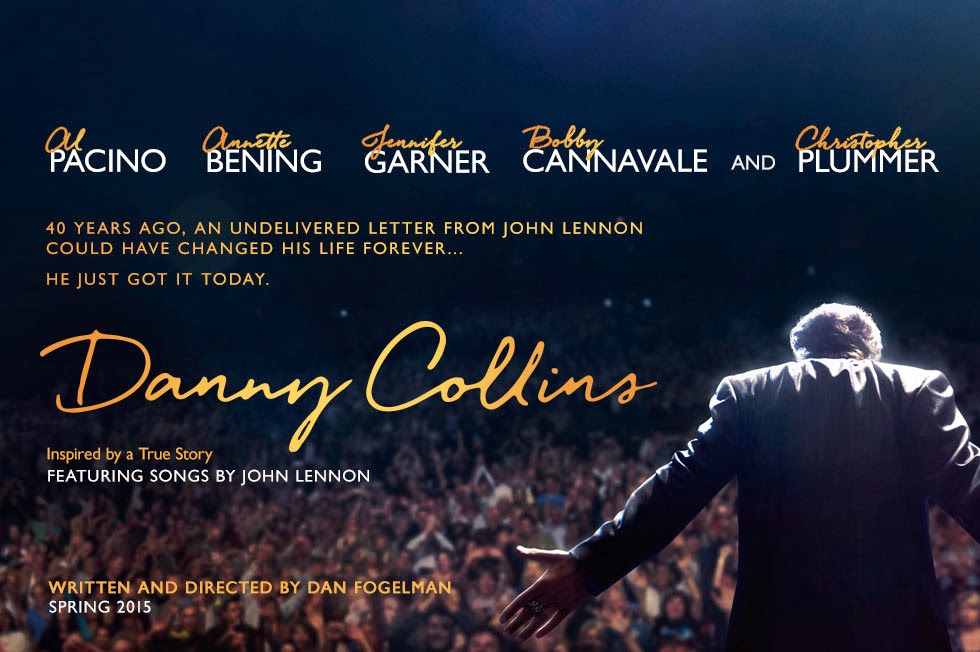
Movie stories often begin with the hero or heroine having everything and then losing it or having nothing and then finding it. But some of the best combine them both, as Writer/director Dan Fogelman (“Cars,” “Tangled,” “Crazy Stupid Love”) has with “Danny Collins,” a heartwarming story of a one time rock star (Al Pacino) who can fill a stadium with his baby boomer fans but has an empty life that even a hot young fiancee and constant partying cannot hide.
And then he discovers that 40 years ago, when he admitted in an interview that he was afraid of becoming successful because it might impair his integrity as an artist, John Lennon sent him a letter saying that it did not have to happen that way and encouraging him to call. The letter never reached him until four decades later, when Collins’ longtime manager and best friend (Christopher Plummer) found it from a collector and bought it as a surprise birthday gift. (This part of the story is inspired by a real-life musician in the UK who did find out 34 years after it was written that John Lennon had sent him a letter almost identical to the one in the film, as we see in the closing credits.)
The letter serves as a wake-up call, instantly connecting Danny to the musician he once was. He cancels his tour, breaks up with the fiancee, and orders his private plane to New Jersey, where he moves into a suburban hotel managed by Mary (a deliciously crisp Annette Bening). He buys a new piano and has it delivered to his hotel room so he can start composing. And he reaches out to the son he has never met (Bobby Cannavale), who lives in New Jersey with his pregnant wife (Jennifer Garner) and young daughter (the delightful Giselle Eisenberg).
It is a treat to see the flamboyant rock star being checked into the numbingly generic hotel by an agog college student (Melissa Benoist of “Whiplash” and the Supergirl TV series) as stunning a transition for him as if he was Alice through the Looking Glass. Pacino is not entirely convincing as a rock star on stage but his genially raffish charm is as endearing to us as it is to the civilians he charms along the way. The highlight of the film is what he calls his “patter” with Mary, a sparkling throwback to the kind of romantic banter that might have been tossed back and forth by Tracy and Hepburn.
Immune to his charm, at least at first, is his son, even after Danny performs some rock star magic to help the family. But that’s what movies are for — to let us see Danny overcome his son’s efforts not to give in, all to the tune of some of Lennon’s most moving songs. And to wonder what we might do differently if we got a long-lost letter from Lennon.
Note: Danny’s catchy song, “Hey Baby Doll” was written by INXS replacement frontman Ciaran Gribbin, selected in a competition with top Hollywood songwriters for a tune that could sound like a real hit from the 60’s.
Parents should know that this film includes rock star behavior including sexual references and nudity, drinking and drug use, and very strong language, as well as family issues including abandonment and illness.
Family discussion: Who would you most like to get a letter from and what would you want it to say? Why did getting the letter make Danny decide to change his life? How often do get to enjoy patter?
If you like this, try: “One Trick Pony” and “The Last Waltz”