Co-writer and star Vince Vaughn brings us what is basically a remake of his “Old School,” a sort of “Revenge of the Un-Nerds” with a little “Legally Blonde,” and a lot from pretty much every story about a group of assorted losers who show the cool kids how it’s done.
Vaughn and his “Wedding Crashers” bro-star Owen Wilson play Billy and Nick, best pals and partners in selling the ultimate in old-school technology, luxury watches. When their company goes under — even the receptionist uses her phone to check the time — it is clear that even the ability to “sell prosciutto to a rabbi,” remembering to compliment the buyer on his daughter’s gymnastics achievements, and a “Get Psyched ” mix with fist-pumping sing-alongs to Alanis Morrisette is no longer a sustainable business model.
It is also clear, with an Adam Sandler-esque notion that any mention of pop culture between 1980-95 is automatically endearing and funny, a complete waste of John Goodman and Will Ferrell, and a dumb joke about a child’s weight that no one is shooting very high, here. It has a numbingly predictable comeback-setback-comeback structure. But as dumb fun, it’s not too bad.
To the surprise of no one who has seen the title, our good-natured but immature watch salesmen apply for the intensely competitive internships at Google. To the surprise of no one who knows anything about the control freaks at Google or the concessions one must make to use the logo and setting of a real-life corporation, Google is portrayed very, very favorably. And to the surprise of anyone who’s ever seen a movie before, Billy and Nick prove themselves to be completely clueless losers but then, when they are put on the team of outcasts, their team spirit and oddball skills will save the day. Even if you haven’t, the English accent of the arrogant bad guy (nicely icy Max Minghella) is kind of a giveaway.
It is all pretty tired, with its fat jokes and crotch hits, and “Flashdance” pep-talks. Then there is an extended portrayal of a drunken visit to a pole-dancing club with lap-dances (three separate shots of the nerd-boy frantically trying to use the hand-dyer on the crotch of his pants) as the ultimate signifier of liberation and empowerment. And really, when will they notice that women can be funny, too? Rose Byrne, so magnificent in “Bridesmaids,” is relegated to the “hyper-competent girl who needs to slow down and enjoy life” role. Vaughn has made a movie about having the courage to adapt to change that is itself stuck in the 90’s. What word would Alanis Morrisette use about that?
Parents should know that this film includes very crude and raunchy humor, strong and vulgar language and explicit sexual references, pole dancers, lap dancing, drinking and drunkenness (portrayed as liberating), and drug humor.
Family discussion: What would be your answer to the blender question? Ask the people in your family about their toughest job interviews.
If you like this, try: “Old School” and “Legally Blonde”
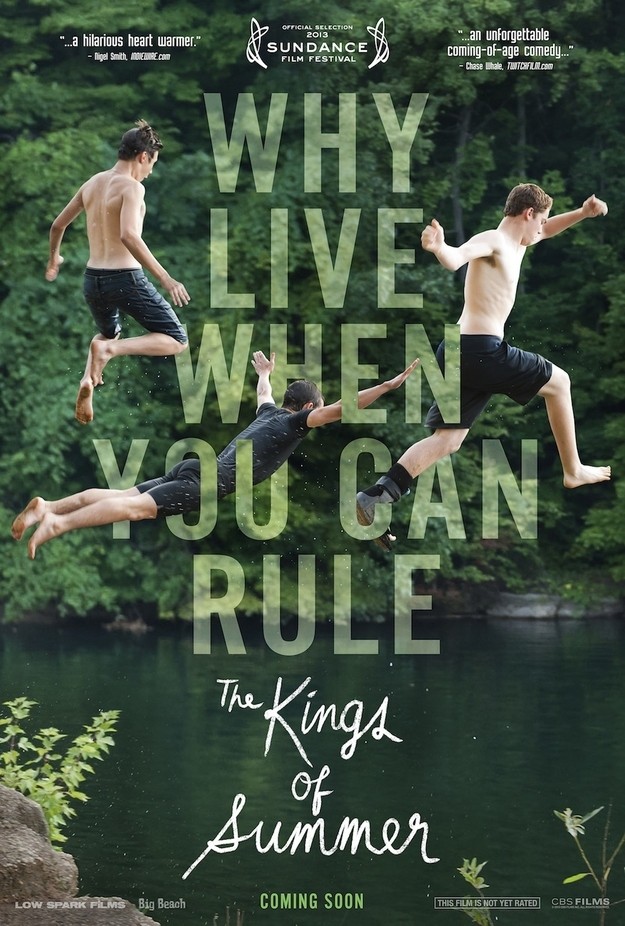
When Mark Twain had Huck Finn leave the kind-hearted widow who hoped to “civilize” him to “light out for the territories,” he tapped into the dream of all teenagers and the teenagers inside all of us to escape from all rules and restrictions and create our lives from scratch. Peter Pan and the Lost Boys had Neverland. Baby boomers sang along with Crosby, Stills, Nash and Young about “trying to get ourselves back to the garden.” Every generation wishes for the simplicity and purity of the natural world. In the wise, touching, and often wildly funny “The Kings of Summer,” three 15-year-olds follow their own call of the wild to run away from home and build a house in the woods. Their parents may see them as boys, but they want a place where they can define what it means to be men.
Nick Robinson, who perfected a look of exquisite pain at the humiliating behavior of his father in a brilliant series of Cox cable commercials, plays Joe Toy. He lives with his widowed father, Frank (“Parks and Recreation’s” Nick Offerman in a witty and heartfelt performance). Of course at that age, a parent does not have to do anything to be excruciatingly embarrassing. It is bad enough that Frank actually exists, but he also has the nerve to tell Joe what to do. Worse, he is dating someone, and worst of all he expects Joe to play a board game with her. The horror!
Joe’s best friend Patrick (Gabriel Basso), is smoldering with his own adolescent fury. His parents say things like, “Rope in the attitude, mister” and just because his ankle is in a cast, they want him to be careful. How dare they! “I’m happy to be where my parents are not,” he says.
Another kid named simply Biaggio (the wonderfully oddball Moises Arias) wants to join them. He does not have any special problem with his family. He just “didn’t want to do nothing.”
Joe, Patrick, and Biaggio build their house in the woods. They breathe the air of free men and rejoice in their liberation from all rules and conventions. They vow “to boil our own water, kill our own food, build our own shelter, be our own men.” If foraging for food in the woods means a stop by the Boston Market across the highway from the forest, well, no one can argue with how good it tastes.
Director Jordan Vogt-Roberts and writer Chris Galletta bring a fresh and sympathetic eye to the story, evoking the pleasure of what feel — for a little while — like endless possibilities. The film perfectly captures that liminal moment when teenagers live in the space between childhood and becoming an adult. And they’re old enough to carry it off, at first. They are young enough to be certain their parents are wrong about pretty much everything — and to be confident that they can do everything better. The house is like something the Lost Boys might build for Peter Pan, with a stolen door from a port-a-potty for the entrance and essentials like a mailbox, a slide, a basketball hoop, and an air hockey table.As is often the case with boys of 15, they look like they are from three different planets. Patrick is muscular and physically much more mature than the others and Biaggio could be 12. Joe is somewhere in the middle. Biaggio’s random and inscrutable pronouncements are amusingly accepted by the other two as if they made as much sense as anything else, or as if making sense did not matter. And of course the most unexpected complication is when a girl comes through the port-a-potty door.
Like that other icon of the dream of escaping the oppression of civilization, Henry David Thoreau, the boys learn that there is a time to go to the woods, and a time to come home.
Parents should know that this movie has very strong and crude language and teen drinking and smoking.
Family discussion: What was the most important thing Joe learned? What about Frank? What would you bring to a house in the woods?
Rated R for some disturbing violent images, language, and sexual material
Profanity:
Some very strong language
Alcohol/ Drugs:
Substance abuse references
Violence/ Scariness:
War violence
Diversity Issues:
Diverse characters, homophobia
Date Released to Theaters:
May 31, 2013
Amazon.com ASIN:
B00CUWL1VI
The internet has made it possible to share all of the world’s knowledge. Sometimes that is a good thing, whether we’re able to track down just the exact item we want at the lowest possible price or make micro-loans to entrepreneurs in emerging economies, tracking down lost friends and family, or crowd-sourcing complex problems. Sometimes it is a bad thing as when personal or embarrassing information we think of as private becomes very public. In essence, it is great when we have access to other people’s information; not so great when they have access to ours.
So, who decides what stays secret? This brilliant documentary from Alex Gibney (“Enron: The Smartest Guys in the Room,” “Taxi to the Dark Side”) explores that question through the stories of two mesmerizing personalities, itself a meta-narrative as the documentarian is exposing the secrets of the secret-sharers.
In 1989, a worm infected more than 300,000 computer systems throughout the world. Like a real-life “WarGames,” it was the work of a smart-alecky teenager. It was Julian Assange, who would grow up to found Wikileaks, a website set up to receive and make public confidential material, protecting the people — whistle-blowers or thieves, depending on your point of view — who provided it.
And then there was Bradley Manning, a private in the U.S. military. Like Assange, he had exceptional computer skills. He had personal and philosophical reasons to be angry at the U.S. government. He was struggling with issues of sexuality and gender identity. He was isolated. And no one thought he was a risk.
The combination was like gasoline and a match, or maybe the Enola Gay and Fat Man. This is the story of two men who think of themselves as following in the tradition of Daniel Ellsberg in exposing the secrets of military operations, while at the same time they are exposing the vulnerability of our systems for keeping information restricted. If what is released brings to light shameful violations of core principles of honor and integrity, is it honorable to make it public? What if it exposes our operations to our enemies?
Gibney’s portrayal is itself a model of even-handed, serious consideration of these issues, as highly principled and professional organizations (the New York Times and The Guardian) play a responsible filtering function in sorting through “a mountain of secrets dumped into the public domain” and providing perspective and judgment, and as Assange and Manning themselves find their own secrets exposed to the world and are charged with crimes that have led to Manning’s being imprisoned under the severest of conditions and Assange essentially a prisoner unable to leave the Ecuadorian embassy in London without being extradited to Sweden to be prosecuted for sexual assault. The film explains that 9/11 was a “watershed moment for the world of secrets,” for both keepers and sharers. There was an unprecedented need to track terrorists and that meant an unprecedented sharing of information. And that meant that a young private had easy access to endless classified material. It was routine for the bored young soldiers to bring in blank CD’s to download music while they worked. It appeared that is what he was doing, but he was downloading hundreds of thousands of documents.
“Was it once not considered patriotic to stand up to our government when it’s wrong?” someone asks. Well, maybe. But not at the time. There is a lot of blaming the messenger for the bad news in this movie, perhaps most sickeningly in the attacks on the women who have accused Assange of abuse. And, as is so often the case, heroes are not the lantern-jawed Boy Scouts we want them to be. That’s in the movies. No fictional story could have come up with the almost sociopathic arrogance of Assange, who likes to brag that “I’m a combative person so I like crushing bastards” or the anguished Manning, whose betrayal of his country is matched by his betrayal by the one person he trusted, an online-only friend who gave his name to the authorities.
The government will always try to control information, whether it is George W. Bush prohibiting the release of images of coffins of dead soldiers or protecting the names of CIA field personnel. The government will aways try to get information, whether it is tracking down Bin Laden or seizing the phone records of reporters. This thoughtful, balanced, essential examination of the clash between privacy and transparency exemplifies the best that intelligence, dedication, and honor can bring to illuminating these issues — and the devastating impact of leaving those decisions to the arrogant and unstable.
Parents should know that this film includes some images of war violence and discussions of sexual assault and gender identity issues.
Family discussion: How do we “destroy corruption?” How do we achieve “a more civilized and just society?” Is there a way to keep secrets? Should there be?
If you like this, try: “The Most Dangerous Man in the America: Daniel Ellsberg and the Pentagon Papers” and “Gatekeepers,” with the former heads of the Israeli secret service revealing their own most classified secrets about shameful episodes in the conduct of their efforts to keep Israel safe.
Please, please don’t call this third entry in the story of Celine and Jesse the final chapter of a trilogy. The audience is almost as invested in them as we are in the stories of the “Up” movie documentary series that has visited a group of English people every seven years since they were children and now shows us how they are doing in their 50′. Those of us who follow the series know their stories almost as well as our own and look forward to the next installment as though it was a college reunion of our friends.
We almost feel that way about Jesse and Celine. They may be fictional characters, but they are so closely connected with the actors who play them and co-write the screenplays that are so intimate, so true to the nature of love in ways that movies seldom approach that it invites us into their most intimate moments, and our own. Most movies take shortcuts when the characters fall in love, giving us a quick, “You’re a fan of that esoteric musician/writer/sports figure no one heard of? So am I!” or just a montage with a pop song while the couple bicycles on the beach and marvels over the choices in an open market.
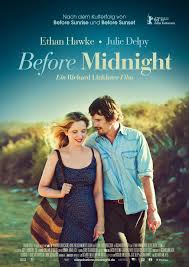
But the first in this series, “Before Sunrise,” was that rarest of films that show us that falling in love is when you start a conversation you never want to end. Jesse (Ethan Hawke), a college student on his last night in Europe before returning to America, impetuously invites a French student named Celine (Julie Delpy) to get off the train and spend the night with him, walking around Vienna. They talk about life, love, and everything and agree to meet in six months and part without exchanging contact information. This was 18 years ago, before texting, tweeting, Google, and Facebook. Writer-director Richard Linklater did not plan to tell another Jesse and Celeste story, though he did include a brief scene with the two of them talking in bed in his animated film, “Waking Life.”
That scene, as marvelous as it was, was non-canon (or, as comic books would say, “an imaginary story”). When we meet them again nine years after their original meeting in “Before Sunset,” they have not seen each other since they said goodbye in Vienna. Like “An Affair to Remember,” one of them was there six months later, and one had a good reason we will find out for not being there. Jesse, married and with a young son, is a writer whose recent novel was inspired by his night with Celine. When he goes to a book signing in Paris, she is there. Once again, he has to catch a plane back to America, and once again they walk through a European city and talk and talk and talk. This time, Hawke and Delpy were credited as co-writers. In the swooningly romantic last moment (spoiler alert), he misses the plane to stay with her.
And now, another nine years have gone by, and they walk around another spectacularly beautiful city, this time on their last night of a working vacation in Greece. Once again, there is a plane returning to America, but this time it is taking Jesse’s son back to his mother, Jesse’s now-ex-wife. It is a wrenching goodbye, in part because Jesse’s son, a young teenager, is so mature and understanding. “It’s like sending him back across enemy lines,” he tells Celine. “This is the one thing I promised myself I would never do.” And then Jesse gets some bad news from home, increasing his sense of isolation from his home.
Jesse and Celine are happily unmarried and the parents of twin girls. In the first movie, they had the excited rhythm of very young people discovering the pleasures of connection. In the second, they had the tentative rhythms of people who knew pain and loss and were struggling to trust again, exploring the possibility of re-connecting. Here, in a long drive from the airport, they talk with the rhythm of people who are deeply connected, laughing, sometimes pointedly, about petty irritations, skirting old wounds. They are comfortable with each other, but struggling to keep a sense of themselves as individuals and as people in love in the midst of domestic chaos. Jesse hates being away from his son, but cannot get custody so he can live with them in France or move back to the United States without disrupting Celine and their daughters.
They have a long, luscious lunch with friends who exemplify every stage of love and talk about meaning and memory and love and art and relationships and the notion of self and the differences between the sexes and the way each generation thinks it is inventing the world and watching it collapse. When they were young, they could not wait and wanted everything to speed up. Now, they want everything to slow down.
Then once again Jesse and Celine go for a long walk and talk, sparing, flirting, testing each other. Their friends have given them every parent’s greatest desire, a night away from the children. They find themselves in a surprisingly generic hotel room, begin to make love, and then enter into the kind of massive meltdown of an argument that only people who know each other very, very well can have. Early in the film, talking about her career, Celine says she is “tired of being a do-gooder that rolls the boulder up the hill” like Sisyphus. We get the feeling that the same applies to the stresses of keeping a relationship strong and intimate when you have to spend so much time scheduling and handing off.
They sit to watch a sunset. Celine says, “Still there, still there, still there….gone.” They know that ahead of them lies loss of all kinds. Will they face it together? There are movies where the sequels are so bad that they reduce your affection for the originals. With this series, each film deepens the meaning and sensibility of the story so that now, taken as one whole, the three (so far) have become one of the most romantic stories in the history of film. I’m counting the days until part four.
Parents should know that this film includes very strong and crude language, sexual references and situations, female nudity, and tense emotional confrontations.
Family discussion: How do the other people who join Jesse and Celine for lunch illuminate the stages of relationships? What do you think will happen to them in the next nine years?
If you like this, try: “Before Sunrise” and “Before Sunset,” the Canadian film “The Barbarian Invasions” and one of the best movies ever made about a relationship over many years, “Two for the Road” with Audrey Hepburn and Albert Finney
“After Earth” goes off the rails in the first minute as Jaden Smith (the “Karate Kid” remake, “The Pursuit of Happyness”) opens the story with a near unintelligible voice-over narration with some mishmash about how a thousand years before all humans were evacuated from Earth because the environment had become uninhabitable (critic on board so far) and then some predatory monsters evolved (still with you) who are blind but track by smelling fear (starting to lose me) and can only be defeated by “ghost fighters” who somehow are not afraid to fight them but still haven’t figured out that with all the cool technology they have invented, it might be good to have some sort of phaser-style assault weapon rather than continuing to fight them with what are basically cavemen-style spears, or technology of 20,000 years ago (critic has left the building). Will Smith has done to Jaden with this movie what Rebecca Black’s parents did to her with “Friday.” At about 50,000 times the cost.
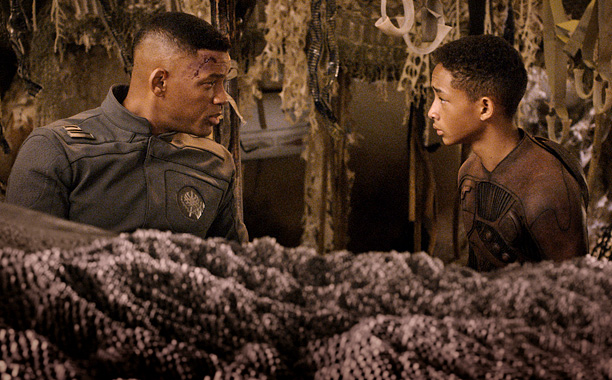
You can see where this comes from. Will Smith is credited with the idea, and it is structured as an allegory for the wrenching moment of parenting he is at with his son, that precarious balance between wanting to protect them and needing them to have the courage, integrity, and skill to take care of themselves. Smith senior plays General Cypher Raige (these names are really over the top), a taciturn, demanding man who has spent more of his son’s life away from home than with him. Jaden Smith plays Cypher’s son Kitai, who, just as his father is returning home is notified that he has not qualified as a cadet. He is desperate to prove himself to his father, but due to a past trauma that will be revealed in great detail, is not sure of himself. Cypher decides the thing to do is to bring Kitai along on movie cliché number three, the “one last mission.” And, in movie cliché number two, something unexpectedly goes very, very wrong. And in movie cliché number one, two people who don’t know each other very well learn to respect and appreciate one another.
The spaceship crashes, everyone else is killed, Cypher is injured badly, and the only way for them to survive is for Kitai to make a very dangerous trip, by himself, to a remote location, so ET can phone home and they can get rescued. This is the part of the movie where the characters lay out the SWOT (strengths, weaknesses, opportunities, and threats), so we can see how they play out over the rest of the story. Are the little ampules for coating the lungs so Kitai can breath absolutely necessary? (Props to the foley team here; the sound these little disks make as he sucks them in are excellent.) Well, somehow Kitai will have to face a shortage. Is the holographic communications system attached to Kitai’s sleeve the only way his father can direct him to the communications disk that is their only hope of calling for help? Somehow it will have to break. And then there are the creatures “all evolved to kill humans” Kitai will run into along the way, plus various other difficulties, one requiring a “Pulp Fiction”-esque injection into the heart.
I have cherished the notion, as M. Night Shyamalan has gone from skillful, absorbing films like “The Sixth Sense” to gimmicky and increasingly self-aggrandizing claptrap (“Lady in the Water,” “The Last Airbender”) that some day we would again see his gift for cinematic storytelling. At times, he has shown an almost Spielbergian understanding of the language of film. But here, even his camera placement is pedestrian. And it is almost as though he sets out to make the worst possible use of his actors. Will Smith’s endless appeal comes from his energy and charm. All of that is tamped down here as he plays a rigid officer who cannot seem to decide if he is talking to his son or issuing orders. Jaden Smith showed himself to be a gifted performer with a nice easiness on camera, but here he is poorly directed. A far better director and a more experienced actor would have a hard time making so much time alone on screen work. Even Tom Hanks had Wilson to talk to. By the time we get to the monster, it is just a relief to know it is almost over.
Parents should know that this film includes pervasive peril and violence, human and animal characters in peril, injured, and killed, some graphic injuries and dead bodies, family member gored by scary monster, snake, spider, falls, and some disturbing images.
Family discussion: How does Moby Dick relate to this story? What do we learn from the way the characters evaluate their resources and options? Do you agree with the General’s distinction between danger and fear?

 Co-writer and star Vince Vaughn brings us what is basically a remake of his “Old School,” a sort of “Revenge of the Un-Nerds” with a little “Legally Blonde,” and a lot from pretty much every story about a group of assorted losers who show the cool kids how it’s done.