Much Ado About Nothing

Posted on June 20, 2013 at 5:59 pm

A-
Lowest Recommended Age: Middle School
MPAA Rating: Rated PG-13 for sexuality and brief drug use
Profanity: Some crude humor and sexual references
Alcohol/ Drugs: Drinking and drunkenness, brief drug use
Violence/ Scariness: Mild peril and skirmishes
Diversity Issues: Brief racial reference
Date Released to Theaters: June 21, 2013
Date Released to DVD: October 7, 2013
Amazon.com ASIN: B00ECR7KX2

MuchAdoJoss Whedon’s take on Shakespeare’s classic tale is swanky, sexy, and sophisticated, as crisp as a dry martini poured from a silver shaker on a summer night.

In many of his best-loved romantic comedies, William Shakespeare sends his mixed-up couples into the woods so they can learn some lessons and straighten out their complicated alliances away from the strictures of society and surrounded by the natural world.  But in “Much Ado About Nothing,” the two couples resolve their mix-ups and misunderstandings at home.

Whedon’s new film version of the play takes that literally. The movie was filmed in the director’s own house.  Whedon had a break in filming “The Avengers” and decided to invite some friends over to  make a movie.  There are scenes in his daughters’ bedroom.  While characters confer in Shakespearean iambic pentameter we can see the girls’ dollhouse, music box, and stacks of stuffed animals.  His kitchen, back yard, and hot tub provide the settings for eavesdropping, plotting, pining, and law enforcement.  Wisely, Whedon had cinematographer Jay Hunter film in a lush black-and-white that gives magic and timelessness to the modern dress and decor.  It seems to dip the proceedings in moonlight, very fitting for the story of two moonstruck couples, one dramatic and one comic, who mirror each other with themes of trust, honor, and intimacy.

Every romantic comedy with witty repartee between initially antagonistic lovers can trace its origins to “Much Ado’s” Beatrice and Benedick, who spend so much energy discussing their dislike for each that other they must be in love.  “There is a kind of merry war” between the couple, a character explains, with a “skirmish of wit” whenever they see each other.

A silent opening scene added by Whedon shows us Benedick (Alexis Denisof of Whedon’s “Angel”) sneaking out after spending the night with Beatrice (Amy Acker, in a performance of striking intelligence and grace).  He thinks she is still sleeping.  She does not let him know that she is watching him leave.  Much later, he returns with his friends the Prince (Reed Diamond) and Count Claudio (Fran Kranz), triumphant after success in battle. He is welcomed by Beatrice’s uncle Leonato (Clark Gregg of “The Avengers”), but not by Beatrice, who mutters, “You always end with a jade’s trick: I know you of old.” We understand what she is remembering.
Their friends conspire to make them fall in love.  They let Benedick overhear them talking about Beatrice’s love for him and when they know she is listening they discuss his love for her.  The next thing you know, the sworn bachelor Benedick has changed his mind about marriage. “The world must be peopled!” he reminds himelf.

Claudio impetuously falls for the lovely Hero (newcomer Jillian Morgese), daughter of Leonato.  The Prince’s bitter half-brother (Sean Maher) tricks him into believing that Hero has been unfaithful.  In the middle of their wedding ceremony, Claudio accuses Hero and storms off.  Claudio is so afraid of his feelings, he clings to the certainty of believing the worst rather than take on the risks of intimacy.

The capable cast is mostly made up of Whedon regulars, with Nathan Fillion a standout as the clueless cop Dogberry, who is a challenge to modern audiences with less tolerance for slapstick and malapropism than the 16th century audience at the Globe Theatre and modern actors who tend to overplay him.  Fillion plays him with a light, understated touch that conveys confusion rather than coarseness.

Whedon brings the same light touch in making the comic couple in every way the heart of the story.  Beatrice and Benedick may be clueless about their own feelings, but they are the only characters who have the wisdom and integrity to understand the injustice of Claudio’s accusations.  That unity of understanding and purpose is as important in sealing their union as their friends’ trick was in revealing that their “merry war” concealed a deep affection. This play about the ability to see through disguise and misdirection has been brought to the screen with wit and style that illuminate its true spirit. 

Parents should know that this film has some bawdy language and sexual references and situations, some drinking and drunkenness, and brief drug use.

Family discussion: Why is it hard for Beatrice and Benedick to admit their feelings?  Why is it easy for Claudio to mistrust Hero and the Prince?

If you like this try: The 1993 version with Kenneth Branagh and Emma Thompson
 

Related Tags:


Based on a play Classic Date movie DVD/Blu-Ray Pick of the Week Remake Romance

New Documentary About the Mysterious, Fascinating J.D. Salinger

Posted on June 14, 2013 at 8:00 am

The author of Catcher in the Rye, one of the most popular and influential books of the 20th century, made no public appearances and published no new writing for the last forty years of his life.  A new documentary reveals extensive new information about his life and, most intriguingly, the prospect that there are files of writing he did over the decades that may be published.  Deadline Hollywood has the first look at the trailer, featuring some of the other top literary figures of the era and writer Joyce Maynard, who lived with Salinger for a short while after he wrote a fan letter about her New York Times article that became the book Looking Back: Growing Up Old in the Sixties.

Related Tags:


Documentary Trailers, Previews, and Clips Writers

Fill the Void

Posted on June 13, 2013 at 6:25 pm

B+
Lowest Recommended Age: High School
MPAA Rating: Rated PG for mild thematic elements and brief smoking
Profanity: None
Alcohol/ Drugs: Drinking and drunkenness, smoking
Violence/ Scariness: Sad offscreen death
Diversity Issues: Role of women in traditional orthodox community
Date Released to Theaters: June 14, 2013

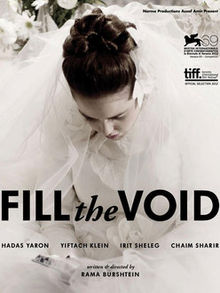
A young woman about to choose the man she will marry is torn between her own desires and the wishes of her devout family, ultra-Orthodox Jews.  We know where the American version of this story would go — the triumph of individual happiness over the antiquated strictures of the community.  But Israel’s official entry for the foreign language Oscar is a sympathetic, layered portrayal, rich with detail, that earns its more complex and resonant conclusion.

Writer-director Rama Burshtein was born in the United States, grew up in Israel in a non-Orthodox home, studied film, and chose to become “baal teshuva” or one who “returns” to the the practice of traditionally observant Judaism.  This movie reflects her deep understanding of both liberal and conservative notions of religious practice as a connection to the divine and the many variations in between.  She is a gifted filmmaker who understands the way the tiniest details tell the story and evokes utterly natural, intimate performances from her actors.  She shows us a world of very strict and demanding tradition, but it is the context for characters who are never caricatured.  They are vividly drawn and portrayed with respect and affection.Fill_the_Void_(2012_film)

Like a Jane Austen novel, the primary concern for Shira (a shimmeringly lovely Hadas Yaron) and her family is a propitious match, and the cultural structures for making this decision are clearly defined.  In this community, young men and women have no opportunities for interaction until they are identified as potential partners by their parents.  Then they have one heart-wrenchingly awkward meeting to decide whether they can spend a lifetime together.  As the invariable small plate of cookies goes untouched, there is no shilly-shallying about what they majored in or their favorite music.  A few simple questions about their aspirations for family life are all they get.

We first see Shira and her mother sneaking a look at a prospective groom in the aisles of a the grocery store.  Shira believes he could be the one.  She is excited and happy.  But then a terrible tragedy strikes.  Her sister, Esther (Renana Raz) dies in childbirth.  And then the widower, Yochay (a smolderingly handsome Yiftach Klein) has an offer to marry a woman from Belgium, which would mean moving there and taking the baby with him.  The only way to keep Esther’s child close to the family is for Yochay to marry Shira.

Suddenly, Shira has to cope with an entirely different set of pressures and an entirely new sense of power.  She has to sort through her feelings without any real opportunity to learn how Yochay is responding.  Could he want her?  Or is he being forced?  What would it be like to be married to someone who has not just been married before, but who was married to her sister?

American films have ranged from clumsy to dreadful in portraying the Orthodox community, with Renee Zellwegger in “A Price Above Rubies” and Melanie Griffith’s “A Stranger Among Us” as notorious failures.  Burshtein’s perspective as someone who chose that life is refreshing in its focus on the lives, relationships, and choices of the characters.  The details of their religious practice draw us in as illumination, not anthropology.  The dynamics of Shira’s parents’ relationship play out in the celebration of Purim, a holiday less observant Jews may think of as a minor celebration for children to wear costumes and shake noisemakers.  For these people, it is also a time to encourage those the community who needs help to ask for it and for those who can to give it.  It is Shira’s father who receives the requests.  But it is her mother who brings the money.  And in the oblique discussions they have about Shira’s choice and the factors to be considered, we see the many layers of family, community, and religious observance twined together.

Parents should know that this film includes drinking and drunkenness and brief smoking.  There is a sad off-screen death.

Family discussion:  What does Shira decide and why?  Do you agree?  Will she be happy?

If you like this, try: “Ushpizin,” another film about the Orthodox community made by a baal teshuva


Related Tags:


Family Issues Movies -- format Spiritual films

Man of Steel

Posted on June 12, 2013 at 6:00 pm

B-
Lowest Recommended Age: Middle School
MPAA Rating: Rated PG-13 for intense sequences of sci-fi violence, action and destruction, and for some language
Profanity: Mild language
Alcohol/ Drugs: Some drinking
Violence/ Scariness: Extensive sci-fi/action violence including acts of terrorism, characters injured and killed
Diversity Issues: A theme of the movie, diverse characters
Date Released to Theaters: June 14, 2013

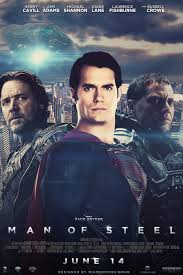
man of steelCome on, guys, can’t you give us one superhero who is not all angsty and conflicted? Director Zack Snyder, who presided over the ultimate superhero deconstruction in Watchmen, and producer/co-screenwriter Christopher Nolan, who put the cinematic “dark” in Batman’s Dark Knight have taken the original superhero, the one all the others are a reaction to, the one who never needed to be reminded that with great power comes great responsibility, and saddled him with an existential crisis.

This is less an updating of Superman than a downgrade.

That is not the fault of British actor Henry Cavill, who plays Clark Kent and Superman with a lot of heart behind that flawlessly heroic jaw, cleft chin, and broad shoulders.  It is the sour tone of the script and the drab look of the film, with completely unnecessary post-production 3D adding a greyish cast over the bleached-out images.

And a reboot really does not require yet another retelling of the origin story.  We all know about the little spaceship sent off from Krypton by Jor-El (Russell Crowe) and Lara (Ayelet Zurer) before the planet exploded, and the baby who was discovered by the childless Kents, honest farmers who called their new son Clark.  Here the re-telling is used to lay the foundation for a battle of former Kryptonians, with towering rage specialist Michael Shannon as General Zod (memorably played in “Superman II” by Terrence Stamp).  A new wrinkle: as in Aldous Huxley’s Brave New World and “Gattaca”, the decadent, depleted Kryptonian society genetically programs fetuses for particular purposes.

In defiance of this system, Jor-El and Lara produce a child the old-fashioned way, the first such birth in generations.  But it is too late.  Krypton has ignored its inconvenient truths for too long.  The world, including technology that features a phone that looks like a talking pomegranate, is about to end.  General Zod, once Jor-El’s friend, rebels, killing Jor-El, and vowing revenge as he and his followers are sent to the Phantom Zone.  (And by the way, the Phantom Zone here is not nearly as cool as the rotating glass plane in “Superman II.”

After the Kryptonian prologue, we get a distractingly disjointed story, beginning with Clark as an adult, saving the day in secret and disappearing before he can be identified.  In flashbacks, we see that Martha Kent (Diane Lane) teaches him how to manage his super-senses without getting overwhelmed.  Jonathan Kent (Kevin Costner) tells his adopted son not to reveal his powers because the world is not ready to understand and appreciate him.  Though he loves his parents, Clark feels isolated and anguished.  He cannot help stepping in when rescue is needed (and in one case when a bully needs a comeuppance), but then he has to move on so his secret cannot be uncovered.

Lois Lane (Amy Adams), spunky as ever (“What can I say, I get writer’s block if I’m not wearing a flack jacket”) finds out Clark’s secret immediately.  She is not someone who is going to be fooled by a pair of glasses and a timid demeanor.  Indeed, one reason this story seems so sterile is that it leaves out some of the core elements of the Superman story.  No kryptonite.  Instead of graceful soaring through the sky, he takes off like a jumping bean.  He does not call himself Superman and is only called it once.  Instead of the iconic bright red and blue uniform, he wears a textured supersuit with a dramatic but not very practical  ankle-length cape.  Edna Mode, where are you when Superman needs you?

Clark keeps his secret, with tragic consequences, until General Zod arrives and insists that Earth surrender its lone Kryptonian.  This leads to a half-hour fight sequence that is ably staged but empty in spirit.  Post-production 3D effects are applied indiscriminately, with the pores of the actors’ skin unsettlingly immersive.  The action is indiscriminate and overblown.  Perhaps some day we will be able to appreciate mass destruction without painful associations.  But here and now, it feels gratuitous.  Clark Kent/Kal-El gets so caught up in his own existential angst he overlooks some complex moral issues in his fight with Zod.  The plot draws too heavily from “Star Trek” (in at least two places) and not enough from Superman’s decades of history.  What about Mr. Myxlplyx?  The City of Kandor?  Bizarro World?  Don’t make Superman into another Dark Knight.  Let Superman be his own super-self.

Parents should know that this film includes extended scenes of comic book-style action violence with fights, chases, explosions, tornado, planet annihilated, sad deaths of parents, crashes, and massive city-wide destruction. Many characters are injured and killed including fetuses. There is a non-explicit childbirth scene, some strong and crude insults, and some drinking.

Family discussion: Was Clark’s father right to tell him to keep his powers secret, no matter what the cost? How does this Superman differ from other portrayals and why? Is morality an “evolutionary advantage?” What would you pick for the symbol of your house?

If you like this, try: “Superman” and “Superman II” and the new book about the teenagers who created the character of Superman: Super Boys: The Amazing Adventures of Jerry Siegel and Joe Shuster

Related Tags:


3D Action/Adventure Comic book/Comic Strip/Graphic Novel Fantasy Movies -- format Remake Superhero
THE MOVIE MOM® is a registered trademark of Nell Minow. Use of the mark without express consent from Nell Minow constitutes trademark infringement and unfair competition in violation of federal and state laws. All material © Nell Minow 1995-2026, all rights reserved, and no use or republication is permitted without explicit permission. This site hosts Nell Minow’s Movie Mom® archive, with material that originally appeared on Yahoo! Movies, Beliefnet, and other sources. Much of her new material can be found at Rogerebert.com, Huffington Post, and WheretoWatch. Her books include The Movie Mom’s Guide to Family Movies and 101 Must-See Movie Moments, and she can be heard each week on radio stations across the country.

Website Designed by Max LaZebnik