The Company You Keep

Posted on April 11, 2013 at 6:13 pm
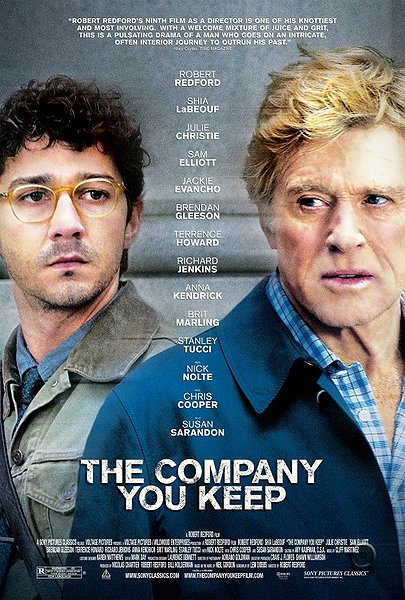
I can’t help thinking that even though this movie is based on a novel by Neil Gordon, it is primarily a trip down memory lane for director/star Robert Redford.  Shia LeBeouf plays Ben, an idealistic investigative reporter a la Redford in “All the President’s Men.”  Redford himself plays a “Three Days of the Condor”-style guy on the run from the government and the aging radical living under another name from “Sneakers.”  There are the buried family tensions of his first filmas a director, “Ordinary People.” And let’s not forget — no matter how much we try — the long debates about philosophy and policy in his last directing/starring movie, Lions for Lambs,  For a moment, I thought he was going to jump off a cliff a la “Butch Cassidy and the Sundance Kid.”

There’s nothing wrong in wrestling with the same themes, especially themes as meaty as the conflicts between our larger responsibilities as citizens and our responsibilities as family members and friends and when the ends justify the means — or when the means just make you into the same kind of bad guy as the people you are fighting.

Redford plays a single dad and small town lawyer who, it turns out, has been living under an assumed name for longer than he lived under his own.  When a suburban mother of two teenagers (Susan Sarandon) turns out to be a long-missing fugitive sought by the FBI for her role in a bank robbery that led to the felony murder of a guard (himself a father of two children).  The robbery was the last act of a splinter group from the anti-war Weather Underground.  (Apparently, this fictional theft was inspired by the 1981 Brinks robbery by members of the Weather Underground and Black Panthers.)

Ben, a reporter at a failing newspaper called the Albany Sun-Times, does some research and discovers that the man known as Jim Kent (Redford) is really Nick Sloan, also a fugitive accused of participating in the robbery.  Jim/Nick leaves his 11-year-old daughter (singing sensation Jackie Evancho, sweetly natural) with his brother (Chris Cooper), and goes on the run, contacting the old gang (including Nick Nolte, Richard Jenkins, and Julie Christie), none of whom are very happy to see him.

Meanwhile, both the FBI (Terrance Howard and Anna Kendrick) and the reporter are chasing after Jim/Nick with all kinds of high-tech surveillance (FBI) and looking at old microfilms for the kinds of esoteric newspaper archives and property records that are not even online (reporter).

There is some talk about protest here, with a pause for a professor’s lecture to his class about determination to make absolutely sure we do not miss the point.  And there is more talk about parents and children and how they change the calculus of responsibility and a great big metaphor of a character who is supposed to represent all of that.

Like “Lions for Lambs,” this is a talky film, but the balance this time is more on the side of story, and the non-stop parade of top-tier actors hold our interest.  The title is as much about our relationship as long-term fans of these masterful performers as it is about the characters who have been hiding out as they come to grips with their failures and betrayals.

Parents should know that there are glimpses of wartime and protest violence and characters use strong language.  The movie includes drinking and drug dealing.

Family discussion: How did having children make people evaluate their options differently?  Do you agree with Ben’s decision at the end?  How did the characters show their different ideas of loyalty?

If you like this, try: “Running on Empty” and “Steal This Movie”
Related Tags:


Not specified

Trance

Posted on April 11, 2013 at 6:00 pm

B
Lowest Recommended Age: Mature High Schooler
MPAA Rating: Rated R for sexual content, graphic nudity, violence, some grisly images, and language
Profanity: Very strong language
Alcohol/ Drugs: Drinking
Violence/ Scariness: Violence and peril with guns, fire, chases, car accident, taser, choking, and torture, some very disturbing images, characters injured and killed, graphic wounds, dead bodies
Diversity Issues: Diverse characters
Date Released to Theaters: April 12, 2013
Date Released to DVD: July 22, 2013
Amazon.com ASIN: B00D3DJI3Q

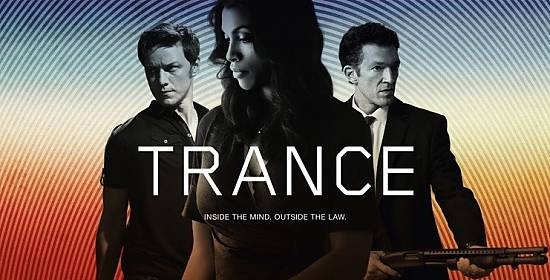
Before he was the establishment figure who won Oscars for prestige projects (“Slumdog Millionaire”) and masterminded the fabulous opening ceremonies for the London Olympics that had the Queen and James Bond jumping out of a plane, Danny Boyle was a skillful director of highly styled and deliciously nasty films about not-so-deliciously nasty people doing dreadful things (“Trainspotting” and “Shallow Grave”).  His latest is “Trance,” a deliciously nasty heist film about the theft of a 27 million dollar masterpiece by Goya, tellingly titled Witches in the Air, and about the mistrust and betrayal that comes next.

Part of the fun comes from having our assumptions turned upside down — and then inside out.  So I don’t want to give too much away.  The title comes from a hypno-therapist named Elizabeth (the stunningly beautiful Rosario Dawson),  brought into the den of thieves because one of them has misplaced the painting and, thanks to a head injury, cannot remember where he stashed it.  The problem faced by alpha-thief Franck (ferret-like Vincent Cassel) is how to arrange it so that Elizabeth can get inside the amnesiac’s head to find the missing painting but not let her find that that by doing so she is abetting a rather notorious crime.  Dawson, too often underused, gets a chance to show what she is capable of in a performance of intelligence and subtlety.  As she explained in an interview, “I wanted to be specific on who she was and make her disappear at the same time.”

The film itself becomes a sort of trance, with deeply saturated colors that shimmer like a dream, and Dawson’s magnetic voice.  We, like the characters, must begin to mistrust what we see and what we think we know as the story turns upside down, inside out, and then, as soon as we think we’ve figured it out, Rubik cubes our minds again.  This is a movie you’ll be talking about on the way home, and probably shivering about in your own nightmare.

Parents should know that this film includes sexual references and explicit situations, very explicit nudity, violence including guns, taser, car accident, torture, fire, characters injured and killed, disturbing and graphic images, very strong language

Family discussion: What do the title and subject of the stolen painting have to do with the story? What do you think will happen next?

If you like this, try: “Inside Man” and “Side Effects”

Related Tags:


Crime Drama DVD/Blu-Ray Pick of the Week

To the Wonder

Posted on April 11, 2013 at 5:51 pm

B-
Lowest Recommended Age: Mature High Schooler
MPAA Rating: Rated R for some sexuality/nudity
Profanity: None
Alcohol/ Drugs: Drinking
Violence/ Scariness: Tense confrontations
Diversity Issues: None
Date Released to Theaters: April 12, 2013
Amazon.com ASIN: B00BU22HCQ

Director Terrence Malick has made a movie for those fans who loved “Tree of Life” but thought it was too linear and easy to follow.

“To the Wonder” is an impressionistic story of love and loss.  Theoretically it stars Ben Affleck, Rachel McAdams, Javier Bardem, and Olga Kurylenko, but in reality the star is the sun,.  It seems to be the focus of almost every exquisitely framed shot, with sunlight flaring always just so through the meticulously arranged tree branches behind the beautiful woman who loves to twirl.  This movie has a lot of sunlight and a lot of twirling.  Also a lot of what I will call affectionate rough-housing, which I think — can’t be sure about anything here — is the primary, if middle-school-ish, way these characters indicate that they like each other.

It does not have a lot of dialogue, and what conversations we do overhear are almost incidental.  The talk we hear is mostly the murmured, diary-like narration of a French single mother who falls in love with an American and brings her daughter to live with him in a barren house in a barren landscape that is in sharp contrast with the “wonder” of the rich environment she left behind.  Malick seems to have a devilish pleasure in withholding information.  The daughter, Tatiana, is the only character whose name we are allowed to know.

It is maddeningly opaque at times but undeniably lyrical.  It does not just break free from narrative; it explodes it into an almost-pointillist kaleidoscope of images, whispers, and detours.  Where “Tree of Life” had a dinosaur, “To the Wonder” has a zig into an underwater scene with sea turtles before it zags into a separate segment (I can’t say story) about a sad priest (Bardem).

If is more tone poem than movie, it is an intriguing one, touching on themes of connection and disconnection, love and betrayal, at the level of society and individuals.  At times it is annoyingly opaque, but there are also moments of stunning beauty.  If he continues down this road, Malick’s next movie will be delivered to the theater in individual frames, to be tossed toward the screen in random order, and many of them will feature sun flares.  But I’ll still go to see it.

Parents should know that this movie includes sexual references and situations, briefly explicit, including adultery, nudity, smoking, and drinking.

Family discussion:  Why is the story told through narration instead of dialogue?  How does the issue of contamination of the soil and water relate to the story?  Why is the house unfurnished?

If you like this, try: “Tree of Life”


Parents should know that this movie includes some nudity and explicit sexual situations, including adultery.  Characters drink alcohol.

Related Tags:


Drama Movies -- format

42

Posted on April 11, 2013 at 12:08 pm

B+
Lowest Recommended Age: Middle School
MPAA Rating: Rated PG-13 for thematic elements including language
Profanity: Racist epithets, crude and ugly insults, some additional strong language (s-words)
Alcohol/ Drugs: Drinking, smoking
Violence/ Scariness: Threats of violence, some scuffles, some injuries
Diversity Issues: A theme of the movie, brief homophobic humor
Date Released to Theaters: April 12, 2013
Date Released to DVD: July 15, 2013
Amazon.com ASIN: B009NNM9OA

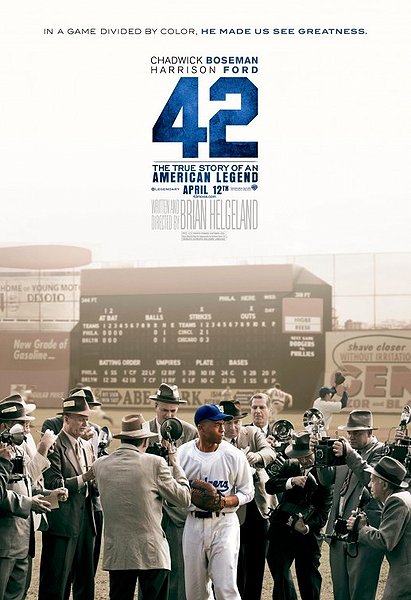
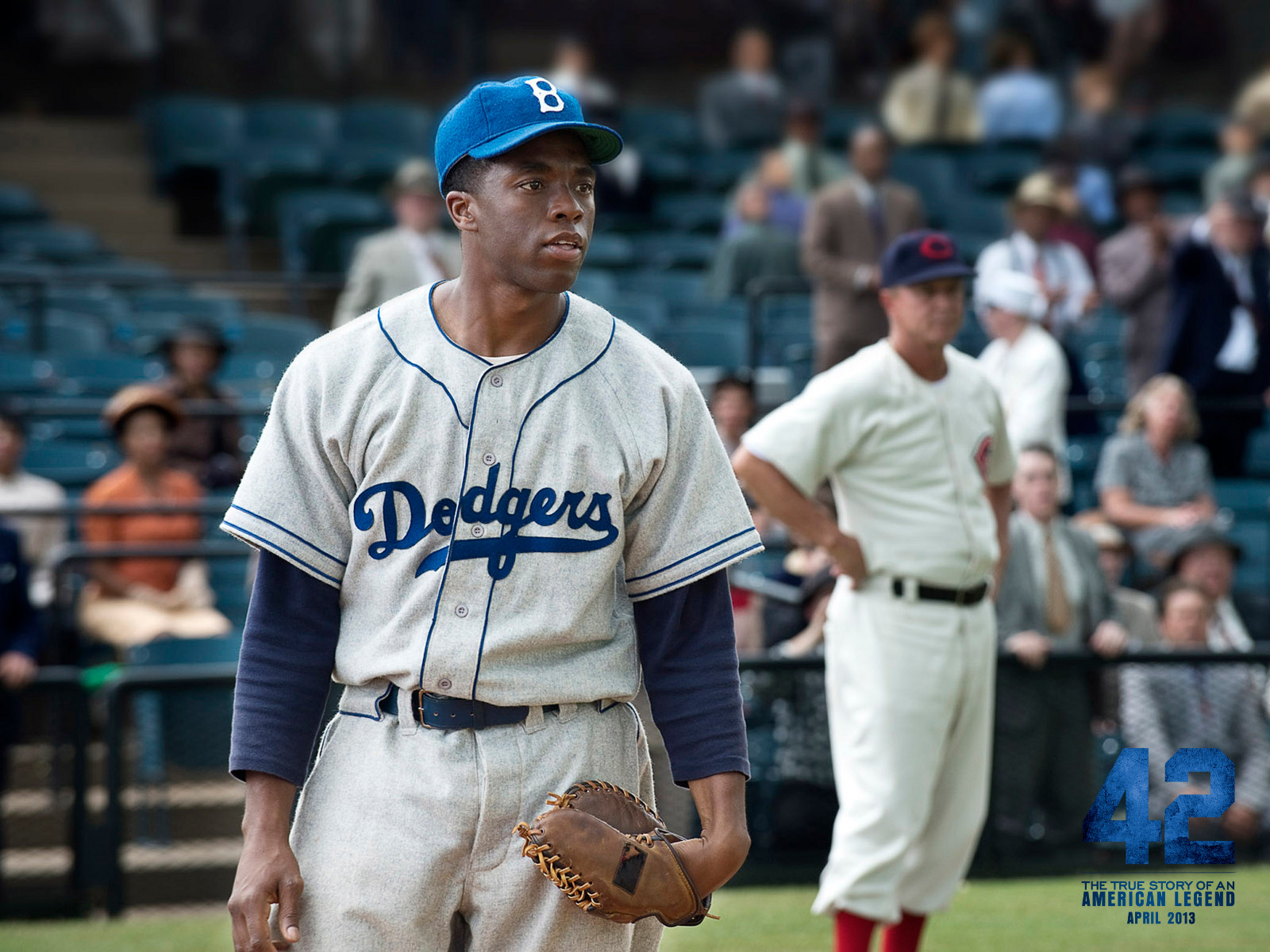
Jackie Robinson was the first black man to play major league baseball. His number, 42, is worn by every player once a year to commemorate his achievements as a baseball player and as a man.  This version of the story of the year the Brooklyn Dodgers broke the color barrier in baseball from writer/director Brian Helgeland is a little superficial, it still packs a lot of power, thanks to an evocative sense of its period and star-making performances by Chadwick Boseman as Robinson and Nichole Beharie as his wife.  If what we see is a small part of the courage and integrity of this extraordinary man in taking on the virulent racism of his era, it is still enough to make this movie deeply moving.

It is just after the end of WWII.  Black soliders returned home from fighting for freedom on behalf of a country that was still segregated, from the separate fighting divisions in the military to the “Whites Only” laws of the Jim Crow South.  Brooklyn Dodgers manager Branch Rickey (a cigar-chomping Harrison Ford, in full growl) decides it is time to integrate baseball.  He needs to find a player who is not only an athlete of unquestionable ability but someone who has the temperament to stay cool despite the constant attacks he will face from his own team, opposing teams, and the fans.  Rickey decides that Roy Campanella was too sweet and Satchel Paige was too old (both would follow Robinson into the major leagues).

Rickey picked Robinson.  He had the skill, he has played with white teammates in college, and he is tough.  He was courtmartialed  for refusing to go to the back of a military bus — and won.  Rickey asks Robinson, “Can you control your temper?” “You want a player that doesn’t have the guts to fight back.” “I want a player who has the guts not to fight back.”  Rickey knows that no matter what the provocation, any show of temper from Robinson will only give ammunition to the bigots.  What would be called “spirit” in a white player will be called something different coming from him.

It is solidly entertaining, delivering all of the expected notes, and if it seems heavy-handed to anyone old enough to remember a time before the Montgomery bus boycott and the passage of the Civil Rights Act, it is perhaps understandable that Hollywood does not take for granted that younger audience members remember there was once a time when segregation was not only legal; it was the law.  It harks back to the Sidney Poitier era of saintly black characters, which is understandable.  But it is a movie about tolerance that cannot resist a homophobic joke about teammates showering together, which is not.

Parents should know that this movie features frank portrayals of bigoted behavior including a stream of racist invective, with crude insults.  There are some sexual references, including adultery.  Characters drink and smoke, and there are some scuffles and injuries.

Family discussion:  Why was Jackie the best choice to be the first?  How did he challenge the beliefs of his teammates?   Read more about Jackie Robinson.


If you like this, try: “The Bingo Long Traveling All-Stars & Motor Kings,” Ken Burns’ “Baseball” series, “Brian’s Song,” and “A League of Their Own”

Related Tags:


Based on a true story Biography Drama DVD/Blu-Ray Pick of the Week Spiritual films Sports

Interview: Chadwick Boseman of “42”

Posted on April 11, 2013 at 8:00 am

Chadwick Boseman plays Jackie Robinson in “42,” this week’s release about the first black player in major league baseball in the modern era.  Robinson’s extraordinary talent and grace under pressure was a powerful rebuttal to the racism that perpetuated segregation in sports and throughout American society.

Boseman spoke to a small group of journalists about preparing for the role and what it was like to work with Harrison Ford, who plays Branch Rickey, the man who offered him a job with the Brooklyn Dodgers.  He did not originally intend to become an actor.  He studied writing and directing.  “As a director, it is important to understand the actor’s process.  So, I took the acting courses at first for that, and then continued just because I caught the acting bug.  For me, they go hand in hand, but it was a gradual process.”

He told us that one of the challenges of the film was that he didn’t just have to play baseball; he had to play it the way they played it in the 1950’s.  “The uniforms changed!  What’s different is the tools, the gear, the bats were a lot heavier.  Not that you would know it from looking at the bats, but you can see it in the swings.  There’s not many hitters that have Jackie Robinson’s swing now.  It appears to be an unorthodox swing when we see it today.  The gloves are different and using those old gloves changes the way you play.  It’s fundamental to use both hands to get a ground ball if you can.  You can see why that’s the case with those old gloves, because you can’t depend on catching anything with one hand.  There’s no pocket.  When they say ‘Make a pocket,’ you have to literally make that pocket.  And shoes have come a long way.  That was one of the hardest parts of the physical aspect of the movie, wearing old-style cleats, take after take.  We went through four or five different sets of cleats and it took my feet a few months to heal.  I would get up in the morning even three or four months after we were done and I would still feel like I had cleats on.  It was like running on nails.  But the game is pretty much the same game.  And it has to be, that’s part of the mystique.  Baseball is about tradition and the scorecard.  You’re measuring players from the past against players now and if the game changed too much you can’t judge this person’s monumental home run season against another.  It’s about the stats.  The game is the game.”

He talked about how the athletes that have “reached that iconic status” have to be able to rise to that clutch moment.  “He had to live his live in the clutch.  It was never mundane because he was always getting judged on a different level.  You have to cherish things in a different way when you know the clock is ticking, you are under pressure.  It’s still human, it’s still detail, it’s still subtle like any other character, but the context that surrounds you has elevated.”  He prepared for the role by playing a lot of baseball, with practice five days a week, plus conditioning five days a week.  “That’s the physical part but there’s also the mental part of it, too.  While you’re out there, failing and succeeding, you get a sense of the kind of pressure he really is under.  You can’t play the role unless you know what it’s like to have the ball coming at you and it’s your assignment.  Baseball is a game of assignments.  From here to here, that’s your ball.  It’s the other guy’s job to cover you.  Or it’s your job to cover somebody else, or whatever it is.  You have to play it to get how much pressure this person is under and how that emotionally affects him, how a mistake could get in his head, how much having his teammates look down on him affect him.  I tried to figure out what he was thinking moment to moment because a lot of things he can’t say.”   He watched footage of Robinson and the Ken Burns series on the history of baseball.  He had to understand what the game was to the other players, too.  “I tried to take in as much as I could.”

“He was an opinionated, assertive, outspoken person.  That’s who he was.  This person, who would come to blows — not prone to fight but doesn’t back down from anyone, not the person to run from a fight” was put into a position where he had to hold it inside.  “He was not a passive person so you cannot play him passively.  You find the most active non-verbal choices.”

After playing two athletes (he also appeared in the fact-based football drama, The Express), he says he’s ready to try something else. “Maybe a musician.”

He said it was “amazing to work with a legend” sharing scenes with Harrison Ford.  “You get to see the shortcuts that they take.  Like Jackie’s swing.  He’s gotten to the point where he looks like he’s skipping stuff but he’s just short-circuiting it.  You’re like, ‘How’d you do that?’  He has a feel for the set, so in tune with all the equipment and knowing how to facilitate the process and that’s a fun thing to watch.  He doesn’t cherish this role any less than anything else he’s done.”

Related Tags:


Actors Interview
THE MOVIE MOM® is a registered trademark of Nell Minow. Use of the mark without express consent from Nell Minow constitutes trademark infringement and unfair competition in violation of federal and state laws. All material © Nell Minow 1995-2026, all rights reserved, and no use or republication is permitted without explicit permission. This site hosts Nell Minow’s Movie Mom® archive, with material that originally appeared on Yahoo! Movies, Beliefnet, and other sources. Much of her new material can be found at Rogerebert.com, Huffington Post, and WheretoWatch. Her books include The Movie Mom’s Guide to Family Movies and 101 Must-See Movie Moments, and she can be heard each week on radio stations across the country.

Website Designed by Max LaZebnik