Greetings from the campus of the University of Illinois at Champaign-Urbana, where the 17th annual Roger Ebert Film Festival is underway. I am delighted to be appearing on a panel of very distinguished film critics this morning and will post a link when it is online. Yesterday I was thrilled to see one of my favorite films, “Moving Midway,” followed by a discussion with the director, Godfrey Cheshire and, via Skype, his cousin, Professor Robert Hinton.
Copyright Nell Minow 2015
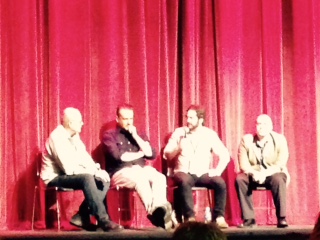
We then got a special treat, a pre-release screening of “The End of the Tour,” directed by James Ponsoldt (“The Spectacular Now,” “Smashed”), and starring Jason Segal as David Foster Wallace. Ponsoldt and Segal discussed the film afterward with Rogerebert.com editor Brian Tallerico and festival director Nate Kohn. Segal told us his biggest challenge in making the film was in the scenes with Wallace’s dogs — “having to do serious acting with salmon down my pants.”
Today I am especially looking forward to one of my favorite Ebertfest traditions — a silent film with live musical accompaniment from the Alloy Orchestra.
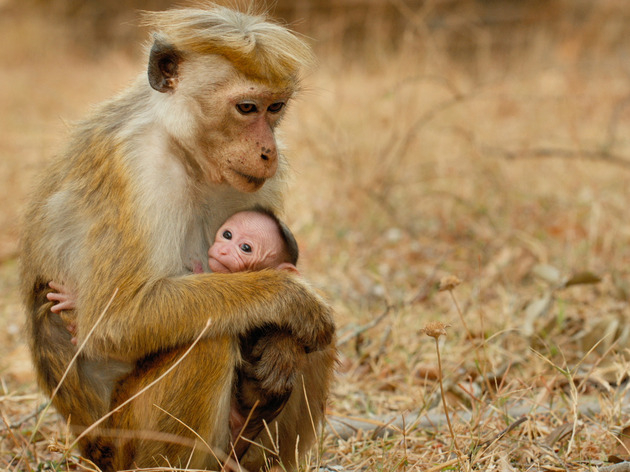
Disneynature’s annual wild kingdom-style nature documentary is predictably adorable but surprisingly absorbing. The toque macaque monkeys of Sri Lanka live in the 12th century ruins of Polonnaruwa in a society as rigidly structured and ruthlessly enforced as a high school cafeteria run by the mob.
After a chipper rendition of “Hey Hey We’re the Monkees” with an extra verse from former Monkee Micky Dolenz, Tina Fey’s warm and reassuring narration takes over, explaining the literal hierarchy of the monkeys, whose status is reflected by their position on their castle rock. “An intricate society of 50 monkeys band together in a strict social order.”
At the top is the alpha male, Raja, and under him are his male lieutenants/enforcers and three females known as the sisters, whose primary occupations are eating the best food and caring for Raja. Every element of the society — where the monkeys sit and sleep, what they may eat, who they may interact with — is clearly established and strictly enforced.
After we get the sense of the social structure, Fey introduces us to Maya, a young female at the bottom of the hierarchy who will be our hero throughout the story. She is a single mom with a son named Kip and since she is precluded from the literal easy pickings of the fruit tree reserved for the elite only, she has to be adventuresome and imaginative in finding food for them. Kip’s father Kumar is an outcast from his original tribe and, for showing interest in Maya and showing no fealty to Raja, from this one as well.
When a rival tribe invades, Raja’s luxurious lifestyle has left him unprepared to win a battle. The entire group is homeless. Maya and Kumar, who has returned, have skills that are suddenly valuable, even vital, for the survival of the monkeys. Maya helps them get food from the nearby town. Can Kumar help them reclaim Castle Rock?
Like all of the series, this is filled with “how in the world did that get that?” moments of extraordinary intimacy and power, like Maya’s tenderness with Kip, her harvesting of the termites who fly in just one day a year, and the monkeys’ interaction with other species, including a mongoose, a langur monkey, a monitor lizard, and, to their utter and hilarious mystification, a dog. Children will enjoy the hijinks, especially the monkey invasion of an empty school, where they discover snacks and a birthday cake. The predators and perils are gently presented and the issues of status and power are described in a manner that is open and accessible. Once the cheery but corny introductory song is over, this chapter avoids some of the cutesiness that marred previous releases. And the drama of the social structure is so intricate and abashedly familiar it will remind all of us to be a little kinder to those we consider beneath us and a little more willing to challenge the Rajas in our lives.
Parents should know that there are scenes of confrontation and predators, with some minor characters injured and killed and brief, discreet images of dead animal bodies.
Family discussion: What skills did Maya and Kumar have that were important to their group? How are the monkeys like and not like humans? How many ways did you see the monkeys communicate with each other and the other animals? How should Maya treat the Sisterhood and the lower-status monkeys?
If you like this try: the other Disneynature films, including “Chimpanzee,” “African Cats,” and “Bears”
Rated R for graphic nudity, language, sexual references and some violence
Profanity:
Very strong language
Alcohol/ Drugs:
Drinking and drug use, intoxication
Violence/ Scariness:
Violence and peril, characters injured and killed
Diversity Issues:
Diverse characters
Date Released to Theaters:
April 17, 2015
Date Released to DVD:
July 14, 2015
Amazon.com ASIN:
B00XI057M0
Copyright A24 2015
Movies about artificial intelligence or computers achieving consciousness are, of course, really about what it means to be human.
When software and hardware combine to mimic or exceed human qualities in “Her,” “Chappie,” “2001: A Space Odyssey,” “Terminator,” or the upcoming Avengers sequel, even “Planet of the Apes,” it is a way to think about what it is that defines us. Alan Turing of “The Imitation Game” used our ability as humans to recognize each other as the famous Turing test to determine whether artificial intelligence has been created. The test is passed when a person cannot tell whether the entity on the other side of a conversation is human. If we cannot tell the difference, then we have to rethink our exceptionalist notions of human supremacy. We accept, sometimes reluctantly, the notion that computers are vastly superior in computation and memory, that they can whomp us in chess or on Jeopardy. But can a machine achieve what we think of as consciousness? Or conscience?
Caleb (Domhnall Gleeson) is a computer programmer who gets the equivalent of Charlie Bucket’s golden ticket. He wins a chance to spend a week at the home of the brilliant founder of his company (think Steve Jobs), a man who at age 13 invented the most powerful search engine and now lives in a home so remote that a helicopter flies over the thickly wooded property for two hours before they reach the residence. They are in the middle of nowhere. (The film was made at the stunning Juvet Landscape Hotel in Norway.)
Nathan (Oscar Isaac, all brutish charm, feral, and entitled, with shaved head and beard), welcomes him with a rough candor, explaining that he is hung over, and giving Caleb a keycard, so that he will have access to those parts of the home where he is welcome and be kept out of those where he is not. It turns out he has been brought there for a purpose. Nathan has been working on what he describes as the greatest scientific advance of all time. He is not creating a robot. He is trying to create life. He wants Caleb to perform the Turing test on his latest creation, named Ava (Alicia Vikander of “Anna Karenina”).
But it turns out that it may not be Ava who is being tested.
Ava is gorgeously designed. Nathan admits that he created her to be intensely appealing and she is, both her humanoid face and her transparent neck and midriff that allow us to glimpse her mechanics. Vikander gives her a tentativeness and innocence, with a sweet seriousness and (at least at first) an endearing wish to please. She tells Caleb to wait while she gets a surprise and it turns out to be clothes that cover up the machinery so well that it is not just the human part of Caleb that recognizes her as a part of the same species; it is the depths of the lizard brain instinct. We may have wondered why Nathan’s test was conducted in a glass box that separates Ava and Caleb. Perhaps it was to prevent him from abandoning the Turing test for a more animalistic evaluation based on smell and touch.
There is that always-compelling hubris/Frankenstein/Jurassic Park/sorcerer’s apprentice element of foolish, narcissistic grandiosity in creating something out of a grant vision without appreciating how dangerous it will be. Something always goes wrong. And anyone who does not realize that does not really understand that part of the essence of humanity, for better and worse, is the chasm between our ability to dream and our ability to execute.
First lesson: Isaac Asimov was right. Second lesson: the qualities of human-hood go beyond syntactical complexity and conversational non-linearity. To be human means independence of thought and action, and the pesky thing about independence is that it overlaps with rebellion. We know computers can outsmart us. Can they out-human us, too? Is it any wonder that Caleb flays his own arm just to check that what is inside is not made of gears and chips?
Screenwriter Alex Garland (“28 Days Later,” “Sunshine,” “Never Let Me Go”), directing for the first time, has an eye for gorgeous visuals and a superb sense of balancing the future-wow with the ordinary to make his sci-fi-style extrapolations amplify and illuminate who we are.
Parents should know that this film has very strong language, substance abuse, explicit nudity and sexual situations, and violence.
Family discussion: What is Ava’s most human quality? What is Nathan’s least human quality?
If you like this, try: Read up on the Turing test and watch movies like “A.I.” and “Her”
A reporter in disgrace for fabricating details of a story sits across the table from an orange-jumpsuited prisoner, accused of murdering his wife and three children. They have more in common than either of them expected. They are both outcasts. They are both unable or unwilling to explain their actions.
And they both used the name Michael Finkel. The reporter was given that name at birth and it appeared on the byline of his stories in the New York Times Magazine, including the one that cost him his job and his reputation. The man who murdered his family used that name when he fled to Mexico to escape capture. The real Michael Finkel, in seclusion at his home in Montana following his humiliating dismissal, got a phone call when the murderer was arrested, asking him for comment. With nothing else to do, and with the thought that this might be the kind of big story that get him back to a job in journalism, the real Michael Finkel, or as real as sometime just fired for lying can be (Jonah Hill), drove to Oregon to visit the man who was accused of killing his family. His real name, by the way, was Chris Longo (James Franco).
Co-writer/director Rupert Goold has a lot of ideas to explore in this film, and some work much better than others. The focus should be on the parallels between the two men, what links them, the ways they tried to use each other, and the resentments and differences that separate them. But Goold wastes Felicity Jones (“The Theory of Everything”) as Finkel’s girlfriend, with distracting diversions like an ominous shot of her running (for exercise) through the woods. She does as well as possible with a scene where her character confronts Longo, but it is artificial and stagey.
Franco perfectly captures the superficial charm that occasionally slips to reveal fierce underlying anger and self-justification. Hill is a bit out of his depth, or more likely the Finkel character is underwritten. We should be able to see his anger and self-justification, too. And he is lost in the scene where he is grappling with a moral dilemma or trying to consider the rights of anyone but himself. He is better at showing us Finkel’s arrogance and his need for approval. When Longo says he took Finkel’s name because he was a fan, Finkel is unabashedly complimented. After his humiliating dismissal, he gravitates toward approval like a moth toward a flame. And we know how that turns out.
The ironic title reminds us that we can never really know the true story; there are always too many conflicting versions, too much that is just unknowable. And yet the difference between Finkel, who violated the most fundamental principles of journalism by combining the details of the Africans he met to tell it as a story about one individual, and the movie of his own story is that fiction is supposed to convey larger truths. It is not at all clear that this one does.
Parents should know that this film concerns the murder of a wife and children. There are some disturbing and grisly images, as well as child slavery and discussion of beatings, deception, some strong language, and drinking.
Family discussion: Why did Jill visit Chris? How did Chris and Mike try to con one another and who was most successful?