
Satisfied
Posted on November 3, 2025 at 4:39 pm
B +| Lowest Recommended Age: | High School |
| MPAA Rating: | Rated PG-13 |
| Profanity: | Mild language |
| Alcohol/ Drugs: | None |
| Violence/ Scariness: | Discussion of miscarriages and fertility issues, scenes in hospital |
| Diversity Issues: | A theme of the movie |
| Date Released to DVD: | November 4, 2025 |
The “Hamilton” song “Satisfied” is sung by a character who is not at all satisfied. The sister she loves is marrying a man she loves, a man who himself, in the words of the song, is never satisfied. She sings,
A toast to the groom, to the bride
From your sister who is always by your side
To your union and the hope that you provide
May you always be satisfied
And I know she’ll be happy as his bride
And I know he will never be satisfied
I will never be satisfied.
The character who sings that song is Anjelica Schuyler, originated in the workshop as the show was developed, its off-Broadway premiere, and then when it was transferred to Broadway, by Renée Elise Goldsberry. This documentary is her story, about the two transcendent goals of her life: to be a mother, and to have a career as a performer, and the way they collided.
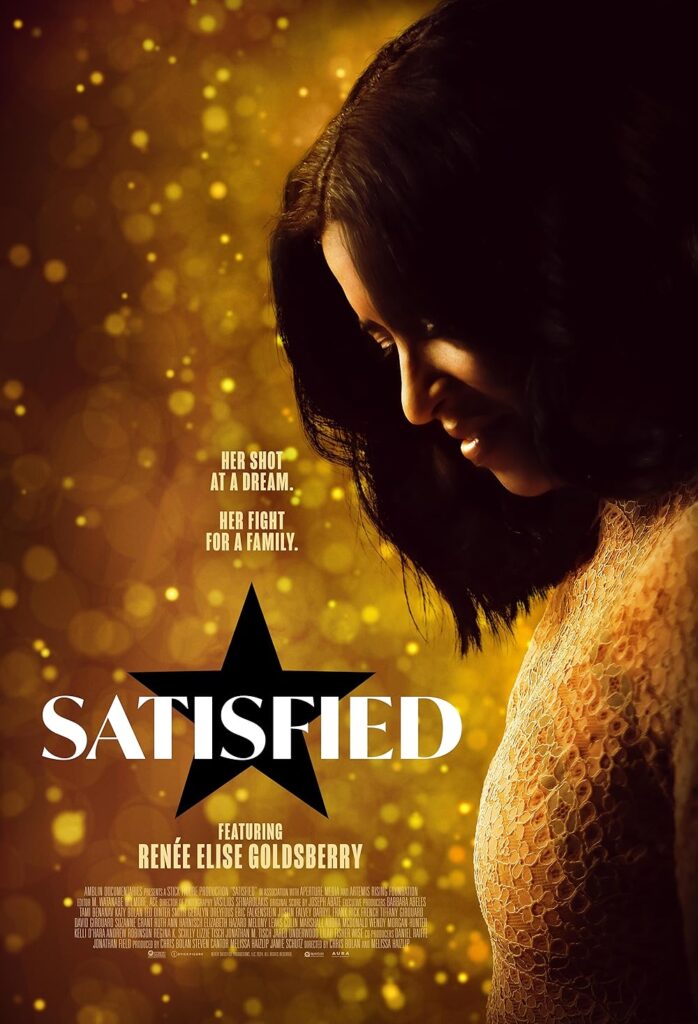
The history of documentaries, going back to the earliest days, is of a filmmaker on one side of the camera and the story on the other, whether it includes archival clips, fly-on-the-wall footage as the story develops, or talking head experts or witnesses. This film presents a different approach that reflects the evolution in storytelling as individuals bypass intermediaries and tell their own stories in the most unfiltered and direct way possible (and usually in vertical mode, filmed on a phone).
“Satisfied” is raw, intimate, and immediate because much of what we see is moments when Goldsberry filmed herself, not necessarily intended to show anyone else but just as a way to process what she is experiencing.
We see her heartbreaking difficulties in trying to have a child, including five miscarriages. We see the overwhelming joy of delivering a healthy baby boy, Benjamin, and then adopting a baby girl, Brielle. Their scenes together are everything we hope for a family. She and her husband adore each other and adore their children and the children love each other and their parents. One of the film’s sweetest moments is a brief home movie when Brielle, still a toddler, wants to go to school like her big brother, even though she is not quite sure what that means. So he puts a backpack on her and one on himself and tells her they are going to school even though it’s just the front door of their apartment. She is so proud and happy and he is so loving.
Goldsberry also provides narration for archival footage, telling us how she met her husband (in church) and did not tell him at first that she was a perfumer. She explains that a performer is two people; the aspiring one who is constantly anxious about getting cast and the successful one who is constantly pulled in a million directions, leaving her husband to hold her purse. That husband, Alexis Johnson, is completely on board with both elements. In another of the film’s highlights, he stands in their kitchen, tearing up as he tells us about how moved he is by her performances.
It was just after they brought Brielle home, when Goldsberry was planning to take some time off, that she was asked to audition for the workshop of “Hamilton.” Initially, she was going to say no, in part because workshop performers often help develop the material and then are passed over for bigger names when the production is launched. But she heard the songs and could not resist. We hear her worry about whether she will get cast when the show opens off-Broadway, and then we see what happens when it moves to Broadway and becomes a phenomenon. Every dream come true has some additional stress. She is nominated for a Tony award but that just means even more time away from her family as part of that process is bringing her story to the attention of the public.
The archival footage of her high school performances is endearing — and impressive. And there’s a lovely scene where she visits the high school drama teacher who cast her as Nellie in “South Pacific,” a play about a white woman dealing her her “carefully taught” prejudice.
She is a star. And yet, as she shows us, that doesn’t mean a cab driver won’t bypass her to pick up the white theater-goers who just gave her a standing ovation. And, as she also shows us, she has the same wrenching conflicts between work and family faced by every parent.
We hear from colleagues including Lin-Manuel Miranda and Oscar-winner Ariana DeBose and we see and hear some of Goldsberry’s thrilling performances. But what makes this film special is its private moments. This kind of honesty’s a gift, especially in a world of augmented reality. We should be grateful to Goldsberry for sharing her struggle as well as her talent and triumphs.
Parents should know that this movie deals with fertility challenges, including miscarriages, family stress, mental health, and racism.
Family discussion: How did Goldsberry decide what to prioritize? What was the most difficult decision? What made her decide to film herself and then to share those very personal moments?
If you like this, try: Goldsberry’s performances in “Hamilton,” “Girls 5Eva” and “The House with a Clock in Its Walls” — and watch the Tony Awards! It’s the best awards show on TV.