
Lucky Strike
Posted on June 25, 2026 at 5:23 pm
B +| Lowest Recommended Age: | High School |
| MPAA Rating: | Rated R for violence, some grisly images, and language |
| Profanity: | Some strong language |
| Alcohol/ Drugs: | Alcohol |
| Violence/ Scariness: | Intense and graphic war violence, many characters injured and killed, disturbing images |
| Diversity Issues: | Depicts the era's segregated military |
| Date Released to Theaters: | June 26, 2026 |
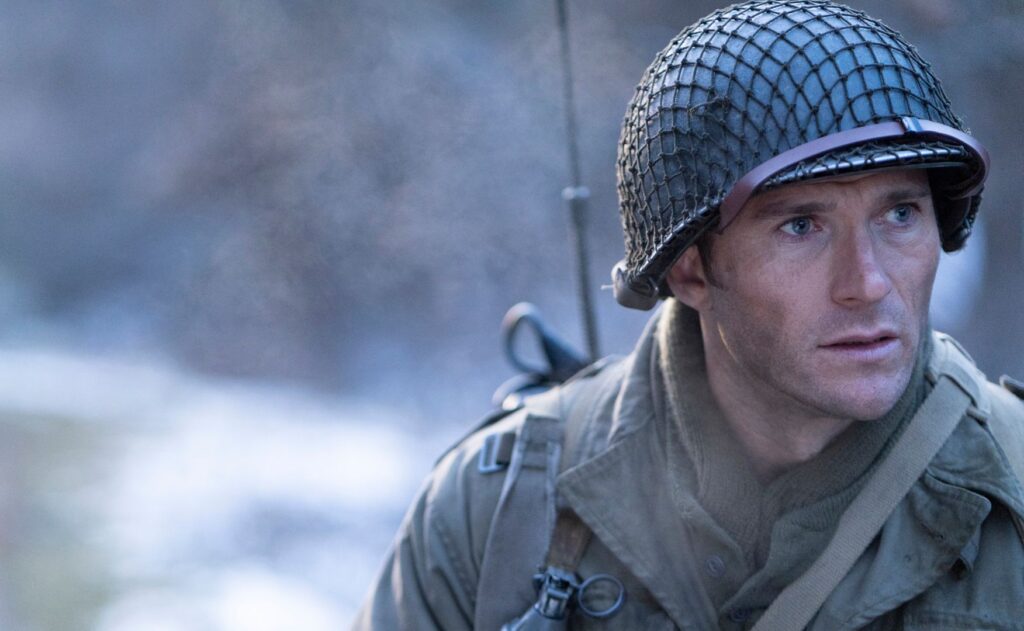
In snowy December of 1944, Hitler launched his last big attack in the Ardennes Forest that runs through Belgium, France, and Luxembourg, in what became known as the Battle of the Bulge. It was a major turning point in the war in Europe that would end with Hitlere’s death and Germany’s surrender six months later. “Lucky Strike,” inspired by a true story, is about an injured US soldier who was caught behind enemy lines early in the battle and had to find his way back to his unit with the help of then-brand-new technology that allowed him to communicate his position.
Scott Eastwood plays Colonel John Castle, a man who chose to enlist even though he was exempt from the draft because he was an engineer who could contribute to the war effort on the home front. He is part of a dedicated but exhausted unit in Charlie Company, 324th Infantry Regiment, part of the U.S. 44th Infantry Division.
Castle is assigned to oversee a small group directed to cut off the road the Germans are approaching, setting and firing off explosives to block them. They are warned that this Nazi division is ruthless, killing everying instead of taking prisoners. They are ambushed by the Nazi forces and everyone but Castle is killed.
With the new communications device, the size of a backpack and nicknamed “Lassie,” Castle learns that he is 30.5 km (about 19 miles) from a rendezvous spot and the overwhelmed soldiers do not have the resources to rescue him. Much of the film is about his near-escapes along the way and the way that Lassie keeps him connected. And we also see how he repaid the person who made sure that Lassie would survive the direst conditions, played by the always-magnificent Aunjanue Ellis-Taylor in a performance of endless dignity and grace.
The screenplay is co-written by “The Outpost’s” Rod Lurie, a West Point graduate with a deep understanding of the military and a superb eye for pacing and detail. Everything in the film is from Castle’s point of view. If people speak French or German, he does not understand them and so we do not get subtitles. There are some breathtaking “oners,” scenes that are all in one long take, which make Castle’s experiences extremely tense and intense. He has an eye for telling details. Castle removes the dog tags from his dead crew, and we glimpse the Star of David on one and the cross on another, connecting us to the soldiers who have just made the ultimate sacrifice and to the diversity of the country they were fighting for.
The cinematography by Lorenzo Senatore is stunning, with three different color palettes for different settings. It opens in black-and-white, emphasizing the fog and snow, with another scene of an American group being wiped out by Nazis. The scenes set in the US are warm and vibrant. In contrast, Castle’s mission and his long way back are more muted.
Lurie’s co-screenwriter is Marc Frydman, who went to school in France, where American veterans were honored by being invited to tell their stories. He was so struck by the one who sought out the person responsible for Lassie that he wanted to tell the story. The different dangers Castle faces along the way are well-crafted — a fight in the very close quarters of the front seat of a truck is especially exciting — and the scenes at the end (with a child who shares his name with Lurie’s late son), are meaningful.
Parents should know that this is a war story with many characters injured and killed, including civilians. There are guns and explosions. Character drink, smoke (see the movie’s title) and use some strong and crude language.
Family discussion: Why did Castle refuse the exemption and enlist? How did he decide who to trust? What technology is important to you and how could you thank the people responsible for it? What technology do you wish would be invented or would you like to invent?
If you like this, try: “To Hell and Back,” “Pressure,” “The Longest Day,” and “Dunkirk’