Interview: Michael Caine of “Journey 2: The Mysterious Island”

Interview: Michael Caine of “Journey 2: The Mysterious Island”

Posted on February 8, 2012 at 8:00 am
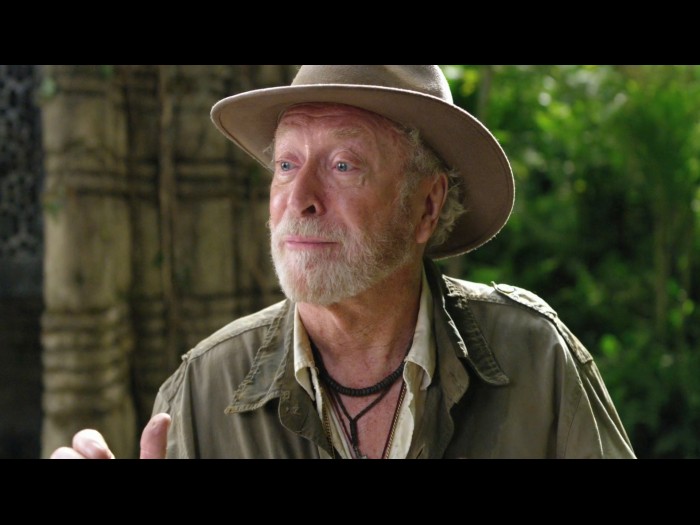
Michael Caine stars in the new 3D family movie “Journey 2: The Mysterious Island,” inspired by the Jules Verne adventure saga.  I spoke to him about what inspired him to take on the role and how it felt to ride on a giant bee.  Don’t forget to enter for a copy of the movie’s activity book!

I really enjoyed the movie!

I saw the movie, and I thought, well, it’s a movie for kids, but I thoroughly enjoyed it!  It goes down well with the kids and it gets some laughs — me and Duane .   The reason I did the film at all — apart from that it’s a fun script and all that sort of thing — is I have three new grandchildren.  And I never make any movies that children can see!   For their mother, I did “The Muppets Christmas Carol,” when she was a little girl, so this one I did for them.   She was about six or seven and a lot of the movies I’ve made are violent and with gangsters, so I wanted to do something she could see.   It comes around here in England every year, even now.  And I had never made a film in 3D, so that was the other reason.  I thought, I’ve got to do this — I’m nearly retiring, I’m 79 years old, and that was another great reason to do it.  I thoroughly enjoyed it, too.  It was great fun.  Where else do I get a chance to ride a giant bee?

Was that in a studio, in front of a green screen?

Yes, but we were really suspended!

Is it different for you as an actor to work in 3D?

No, not at all, it’s all special effects.  You don’t suddenly shoot your arm out and knock off people’s hats.   I thought their use of 3D in this was very clever.

I loved your uniform in the film, really the essence of an explorer.

It was easy!  It didn’t have to fit anywhere, it didn’t have to be clean and pressed, or rather it was pressed the wrong way, very badly!

What was it like to work with Duane “The Rock” Johnson?

He’s the nicest guy.  I suppose if you’re that big you can afford to be nice because no one’s ever going to be nasty to you!  But he’s the gentlest soul.  And he gave me the biggest surprise when he did his song.  When they said, “He’s going to sing the song now,” I thought, “Blimey, what’s he going to do with this?  I’ll bet he can’t sing.”  But he could sing!  He did a lovely little job with it, I thought.  It’s an amazing scene because that’s when the friendship starts.

Your character is very hostile to his character, right from the beginning.  Tell me how you established that relationship on screen.

There’s a sort of familial jealousy because he’s the new kind on the block.  But it was very easy because he’s a good actor.  I know he was an athlete and all that, but he’s done enough acting now to know what he’s doing and we had some good fun with the rows and everything.  They were also gentle rows.  It never looked like he was going to hit me or anything.  Thank God!  I thought the relationships were great in the film.

The production design is also outstanding.

When I first saw my place, made out of the hull of the ship, I thought it was wonderful!  I’ve never done a film like that before.  The closest I’ve come is “Batman.”  But that’s more grown-up, that’s not for little children.

It reminded me a little bit of one of my favorite of your films, “The Man Who Would Be King” because of the sense of adventure. 

I know what you mean!  Setting out to find your destination.  It was a journey — I wonder if there will be a “Journey 3?”

Are you going to do a sequel?

I’ll be 81 or 82 by then.  They’re going to the moon.  Not sure if I’ll want to spend three months in Iceland or something!

Where was this one filmed?

This was filmed in Hawaii in the English winter and we all got home for Christmas — another reason for doing it.  Hawaii has the strangest jungle.  It’s like an African jungle but because it is 2500 miles from the nearest land there’s nothing in it.  No insects, mosquitos, animals, reptiles, birds, nothing.  It’s quite weird because you go through this great big jungle and there isn’t a sound or a movement or anything.  Very spooky but at least you don’t get bitten or attacked.  There’s a couple of rats and snakes brought in by outsiders.

What was the toughest part of filming?

The most difficult part was the days in the deep jungle, walking uphill.  I am tough so it’s okay.

 I liked the way it was an adventure film with something to say about the relationships and especially what it means to be a father.

I was amazed at how a movie of this type, an adventure story for kids, the scriptwriters really went into the relationships.

What made you want to be in the movies?

I am the world’s biggest movie fan.  I used to watch a movie every day after school and I’ve seen every movie good, bad, and indifferent that was ever made.  I really am a movie buff.  I went to the movies when I was four, to the children’s show on a Saturday and fell in love with the whole thing.  The first person I ever saw on the screen was The Lone Ranger.  I thought, “I want to be The Lone Ranger.”  They were mostly American movies, because they made the movies for children.  I remember “Bambi” very well and “Snow White.”  The first time I ever cried in a movie was “Bambi.”

If you do make the next chapter and go to the moon, what do you want to see happen?

I’d like to see us get back!

Related Tags:


Actors Interview
Interview: Ali Landry of ‘Me Again’

Interview: Ali Landry of ‘Me Again’

Posted on February 2, 2012 at 8:00 am

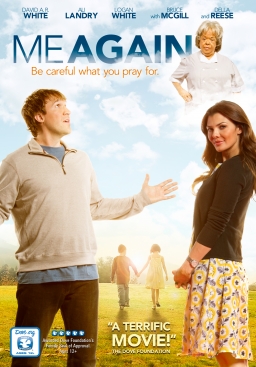
"Me Again" starring Ali Landry

Have you ever wished you had taken another path?  We all wonder what our lives would be like if we had made a different choice and movies like “Me Myself I,” “The Family Man,” and “Sliding Doors” feature characters who get a chance to see the road not taken.  The latest film to explore this idea is “Me Again,” a funny and inspiring film about a middle-aged pastor (David A.R. White) who gets a chance to see himself in several different lives, from a wealthy businessman to a model and even a fish.
I spoke to the beautiful Ali Landry about her role as the preacher’s estranged wife and her faith as a sustaining force in her life and her relationships.

Why was this film something you wanted to do?

Me Again is a great little family film and very witty and funny and I liked the topic it tackled.

Is it important to you that your work be family-friendly?

Yes.  There are a lot of things I consider when I look at a project, but the most important is the takeaway for the audience.  Does it inspire them to take action?  What is the message behind it?

What is the takeaway for this film?

They say it several times in the film — happiness is a choice and before you start looking outside the place you are in, think about the blessings that you do have in your life.  My husband and I talk about it all the time.  We don’t understand how a marriage can survive without having God in it.  All you have to do is reach out and He will answer.  He is there for you.

What do you and your husband do to keep God present in your marriage?

We go to church of course.  We have a Bible study we go to — that’s where we met.  We surround ourselves with like-minded friends.  And we like to do business where everyone is on the same page.  My husband knows that his producing partners will hold him accountable and have his back in every situation.

Tell me a little about your faith journey.

I grew up Catholic and I was practicing to a certain extent but I was not walking the walk.  I was going through my life with blinders on.  I am very clear on the changing moment.  Before I met my husband I was in a relationship for six years.  There was infidelity and it really caused me to re-evaluate and change my entire life.  That was the moment I began seeking out God and needed Him to help me put one foot in front of the other.

Do you have a favorite Bible verse?

I didn’t have a favorite verse at the time when I was seeking God but I would pray before opening the Bible and ask a question and the passage I would read would give me a wave of peace and I always thought, “My questions were answered.”

How do you balance your home and work life?

That is the big question.  Every day I try to figure it out.  I go into every day with the intention of being the best I can be for my husband, for my children, for my work, for my friends.  But I try to give myself a break.  As a mom there’s the overwhelming guilt you always have about not doing enough but the next day is a new day and I will start fresh and try again.

Do you, like the character in the movie, sometimes wish you could see what your life would be if you took another path?

I don’t even go there.  I honestly feel like in that situation I told you about I heard God’s voice more clearly than I ever had in my life.  That’s where I was seeking Him out the most.  Even with the choices I’ve made since then I’ve felt I was swimming against the tide and out on my own.  I had a lot of pushback from my agents and managers when I gave them limitations on what I would and would not do.  But it gave me strength and I know I am doing exactly what I need to be doing in my life.  Any time I see a glimmer of “what if” or “I wish,” it’s about switching the gears in your mind.  I know I am where I am supposed to be and I’ve never been so happy and content.  That’s the difference in having the Lord in your life.  It keeps you in check.

Is it difficult to be a person of faith in show business?

Absolutely!  I have to say no to a lot of projects.  Thank goodness my husband and I are on the exact same page and he encourages me.  I was working working working for ten years with no breaks.  As soon as I took a stand, everything stopped and that was shocking.  But he encouraged me to take on my own projects and and I am working very hard and very excited and happy.

Tell me about your newest television project.

It’s called “Hollywood Girls Night.”  It was originally “Hollywood Moms Night.”   Alison Sweeney and I started it about 18 months ago.  We would invite our friends, other girls in the business and celebrity moms once a month, pot luck at each others’ homes, to be a support system for each other.  On television you see women so many times tearing each other apart.  One of my friends is actually on one of those shows and they pull her into meetings and say, “There’s not enough drama, you need to confront each other!”  We wanted to do something where we just showed up for each other, a support system both professionally and in our home lives.  People really responded to that and said they wanted to start their own groups.  So we decided to create a television show, and it premieres on March 5.  And I have another project called Spokesmoms, where every mom is a spokesmom, giving moms that really strong voice about the products they love.


Related Tags:


Actors Interview Spiritual films
Red Carpet: Drew Barrymore Comes to Town for ‘Big Miracle’

Red Carpet: Drew Barrymore Comes to Town for ‘Big Miracle’

Posted on January 26, 2012 at 12:11 pm

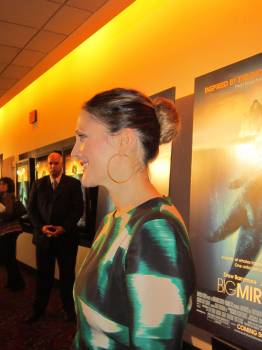
Drew Barrymore came to Washington for the premiere of her new film, Big Miracle, about the extraordinary real-life rescue of whales stranded in Alaska in 1987.  I had a blast on the red carpet, talking to the real-life characters who inspired the film as well as Barrymore, her young co-star Ahmaogak Sweeney, writers Jack Amiel and Michael Begler, and director Ken Kwapis.

It was a special treat to speak to Bonnie Carroll, who was working in the White House in 1987 when the whales were discovered and coordinated President Reagan’s involvement.  She told me that when she got on the phone for the first time with the military officer overseeing the rescue, she fell in love with him as soon as she heard his voice.  “I was in the West Wing and he was in Barrow, Alaska.  Just hearing his voice — we both knew, and we were together from then on.”  The closing credits of the movie show their real-life wedding photo.  “The world came together for the whales,” she said.  “My husband was the kind of leader who could make something like that happen.”  The premiere last night honored the Tragedy Assistance Program for Survivors (TAPS) program she founded following the  death of her husband.  Bonnie and her husband are played by Vinessa Shaw and Dermot Mulroney in the film.

I also spoke to Cindy Lowry, the environmental activist who inspired the character played by Drew Barrymore in the film.  They spent a lot of time together and Barrymore wanted to know everything about where she lived and even what she wore.  “She’s really passionate about the things she cares about and has an appreciation for why I am so passionate about whales.”  Barrymore talked about the way Lowry inspired her.  “She’s willing to cross boundaries and be very forceful, but it is always in a very informed way, to articulate your point and do it with flair.”

Director Ken Kwapis: “When I read the script, what I fell in love with was the idea of a group of people with different agendas, often competing agendas, who had to figure out a way to set aside their differences and solve a problem.  That’s what attracted me, this idea of unlikely collaborators who have to work together.  I also fell in love with the whales!  They made me cry.  The fact that they were trapped in this hole.  I found it very emotional.  The reason to see the film is the emotional experience.  There’s spectacle, there’s humor, there’s romance, there’s wonderful characters but it is really an emotion picture.  Alaska was beautiful, the people were fantastic, but it was very cold and there was a dearth of daylight.  I had a huge ensemble cast and many of them had never worked in front of a camera.  And on top of that, we had three gigantic robotic whales that worked — most of the time!  There’s something for every member of the family — a wonderful coming of age story, a romantic triangle, a lot of layers.”  This was his second time working with Drew Barrymore (they did “He’s Just Not That Into You”).  “I wanted someone who could be very forceful and at the same time very accessible. As strong as she is, she wears her heart on her sleeve.  Audiences love her for that. ”

Amiel and Begler were writing sit-coms when they got a copy of the book about the whale rescue by journalist Tom Rose, who inspired the character played by John Krasinski.  They bought the rights for $1 (Rose was paid more later when the movie went into production) and worked for 15 years to get it made.  “People all showed up for their own reasons but got involved in a story that became a massive cause for them.  There were oil companies and Greenpeace and the Reagan Administration and Inupiat whalers all coming together for what seemed like their own purpose and it ended up being everyone’s purpose,” Amiel said.  “It was important to me to show all sides in this movie, and I think we did.”

First-time actor Ahmaogak Sweeney told me why kids should see the movie:


Related Tags:


Actors Directors Writers
Interview: Cuba Gooding, Jr. and Anthony Hemingway of ‘Red Tails’

Interview: Cuba Gooding, Jr. and Anthony Hemingway of ‘Red Tails’

Posted on January 19, 2012 at 8:00 am

Actor Cuba Gooding, Jr. and director Anthony Hemingway sat down with a small group of critics to talk about their new film, “Red Tails,” the story of the Tuskegee Airmen, the highly decorated heroes who flew missions in the still-segregated Army of WWII.  It was the dream project for producer George Lucas.

This was Gooding’s second time playing a member of this legendary group. He appeared in the 1995 made-for-cable The Tuskegee Airmen.  “It’s like you’ve been researching the role for 12-15 years,” he said.  “The first one was more about their training and the racism and hardships and culminated with their first intro to the war effort and the first dogfight.  This was George Lucas’ passion project to display the warriorism and the heroism that are the Tuskegee Airmen in combat.  So this movie opens up during the war and we meet these guys after the’ve been in training for as many months as they will actually engage in combat.  This is the roller coaster ride.  Some of the footage in this movie, you feel like you’re in one of those P51 cockpits when they’re flying.  You feel like you’re being shot at by the German Messerschmitts.  It’s everything I wanted the first one to be!”
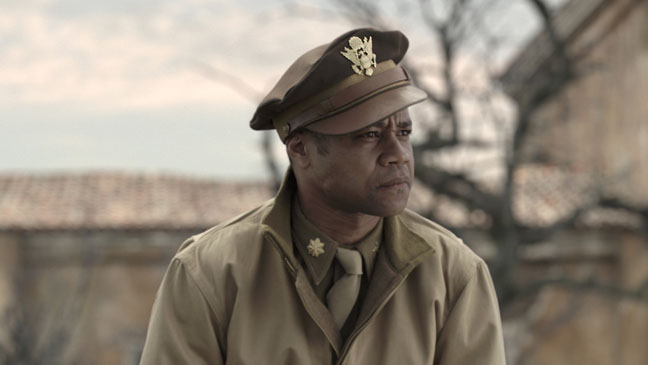
Director Anthony Hemingway talked about putting the actors through flight training.  “It was fun!  To actually experience that G-force.  You hear about it but you can’t really connect with it unless you go through it.  We did actually fly in a real P51.”  Gooding said he was inspired by classic WWII movies and by real-life heroes like General Benjamin O. Davis, the commander of the Tuskegee Airmen.  That still strength that he portrayed, the way he carried himself, was what I wanted to resonate with my character and echo and mirror.”

Hemingway said the movie is very relevant today because it relates to all struggles that people face.  “Seeing the obstacles that they overcame so brilliantly, the perseverance there, we can learn from that.”  “Selfless sacrifice is what these guys represented and dedication to our country over themselves is something our men and women overseas today can absolutely identify with,” added Gooding.  “I like to say this is my love letter to the armed forces, no matter what branch you’re in, no matter what race you are.”  “It’s our salute for their service,” said Hemingway.

They had just come from the White House.  “It was beautiful to see all these legacies coming together in one room,” Hemingway said.  “A handful of the real airmen who flew in combat, our first black President, George Lucas. Honestly, it was a beautiful experience.  We sat in the family theater in the White House and screened my first film.  And we were in Houston and George and Barbara Bush were there and she walked out bawling because she was so moved by the film. They’ve asked to be able to show it to George W. and his family.”  They were just as thrilled at a big premiere at the Zeigfeld theater when an elderly woman came over to introduce herself as a Tuskegee Airman.  She was Nancy Colon, a nurse.  “It was an all-black airbase in the segregated military so every face there was black.”

Gooding said that when he heard about the project he insisted on meeting with producer George Lucas to demonstrate his passion for the project and joked that he would be willing do do anything, even the catering for the set.  Lucas warned him it would be a tough shoot, down and dirty.  “I’m in!” was Gooding’s response.

I asked Hemingway about how he as a director worked to allow the acting of the combat scenes come through when the characters had their faces obscured by oxygen masks.  “We took a little creative license.  There are four or five action sequences in the film and in the first two I took the liberty of not using the masks to enable you to connect with the characters.  Once we got there, if you didn’t know who the characters were, we failed.  By then you could identify them by voice and in the casting of it, knowing from the beginning that their faces would be covered, we worked to make sure that the palette of the cast, the hues of their faces would help you easily stay connected to the story.”

Hemingway told us with tears in his eyes of the privilege he felt to present the legacy of the Tuskegee Airmen.  He did a great deal of research at George Lucas’ Skywalker Ranch, were huge amounts of information and resources had been assembled for him, but he also went to Tuskegee to “walk in their footsteps” and see where the men had trained and where First Lady Eleanor Roosevelt made her famous visit to fly with one of the Tuskegee-trained pilots.

They spoke about what it meant to them to have four of the real Tuskegee Airmen on the set with them every day, sharing their stories and providing support and guidance.  Gooding said it meant a lot to him to see the real heroes inspiring the young actors who were playing them.  “The first real wow for me was when I would sleep in the car on the way to the set because we would start shooting at 5 am to get the light.  I would wake up and we would be on this airbase, back in time.”  Hemingway said that one of the Airmen, the late Lee Archer, lifted up his cane to point at the aircraft and said, “Get rid of all you civilians and I’ll be back in the air.”  He got choked up telling Hemingway that when he was growing up everyone said they couldn’t do it.  “To see the story being told meant so much to him.”

They spoke about the commitment George Lucas had to the story, putting up his own money for the feature film and for a documentary narrated by Gooding called “Double Victory.”  “One of the first things Lucas told me was, ‘You focus on the story, the shooting, the acting, the I got your back on the flying.'” He’s been studying the dogfights for years and I was confident knowing the support was there.

Gooding said, “Come see the movie because it’s action/adventure and a statement and an American tale.  President Obama stood in front of the screen, and we were all so emotional, and he said, ‘This is an American tale of heroism.’  That’s why people should come to this movie.”


Related Tags:


Actors Directors Interview
Interview: Max von Sydow of ‘Extremely Loud and Incredibly Close’

Interview: Max von Sydow of ‘Extremely Loud and Incredibly Close’

Posted on January 18, 2012 at 11:59 pm

Max von Sydow plays the mysterious “renter” in “Extremely Loud and Incredibly Close,” opening this Friday. It is based on the acclaimed book by Jonathan Safran Foer about young boy named Oskar devastated by his father’s death on 9/11. Trying to make some sense out of what happened, the boy searches all over New York to try to solve the mystery behind a key his father left behind. He is accompanied on part of his quest by “the renter,” a mysterious, silent old man who has moved in to the apartment of the boy’s grandmother. The renter is mute and communicates by holding up his hands with “no” written on one palm and “yes” written on the other and by writing in a little notebook.

Von Sydow has had one of the most distinguished and wide-ranging international careers in movie history.  He has played Jesus (“The Greatest Story Ever Told”) and the devil (“The Soldier’s Tale”).  He has appeared in films directed by Ingmar Bergman and Woody Allen (“Hannah and Her Sisters”).  He co-starred in “The Exorcist,” “Judge Dredd,” “Rush Hour 3,” and “The Adventures of Bob & Doug McKenzie: Strange Brew.”  And now, age 82, he talked to me about playing a man who does not speak.

I loved the film.  It was so moving.

It is a wonderful story.  My wife and I read it and we were profoundly moved, both of us.  It concerns everybody.  This idea with this man who has decided not speak any more but who speaks by writing, it was a great pleasure and a great adventure.   And it was a pleasure to work with Stephen Daldry.  I like very much that he does plays, quite a lot of political material.

The whole row of critics I saw it with were snuffling by the end.

I always wonder.  I have through the years got the feeling, maybe I am wrong, that if critics are moved, they hate the picture.  They cannot accept their own emotion.

The movie wisely does not tell us to much about your character’s background and I think the mystery works well.

Did you read the book? In the book there is much more, but there are little hints in the film.  You really have to keep your ears open to hear what is said.  It is the boy who asks, “Why do you not speak” and suggests I had a shock of some kind.  Later he says he knows why someone does not speak — either your vocal chords are ruined or you have come through a mental shock that has made you decide not to speak.  And then in the scene in the bar where I have sort of left him on this bridge, he finds me in the bar drinking whiskey and writing messages that the barman reads, and he says, “I was born in Dresden.”  I was apparently present when my family was totally annihilated in the fire-bombing in Dresden.  Maybe today people don’t know about what happened there.  But there little notes about what is the background for this man.  And the grandmother’s attitude is interesting, also.

Is it a challenge to play a character who doesn’t speak, to give up one of the most important tools in an actor’s toolbox?

There’s no difference.  The only difference is that he doesn’t speak.    Just because I don’t speak in this part and write instead of speaking, had I been speaking I would have done exactly the same thing.  I cannot say I would have to act differently because I don’t speak.  I love in the city and I am together with this young boy and he does things and says things and I react positively or I object.  I don’t think his thoughts are different because he does not speak.  Don’t compare this thing with a silent film, a film like “The Artist.”  It’s totally different.  In a silent film, you speak but the audience does not hear you.  Maybe there were actors in the silent films who in their physical behavior exaggerated their gestures to be better understood but you cannot compare that with this character.  He does not speak but he is not a silent character.

Your character seems reclusive at first.

Grandmother has told him, “Okay you can live here and have this room but I don’t want you to have contact with Oskar.  But of course this is the only thing he’s dreaming will happen.  He hopes that something will change.  When it finally happens it is not he who takes the initiative, it’s the boy.  Grandmother tells the boy, “Don’t talk to this man.  He can be very, very angry.”  I love that part.  She doesn’t scare him but she warns him that he can be very unpleasant.

You acted opposite a young boy who had no acting experience.  How did you develop a working relationship with him?

He’s a very brilliant boy.  He had never done TV, movies, no commercials, anything.  When I first met him we went through a couple of scenes and talked about it.  Stephen Daldry had him read his lines and it was very dry, no expression.  But coming back to New York after a month and a half he was already a competent actor.  He said his lines perfectly.  He had some help, people who worked with him and he was very disciplined, remarkable patience.  It was great fun to work with him.

He has a long, long monologue after he says, “Can I tell you my story?”  He did it perfectly every time.  I admired him.

Related Tags:


Actors Interview
THE MOVIE MOM® is a registered trademark of Nell Minow. Use of the mark without express consent from Nell Minow constitutes trademark infringement and unfair competition in violation of federal and state laws. All material © Nell Minow 1995-2026, all rights reserved, and no use or republication is permitted without explicit permission. This site hosts Nell Minow’s Movie Mom® archive, with material that originally appeared on Yahoo! Movies, Beliefnet, and other sources. Much of her new material can be found at Rogerebert.com, Huffington Post, and WheretoWatch. Her books include The Movie Mom’s Guide to Family Movies and 101 Must-See Movie Moments, and she can be heard each week on radio stations across the country.

Website Designed by Max LaZebnik