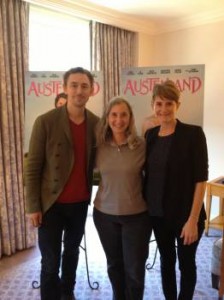
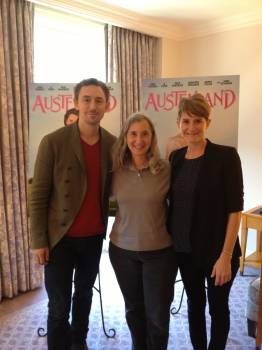
 No movie this year made me laugh more than “Austenland,” based on the novel by Shannon Hale
 . The film has Keri Russell as a Jane Austen fan who visits an immersive Jane Austen theme park/experience. It was a lot of fun to talk to writer-director Jerusha Hess and actor J.J. Feild, who plays the brooding but dashing Mr. Nobley — and who played Mr. Tilney in the version of Austen’s “Northanger Abbey” that was shown in the US on Masterpiece Theatre. This is the first directing gig for Hess, who co-wrote “Napoleon Dynamite,” “Nacho Libre,” and “Gentlemen Broncos” with her husband, director Jared Hess.
Tell me a little bit about the place where the movie was filmed and what it was like to be there?
JJ: It’s one of the great British estates. I’ve filmed there three times!
Jerusha: It’s called West Wycombe. And there’s even a lord named Lord Dashwood . It’s very steeped in Austen. It’s been used in many films, but not in its entirety and we shot the inside and the outside and used every nook and cranny. The inside is very gaudy. It’s a little naughty inside. There’s a lot of portraiture.
JJ: Slight sexual innuendo with the portraits there, but that’s the home of something called the Hellfire Club, which is a very, very old society in Britain, that was known in Charles II’s time, but it goes back beyond that and who knows what else. It’s the home of that society that supposedly no longer exists, but I have heard that Prime Ministers and Cabinet members are still members.
Jerusha: We used that gaudiness to our benefit.
Tell me a little bit about the wardrobe.
Jerusha: The costume designer, her name is Anne Hardinge. She’s done “Shaun of the Dead” and “Hot Fuzz.” She’s really comedic costume designer, which was right up my alley. She was a joy to work with. She was like fabulous Geena Davis. She was just floating with her red lip and kind of fabulous.
JJ: Mostly with her costume designed just looked good.
Jerusha: She just couldn’t wait to get her hands on Jennifer Coolidge and design these gowns that matched the curtains and the bedspread. Yes, she had a lot of fun with it and we all did, because a lot of just a very straight regency costumes that we just rented from the houses, but some of it we got to make and have fun with.
The dress that her friend made was very funny, the idea of someone who really does not know the period and is just piecing something together, with good intentions but awful results.
Jerusha: The cheap, renaissance get on that.
I also loved it when Keri Russell’s outfit just felt apart when you were carrying her around there. I thought that was very well done and surprisingly shocking.
Jerusha: It was shocking to see a leg! You’ve never seen a leg in these stories. We made it a little saloon girl. We played up on many elements because everything is just very covered and the tights are very thick and heavy. And then to have it all fell apart, absolutely, we wanted to see the leg!
It was also very shocking to see the scenes by the pool, where you see some of the men in modern clothes, but Nobley was still in his full period dress.
Jerusha: Yes, absolutely and Martin because we couldn’t reveal too much. That was really fun to just have guys in the pool with the wig on.
How did you and “Twilight” author Stephenie Meyer, who produced, and this book by Shannon Hale all come together? Tell me about Stephenie Meyer and how she got to be involved.
Jerusha: Stephenie was a friend of Shannon Hale previously, because they’re both girls in the writing world and Mormon girls to add to that. They were buddies and they always talked about making a movie together. Apparently, when I came on it became real which I laughed at. I was just another girl adding to the mix. There was a time where we went on a little trip together and we just like giggled, like, “It’s going to be so fun to make this movie and think about all about the handsome men.” We were just such chicks making a movie. She was great. She’s powerful woman. I met Shannon Hale through some friends and family. I was interested in her book called Princess Academy , which is just a very sweet, Newbery-nominated fairy tale for young readers. She was like, “Oh, actually I have something else for you.” She gave me Austenland. The next morning, I’m sure I called her and I was like, “Let’s make this movie.” It is so fun. It just felt so girly and great and a great vehicle for the weird Hess comedy.
The weird Hess comedy has mostly been more boy-oriented.
Jerusha: Absolutely and very young boys. I was just ready to make a movie for the girls. It was just really fun to write for a girl. It was really indulgent and sweet. The whole movie feels indulgent, doesn’t it? It’s such a romp in England. And our experience in England was that. It was a delight. I had never even been to England and I got to spend five months there in a beautiful estate and just party with these gorgeous men and women and poke fun at their beloved genre, which they all loved. We teased it, but it’s so gentle, that you’re still swept away the whole time.
What’s the difference between playing a real Austen character and a fake Austen character?
JJ: One is a comedy and one is not. Playing this part in “Austenland,” for me it’s the man who doesn’t want to be there, who’s there by accident and he’s feeling deeply embarrassed.
Which is very Darcy.
JJ: Exactly. Then you just take the world of British costume drama and trying to send up as much of it as you can.
Why is that such a perpetual romantic fantasy?
JJ: It’s the outspoken, funny, poor thinking woman who can actually soften and tame someone like Mr. Darcy. It’s the fantasy that perhaps some men are misunderstood.
What was the biggest challenge that you had as a first time director?
Jerusha: It was just so cushy — like the time frame. I had 41 days to shoot. I had amazing comedians at my fingertips. I had this very cool Director of Cinematography who shot all the Stanley Kubrick films. I had all the staff at my fingertips, amazing talent and I’m like a nice to a fault whoever wanted to raising me up, like, ‘We’re going to make you look really good.’ I don’t have to do much. What I was surprised at and the challenge was that dealing with an ensemble cast who are in scenes together everyday all day, that is a challenge. It’s a challenge to make sure everyone get as much coverage and attention, it got just kind of competitive. I loved it because it made it funnier, but the improv went nuts. People were like, “Oh wait. I have something better to say.” “Now, I’m going to say…”
JJ: We needed six cameras.
Jerusha: It got hard to juggle the funny on set and then even harder in post-production.
Fortunately you had the credit sequence where you could throw in some of that stuff, which was great, great fun. I thought that was just too sweet. What about you, what was the biggest challenge of doing it for you?
JJ: Keeping a straight face. It’s not easy to have a grouchy face in front of Jennifer Coolidge and Bret McKenzie and Georgia King and it’s just hilarious. Jennifer Coolidge’s improvisation could be very physical or one line. James Callis when he started talking, he would talk an entire roll of film out. I don’t know how you can extemporize that amount of dialog, because he doesn’t prepare it. It’s just sort of flows. He’s extraordinary.
If you could enter a theme park of a book, what book would you pick?
Jerusha: I would do Winnie the Pooh. We would live in the tree house. We would hunt for honey.
JJ: I just got a new son and my childhood was made magical by Narnia, so if I could take my son to a wardrobe that would be it.

 . The last time