Character Actor Tributes on Huffington Post: Beth Grant
Posted on March 19, 2013 at 3:53 pm
I’m a huge fan of character actors and always try to feature them in my reviews. I highly recommend the documentary shown on showtime about male character actors called “That Guy….Who Was In That Thing.” So I was really glad to see that Huffington Post is doing a new series on those character actors, starting with Beth Grant. I had the pleasure of meeting her once and could not resist reciting one of my favorite of her movie lines back to her, from “Donnie Darko:” “Sometimes I question your commitment to Sparkle Motion.” Despite that, she was extremely kind and gracious.
Here’s a brief film I made of her dancing at the Critic’s Choice Awards.
A St. Patrick’s Day Tribute to Some of the Greatest Irish Actors
Posted on March 17, 2013 at 8:00 am
Celebrate St. Patrick’s Day with movies starring some of the greatest stars in movie history. If you haven’t seen all of these, you deserve a pinch!
1. Maureen O’Hara — the fiery red hair was made for technicolor and she was ideally cast opposite John Wayne in films like “The Quiet Man” and “McLintock.” I especially loved her as the mom in “Miracle on 34th Street” and “The Parent Trap.”
2. Colin Ferrell — he is electrifying as a bad guy but willing to go all out in a comedy like “Horrible Bosses.” I especially loved him as a sensitive gay man in “A Home at the End of the World,” and his appearance with Elmo on “Sesame Street.”
3. Saoirse Ronan — one of the most talented young stars working today, she will soon be seen as the lead in “The Host,” from “Twilight” author Stephanie Meyer. She first gained international stardom in “Atonement.”
4. Liam Neeson — an Oscar winner for “Shindler’s List,” Neeson is equally at home in serious drama and action films like “Taken.”
5. Pierce Brosnan — possibly the most elegant of the James Bonds, Brosnan also played a very different kind of spy in “The Matador” and sang (or tried to) in “Mama Mia.”
6. Peter O’Toole — best known for “Lawrence of Arabia,” but his most endearing performance is probably the swashbuckling movie star guesting on a live television show in “My Favorite Year.” And don’t miss him as a movie director in “The Stunt Man” and an art expert turned thief in “How to Steal a Million.”
7. Jonathan Rhys Meyers — he was Henry VIII on HBO’s “The Tudors” and the soccer coach in “Bend it Like Beckham.”
8. Chris O’Dowd — Kristin Wiig could not resist him in “Bridesmaids,” and he was equally appealing in “Pirate Radio” and the British sitcom “The IT Crowd.” He plays the manager of a girl group in this week’s release “The Sapphires.”
9. Daniel Day-Lewis — he played Abraham Lincoln last year, but he has also played real-life Irish icons Christy Brown (“My Left Foot”) and Gerry Conlan (“In the Name of the Father”).
10. Pat O’Brien — this dependable character actor starred as Notre Dame coach Knute Rockne.
With his concave cheekbones, lanky build and grooved brow, Daniel Day-Lewis replicates Abraham Lincoln more accurately than the head of a penny.
His performance in “Lincoln” has earned rousing endorsements from Civil War historians, but close watchers of the film have spotted one glaring anachronism in this otherwise honest Abe — earring holes.
Day-Lewis, a meticulous actorknown for disappearing into his roles, had the tattoos on his hands and forearms covered by wardrobe and makeup. He removed gold hoops from his ears. But despite makeup, the piercings were still visible.
Director Ang Lee found it a challenge to cast “Taking Woodstock” because today’s actors are much more toned than the people who attended the Woodstock concert in 1968. It was also hard for him to find actors who had not removed their body hair. Keegan describes the same problem with last year’s “Not Fade Away,” also set in the late 60’s. And “Lincoln’s” problems extended beyond its title character. There were plenty of Civil War re-enactors in the Richmond area who were happy to be in the movie, but most of them were well-fed or overweight, and, as someone who was working on the movie told me, “There were no fat people in the Civil War.” Keegan notes, “Teeth whitening, plastic surgery, body piercings, weight training, healthful eating and yoga have made it a challenge to find the perfect period performer.”
Interview: Eleanor Tomlinson, the Princess in “Jack the Giant Slayer”
Posted on February 26, 2013 at 8:00 am
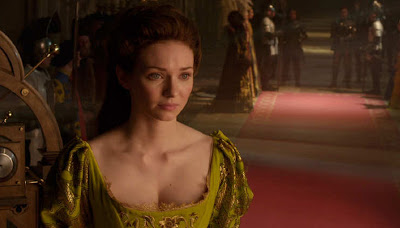
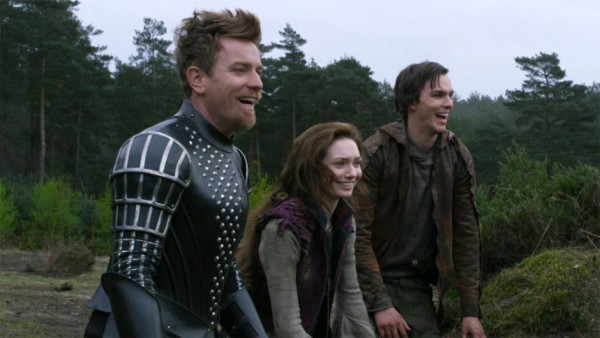
Eleanor Tomlinson plays Princess Isabelle in “Jack the Giant Slayer.” But she is not your grandfather’s fairy tale princess. This one goes undercover to explore the world of her subjects, rebels against her father’s plans to marry her off to the odious Roderick (Stanley Tucci), and suits up in armor to fight the giants. I spoke to her about doing her own stunts, acting in a lycra suit studded with ping pong-like balls for the CGI, and keeping the enduring appeal of fairy tales while making them new again.
Tell me about the costumes — they are gorgeous and must have been a lot of fun to wear.
I absolutely loved the costumes. They were all amazing. The costume designer, Joanna Johnston (“Lincoln,” “Love Actually”) was fantastic at creating that fairy tale aspect. She and Bryan , worked very hard and the minute I put on the armor or the dress I felt like a princess. It was fantastic.
Your character is not a typical fairy tale princess.
That’s what drew me to her in the first place. She’s not a damsel in distress, waiting in the tower; she’s very independent and feisty. She was born into the royal family. She didn’t choose the life and all that comes with it. So it was interesting creating that character and I worked very hard with Bryan because I didn’t want her to come across as spoiled. She still has to be lovable and Jack has to fall in love with her. Bryan was brilliant. He was so helpful. This is my first lead role in a big movie, my big break and he really took the time, working with me before we started filming to talk about exactly where we wanted the character to go. So, for example, I looked to Sigourney Weaver for inspiration because she’s a very strong, powerful woman. We decided to go down that route as opposed to making her the princess that everyone has seen before. So that was cool.
What was it like to work knowing the computer images would be filled in later?
That was a huge challenge. Bryan talked to the actors and showed us what he had lined up, how the scenes were going to play and how the giants were going to interact with us. It was fantastic! He’s a really lovely man. We shot all of the motion capture stuff right at the beginning with Bill Nighy so that his performance was captured and put onto the giant. We would all be dressed in these strange lycra suits with balls on them and then our physical performance would be transferred onto a computer screen so you could see how your character would respond. Every movement was transferred so you were controlling this little figure. And Nicholas and I were mainly looking at tennis balls on very large poles to show us where the CGI would be added later. Bryan was very helpful in showing us what the giants would look like and where they were going. What they did with the giants was incredible! Nick and I both said it was beyond our imagination. They are really amazing.
Were you climbing on something real for the beanstalk?
Yes, they built an enormous beanstalk! We used some of it to train before shooting so we were in tip top physical condition so we could tackle any stunts our characters would face. Both Nick and I were really passionate about doing our own stunts and we felt that was crucial for our characters. We were on the beanstalk and they would turn on wind machines and rain machines and it was all very scary! But the most amazing fun. Being thrown around by the giant when he gets hold of me — that was quite painful, and that was the day my mum came to the set. She was all, “What are you doing to my daughter!”
You come from a family of actors. What’s the best advice you got about acting?
“Keep your feet on the ground.”
That’s hard to do in a movie where you climb a five-mile beanstalk!
Exactly! My family are very down to earth people. Keeping your friends close and doing your best. Having the confidence to speak up and be brave about getting your ideas out there. Sometimes it’s nerve-wracking in a movie this big to say, “I kind of saw Isabelle as doing this” or “I saw so-and-so doing that.” But it’s important that you do your job and are not shy about doing it. It was fantastic working with people like Bill and Stanley and Ewan . They were so helpful. They were really lovely to me and took me under their wings.
Isabelle has to stand up to her father but she does it in a loving and respectful way. Did you bring anything to that from your own experience?
Well, I’m not a princess in real life but I am pretty feisty! There are definitely elements of my personality in Isabelle and it was fun merging the two together. I think she feels very trapped by the lifestyle that she was born into. Working with Ian McShane was fantastic. He was very helpful. It’s not every day that you go to work with Ian McShane playing your dad and Ewan McGregor playing your guardian! It was pretty special. And Stanley Tucci is so funny and so amazing to watch. Everything he does with his character is just amazing. He really pushes the limits and he is hilarious. I absolutely love his performance.
What is it that makes fairy tales so enduringly meaningful over hundreds of years?
It’s a form of escapism. Everybody loves to go back to the stories that were a huge part of their childhood. But also it’s lovely to see a movie that the whole family can enjoy. There’s something in “Jack the Giant Slayer” for everyone, romance for the teenagers, the giants for scaring. It’s nice to have a family movie. And with CGI they can tell the story in a way no one could before. It’s fascinating to see what they do. They make make it again in 20 years and it will be totally different!
What lesson do you want people to take from the movie?
The movie’s about achieving your dreams and not being afraid to stand up to people to are telling you what to do. It’s about deciding who you are, doing the things you want to achieve, even if it is climbing a five mile high beanpole for an adventure. Why not?
Interview: BerNadette Stanis of “Good Times” and Gospel Musical Behind the Pulpit
Posted on February 18, 2013 at 3:59 pm
It was very exciting, as a long-time fan of “Good Times,” to get a chance to interview BerNadette Stanis, who played Thelma. She was a teenager herself when she was given the role. She made me feel like an old friend and it was a lot of fun to talk to her about going from living in the projects to starring in a hit television series about a family living in the projects, about meeting classic movie stars Mae West and Loretta Young, what she learned from her TV mom, Esther Rolle, being a caretaker for her own mother with Alzheimers, and her current role in the gospel musical “Behind the Pulpit.” To see the tour schedule and buy tickets, check here. To bring them to your church, contact them here.
Tell me about the play.
I play Deborah, the first lady of the church. And my husband the pastor is so involved in this church that he’s forgetting about his family. And his son. And so we have those issues in the church and all the little stuff that’s going on. It’s a real fun play. It’s a very good play. Lots of singing. You know the gospel thing. Those gospel people can sing, baby. I can do the acting and they can do the singing.
And what do you hear from the fans of the play? How do people respond to it?
They really like it. They are intrigued and they are astonished by what it says. Because my son in the play is gay. And I love him. He’s my only child. I love him to death. He can do no wrong. And his father is not having it. So you have that going on. And being a pastor. And how does he tell his church members my son is gay. So he doesn’t go along with it. And gives the boy a hard time.
That’s very difficult. What do you hope people will take away from the play?
Well what I would hope that they take away from the play is that sometimes our children are not what we want them to be or they don’t turn out the way we think they should turn out because it reflects badly on us because were pastors or were doctors or were whatever. But it doesn’t happen for them and we have to learn to embrace them as human beings and love them as their parents. Even though they are going through things they still need our love. And if they feel they don’t have the love and they are going through stuff sometimes it becomes overwhelming. And they can’t handle it. Pastors do have a lot on their shoulders because they are obligated by God to lead in the right way according to bible. Then you have these things that may come up, you have a child that’s wayward, you may have a child that’s gay, what are you going to do with that? I think Jesus would love them anyway.
We all deal with that work/life balance. You have to deal with that work/life balance. You’re a mom.
My mom passed in 2011 from Alzheimer’s. I had been a caregiver for 8 years. So I was caregiving and promoting a book at the same time. I had written a book in ’06. She came to live with me in ’06. And I had a ten year old daughter at the time. She’s 18 now. But I’m just saying that was living the sandwich life. It was like balancing mom and balancing my little 10 year old and balancing trying to get out to promote my book. Thank God my husband was there to help me but still. It was difficult.
And it’s hard for kids to understand because they want 100% of your time.
That’s right. That’s it. So my mom came, it was like “I don’t understand that. You’re taking all my mom’s attention.” So we had to deal with that. Yeah, there was a lot of dynamics going on with that disease.
It’s wonderful that you were able to care for her.
To the end.
I’m sure that was a great comfort to her.
Yes. And she always wanted to live with me anyway. And I’m writing a book on the last night. The last night we spend together and that’s going to be for the Alzheimer’s community. I’m going to be doing a lot for them to educate the African American community on this disease. And I have an organization I put together for my mother, Remembering the Good Times. Nonprofit. Yes, remembering the good times. That’s what I’m doing for her.
What do you think families can do to be more supportive of care givers?
A lot of times when this particular disease hits a family a lot of people don’t understand the disease so they think if you forget a few things that you are no good. You’re not mommy anymore. And they hurt them so they walk away. And I would say that with something like this just understand why they want to hold on instead of putting them in a home. Let them live a quality life even though they are going through this disease. Know they are loved. And support your family members that are trying to hold on.
Tell me about your books.
I have a book called Situations 101. Its about the good, the bad and the ugly in relationships. 101 different situations and my responses to them. It’s a funny book. Everything in there is real. I have heard those stories from someone. And then I have another book called Situations 101: Finances. The good, the bad and the ugly and the basics. In everyday terms. Because a lot of times people don’t really quite understand it. You read the financial books and I mean for me I was reading the financial books and really, really trying and I would go to sleep. My brain would just shut down. I have a book called For Men Only and another Secrets from the Soul of a Woman in Love. And I’m writing one with my daughter. She’s 18 now and it’s Situations 101: Teenagers. You wouldn’t believe what teenagers go through. She tells me everything in school. There’s enough stories right there. And it’s different stories with different children. And some children have multiple stories. And how do they handle it. So a lot of her friends come to me and ask me things. And I help them as much as I can.
You got famous very young.
That wasn’t a problem. My mother was there. My parents were very supportive. It was beauty pageant that actually got me that opportunity. That was very interesting because it was like coming out of the projects going into the projects. I’m glad they picked me. That was a wonderful time in my life.
What was the audition process?
Well I think they auditioned every black young actress in America. I remember when I went up to CBS. I was in a beauty pageant and the manager came over to my mother and said were looking for a teenage daughter for a television show. That’s how we got in there. So we went up to CBS and the room was packed — you’re talking about a cattle call. I thought I was the only one. I thought, “Oh my God, look at all these people,” and then I saw some famous people there. And I’m like “Oh no, I’m not going to get this. Get out of here.” I was just so excited to be there. And then they called me into the room with Norman Lear and Jimmy Walker because Jimmy was already picked. And Norman was the producer of “Maude” and “All in the Family.” And he’s a very interesting man. He loves comedy. He knows comedy. So were sitting there and I get the script. The script was a little stiff to me. To me. The expert. So I’m like, “Can I improvise and do like I do at home with my brothers?” He’s like, “Go ahead. Just do something.” So I auditioned and I went up to Jimmy and I said something to him and he was like ignoring me and I just gave him a push. You know how you push your brothers and he went “What!” And we went back and forth and Norman loved that. So I think that won me over.
What kind of reaction did you get from the fans?
It was nothing like it is today because you see back then they had to write letters. We got lots of letters but now you get email and Facebook and all of that has changed. I couldn’t communicate with them like I can today. But they loved me and I really felt the love when I went out for my book promotions in ’06. 30 something years later.
That show seems to have really connected to people. I think because it was such a strong family.
And it was written with real issues. It wasn’t necessarily written like we were just black people. We were people going through issues. Now there were some situations that pertained to blacks like hypertension, high blood pressure, that we were going through and we addressed that. And I loved the way they wrote that. The show went into a lot of different dynamics and when I was thinking about it as an adult. They had the mother and father at one point. There’s a family with the mother and father and then the father was gone and then you had the mother supporting the children and you had a step father come in. then the mother went away and it was just the children and an aunt. Willona. So we adopted a kid.
Janet Jackson! You had a chance to work with some really fine older actors. What were some of the things they taught you?
They taught me about being professional. And taking your craft seriously. And learning your lines and being real with your character and I learned about discipline in the work place and because I didn’t have that. I was late all the time. And Esther fixed me real good.
Did she? What’d she say?
She fixed me real good. She would pick me up around where I lived and we would go to work together and so I was always late. And she said, “BerNadette, I don’t like being late and if you’re late, I’m late.” I was supposed to be on the corner waiting for her at 9 o’clock. “And if you’re late tomorrow I’m going to leave you.” I started laughing. “Mom, you know you’re not going to leave me, stop it.” So she said “Hmmm.” And so this day I was late. I was trying to really get there on time I still was late. And I got downstairs and there was no car. So I said, “Maybe she’s late.” I stood there for about 10 minutes and I realized she left me. She really left me. Oh, my God. And you can’t get a cab in California. So it took me like two hours to get the cab and it cost me about 30 bucks. It was like a mess. When I got there I had a little attitude. I got up there and she said, “Hmmmm,” and I couldn’t even get mad because she was right. But you know I got mad anyway and she said, “Don’t be late.” It was a hard lesson but I learned it.
What do you get from live performance that is different being on television?
Live performance is you’re right there. You don’t know what’s going to happen. You know your lines but each night it’s different. And that’s what I like about it because when I do my scenes with Terrell, the one who plays the pastor, he’s so good and he flows with me well and when I come out and he’ll say something it’s so real. And that’s what I enjoy, having an actor that has good chemistry. So you can enjoy your work. So that’s what I love about that. But as far as television is concerned it gets way out there and everybody sees it in one little spot. So if you want your popularity to be there, television is it. But if you want to hone in on your craft, the stage is it.
And what books do you like to read?
You know I like to read autobiographies in fact I’m reading Mae West’s. She was way ahead of her time and you know I was reading about her is that her mom raised her basically to think like a man. Not to be a man, just to think like one because her mother wanted to be a star and was married and back in those days, she was born in 1997 or something. So you can imagine. Her mother was stuck with three kids and a husband and she couldn’t make it. But she saw this pretty little girl she had and she adored her and just let her just blossom and she put everything into her. And didn’t teach her the way you would teach a girl. Don’t do this. You can’t do that. It wouldn’t be lady like. Her mother just let her go. And she did the opposite. And she didn’t let anybody stop her from being who she was.
And I had an opportunity to meet her. Because Herb Kenwith was our first director on Good Times. And he was one of her best friends and he’s in the book. So Herb came to me when we first started the show. Like the second season and he said were going to the CBS dinner and “Ms. Mae West would like to meet you.”
So I met her at the escalator and we walked in and we sat at the dinner table and everything but she wouldn’t speak but now that I’m reading the book I realize she didn’t speak much, she was studying people. And so I sat with her and everything for a while. But she didn’t speak much and I didn’t know what to say. So I just drifted off into my friends.
And I got to meet Loretta Young. You want to know what she said to me. She asked me to pray for her.
When did you decide that you wanted to act?
When I was a very young teen. I had a class and I improvised something and the teacher thought I was very good. I was a dancer so I would interpret dancing in an acting way. You know what I mean I would put music on and I would act it out in dancing. So I was always acting and that’s what I did. Interpretive dance, modern jazz, and I was always doing things like that so acting came kind of natural.
And your parents were supportive of that?
Oh yeah. I can remember this is so interesting now that I have teenagers you know we were living in a two bedroom apartment in the projects and you have the living room and you have the little bedroom and I would get up on Saturday or whatever day and I would play my music, no one ever stopped me. And I would play it loud. My mother never said turns it down. And I would play the song over and over. And she just let me do that. Now that I think about it that’s pretty incredible.

 . Its about the good, the bad and the ugly in relationships. 101 different situations and my responses to them. It’s a funny book. Everything in there is real. I have heard those stories from someone. And then I have another book called Situations 101: Finances. The good, the bad and the ugly and the basics. In everyday terms. Because a lot of times people don’t really quite understand it. You read the financial books and I mean for me I was reading the financial books and really, really trying and I would go to sleep. My brain would just shut down. I have a book called For Men Only and another Secrets from the Soul of a Woman in Love. And I’m writing one with my daughter. She’s 18 now and it’s Situations 101: Teenagers. You wouldn’t believe what teenagers go through. She tells me everything in school. There’s enough stories right there. And it’s different stories with different children. And some children have multiple stories. And how do they handle it. So a lot of her friends come to me and ask me things. And I help them as much as I can.