
Your Favorite Actor’s Favorite Actor
Posted on April 12, 2013 at 3:59 pm
Who inspires George Clooney, Emma Stone, Ryan Gosling, or Morgan Freeman? The answers will surprise you as Flavorwire lets us know who inspires today’s best actors.
Posted on April 12, 2013 at 3:59 pm
Who inspires George Clooney, Emma Stone, Ryan Gosling, or Morgan Freeman? The answers will surprise you as Flavorwire lets us know who inspires today’s best actors.
Posted on April 12, 2013 at 8:30 am
It was an honor to interview Lynn Whitfield, co-star of the new faith-based film “King’s Faith,” about a couple who take in a teenage foster child.
The scene where you are arranging the flowers while you were having a very difficult conversation with your husband was a really beautiful one. You had to convey a lot with few words while you continued to make a beautiful flower arrangement. How do you prepare for a scene like that?
I played Vanessa Stubbs and what she did in her life after the death of her son was withdraw from people. And so her relationship was with gardening, with her flowers. Flowers can’t answer back, you know you plant them, you water them, they grow. You know that they die. But if they are perennials or whatever they come back. They don’t talk back to you. There’s nothing that it could offend. It was her place of comfort. And her escapism was into her gardening. And so that scene was all about that. And when her husband starts to bring the reality of the cold, hard world back to her about becoming more apart of society again, seeing her friends, it just sort of disrupted that. So the preparation was the comfort of that kind of escapism and once I was there the disruption as great even though without words. Thank you so much for perceiving it because you got to kind of feel and see the thought process without words.
That is also true the very first time that we see you in the film, where you say very little but it is clear that your attitude toward the foster child is so different from that of your husband. Are you the kind of actress who spends a lot of time thinking about the backstory of the character and about where she has been?
Yes, about where she’s been. About her psychological state and emotional state at the time. When I got the script and read it I asked for that scene to be written because it wasn’t in the original script. In the first version, he brought Brendan home and took him directly to the apartment over the garage. And I said to Nicolas , I said “You know that doesn’t really work. I think we could set up better what is going on in this household and what the challenges are if we had a moment. Because any black family I know in America or maybe it’s because I’m Southern, it’s a regional thing, they’d never just bring somebody to their home and take them to their room. Have a meal together. A dinner would actually let you see the contrast in what Vanessa is going through with the husband and the discomfort of this boy to settle in. So yes, I asked for that scene and I think it was a right instinct. It works for the movie.
I think that’s fascinating that you asked for the scene to be written because that was a very important scene. So you’ve got a good story sense. Have you ever written a script yourself?
No I hadn’t but almost everything you have ever seen me in I come at it with those kinds of suggestions. You know very rarely are they taken personally in a negative way. And usually it does help to affect some enhancement of the story. I just always try to see either by performance or by text what we can do to make it richer, to make it better, to serve the story. As you can see it wasn’t about “Oh give me some more lines.” It was more about setting the tone for the whole movie. Not the whole movie but the tone for this family. And what they were going through, the differences. So, no but I am really interested in producing and I do work well with writers.
What is it that you look for in the parts that really speak to you and you feel that you want to explore?
Well the conflict in the character that I am playing. The roadmap to telling it. Whether or not it has any elements to it that will exercise me well as an actress. Whether or not it is something I would enjoy. And whether or not my doing it would enhance the story. So all of that comes into play. And you know whether or not it is something that I think I would make good on. You know? For all concerned. For the story itself, for me personally, for thematically, what it is about, all of that stuff comes into play.
You didn’t have a lot of dialogue to make clear the history of your relationship with your on-screen husband. How do you work with an actor to show that on screen?
Rapport. Talking through it. For me it works best when two people are comfortable with each other in a professional sense I mean, in an artistic sense, comfortable to try things as actors, this way or that. Where there is respect and regard. Not a sense of competition but of teamwork. Because really at the end of the day I’m only as good as my fellow players. Because if everybody is comfortable with each other, it makes it a better playground, a playing field for throwing the ball back and forth and getting it back over the net and making it easy and agile and comfortable. And that makes for creating a good rapport on screen.
Now you were working with a much younger actor in this film. Did you give him any advice?
Every now and then I might throw out a suggestion or something. But what I was saying about before it’s the same thing with younger, less experienced actors at the end of the day. When we’re shooting, we’re equal because we have a story to tell. We have a truth to tell. And if we can work together well, sometimes it doesn’t matter as much about the experience as the fact that someone feels safe with you to behave. You play it out. They are not threatened or intimidated or feel they are being judged. There’s a rapport. And that makes it much easier to connect when the camera is rolling. And to tell the truth of the scene. You know?
And what is it that you hope families who see this film will talk about after they see it?
That everybody deserves a second chance. There are second chances for everybody. And they come a lot easier when you walk by faith and belief that there is something around the corner good for you than if you don’t. So even though it doesn’t look like it. In the Bible they say “walk by faith and not by sight.” And we are our brother’s keepers. Seeing an African American couple take in this white guy from the other side of the track when he is aging out of the foster system. You see a community service group at a school decide to go beyond their reach and do something more for the community that’s deeper. You see a young girl who has everything, all the blessings but there is something she was ashamed of and didn’t know how to get around it to see that life had something better for her. So it all along the way I want people to believe to see that by doing good you create good for yourself.
Posted on April 11, 2013 at 8:00 am
Chadwick Boseman plays Jackie Robinson in “42,” this week’s release about the first black player in major league baseball in the modern era. Robinson’s extraordinary talent and grace under pressure was a powerful rebuttal to the racism that perpetuated segregation in sports and throughout American society.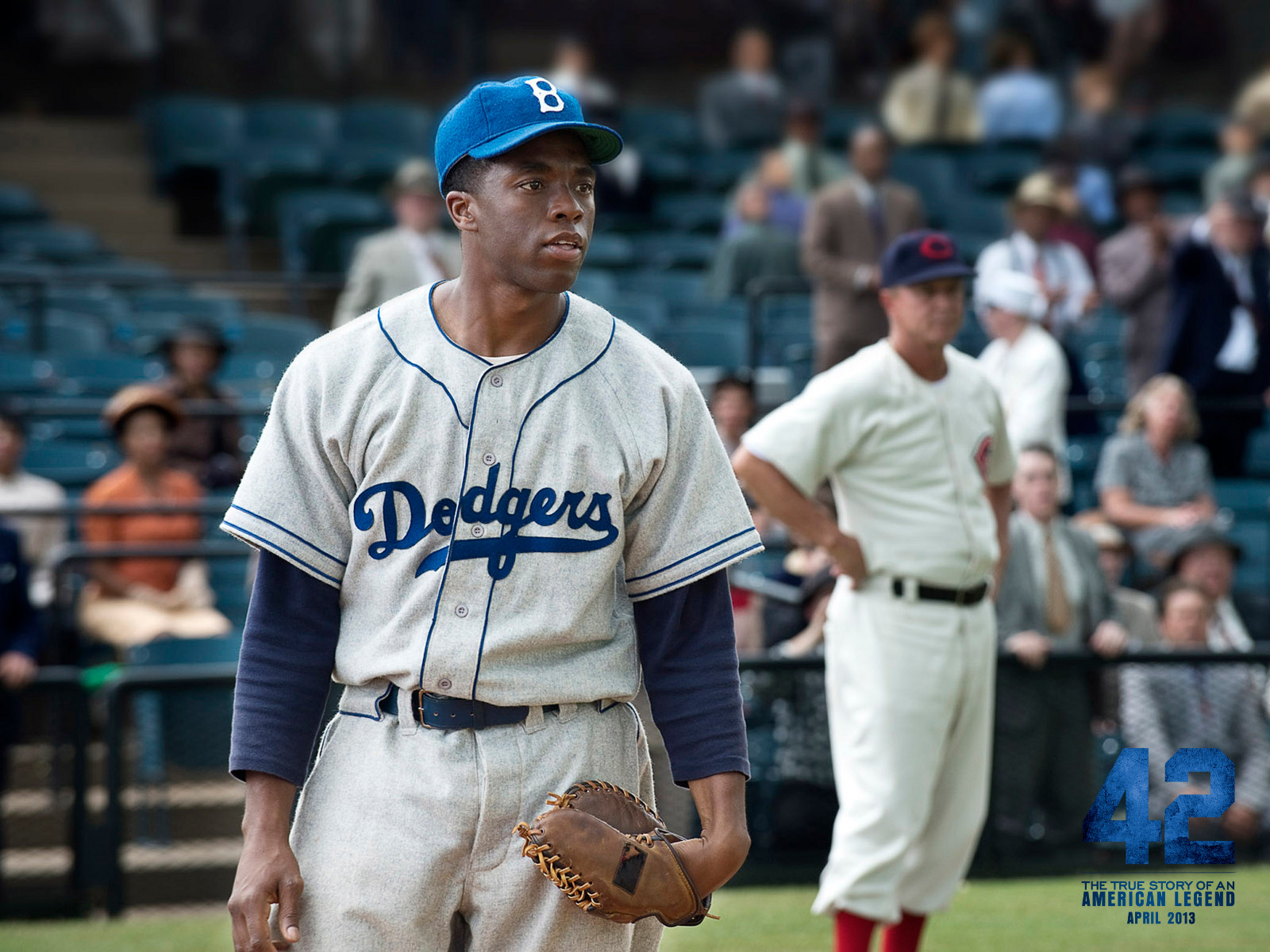
Boseman spoke to a small group of journalists about preparing for the role and what it was like to work with Harrison Ford, who plays Branch Rickey, the man who offered him a job with the Brooklyn Dodgers. He did not originally intend to become an actor. He studied writing and directing. “As a director, it is important to understand the actor’s process. So, I took the acting courses at first for that, and then continued just because I caught the acting bug. For me, they go hand in hand, but it was a gradual process.”
He told us that one of the challenges of the film was that he didn’t just have to play baseball; he had to play it the way they played it in the 1950’s. “The uniforms changed! What’s different is the tools, the gear, the bats were a lot heavier. Not that you would know it from looking at the bats, but you can see it in the swings. There’s not many hitters that have Jackie Robinson’s swing now. It appears to be an unorthodox swing when we see it today. The gloves are different and using those old gloves changes the way you play. It’s fundamental to use both hands to get a ground ball if you can. You can see why that’s the case with those old gloves, because you can’t depend on catching anything with one hand. There’s no pocket. When they say ‘Make a pocket,’ you have to literally make that pocket. And shoes have come a long way. That was one of the hardest parts of the physical aspect of the movie, wearing old-style cleats, take after take. We went through four or five different sets of cleats and it took my feet a few months to heal. I would get up in the morning even three or four months after we were done and I would still feel like I had cleats on. It was like running on nails. But the game is pretty much the same game. And it has to be, that’s part of the mystique. Baseball is about tradition and the scorecard. You’re measuring players from the past against players now and if the game changed too much you can’t judge this person’s monumental home run season against another. It’s about the stats. The game is the game.”
He talked about how the athletes that have “reached that iconic status” have to be able to rise to that clutch moment. “He had to live his live in the clutch. It was never mundane because he was always getting judged on a different level. You have to cherish things in a different way when you know the clock is ticking, you are under pressure. It’s still human, it’s still detail, it’s still subtle like any other character, but the context that surrounds you has elevated.” He prepared for the role by playing a lot of baseball, with practice five days a week, plus conditioning five days a week. “That’s the physical part but there’s also the mental part of it, too. While you’re out there, failing and succeeding, you get a sense of the kind of pressure he really is under. You can’t play the role unless you know what it’s like to have the ball coming at you and it’s your assignment. Baseball is a game of assignments. From here to here, that’s your ball. It’s the other guy’s job to cover you. Or it’s your job to cover somebody else, or whatever it is. You have to play it to get how much pressure this person is under and how that emotionally affects him, how a mistake could get in his head, how much having his teammates look down on him affect him. I tried to figure out what he was thinking moment to moment because a lot of things he can’t say.” He watched footage of Robinson and the Ken Burns series on the history of baseball. He had to understand what the game was to the other players, too. “I tried to take in as much as I could.”
“He was an opinionated, assertive, outspoken person. That’s who he was. This person, who would come to blows — not prone to fight but doesn’t back down from anyone, not the person to run from a fight” was put into a position where he had to hold it inside. “He was not a passive person so you cannot play him passively. You find the most active non-verbal choices.”
After playing two athletes (he also appeared in the fact-based football drama, The Express), he says he’s ready to try something else. “Maybe a musician.”
He said it was “amazing to work with a legend” sharing scenes with Harrison Ford. “You get to see the shortcuts that they take. Like Jackie’s swing. He’s gotten to the point where he looks like he’s skipping stuff but he’s just short-circuiting it. You’re like, ‘How’d you do that?’ He has a feel for the set, so in tune with all the equipment and knowing how to facilitate the process and that’s a fun thing to watch. He doesn’t cherish this role any less than anything else he’s done.”
Posted on April 8, 2013 at 10:40 pm
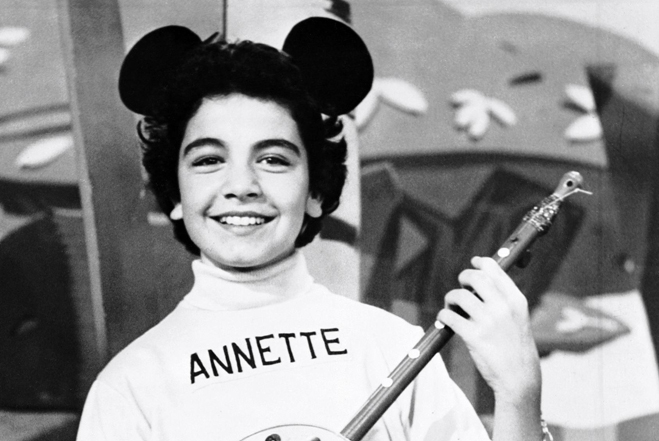 Once upon a time, there was a young Disney star who grew up to be lovely, gracious, stable, and every bit the sweetheart she always seemed. That was Annette Funicello, who died today at age 70.
Disney’s original “Mickey Mouse Club” was the show that children of the 1950’s raced home from school to watch. Annette was everyone’s favorite. She could sing and dance, but so could all the others. But there was something about her, a warmth and sweetness and endearing natural quality on camera that made her seem like the girl you’d like to have for your best friend.
Walt Disney was so captivated by her that he had her guest on on the popular “Spin and Marty” serial, star in her own serial featured on the “Mickey Mouse Club,” and, for a birthday present, allowed her to guest star on the hit “Zorro” series. As she grew up, she appeared in Disney films like “Babes in Toyland,” “The Shaggy Dog” and “The Monkey’s Uncle,” where she sang with the Beach Boys.
When she was offered a role in a low-budget movie for teenagers called “Beach Party,” she visited the man she always referred to as “Mr. Disney” to ask his permission. He requested that she not wear a two-piece bathing suit. Her suits we notably modest in the very successful series of beach movie films filled with bikini-clad girls that she made with teen idol Frankie Avalon (sweetly spoofed in Tom Hanks’ “That Thing You Do”).
http://www.youtube.com/watch?v=kDesGtp-JIILater, she appeared in television commercials for peanut butter advising that “Choosy mothers choose Jif,” still warm, unpretentious, and gracious. When she was diagnosed with multiple sclerosis, she became a leader in providing support, raising the level of awareness, and establishing a foundation to fund research.
The CEO of Disney made a statement today:
Annette was and always will be a cherished member of the Disney family, synonymous with the word Mousketeer, and a true Disney Legend. She will forever hold a place in our hearts as one of Walt Disney’s brightest stars, delighting an entire generation of baby boomers with her jubilant personality and endless talent. Annette was well known for being as beautiful inside as she was on the outside, and she faced her physical challenges with dignity, bravery and grace. All of us at Disney join with family, friends, and fans around the world in celebrating her extraordinary life.
Posted on March 27, 2013 at 5:25 pm
This summer’s Pixar release, Planes,is an airplane saga “inspired by the world of ‘Cars,'” with Dane Cook as Dusty, a plane who dreams of competing in a big air race. It will star:
· Stacy Keach (“The Bourne Legacy,” Alexander Payne’s upcoming “Nebraska,” Robert Rodriguez’s and Frank Miller’s “Sin City: A Dame To Kill For”) provides the voice of Skipper, a reclusive old Navy Corsair who takes Dusty’s training to new heights.
· Brad Garrett (“Everybody Loves Raymond,” “How to Live with Your Parents for the Rest of Your Life”) lends his voice to fuel truck Chug, Dusty’s buddy, coach and biggest fan.
· Teri Hatcher (“Coraline,” ABC’s “Desperate Housewives”) brings life and charm to the say-it-like-it-is mechanic Dottie.
· Cedric the Entertainer (“Barbershop,” “Larry Crowne, “Madagascar”) as Leadbottom, a puttering old biplane who has no time for Dusty’s far-fetched flights of fancy.
· Julia Louis-Dreyfus (“Veep,” “The New Adventures of Old Christine,” “Seinfeld”) lends her voice to Rochelle, a tough and confident racer who is the pride of the Great White North.
· John Cleese (TV’s “Whitney,” “A Fish Called Wanda”) is the voice of Bulldog, the oldest and arguably wisest racer on the circuit.
· Carlos Alazraqui (James Garcia on Comedy Central’s “Reno 911”) brings to life the intensely charming El Chupacabra, a racer with more dramatic flair than is recommended at high altitudes.
· Priyanka Chopra (“Barfi!”) voices the exotic, mysterious and ruthless Ishani, the reigning Pan-Asian champion from India.
· Roger Craig Smith (Captain America in Disney XD’s “Marvel’s Avengers Assemble,” voice of Sonic The Hedgehog in “Wreck-It Ralph”) voices world champion racer Ripslinger—wings down, the biggest name in air racing—and he knows it.
· Gabriel Iglesias (Comedy Central’s “Gabriel Iglesias Presents Stand-up Revolution”) provides the voices of both Ned and Zed, two not-so-sharp saboteurs who work for Ripslinger.
· Val Kilmer (“Batman Forever,” “Top Gun”) provides the voice of Bravo, a member of the Jolly Wrenches and a fan of air racing.
· Anthony Edwards (TV’s “Zero Hour,” “Top Gun”) is the voice of Echo, a member of the Jolly Wrenches and a fan of air racing.
· Colin Cowherd (ESPN) gives play-by-play coverage as Colin Cowling, an affable blimp and an eye-in-the-sky reporter for the Racing Sports Network.
· Sinbad (Comedy Central’s “Where U Been?”) brings to life Roper, an irascible race official pitty full of sly remarks and colorful commentary.
· Oliver Kalkofe (“Neues vom Wixxer”) provides the voice of meek German minicar Franz and his brazen airborne alter ego Fliegenhosen.
· Brent Musburger (ESPN, ABC Sports) brings Brent Mustangburger, the excitable 1964½ Ford Mustang sports broadcasting icon, back to the big screen.