
Happy Birthday, Lucille Ball!
Posted on August 6, 2012 at 1:16 pm
I love the look on her face when she first tastes it!
Posted on August 6, 2012 at 1:16 pm
I love the look on her face when she first tastes it!
Posted on August 5, 2012 at 8:41 am
On the 50th anniversary of Marilyn Monroe‘s passing, we remember her.
Posted on July 29, 2012 at 3:59 pm
One of the highlights of my time at Comic-Con was a press conference with Don Cheadle, Robert Downey, Jr., producer Kevin Feige, and Shane Black about “Iron Man 3.” Black (“Kiss Kiss Bang Bang,” “The Last Boy Scout”) co-wrote and takes over direction from Jon Favreau. Just after their appearance before more than 6000 fans in the cavernous Hall H, they met with journalists to talk about one of 2013’s most eagerly anticipated films.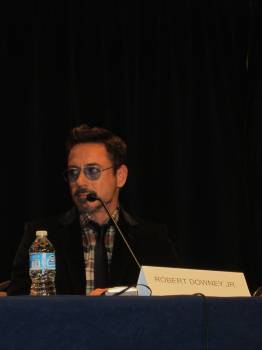
Asked about pressure to top the action scenes in the previous chapters and the blockbuster “The Avengers,” Downey said, “There is an idea about being big. But for me it’s more about capturing and redoubling the intensity, like ‘The Avengers,’ that sort of lighting in a bottle, the thrills in a short space.” “We’re not looking for bigness, necessarily,” said Black, “We’re looking for different and fresh and new and change.” They talked about the “real, practical suit” — not CGI — that has made the “Iron Man” movies so mechanically satisfying. “More uncomfortable for the actors, more satisfying for the audience,” Downey smiled. And everyone agreed that most of the rumors and speculation online was wrong. Black said he was surprised about “how much generous help was available to me.” Favreau gave him “all kinds of tips and advice” and “the transitional feel I needed,” asking only for some salmon and blueberries. He also appreciated Marvel’s special effects help so he could “concentrate on story. It’s as self-contained a story as we’ve done since ‘Iron Man 1.'” They promised romance and some comedy, too. And Black said he appreciated Marvel’s letting him take some risks. “He’s a great story-teller, and he has a great relationship with Robert,” said Feige. “We’re confident in the infrastructure we can provide.”
Downey said that even he was surprised at the success of “The Avengers” and was looking forward to exploring the relationship between Rhodey and Tony with more depth, as the comics do, and seeing Tony Stark reconsider his role “in a post-Avengers world, what sort of limitations might be placed on him and what threat would make him, as usual, ignore those limitations.” “You have to find a way that the first two aren’t done yet, in other words, how has the story not yet been completely told, to make it feel organic and new,” said Black. “We seriously dug into Tony’s world.” “I do suit up,” Cheadle said, and promised some “additional iterations” for his character. “I liked in the comic there was a bit of suit envy,” said Downey, pointing out the difference between a corporate and military approach. “And for some reason or other, Tony is the one they trust!” “This film has a lot of breadth to it. There’s a way to enjoy all that kind of shadowy stuff” in Tony’s character.
“We’re not really going to China,” Black stage-whispered, though some scenes are set there.
Downey charmingly insisted on taking a question from a boy with a Sharpie Tony Stark goatee, who stood up, took a deep breath, and asked how it felt to be a hero. “I think I speak for any of us who get to live in this world. I take it as seriously as Shakespeare.”
Posted on July 25, 2012 at 11:59 am
Sherman Hemsley, best known for playing the outspoken George Jefferson on the classic Norman Lear sit-com “The Jeffersons,” died this week at 74. It was a challenge to play the role of George Jefferson, who was often referred to but never seen for many episodes of one of the most popular and influential television shows of all time, “All in the Family.” Creator Norman Lear wanted to come up with a worthy foil the his conservative and bigoted Archie Bunker played by Carroll O’Connor. The idea of a black man who was as prejudiced against white people as Bunker was against non-whites was surprising and provocative. At first, viewers only heard about George from his wife, played by Isabel Sanford. But when Hemsley stepped into the role he made the peppery and sometimes arrogant character who moved like a bantam rooster so appealing soon he and Sanford were starring in the spin-off, with its unforgettable theme song. It ran for 11 years. Hemsley later starred in “Amen” as a church deacon and as George Jefferson again in “Tyler Perry’s House of Payne.”
http://www.youtube.com/watch?v=L09qnRfZY-kHigh-strung and irrepressible, George Jefferson quickly became one of America’s most popular television characters, a high-energy, combative black man who backed down to no one — something that had rarely been seen on television. At the same time, however, he was vain, snobbish and bigoted (“honky” was one of his favorite epithets directed at whites), and flaunted his self-regard like a badge. Each week, his wife or their irreverent maid, Florence (played by Marla Gibbs), would step up to scuttle his wrongheaded schemes or deflate his delusions of grandeur.
Hemsley’s great gift was to make us understand that beneath his bluster, George Jefferson loved his family and worked hard for his success. He surrounded himself with people who were not above putting him down and at some level he enjoyed it. May his memory be a blessing.
Posted on July 25, 2012 at 8:00 am
Zoe Kazan, the grand-daughter of legendary director Elia Kazan (“On the Waterfront”) and the daughter of two writers, has made a strong impression in small roles opposite Meryl Streep (“It’s Complicated”) and Leonardo DiCaprio (“Revolutionary Road”). Her boyfriend is Paul Dano, whose performances in films like “There Will be Blood” and “Little Miss Sunshine” have earned him the reputation of one of the most thoughtful actors of his generation. Kazan wrote and produced “Ruby Sparks” and they appear in it together. Dano plays an acclaimed young writer who is struggling to follow his successful first book and is stunned and then captivated when the young woman he creates with his typewriter comes to life.
Did you know when you wrote the script that you would be playing the title character?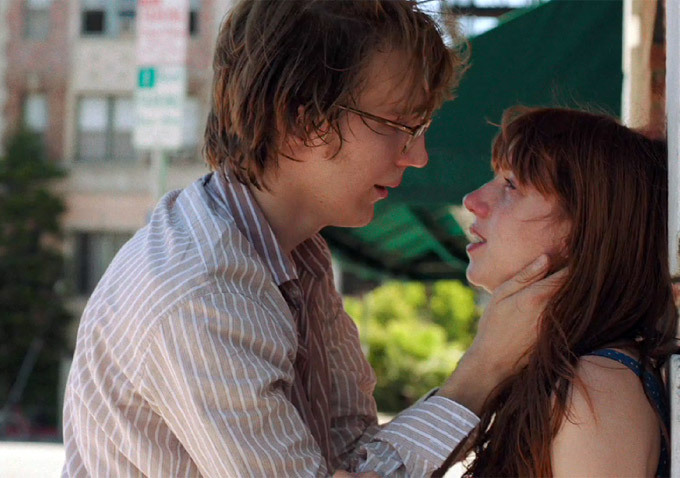
Kazan: Well, it wasn’t the title character when I wrote the script – that happened in retrospect, but yeah – I had a sort of flash of inspiration, not unlike Calvin . I had a dream and I woke up in the morning and the scenes of this movie were in my head and I wrote it down as fast as I could so I wouldn’t lose it and then showed those five or 10 pages to Paul and he said “you’re writing this for us, right?” It really hadn’t to occurred to me – and then it was completely obvious to me that that was what I was doing – so from that point on I knew I was writing for myself and I think it was…they were just such clear people to me that I didn’t think too much about us. It wasn’t until later when I was actually having to do it that I said “oh God, what have I written?” For so long, I was just thinking about it as a writer but it wasn’t until the very last month of preparation that I even started thinking about acting it.
Both of them are really acting-challenge roles – people don’t like to play writers because they are sitting and looking at a piece of paper, and a lot of it is very internal.
Dano: Well, you just sort of take the basic building blocks that the script gives you. In this case he’s gotten out of a long relationship, he does not have any friends—his brother, rather, is his only friend, he lives in a big house alone, he got a dog to try and help them meet people but that doesn’t seem to be working out, his father has passed away, and he’s had a huge success that he cannot follow up and has writer’s block and so those are all just great, great, great starting points to sort of then figure out, “okay, how do you feel about those things?” Because each of those is a big thing and a big feeling and you can start to figure out what happened before that, especially with his book and how he got into writing and what his relationship maybe with his father was like and with the ex-girlfriend– you just sort of build it up but you start with what’s on the page that’s given to you and then you just sort of fill in the blanks.
And Zoe, your character was almost like an acting exercise, somebody throwing things at you, ”now be this, and now be that.” How do you create a character, that is, when you’re playing something so changeable?
Kazan: Well, you know, the main thing that Jonathan and Valerie and I talked about in the writing and then in the playing of her was that we wanted her to feel very real, and we never wanted her to feel like a fantasy or like the idea of a person. It was sort of like doing my preparation, like, “who is Ruby?” and finding things out about her as I wrote. She’s a very forthright person, and she’s sort of a person in charge of her own desires, she knows what she wants and she’s more straightforward than I am as a person, and there was some surprise in that, especially when you started playing it in her rehearsal—where she lived, where her voice is where her energy is, she’s very front foot, very forward and I think a little more cat-like than dog-like. So, a part of it was just moving away from the writer’s head, which was all about the story and how these people interact and then moving into my body and then feeling who she was physically. That was a real moment of discovery for me, which I wasn’t anticipating, because I sort of thought writing it, I would know everything, but I learned a lot just within the first week when we were rehearsing. The important thing for me with the changes that happened to Ruby me was that they feel like a related person but not the same – he’s changing her, he’s bringing out a different side of her, so, those things were fun to play because they were like an exaggerated quality. But you know, we were always trying to keep it grounded in reality.