
Lupita Nyong’o Joins the Cast of the New “Star Wars”
Posted on June 3, 2014 at 9:55 am
Oscar-winner Lupita Nyong’o and “Game of Thrones” star Gwendoline Christie have been added to the cast of the new “Star Wars” film. Very exciting news!
Posted on June 3, 2014 at 9:55 am
Oscar-winner Lupita Nyong’o and “Game of Thrones” star Gwendoline Christie have been added to the cast of the new “Star Wars” film. Very exciting news!
Posted on May 31, 2014 at 3:59 pm
The most mind-blowing scene in the blockbuster “X-Men: Days of Future Past” is when the Quicksilver character played by Evan Peters stops time and rearranges everything from the trajectories of bullets seemingly suspended in air to the positions of the soldiers’ arms and legs. CinemaBlend explains how it was done.
By speeding up the frame rate on everything but Evan Peters, you could then film the actor at regular speed, and when combined together, it would make Quicksilver appear as if he’s moving 150-times faster than everything and everyone around him. This allows Singer to let Peters manipulate his surroundings – moving a bullet or shifting a security guard’s arm – without disrupting the scene.
Be sure to check out the full description. That’s why they call it movie magic.
Posted on May 27, 2014 at 8:00 am
I last talked to editor/composer John Ottman about “Jack the Giant Slayer” and loved hearing about his unique combination of roles, often working with his former classmate, director Bryan Singer. They collaborated again on X-Men: Days of Future Past and it was a pleasure to catch up with him to discuss the challenges as both editor and composer of working with so many characters and two different time periods.
You have so many characters in this film and some of them change their appearance a lot, either due to use of their superpowers or being played by different actors in different time periods. How do you as an editor help the audience keep everybody straight?
The hardest thing when you have many characters in a room in one scene is to basically keep their presence alive in the scene. If you spend too much time with one character talking, your mind inevitably wants to know what the other characters are thinking or how they are reacting. And if you spend too much time away from showing their reaction to the other character talking, the more I think you feel uncomfortable in the scene. So the challenge is sort of the keep everybody alive even if they’re not speaking.
What are some of the ways that you do that?
I just put myself in the mind of the audience. I’m watching someone speak and I as soon as I start to wonder what the other character or character being spoken of might be a reacting, I want to see them. I use my own reaction to cut to another character.
And there are different time periods in this film also.
Yeah, there’s a dreary future and then there is 1973. Logan’s consciousness was fed back into his younger self so that he can change an event that happens in the past so that the future might be fixed or not be so dreary.
How do you keep the audience constantly aware of where they are in time?
It’s pretty obvious where you are. Nevertheless, we did have internal debates sometimes where people were like, “Are you sure people know that we are in 1973?” “I think so.” But that wasn’t a huge problem. It was just basically the timing and keeping the storyline as clear as possible. It’s extremely convoluted and a very complex story.
 You’ve got the young and old version of some of the characters, right?
Correct, yes. And the other biggest challenge of the film was the time travel aspect. It’s like the “whack a mole” game where you whack one mole and then you create another problem. It’s sort of like you have to keep whacking a mole until you can live with the smallest problem. But there will always be imperfections in time travel stories so that was a big challenge; sort of building consensus with everyone to try to accept what we were going to accept.
Did you once again do the editing first and then composing second?
Of course, yes. It’s overwhelming to actually deal with all of the management of the film to get it together. The editing is not just putting pieces together. At least for me it’s also storyboarding scenes, it’s designing the pre-visualization of the scenes with the pre-vis artists, it’s generating the shot list with the second editing director, visual effects issues, looping the actors and all that endless stuff. I have no hope of even starting to write the score until I have some sort of editor’s cut.
So do you work with a temporary music track as you are editing?
Yes, but people would be surprised to know that I don’t really use music to cut my scenes together. I wait until I get my full editor’s cut together before I put any temporary music in. And working without music, I know where the film is strong and it’s not reliant on the score. Once I get to that point, I spend about two weeks putting temporary music in so we can have screenings and show the studio.
I’d like to go back to that same challenge of two time periods and so many characters. How do you use the music to help the audience keep it all straight? You don’t have different themes for the characters, right?
In fact this has fewer characters themes than X-Men 2. It’s not so typically superhero-like when a character walks and you hear a motif for them.
This film is different so it does not really lend itself to have numerous character themes. There is the overall theme of the film; the X-Men world, which is my theme from X-II but then there are really three other themes in the film. The main one is Charles Xavier’s theme because it’s really his story about how his character has lost all the hope when we see him in the 70’s.
And it’s Logan really trying to get him to rekindle that hope. That’s the centerpiece of the score; at least subliminally, his music. And also he’s trying to fight for Raven’s soul so she has a little bit of a motif in the movie and then Magneto himself has a very simple very accessible motif. There’s not much time in modern movies to establish a beginning, middle and end theme for each character so you barely have time to do signature sound that you can recognize, so his is very simple but very sort of malevolent.
For lack of a better description, there’s a metallic sort of sound. And Mystique has her transformation swishy kind of sound. So I obviously left room for those things. I am very involved in the sound design so I think I surprise people when I am directing the dub as the editor, how I often bury the music or intertwine it with the sounds I use.
What about the time period differences? Are there different instruments or different time indicators?
The 70s gave me an excuse to use some analog synthesizers; we use some old keyboard synthesizers and electric piano and guitar, sometimes very subtly but it was fun to do that. And especially for the sentinels of the past, I was able to do some sort of electronics that were of the period. The score for me is unlike Jack in that Jack was a very pure orchestral swashbuckling score where you had basically everything emulated from the orchestra. This score was very synthesizer heavy with orchestral supplementation. So that was just our decision because every movie is different and that’s what felt right for this film.
If you could take one of the X-Men, which powers would you pick?
I guess I would have Mystique’s power so I can sort of… I can be really out of shape and morph into someone has a great body.
Yeah, I think we’d all like that one!
Posted on May 16, 2014 at 8:33 pm
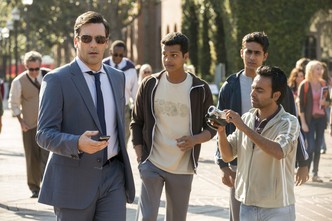 Mark Ciardi is an athlete turned producer who specializes in taking real-life sports stories that sound like Disney movies into actual Disney movies: “The Rookie” and “Miracle.” His latest is the Cinderella story “Million Dollar Arm” about sports agent J.B. Bernstein’s “American Idol”-style competition to find athletes in India who could become major league baseball pitchers, despite the fact that no one in India plays baseball.
Ciardi spoke to me about why audiences connect to sports stories and how the real-life J.B. Bernstein changed as a result of the competition.
What is it that makes sports such a powerful metaphor for so many other things in life?
It’s a great backdrop for stories. Hopefully the really great sports stories are never about the sports, they are really about the people and how they change. Usually it’s either a great underdog story or how you’re overcoming something or second changes. So I think the themes are really great in sports stories and when they’re done well they’re just very, very powerful.
I’ve never heard of the real life million dollar challenge before. How did that come to your attention and what made you think that would be a good movie?
I know the guy personally who started the contest, J.B. Bernstein. I knew him well before I got into the film business and in 2007 we actually ran into each other at a super Bowl party in Phoenix. And he was just about to go to India. And was telling me the story about wanting to find two kids to bring back, and I remember looking at him, and I looked across eyed and was like “…good luck. That sounds crazy.” And about a year and a half later he ended up in my office saying he got these two kids signed and I was stunned. It was a quite, quite incredible story for him. It just became apparent to me that it would make a great film.
And what about the sort of personal aspect of that, did that play out the same way that it did in the movie in terms of his attachment to the two players and his romantic involvement?
Absolutely, that’s the great thing. Everything on the field really takes a backseat to the love he has for these boys and he’s was just together with them in Pittsburgh or at the premiere. He definitely gives credit to the boys to meeting Brenda and obviously falling in love and now having a family of his own. It’s was a great thing for me to watch personally. All those relationships — I had a front seat to all of them. I can attest that it is all true and he now has a family which is great. At the end of the film you see all these images of the real J.B. We’re really excited about that emotional transformation, spiritual transformation as well.
You kind of had the same challenge with the actors that Bernstein did with the athletes — you had to teach them how to play baseball at a very high level very quickly. How did you do that?
It was funny, it was like imitating art. As difficult as JB had it, this was more because these kids aren’t actually athletes. We had to find doubles to actually double our actors but we had great students in Suraj and Madhur and even Suraj who plays Rinku, a leftie, and he is right-handed. We had to flip the negatives. So there was a lot that went into what you saw the screen, it’s years of work and we really feel like we pulled out the sports really well.
Which part of the production did you work on?
We’re involved in getting the rights to the story, finding the director, bringing it to Disney, hiring, casting, everything. I was the one over in India and when we came back and shot in the States. I was there kind of every day on the set dealing with it and I guess I was the most involved.
Was this you first time ever in India?
It was, we actually scouted over there in March and we did a lot of the casting so when we went back to film for a month it was my second time. We were there at the very hottest time of the year, getting in before the monsoon started. So it was anywhere from 100 to 126 degrees. All the sweat you saw on our actors and everyone was the real thing. There was no makeup artist going in and spraying anybody down. It was brutally hot but I think it added the feeling of what JB went through with the contest and frustrations. It’s an amazing country I think everyone came back better for being there.
And what do you want families to take away from this movie?
It will make you feel good, put a smile on your face. It’s uplifting. It’s just one of those movies that entertains you, and you walk away and it stays with you. I’ve seen this many, many times in front of many audiences and it’s incredible, like the response. We know it special.
Posted on May 3, 2014 at 4:17 pm
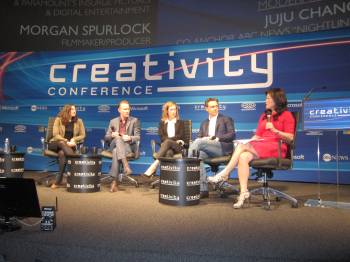 If you get invited to a conference on creativity featuring Vice President Joe Biden, 3D printers, President Fitzgerald Grant from “Scandal” (that’s actor/director Tony Goldwyn), a minion, and a chance to sit on the Iron Throne from “Game of Thrones,” I’m sure you agree with me that the answer is “Yes!” The event was sponsored by the MPAA (the association of the movie studios) in partnership with Microsoft and ABC News. MPAA CEO Chris Dodd told us that movie studios are technology companies that produce content and we got to see some great examples, with glimpses of upcoming films from Warner’s and Disney.
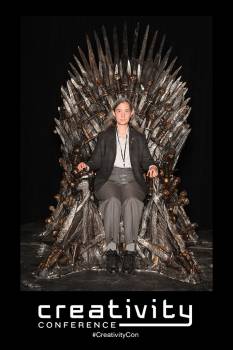 It was tremendously exciting. I got to play with some cool new technology. The throne is more comfortable than it looks. The minion was very cute. The Vice President gave a stirring speech about the way that movies convey a sometimes raw but profound message to us and to the rest of the world. They are “the face of American culture,” and more powerful than diplomacy. He said that America’s unique and unprecedented renewal is due to our “overwhelming and constant stream of immigration” and the optimism and commitment to improving things that is a part of our culture.
The presentation by Avi Reichental of 3D systems was mind-blowing. He told us of the grandfather he never met, a cobbler who died in the Holocaust. He talked about what manufacturing was like in his grandfather’s time, the opportunity for individual creativity and innovation. With his company’s 3D printers, the forces that have made manufacturing large, institutional, and moved overseas will become less important. 3D printing “democratizes” manufacturing and creates opportunities for individuals to create (and sell) anything they can imagine. Reichental’s very colorful shoes and cool-looking watch were both made by 3D printers.
I especially enjoyed a panel discussion moderated by Juju Chang of “Nightline,” featuring Tony Goldwyn (who plays the President on “Scandal”), Kati London of Microsoft, Amy Powell of Paramount, and documentarian Morgan Spurlock (“Super Size Me,” “Inside Man”). Goldwyn, also a producer and director, talked about how Twitter created an exceptionally close connection between “Scandal” and its fans and London told us how a multi-player online game was more effective than traditional PSAs in reaching middle schoolers. It was a lively and illuminating morning and I’m looking forward to next year already.
