
Saving Mr. Banks

Posted on December 13, 2013 at 5:17 pm
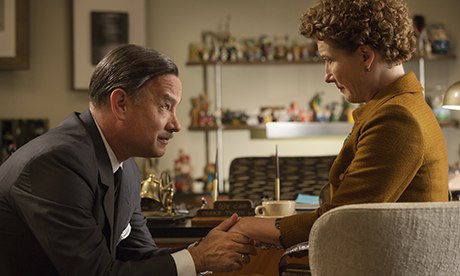
Saving Mr BanksFor most of this story, Walt Disney (Tom Hanks) and P.L. Travers (Emma Thompson) are on opposite sides.  He has been trying for twenty years to persuade her to let him make a movie based on her books about the magical nanny, Mary Poppins.  She needs money, as her agent reminds her, which is why she has very reluctantly agreed to leave home and fly to Los Angeles to talk to him about it.  But she cannot bear the idea of losing control of the characters who mean so much to her and she abhors everything about Disney and California, including sunshine, cheerfulness, twinkling, music, and calling people by their first names.

But there is one moment when, in the midst of some obvious culture clash jokes, there is a quiet moment that shows they are both on the same side.  Disney tells Travers that he was in her position when someone wanted to pay him for Mickey Mouse and he simply could not bear the agony of allowing anyone else to make decisions about a character he had created.  Travers says that Mary Poppins and the Bankses are her family.  But in a very real way, the character these artist created are their own very souls.  “We restore order with imagination,” Disney tells her.  And, engagingly, throughout the film we see the process, the inspiration, the despair, the triumph, the necessity of creating art, from a father soothing his little girl with a story to songwriters puzzling out a way to show Mary Poppins’ upside down world by having the tune go up as she sings the word “down.”

We all know how it turned out.  Disney’s “Mary Poppins,” celebrating its 50th anniversary next year, is one of the beloved and honored family films of all time, with five Oscars (Best Actress, Song, Special Effects, Score, and Editing) and eight more nominations.  But anyone who has read the books knows that there are some major departures from the Travers version, and that the fears she expressed — as documented in tape recordings of her sessions with the screenwriter and songwriting team — were more than justified.

Some people have criticized this film as Disney’s burnishing of its own brand, with its founder portrayed as a decent man who is just trying to keep a two-decade old promise to his daughters to make a movie from one of their favorite books.  Amy Nicholson writes in LA Weekly that “Saving Mr. Banks” is “a corporate, borderline-sexist spoonful of lies.”  She says that Thompson’s “Travers is as unpleasant as a pine needle pillow, and she’s as far away from the actual woman as ‘supercalifragilisticexpialidocious’ is from being a real word” when in fact she was a “a feisty, stereotype-breaking bisexual.”  I think this is a misreading of the film’s attitude toward Disney, Travers, “Mary Poppins” (the movie), and what it means to be a creative person in a world that is very imperfect when it comes to assigning monetary value to art (see also: “Inside Llewyn Davis”).  To come to Nicholson’s conclusion, one has to assume that the movie wants us to believe that Disney somehow outsmarted Travers by improving her work.  On the contrary, the movie makes it clear that the movie Mary Poppins was very different from Travers’ idea of the characters, moving them several decades earlier, for a start, and, crucially, as indicated in the title of this film, transforming an episodic storyline about children’s adventures with a magical nanny into a story about parents discovering the importance of being close to their children.  It is Nicholson who underestimates Travers by suggesting she was somehow snookered.  She made a decision that it was worth it to her to let that happen to get the money she needed to be as financially independent as she wished.  As is shown in the very first scene, she could have made money another way — by writing more books about Mary Poppins, for a start — but she chose to consent to the movie, and then to make absolutely sure that no American would ever touch her characters again.

colin-farrell-saving-mr-banks-gintyWhile the cute culture clashes and Travers’ resistance to Disney’s brand of pixie dust are featured in the movie’s trailers, the film itself devotes a substantial amount of time to Travers’ childhood, clearly taking her very seriously as a woman and an artist.  We see her as a child dearly loved by the father she adored (a superb Colin Farrell), a man of great imagination and charm, but, perhaps in part due to those same qualities, not able to manage life as a banker in the far reaches of Australia. As we see him sink from manager at a bank to manager at a smaller bank to teller, fans of the Poppins books will remember her description of what Mr. Banks did at the office (it is not coincidental that he shares a name with his profession).  He “made money.”  Meaning that, at least in his children’s minds, he sat at his desk cutting out coins each day.  Some days he was able to cut out many, and the family was quite comfortable.  But other days he was not as productive, and there were fewer coins to go around.

We can see the origins of this idea and many other Mary Poppins book details in Travers’ past, a seemingly bottomless carpet bag, a crisp “spit spot” from an imposingly organized woman who arrives to put the household in order.  But the most telling detail from the past is the key to the invention of Travers’ most important character: herself.  Her name is not P.L. Travers at all.  Nor is she Mrs. Travers, despite her insistence that Mrs. Travers is what she prefers to be called.  The Australian girl who would grow up to be the ultra-English P.L. Travers is named Helen Lyndon Goff, called “Ginty” by her dad.  His name was Travers Robert Goff.  She took his first name as her last name and put a “Mrs.” in front of it to create the character she chose to be.  This revelation, and Thompson’s brilliant portrayal of Travers show us a woman whose most important creation was the character she pretended to be — or became.

And of course Disney, too, played a character, the folksy host who was going to entertain you no matter how hard you tried to resist, and very well aware that these qualities were his best assets as a businessman.  He insists on taking Travers to Disneyland (beautifully recreated as it was in 1961).  Disney is persuasive enough to get Travers onto the carousel and canny enough to tell her the truth — that getting her on a ride won him a $20 bet.  And he tells her a story about his childhood, showing that just because he promotes an idealized vision of the world does not mean that he is unfamiliar with its harshness and disappointments.

Thompson gives one of the best performances of the year, showing us the insecurity and humanity and wit of a woman who is far more complex than she wishes to appear.  Jason Schwartzman and B.J. Novak as the song-writing Sherman Brothers and Paul Giamatti as the limo driver are all excellent as characters who underscore the theme of art as a path to meaning.  The glimpses of the “Mary Poppins” movie are so entrancing (okay, I had to come home and watch it again and am still humming “Step in Time”) that it is easy to be temporarily distracted from the bittersweetness of the story.  Hmmm, where have I heard that idea before?

Parents should know that this film includes the very sad death of a parent, substance abuse, a suicide attempt, tense confrontations, and some disturbing images.

Family discussion:  What did Walt Disney and P.L.Travers have in common?  What do you learn about her from her relationship with the driver?  How can you take details around you and make them into a story?

If you like this, try: the Mary Poppins books by P.L. Travers and the Disney musical film and the documentary “The Boys,” about the Sherman Brothers

Related Tags:


Based on a true story Behind the Scenes Drama Family Issues

Free Book About Saving Mr. Banks — And Mary Poppins

Posted on December 11, 2013 at 3:54 pm

Walt Disney Studios is celebrating its new film about its own history with Saving Mr. Banks: The Official Multi-touch Book.   Walt Disney spent 20 years trying to persuade author P.L. Travers to allow him to make a movie based on her book, “Mary Poppins.” This interactive ebook includes a foreword by Academy Award-winning composer Richard Sherman; never-before-seen correspondence between Walt Disney and P.L. Travers; rare storyboards and scripts from the Disney archives; a timeline of historic Walt Disney Studios milestones; original recordings of the Sherman Brothers performing their “Mary Poppins” hit songs; facts and profiles on the key characters in “Saving Mr. Banks”—all created by Apple’s  digital book creation app, iBooks Author.

The “Saving Mr. Banks” book is available for free, exclusively on iBooks at www.iTunes.com/SavingMrBanks.  Readers can watch interviews featuring the cast and filmmakers, browse extensive photo galleries and explore the original storyboards and concept art—all in full retina detail. ‘Mary Popovers’ deliver fascinating facts throughout the book.

Related Tags:


Behind the Scenes Books

Interview: William Lorton on “Take Away One” about Teacher Mary Baratta Lorton

Posted on November 25, 2013 at 12:56 pm

Mary Baratta Lorton was a pioneering teacher whose revolutionary ideas about making learning more accessible and involving transformed nearly every classroom in America in the 1970’s.  Her books included Mathematics Their Way.  Tragically, she was murdered.  The killer was never found.  Her nephew, the talented filmmaker William Lorton, has made an enthralling documentary titled, “Take Away One,” which tellingly applies to both stories.  Lorton answered my questions about his film.

When did you first hear about the mystery involving your aunt’s death and how was it explained to you?

Mary was killed in 1978 when I was eight. My parents had to tell us within a day that she had been shot and that the murderer was at large because they knew it would be on TV and probably also on our school playground. I didn’t hear the larger context until college, but even then the whole thing was so convoluted and contested that by the time I was shooting interviews 20 years after that, there was quite lot of detail to sort out. During my adulthood I would sometimes be asked about the case and would always find it an unruly anecdote. I’d be telling the story to someone and I would sound like: “And then this, and then that, oh, but before that there was this…” So making a documentary to get the story in one place with as many participants speaking for themselves as possible had been on my list for years.

When did you first understand how influential she was as an educator?

When I was 14 I got a job at my aunt and uncle’s educational non-profit in Saratoga. Working in the stock room was my summer job for a few years. From the volume of manipulative teaching materials I personally shrink-wrapped and the sheer size of their warehouses and staff, it was clear that people were way into Mary’s work. I mean they were moving pallets of Unifix cubes around with a forklift. They also had this huge wall-chart of how many workshops were being held world-wide and the number of attendees.
You had a real challenge as a filmmaker in essentially having two different stories to tell, the professional and the personal. How were you able to do justice to both?

That was the central filmmaking issue. It was a challenge as a storyteller and as a nephew. Ideally, my aunt would be alive today. She’d be the J.D. Salinger of math textbooks and she would have granted me a two-day interview that would have been just her with some blocks and beads. And believe me, thousands of people would have watched that.
Some of the math people around this issue were against the idea of a film about Mary because they realized it would be impossible to produce her biography without including a component of true-crime material that would either bring up memories that are too painful to re-visit, and/or would distract from the importance of her work. As you can understand, educators are intensely focused on protecting children and politically are keenly aware that anything resembling scandal can be twisted into promoting one teaching method over another. On the other hand, Mary’s family and the retired police who promote the conspiracy theories about her death felt that anything I, as a family member, put together would by definition be biased.

So I would explain to the math people, sometimes in vain, that this is the true story we are unfortunately stuck with, and how would it look if one made a biography of JFK or John Lennon while leaving out the fact that they were victims of foul play? And I would tell the conspiracy theorists, who think the only story here is the murder, that you have to explain who a character is and what she achieved if you expect that murder to have any impact on an audience member who arrives at the theatre knowing nothing about Mary at all. On top of all of this I had to make certain that I as the filmmaker was clearly identified as a family member and to make sure my own perspective was delineated so the viewer has what they need to unwind the perception matrix.

And I would explain to everybody that to make a documentary that is not inclusive is to fail before you begin.

So during four years of production I continually imagined myself in a room giving an oral report with all the diametrically opposed participants watching me. I think the audience gets it, but I doubt whether any of the real-life participants will be 100% satisfied. People prefer to tell their own version of events. Once someone else starts telling what you have owned as your personal narrative for 35 years, every single divergence gets under your skin. And this is a film with over a dozen people voicing the story.

Was there anyone you wanted to interview who refused to participate? Or imposed conditions on the interview that made it more difficult?

The first person I contacted was Mary’s brother, the lead proponent of the conspiracy theory of her death. The guy’s a professor and author and not in any sense an intellectual lightweight. I really wanted to interview him but he rejected it outright, saying that any project that didn’t both start out and end up with the conclusion that my uncle killed my aunt would be “a deception.” But I felt that such an approach would not be “a documentary.” So that was too bad, because for many years I had wanted to meet him in person.
I came very close to having better luck with the original investigating inspector. As I recount in the film, the inspector was very into participating. We emailed and spoke by phone. He was going to get his speaking fee (he’s been on TV many times as an expert.) He introduced us to a great location we could use for the shoot in his hometown. We were even discussing his wardrobe choices. Then a couple of days before the interview he told me he was going to the Hall of Justice in San Francisco to review the case file. He also mentioned, ominously, that he would be asking the DA to review the file as well. Then two days before the interview, he emailed me saying he’d reconsidered after re-reading the file, and decided not to participate. He didn’t mention what the DA’s reaction had been to the file.

This was also someone I’d always wanted to meet, because he’d not only handled my aunt’s murder case, but he had been Dan White’s softball coach and three months after my aunt’s death had done the interrogation on White about his assassination of Mayor Moscone and Harvey Milk – which got him some criticism in the press. I’d also wanted to talk to the modern-day SFPD. Although their PR office was very friendly and responsive, it was clear the department has some unspecified issue with discussing anything about this 35 year old unsolved case. They would not even come on to say where or when it happened, which they were happy to do previously for a newspaper article.

What was it like to play at Mary and Bob’s home?

Great. As you can imagine, they were experts with children and knew how to keep your mind constantly engaged with no budget. I think my brother, sister and I (incorrectly) perceived them as “hippies” because they had green shag carpet, wore sandals and were authors. So I at least perceived their place as a “freedom zone” in contrast to the kind of disciplined atmosphere parents are obliged to provide. And they had a staircase.

How were you able to find the archival footage, like Mary’s television interview with Captain Kangaroo?

Every aspect of the Bob Keeshan footage was a very lucky break. Mary’s publisher got probably one of the first VHS cassettes ever made from KPIX after that interview was taped in the early 70’s. Getting the rights to use images of Keeshan and the show’s host, Kathryn Crosby (who acted in “Anatomy of A Murder” and is the widow of Bing Crosby), turned out to be a rabbit-hole of its own, but it had a happy ending. The 16mm news footage was all located at the Bay Area Film and Television Archive in San Francisco. I can’t tell you how lucky we were that this material was archived and intact. Apparently most of the local TV stations had big bonfires of all their 16mm material in the 1980’s because they had switched over to videotape and didn’t want to store their film forever. This of course is absolutely galling to any film historian, or any thinking person for that matter — and so ironic of course because by now that whole bonfire could fit on a medium-size hard drive.

Did your family have any concerns about telling this story?

Yes, and they still do. Some of them have the concern that telling the complete story will distract from Mary’s educational work, the value of which is and should be the main takeaway from the film. My response to them was and is that a.) to leave out Mary’s death would not be biographically ethical and b.) the well-established function of a death in a story about an emerging innovative leader is to throw the shortened life of that person into starker relief as you contemplate exactly what was lost.

You have some innovative visuals, like the numbered hangers whose import is not fully revealed until the end. In a way, this is the clearest demonstration of Mary’s approach to showing, not telling. How did you develop these techniques?

That’s the point where Mary and I converge. The best films and the best teaching techniques both follow the “show don’t tell” rule. After all, they’re doing the same thing, right? (For example, when I was informed one Thanksgiving that I had to carve the turkey, I went to YouTube and watched a video of someone carving a turkey, I didn’t look up written instructions on how to do it.) The classic challenge to anyone making a non-fiction piece about events that happened 40 years ago is that you don’t have much footage of what you are talking about. So unless you actually want a 105 minute parade of talking heads, you need to get creative with filling what we call the “black holes” in the cut, which are the places in the film that you leave empty, waiting to find a photograph or element that will illustrate the story and get the camera off the interviewee’s face. I did a lot of this in “Take Away One” by using family photographs, fair-use imagery and motion graphics I made on my computer –- but fortunately Mary’s work was largely visual, and attractively so, so it was a natural solution to fill up the movie with images she herself made, whether it’s re-creations of her math lessons or the notecards she used to write down what was happening in her life.

Related Tags:


Behind the Scenes Interview

Interview: Mark Henn of “Frozen”

Posted on November 24, 2013 at 3:59 pm

I always love talking to Mark Henn, one of the top animators in Disney history.  Previously, we spoke about young Simba in The Lion King and the most recent Winnie the Pooh.  This week, we talked about the adorable snowman character, Olaf (voiced by Josh Gad) in the Thanksgiving release “Frozen.”

http://www.youtube.com/watch?v=JqBU1aKTe6E

I’d think from an artist’s point of view it would be a real challenge to work with a character made of snow and backgrounds made of snow.  That’s a lot of white!

Snow is certainly a real challenge, but the effects team rolled their sleeves up and dove right in and it is amazing what they were able to do.  They spent a lot of time in the snow, quite a bit of research.  They spent a lot of time tromping around in Scandinavia and some of them also went to Jackson Hole.  And snow isn’t always white.  A lot of credit goes to our amazing art director, Michael Giaimo.  If you see paintings of snow, you will see that snow isn’t always depicted as white.  Depending on the lighting you can have orange, blue, pink — it’s like a piece of white paper, very reflective.  You have a lot of options, particularly in how you light the snow.

And you have a character whose limbs fly off and then reassemble all the time.  How do you make that feel believable when he is such a fantasy figure?

You do have some reality to him.  We’ve all built snowmen and they come together in parts and pieces.  He is the most fantasy, magical character in the film so we can take some liberties.  His arms and head can pop off.  He gets discombobulated a couple of times and has to be put back together, whether he does it himself or has someone do it for him.  Those were his assets, what the animators wanted to take advantage of and make him really unique.

There are several scenes where his head is detached and his body seems to have a life of his own.  He says in the movie that he doesn’t have any bones.  He’s just snow and twigs an a carrot and some coal, but he has a warm heart and he’s all about love and hugs.

How does Olaf fit into the story?

He’s comic relief in one sense.  But he’s also a link between the two sisters.  As children they create a snowman when they are playing and it is Olaf.  So he is integral to their relationship and to connecting them.  He is reintroduced when they are adults and Elsa has left but he is a reminder of what they shared as children.  There’s a simplicity to his design.  We all know snowmen, we’ve built them, we know about Frosty who came to life.  There’s something very fun and magical about Olaf.  He’s fun and non-threatening, and has an innocence like a small child.  He’s the character everyone wants to take home.

Do you have a favorite scene?

There are so many!  The music is so strong in this film, so a lot of my favorite scenes grow out of those musical pieces.  When he is dreaming of heat and summer, it is so funny.  You think there will be a rhyme with puddle but he is totally oblivious to the expectations and to what happens to snow in the middle of summer.  The high point of Elsa’s transformation is when she is being attacked by the palace guards and she has what I call her werewolf moment — she is that monster and then quickly realizes what she is becoming and starts to back off.  It’s quick but very powerful.  And I love the scene at the end with the blizzard.  You’ll be buttoning up your collar when you see it.

What do you want people to talk about with their families after they see it?

The story is about sisters, about family.  There are great lessons for families to talk about — the importance of communication.  There are elements of trust and faith for them to talk about.  It’s about taking the time to talk to each other.  If Elsa and Anna had a chance to sit down and talk things out, we would have had a very short movie.

Related Tags:


Animation Behind the Scenes Interview
THE MOVIE MOM® is a registered trademark of Nell Minow. Use of the mark without express consent from Nell Minow constitutes trademark infringement and unfair competition in violation of federal and state laws. All material © Nell Minow 1995-2026, all rights reserved, and no use or republication is permitted without explicit permission. This site hosts Nell Minow’s Movie Mom® archive, with material that originally appeared on Yahoo! Movies, Beliefnet, and other sources. Much of her new material can be found at Rogerebert.com, Huffington Post, and WheretoWatch. Her books include The Movie Mom’s Guide to Family Movies and 101 Must-See Movie Moments, and she can be heard each week on radio stations across the country.

Website Designed by Max LaZebnik