
Interview: John Madden of ‘The Debt’

Interview: John Madden of ‘The Debt’

Posted on August 30, 2011 at 8:00 am

John Madden, director of “Shakespeare in Love” and “Proof,” came to Washington, D.C. to talk about his newest film, “The Debt.”  It is a remake of an Israeli film about three Mossad agents who are revered as heroes for capturing a Nazi war criminal, who was then killed trying to escape.  The film moves back and forth in time between the capture in the 1960’s and 1997, when a book about it, written by the daughter of two of the agents, is published.  We spoke about the challenge of casting a villain,

How did you become involved in a remake of an Israeli film?

An agent called Ari Emanuel, the brother of Rahm represents Matthew Vaughn and the producer of the original film.  Because it was in Hebrew it did not get a release anywhere else, but they thought it was an interesting project to reconsider or adapt for a wider audience.  So Matthew wrote a script that was faithful to the original story but it was structurally a little different.  The original film cross-cuts more between the two time frames.  He sent it to me, so the first way I came across the material in that form.  I thought it a very compelling and interesting story which I immediately wanted to unravel.  I did watch the original film — it’s the raw material and I wanted to honor that.  But I hoped it would not be very good!  It would be easier.  But it was good, very arresting.  It didn’t daunt me or arrest me.  It excited me because I could see it was a very powerful piece.  We inevitably developed the story in different ways, with different emphasis.  The material is sufficiently strong and charged and complex that as a director you need to find your own way through it.

I’m always interested in what goes into casting the villain, especially in this film where you have an actor who is unknown in the US and who gives a spectacular performance.

Jesper Christensen plays the villain.  He’s Danish and fantastically highly regarded and respected actor with a very long list of stage and movie credits.  I didn’t want an audience to be able to say immediately, “Oh, here’s the villain.”  The preoccupations of the story is about moral responsibility.  I didn’t want the ground to be completely solid.  One of the things you wonder as the Navy Seals must have wondered as they came into the compound in Abbottabad not knowing if the person there was Bin Laden.  You do find yourself thinking even once he’s in captivity, “Have they got the right guy?”  He is clever enough to exploit the weaknesses in the scenario to his own advantage.  A Nazi doctor is about the apotheosis of villainy in a certain kind of cinematic literature and that’s a trap, a danger of two-dimensionality, and Peter  Straughan and I were very conscious of not wanting this character to cooperate with the script, not wanting him to be this monstrous presence.  He does say things that are monstrous, but even that you have to contextualize that he’s a man fighting for his life and looking for any advantage.  He can be quite charming when he says he would prefer to be fed by Rachel, who had, he says, the makings of a nurse in another life.  There’s something beguiling in that sort of wisdom and you find yourself agreeing with him when he says that.

We were under a lot of pressure to change the title at one point.  It’s somewhat of a negative signifier in this modern age though I always thought it was a marvelous title.  In the interest of collaboration, I said, “Well, if we can come up with another one,” and one we thought of was “Another Life.”  He is a man who makes another life for himself, or tries to.  Watch for the moment when he starts speaking in English.  And there’s Rachel, looking out behind sunglasses which are supposed to protect her eyes from the sun but she’s looking out at a life she should never have had, that is a false life, that seemed a provocative and interesting idea.

It is very Israeli to have such an international cast.  Israel is even more of a melting pot than the US.

I’m slightly conscious of the fact that other than the Israeli actors, the principals are not by in large Jewish.  That wasn’t by intent.  But the internationality of the cast gave me a kind of latitude.  I don’t think anyone watching the film would know where Jessica Chastain or Marton Csokas was from.  He’s actually half Hungarian.  And Jesper is a Dane who blessedly is completely fluent in German and English.

Did you have the actors who played the younger versions of the characters work with the actors who played their older selves?

Only Helen and Jessica.  That symbiosis is necessary for the story and I set higher standards of physical affinity.  I wanted Jessica to be an unknown but she’s less of an unknown now!  I looked at the photos of the men side by side.  But David is almost unrecognizable to himself, one of those situations where you might say, “I saw him the other day and you wouldn’t recognize him.”  So resemblance was less important.

It is a story about stories, isn’t it?

There’s a lot of thematic richness in the film.  It’s about a need for heroes and the way we mythologized them.  This country’s whole political discourse and movie culture is based on the idea of the hero. It’s a very potent idea to deconstruct.  And we all mythologize our own histories with an unconscious editing of our own behavior.  You know you’ve got a good story when it starts talking back to you and revealing things that you haven’t foreseen.  It’s the daughter’s unawareness, the way she is enveloped in a lie — the mother has to do something truly heroic, to immolate herself in order to release her daughter from the contamination of the lie.


Related Tags:


Directors Interview
Interview: Vera Farmiga of ‘Higher Ground’

Interview: Vera Farmiga of ‘Higher Ground’

Posted on August 24, 2011 at 3:48 pm

Vera Farmiga (“The Departed,” “Up in the Air”) directed and stars in a new film based on the memoir by Carolyn S. Briggs, Higher Ground: A Memoir of Salvation Found and Lost.  As she spoke to a small group of reporters in a Georgetown hotel, it was clear that she shares her character’s passionate yearning for an intimate connection with the Almighty.
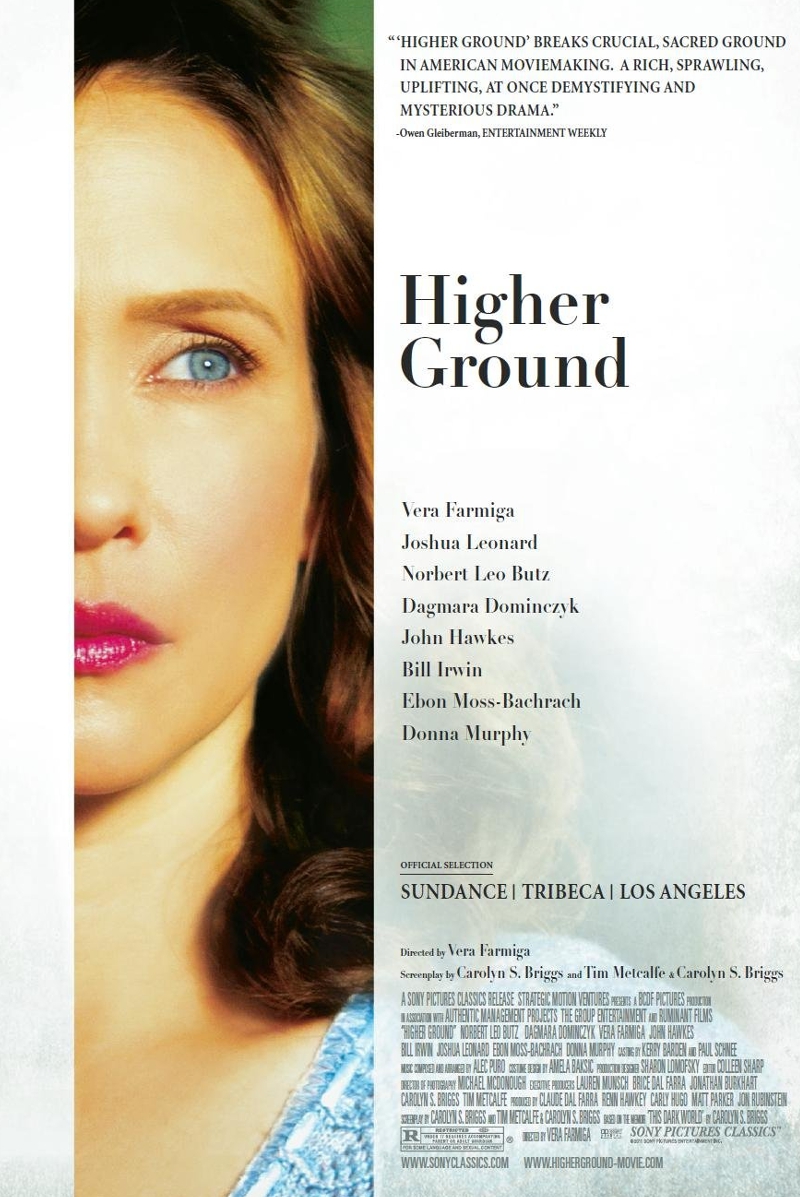
I began by asking her about her character’s hair, which seems to reflect not just the changing fashions over the decades covered in the film, but her spiritual and emotional state as well.  “It was three different time periods.  The church changes.  It goes from worshipping outside to worshipping in basements, hallways, annexes, to a proper, steeple-topped church.  As the hippies turn into yuppies, so do the hairstyles.  Her hair starts off wild and carefree and long and tangled.  And passionate.  And then there are the trials and tribulations and ebbs and flows of her path, and she engages in spiritual warfare and her hair also has its phases.  Childbirth, and then she gets shorter.  We did a perm curl – it gets corrupted.  It gets poisoned — by a home perm!  And then by the end it’s a looser wave, gentler.”

She admitted that this book was an unusual choice for her debut as a director.  “It chose me.  I really feel that way.  I tried to wriggle out of its grasp, several times.  Every time I tried, something else would happen that made it unstoppable….It touched me in divinely mysterious ways.  It slayed me in the spirit.  I loved this woman’s yearning to be passionate in her faith and all her relationships.  That yearning is such a holiness to me that it touched me in a very deep way.  I wanted to defend her journey….It was so juicy to me….I had a lot of ideas I wanted to bring into the film, ideas about music and praise and worship and joy.”  It began to come together when her mentor, Deborah Granick, agreed to advise her and John Hawkes (from Granick’s “Winter’s Bone” agreed to appear in the film. “Before I knew it, I was on the set, having to deliver the last speech first.”  And after that, she relaxed and enjoyed it.

“A story about God tends to make people tremble,” she said, “as the Almighty should.  We all have our personal concepts of that that means.  But that three-letter word makes people quake, especially in Hollywood.”  But she had the support of her producers (including her husband) who “totally vibed with my vision, no mockery or judgment, just to look at how arduous that spiritual road is, how bumpy.  No matter what your religion is, what your spiritual tenets are, what your idea of God is, we’re all on the same human team, trying to transcend self and look upwards for healing and holiness.”

She spoke of learning from directors like Granik, Anthony Minghella, and Martin Scorsese about the spirit they bring to their work, “their leadership, their approach, their wholesomeness, their joy, the good cheer that they spread as they attack their missions.  In order for it to be a ‘holy experience,’ everyone’s got to be invested.  You have to treat them like kings and queens and show them you are truly grateful.”

Farmiga cast her real-life sister as the younger version of her character.  “We have the benefit of genetic similarity, so we did not have to do much as far as matching our performances.  We move in similar ways because of the house we grew up in, probably even the Ukranian folk-dancing!”

I asked her about the portrayal of the main character’s friendship in the film.  “I’ve learned so much from my best friends and they demand so much of me and inspire me in the ways that make me me.  The character is able to be her best carnal self and her best spiritual self because of her friendship with Annika.  We wanted to make it the most passionate and pure relationship — and then it gets taken away so she can find it within herself, the same energy, the same approach with the rest of her relationships, including her relationship with God.”

The tone of the film is respectful of all of its characters and their journeys.  “My heart and my intent, indigenous to my personality is not cynicism, but compassion and serenity and gentleness and respect.  I’m curious, what draws me into a story is recognizing my humanity, my imperfections, telling a story about struggle.  This is not a general statement about Christianity; this is a moment this woman found herself in.  We are still finding our voices.”

Related Tags:


Actors Directors Interview Spiritual films

Interview: Harry Markopolos of Chasing Madoff

Posted on August 22, 2011 at 5:32 pm

The award for the biggest “I told you so” of all time has to go to Harry Markopolos, who fought for nine years to convince anyone — regulator, prosecutor, journalist, or customer — that Bernard Madoff was a crook.  Finally, Madoff turned himself in for what turned out to be the biggest financial fraud in history.  At least, it’s the biggest one we know about so far. And it continues to make headlines, the latest today as a court ruled that Madoff victims cannot recover the fictitious profitsreflected on the statements they received.

Markopolos is the subject of a new documentary called “Chasing Madoff.”  He spoke to me about preventing and detecting fraud and the cases he is involved with now.  He will be attendng the Taxpayers Against Fraud conference in Washington, D.C. next month.

In the movie, you describe yourself as the boy who cried wolf — except that there was a wolf.

It felt like a fairy tale or was entering The Twilight Zone, no straight lines, just crooked lines.

I can understand why harried bureaucrats and conflicted politicians and journalists might be reluctant to tell the emperor he had no clothes. Madoff was a very connected and distinguished man. But why would the people who had money invested with him have no interest at all in asking him about the questions you raised?

The key point is that the smart people assumed he was front-running. That would put Madoff in jail if he was caught, but not the people who invested with him, and they’d still have the money. He was handling 5-10 percent of the stock value trades in the US and they assumed they were the beneficiaries of the fraud, not the victims. He intimidated people into not asking any questions. If you tried, he’d offer to give your money back. People did not pursue it because they wanted to remain in the money club.

Why would such a successful man think fraud was worth the risk?

You’re assuming he was successful before. He had a boiler room operation out of his apartment when he first entered in 1962. He had a 46-year-long crime spree.

Why did he finally give up?  To protect his sons?

To protect himself. It didn’t start out dangerous. When I saw the offshore hedge funds putting money in, I knew it was organized crime, laundering money against host nation tax authorities. Prison was the only place to keep him alive.

Do we know the truth now? Have you read his interviews since going to jail?

He is still lying. One or two or three things are true; the rest are lies. It is true that he hates me; he said that. He worked with the Chicago Board of Exchange and the big banks; they were willing conspirators. He named some names, threw some people under the bus. But three out of four of them are dead and the other one is 99 years old. There were a lot of people in bed with him.

Have any lessons been learned? Are we doing a better job of preventing and spotting fraud?

Not really. They should call them “compliant officers,” not “compliance officers.” Their specialty is looking the other way and not rocking the boat. You might as well give them a broom, they just sweep things under the rug. They are about appearances, not reality. Our cases against Bank of New York and State Street are moving forward and more are in the pipeline. For years, they were taking .3 of a percent from every trade for their pension fund clients.

Related Tags:


Crime Documentary Interview
Interview: Barbara Dee of Trauma Queen

Interview: Barbara Dee of Trauma Queen

Posted on August 22, 2011 at 8:00 am

Barbara Dee is the author of Trauma Queen, a terrific new book for ages 9-14.  It is the smart and very funny story of a 7th grader named Marigold.  While most parents are what we might call amateurs in the field of child embarrassment, Marigold’s mother Becca is a professional.  She is a “performance artist,” whose job is to do outrageous and provocative things, including one presentation that attacks the mother of Marigold’s (soon to be former) best friend.  Ms. Dee answered my questions about the book, how she knew she was funny, and why she likes writing for kids.

Why are all young teens so easily embarrassed by their parents?

Well, I’m no child psychologist, but as a mom of three teenagers I think it’s pretty normal for young teens to separate a little from their parents. Maybe a part of this process involves holding up your parents to incredibly complex rules of behavior—and rolling your eyes.

What was the most embarrassing thing your parents ever did to you?

I’m not haunted by any one excruciating incident. But I do remember cringing at some of their fashion choices—paisley scarves, wide lapels, big jewelry. In Trauma Queen Becca describes being mortified by Gram’s plaid pants, which may have been inspired by—and I’m just guessing here—my own parents’ wardrobe in the Seventies.

How do you think contemporary performance art will be seen 100 years from now?

I wonder! The boundaries between types of media keep changing, so maybe by then all art will be performance art. Or possibly in 100 years art will be accessible only electronically, so Becca’s type of performance art—spontaneous, low-tech, performed in front of a live audience—will seem antique. I hope not. I love going to the theater, because I love that feeling that once the curtain goes up, anything can happen.

Should Becca have refrained from putting on a performance that she knew would hurt her daughter’s friendship with Emma?

Oh, definitely! Becca made a big mistake by putting her self-expression ahead of her daughter’s feelings, and I think she figures that out. But I know how hard it can be sometimes to put your work second to your family’s needs. And of course no mom enjoys being judged by other moms, so I completely understand why Becca felt provoked. Still, she should have considered that her thirteen-year-old daughter had a separate—and valid—perspective.

When did you know you were funny?

My kids are all very funny, and we spend our dinners trying to crack each other up.  So I knew I could make them laugh, but of course writing funny is a whole different thing. I wasn’t sure I could do it until I printed out the manuscript of my first book (Just Another Day in My Insanely Real Life), left the room–then listened by the door while they read it out loud and giggled. An amazing moment for me!
What made you decide to bring in two generations of mother-daughter conflict?

Trauma Queen is a kid-centric book, but I didn’t want to write nothing but Oh-my-crazy-mother. I wanted the mom to be as well-rounded a character as the daughter—far from perfect, yes, but also creative, smart, and big-hearted. So I decided to show a bit of Becca’s history, especially what sort of daughter she was herself. I think Gram helps Marigold begin to see her mom as a whole person, and also to understand that we’re all just family.

Will you write more about Marigold?

Hmm, maybe. When I finished writing this book, it was so hard to let go of the characters, so that’s certainly a possibility.

What do you like best about writing for a YA audience?

Actually, most of my readers are tweens, kids who’ve outgrown the Children’s Section of their library but aren’t ready for the edgier stuff in some YA fiction. (These readers are usually ages 9-14.) I love how strongly this audience connects with characters, so I try to write the sort of people they’ll want to hang out with. I’m not interested in creating superhumans coping with dark fantasy worlds; I’m going for the flawed, complex, funny types of characters which kids that age will find in real life.

I also love how a tween audience expects direct contact with authors. For a writer, there’s nothing more precious than reader feedback! Most of the time it’s email–but once in a while a reader sends an actual letter written in purple gel pen. Those are always the best!


Related Tags:


Books Interview Writers
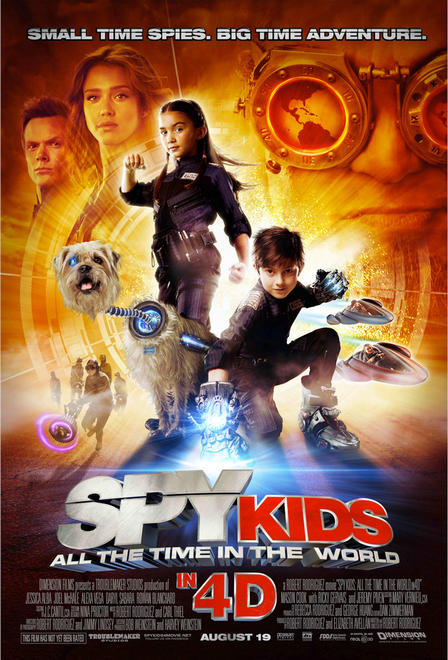
Interview: Robert Rodriguez of ‘Spy Kids: All the Time in the World in 4D’

Interview: Robert Rodriguez of ‘Spy Kids: All the Time in the World in 4D’

Posted on August 15, 2011 at 12:30 pm

Robert Rodriguez is a ground-breaking movie director whose first film, “El Mariachi,” was made on a micro budget of $7000 (with another $220,000 after it was purchased for release).  He is known for striking visuals and ultra-violence in movies like Once Upon a Time in Mexico and “From Dusk til Dawn” and for wildly imaginative family movies like Shorts and the Spy Kids series.  Rodriguez continues to operate outside of the film-making establishment.  He has established his own film-making set-up in his home town of Austin, Texas, and works with his family, writing, editing, shooting, and directing himself, with his ex-wife, Elizabeth Avellan, and his sister as his producers, and his cousin Danny Trejo appearing in many of his movies, including this one as “Uncle Machete.”

I spoke to him about the fourth in the “Spy Kids” series, this one in “4D.”

What does 4D mean?

It’s been a very scrappily innovative series since the beginning.  In “Spy Kids 2” we started shooting digital.  And with the digital camera, I thought, “Hey, I think I could bring 3D back.”  It hadn’t been tried in 20 years.  I tried it with “Spy Kids 3” and that became the biggest “Spy Kids” of all, and Jeffrey Katzenberg took note of that and said, “We’re really going to bring 3D back.”  In keeping with the series, with everyone being 3D, we really had to go to 4D.  I remembered a film with “Odorama” called “Polyester.”  That wasn’t a family film, but I said, “That would be a terrific gimmick in a family movie and I’m sure the technology has gotten a lot better.”  It has — everything doesn’t smell like batteries.

How do you keep the smells from colliding with each other?

They don’t do that any more.  It used to be that all the smells had a real chemical base to them and they all started smelling the same after about the third or fourth one. Once you got to the dirty socks, everything kind of smelled that way.  But now they call stay really distinct.  The technology has really gotten better, and I didn’t have to do anything but pick which flavors I wanted and they put them on the card for me.  And it’s free, just as with the 3D movie where we gave the glasses away for free as well.  It’s a level of interactivity that you just don’t get in a movie.  Kids are so into interactive things like video games for entertainment.  A movie can be very passive by comparison.  This brings back the active excitement of putting yourself one step closer to the actors and the characters on screen because you’re smelling exactly what they’re smelling at the same time.  In the tests we did, the kids felt it was really a home run as far as making them feel they were a part of the action.  That’s what you hope to do with another dimension, just make them feel closer to what is going on in the movie.

One of my favorite things about theThe Spy Kids Trilogy is the fantastic gadgets the kids get to use.  What’s your favorite gadget in this film?
There’s a dog they could never understand who watches over the kids in the house and he turns out to be a robot dog voiced by Ricky Gervais.  That’s probably my favorite.  He can do just about anything.  He’s like a multi-tool gadget knife and James Bond car all built into a dog.  And another of my favorite gadgets is the hammer hands that the boy puts on, like Hulk hands — they can smash through anything you touch.  I think my little boy would really love them.

I love the way the “Spy Kids” movies have a lot of action but very little violence.

There’s a very comic line to the action and a lot of it comes back on the kids themselves, so it really promotes adventure and not violence.  That’s what parents have always loved about the series.  I’m always very careful not to put anything over the kids heads in my family films.

Is there anything you wanted to include in this one that you didn’t get to do?

I wanted to do a James Bond-type song over the end credits with the dog’s head like Sheena Easton but we didn’t make it happen.  Maybe next time!

How do you cast a villain? What do you look for?

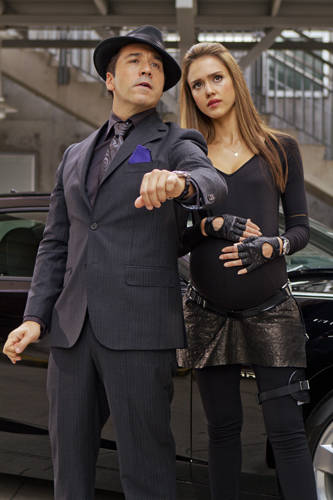
You want a surprising quality.  The villains in my movies are never really villains; they’re just misguided.  The children always teach the villain a lesson.  They don’t defeat him.  This movie’s villain is the Timekeeper, and he’s very much me.  I’m always worried about time there is.  Seeing my kids grow up so fast, I always want to freeze time.  So he is just a little eccentric and it turns out he has a tremendous amount of heart.  He’s a super-villain with family values.  You need someone who’s a real chameleon.  I knew Jeremy Piven could create three or four distinct characters and pull it all together.  He has a lot of heart as an actor.

The “Spy Kids” movies are always about the importance of family.  In the earlier movies, there was a typical nuclear family but in this one there’s an issue a lot of kids have to deal with — adapting to a blended family.

I got the idea from seeing Jessica Alba on the set of “Machete” with her baby, but dressed for filming.  I thought, “Wow, she kind of looks like a spy, and having to deal with this baby — wouldn’t that be cool as an element in the ‘Spy Kids’ movies.”  I said to her, “You should be the mother in the new ‘Spy Kids’ movie and have to take the baby on a spy mission.”  She said, “I’d probably have to be a step-mother because I am too young to be the mother of school-age kids.”  So I thought, “that’s even better.”  She’d be harboring this big secret and kids are really sensitive.  They know when someone is hiding something from them.  So they don’t really like her as a stepmom because they can tell she is not being honest.  Through this mission they find out what her secret is and everyone becomes closer because of it.  I thought that would add a really great wrinkle to the whole idea of what family means.

I also like the way the kids in your movies are real kids but also very brave and capable.

Kids crave things that empower them.  Seeing kids on screen flying around saving the world gets into their dreams and they identify with it and pay-act it out.  I saw it in my own two youngest, who weren’t born when the first ones came out.  I told them I made them but they did not really understand what that meant.  They just like them and pretend to be spies and to be strong.

And Machete is in this movie?

Danny Trejo’s code name in the original “Spy Kids” movie was Machete.  We were doing a nod to this idea for a movie that we never got off the ground.  We had been talking about doing a “Machete” movie since “Desperado.”  So we said, “We should make your character’s code name ‘Machete.'”  His name was really Isadore.  He’s not the same character as in the movie “Machete!”

That’s good to know, but I hope he doesn’t text.

No, he doesn’t text.  Some things are sacred!

Related Tags:


Behind the Scenes Directors Interview Writers
THE MOVIE MOM® is a registered trademark of Nell Minow. Use of the mark without express consent from Nell Minow constitutes trademark infringement and unfair competition in violation of federal and state laws. All material © Nell Minow 1995-2026, all rights reserved, and no use or republication is permitted without explicit permission. This site hosts Nell Minow’s Movie Mom® archive, with material that originally appeared on Yahoo! Movies, Beliefnet, and other sources. Much of her new material can be found at Rogerebert.com, Huffington Post, and WheretoWatch. Her books include The Movie Mom’s Guide to Family Movies and 101 Must-See Movie Moments, and she can be heard each week on radio stations across the country.

Website Designed by Max LaZebnik