Interview: John Wells of ‘The Company Men’

Interview: John Wells of ‘The Company Men’

Posted on January 19, 2011 at 8:00 am

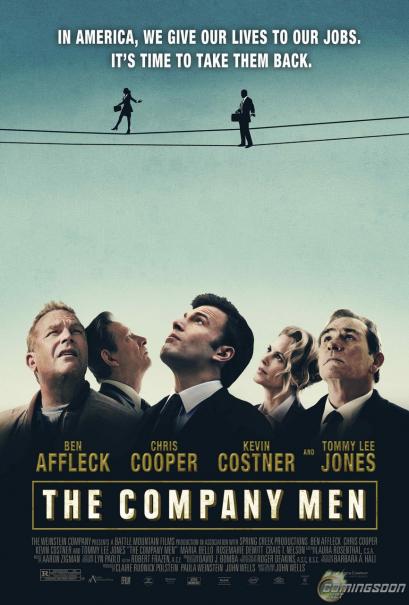
“The Company Men” is a recession-era drama that follows three downsized executives at a huge conglomerate. Writer/director John Wells (producer of “ER” and “West Wing”) talked to me about the research that helped him to develop the script, how he had to keep amending the screenplay to stay accurate, the surprising reaction from audiences who think they know who the villain is, and what he learned about how men and women react differently to job loss.
This movie has an amazing group of actors, including Tommy Lee Jones, Ben Affleck, Chris Cooper, Maria Bello, Kevin Costner, and Rosemary DeWitt. How did you assemble your cast?
I kept sending the script out to people and they kept saying yes. The biggest surprise was Kevin Costner, who had read the script from his agent for a different part, called me up and said he really wanted to play Jack, the brother-in-law. I thought the agent had made a mistake when he told me that. He said he connected with that character and would love to do it if we could work it out. The_Company_Men_3.jpg
It feels very much of this moment and this economy. Did you do a lot of research?
I did a tremendous amount of research. It really came out because a member of my family lost his job. He started telling me about what was going on in his life in the time afterward. He had been very successful and this kind of caught him off guard and he had a lot of trouble finding another job because there were a lot of other people in his exact field looking at the same moment that he was. I went onto a bunch of different downsizing websites, places with chat rooms and put in little notices that said, “I’m a writer and I’m interested in this subject and if you want to tell me a few anecdotes, a few things about what’s happened in your life, let me know. I had a couple of thousand responses in the first weekend.
I ended up talking to literally hundreds of people, both people still working in companies, CEOs and human resources, and a lot of people who had actually or were actually going through this experience. A tremendous amount of the movie is just their experiences, things they told me.
I wrote an article about the corporation in the movies of 2010 and mentioned yours as exceptionally accurate, not just about the experience of being laid off but about the corporate environment and lines like the CEO saying that all that is left for American business is “health care, infrastructure, and power generation.”
Some of it changed as we made the movie because things kept changing. We made it right during the worst of the TARP period and were following things on a daily basis. When we made the film we assumed that the recession would be over by the time it was released and it would be an historical document. Things have gone on longer than we thought. When I was first writing about the film, I made it about the steel industry because I went to school in Pittsburgh. But when I went to scout it, it was gone.
So I had to talk to people about other heavy manufacturing and other and fabrication industries that might be suffering similar fates. One that was suggested was the auto industry, and I thought, “No, that’s ridiculous, no one would believe that the auto industry could go up in smoke.” Goes to show you what I knew! The other was non-military or non-protected ship-building. So I started looking around and we found that wonderful shipyard in Boston, which had only been closed a couple of years.
On a daily basis I had a couple of different people in the financial world who would keep me up to date on what was happening. When we started, there was still credit available. By the middle of it, we had to change things left and right to make corrections. The character Ben Affleck plays was originally working in new construction of homes. By the time we got to shooting it, the whole new home construction business had collapsed, so I had to switch to remodels. Six months later, that had also disappeared. The severity and depth of the recession is so much greater than anything I had ever experienced.
The things the corporate executives said to each other changed every day — the “infrastructure” line changed the day we shot it.
You focused on people we haven’t seen much of before, the top-level executives with six- and seven-figure incomes who are suddenly let go with no comparable alternative employment.
And it’s millions of people, tens of millions of people who felt that they had done everything they were supposed to do to fulfill the American dream. They got an education, they worked hard at companies, and really found themselves out in the cold. That’s what’s different about this recession that people don’t really understand, especially for older workers and by that I mean anyone over 40.
The characters seem to go through the Elizabeth Kubler-Ross grief stages but in different order — anger first, then denial.
Men don’t always respond to the stages the same way women do.
The women in the movie seem to be the truth-tellers, especially Rosemay DeWitt, who plays the wife of Ben Affleck’s character.
I found that to be true in the research that I did. One of the common themes was that the men involved in white collar work — finance, insurance, marketing — that the representation of what they did was how much they made and their possessions. So when they lost their possessions they lost their identity. And the common thread from the families I spoke to was how disturbing this was to the women, who didn’t understand that the men had built their self-respect on such a narrow base. They would say, “I was shocked at how losing his job completely undermined his sense of self-worth.” I kept hearing versions of the same stories, of them having to say, “Just do anything. Just get a job. Flip hamburgers. Just get out of the house and have a sense of going somewhere.”
The character a lot of people see as villainous in the picture is the woman who runs the outplacement service. I went to a number of different outplacement places and that woman and the tiger chant and all that, I asked, “Don’t you feel a little ridiculous when you’re doing that?” And she said, “Sure, it’s completely ridiculous. But you have to realize, these men come in here and they’ve been in something like a car accident. And I’m like the physical therapist who has to get you out of bed even if I have to slap you around to do it.”
There was a real difference to the way the women this happened to approached the loss of a job. It was equally devastating, equally economically difficult for their families. But they did not become unmoored in the same way the men did.
I liked the contrast in the film between the way the Kevin Costner and Craig T. Nelson characters thought about their employees.
Originally it was more of a screed and the Craig T. Nelson character existed and the Tommy Lee Jones character didn’t. But I felt I hadn’t given an explanation for the complexity of the way executives really look at this. So I interviewed a lot of people and a number of the things Craig T. Nelson says were things people really said to me. I was surprised by the number of CEOs who called me back. They really wanted to explain their responsibilities to the stockholders and the stockholders are us. One of the lines I snuck in was after the first big downsizing Tommy Lee Jones’ secretary says to him in the hallway, “Hey, my 401(k) stock is up!”
The thing we don’t quite accept is that we are the pressure — everyone who’s in a 401(k) or a public pension plan or a union pension plan — these large institutional investors have their responsibilities, too. You can demonize Goldman Sachs all you want and I’m sure there are reasons to do it. But the real pressure is all of us pressuring the companies for stock returns and that leads to all kinds of decisions. I was really trying to get across the two different attitudes that executives had. One was this attitude that my only responsibility is the corporation and the other was what the Gene character talks about, the sense that these are people who have put their faith in us.
It reminds me of the fight in the old movie “Executive Suite” between the guy who thought companies should provide meaningful work and make a commitment to the workers and the guy who thought it was all about cost-cutting.
I was trying to not make it too simple — I hope that comes across. Those jobs are gone and they’re not coming back and we haven’t had a conversation, except in the very unrealistic political arena, about what we’re going to do about it.
Even if it was a bit of a fairy tale, I was glad you provided some hope at the end, and I think it came from the right place — entrepreneurial spirit.
It came from a real story in the steel business about a guy who made a lot of money when his company was sold. And then the people he worked with all those years lost their jobs, everyone he cared about. He created a small, high-tensile steel side business. It could only employ about ten percent of the people, but they’re doing okay.

Related Tags:


Directors Interview Writers
Interview: Tom Hooper of ‘The King’s Speech’

Interview: Tom Hooper of ‘The King’s Speech’

Posted on January 13, 2011 at 8:00 am

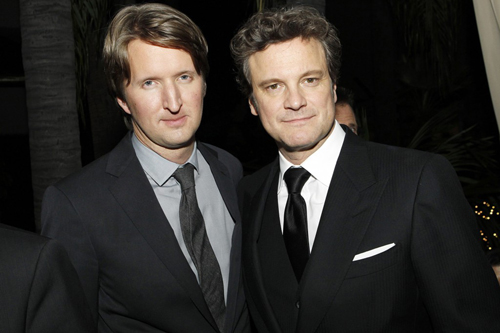
Tom Hooper, nominated for Golden Globe and satellite awards as best director for his acclaimed film, “The King’s Speech,” spoke to me about what made the movie especially meaningful to him, why the MPAA’s decision to give it an R-rating was so disappointing, and what he and star Colin Firth learned from watching footage of a speech by the real King George VI.
I don’t know anything at all about sports in the United States or the U.K., but I loved your last film, “The Damned United” (about real-life soccer coach Brian Clough).


That’s fantastic to hear! It was a very hard sell in America. I’m actually not a soccer fan myself, so for me to do it was proof that for me it worked on many levels and not just the sporting story.
There is some similarity to “The King’s Speech” as both are about big events surrounding the relationship between two people.

Weirdly, they’re almost unlikely companion pieces. They’re both about love between men, or at least strong companionship. And both films explore how men become great through the help of a friend. They can’t do it on their own. We live in a society that’s very focused on self — me, me, me, all about going into yourself to make yourself better. And my films suggest that it’s actually sometimes about opening ourselves up to collaboration with others that we can achieve our best.
How did you come to this project? I know the screenwriter, David Seidler, worked on it for decades.

I only came to it because I happen to be half-Australian, half-English and living in London. My Australian mother happened to be invited late 2007 by some Australian friends in London to make up a token Ozzie audience to a play reading of an un-produced, un-rehearsed play called “The King’s Speech.” She’d never been invited to or attended anything like that and it didn’t sound very promising. But it was a good thing she went because she rang me up afterward and said, “Tom, I think I’ve found your next film.” And so the moral of the story is, “Always listen to your mother.”
What’s extraordinary about it is that it was going nowhere, even as a play. It was off the mainstream industry’s radar completely. It’s a great reminder that there’s often wonderful material that’s gone unnoticed and we should remain alert to that, and the extraordinary role that chance can play.
I agree with that! Seidler was dedicated to the story in part because of his own struggles with stuttering. And it sounds like the story became very personal for you as well.

As a half-Australian, I had wanted to tell an Australian story for years, or a something that explored my background. In some ways the narrative of my childhood was my Australian mother dealing with the effects on my father of his rather brutal English upbringing. It was nice that it came through my Australian side because there were some strong emotional connections for me.
It was very important to the story that Lionel was Australian, an outsider.


It was essential. Just before Christmas I was in Australia and Baz Luhrman hosted a wonderful screening in Sydney. In his introduction, he said the movie expressed a key Australian quality which is that the Australians are “impervious to majesty.” I think that quality is very key to Lionel Logue. He’s not so in awe of it that he is can’t approach Bertie about his childhood or his father brother or his struggle, which the aristocracy would consider not good form to talk about.
My mother told my father that over her dead body would her children go to an English boarding school, because those schools had a big effect on a generation of English men, including my father. His father died in the war when he was two and he was sent to boarding school when he was five, incredibly young. That was the era of cold baths in winter and corporate punishment and outside loos with no doors and all those British innovations. My mother was always great at saying, “This obviously affected your dad and it is up to us to unpack it. She was in a much gentler sense a kind of Lionel Logue to my dad.
I’ve been very frustrated and unhappy about the MPAA’s R rating for this film because of a brief scene of some bad words used in a vocal exercise. What is your response?


I’m finding it very sad. We just did a staggering opening in England, twice the next film, ironically titled “Little Fockers,” talk about language. And it’s playing as a family movie; people are taking their 10-year-old kids. Although it appears to be starring middle-aged men, it’s essentially about the risk that you can carry the effects of your early childhood right through your adult life and never address them and always be locked by it.
One of the key lines in the movie is the line Lionel says to Bertie, “You don’t need to be afraid of the things you were afraid of when you were five years old.” You’re living your adult life in the same defensive cringe you had to adopt when you were five and the world really was against you. But now you’ve got a lovely wife and lovely kids — it’s not that world any more. You don’t want kids to wait until therapy when they’re middle-aged to learn that. It’s so important to understand.
I respected the economy with which you established the characters of Bertie’s brother, David and Mrs. Simpson, the woman he abdicated the throne to marry.


One of the challenges was how to draw tip of the iceberg portraits of these two key characters without being caricature. David Seidler warned me when we first sat down of the danger of having them hijack the movie. In his original script, Wallis Simpson literally didn’t open her mouth. We had an incredible ensemble cast and having actors of the talent of Guy Pearce and Eve Best really helped– Guy did as much research as if he was playing the lead role in the film.
How did you work with Colin Firth to achieve an authentic stutter?


Partly it was talking to David Seidler, who had a childhood stammer and was the best source. We did have some speech therapists, but their specialty is teaching people how not to stutter, not making people start. Colin’s sister is a voice coach, so she was helpful to him. But mainly it was watching the archive footage of the real King George VI. There’s a wonderful 1938 clip where you can see him really struggling. In his eyes, all he really wants to do is the right thing and he keeps drowning in these terrible silences.
How did you decide to use the Beethoven in that last scene? It is so stirring.


My wonderful editor, Tariq Anwar, who cut “American Beauty” and “The Madness of King George” — the very first time he showed me the assembly of that final climax he used the Beethoven 7th and it was a revelation. It was so well chosen. When we showed it to Alexander Desplat, who did the score, I expected him to say, “I should write something for that scene myself.” But he didn’t. He said, “The reason that choice is so good is that Beethoven exists in our public imagination, our public space. It helps to elevate the speech to the status of a public event instead of a private event. No film score can do that because it’s always internal to the movie.” And I thought was a rather brilliant explanation about why that was a perfect choice.
Great actors say a lot when they act and you have this risk that the composer comes along and it’s like he says, “No, no, no, what he really means is that he’s very sad. It’s just a sad scene.” Music can be quite reductionist because it’s harder for music to move from mood to mood second by second. Alexandre was particularly brilliant at dancing with these great performances, understanding the greatness in the performances and protecting and amplifying the performances and amplifying the sense of multiple meanings, not closing them down.

Related Tags:


Behind the Scenes Directors Interview
Interview: Andrew Jarecki of ‘All Good Things’

Interview: Andrew Jarecki of ‘All Good Things’

Posted on December 27, 2010 at 3:47 pm

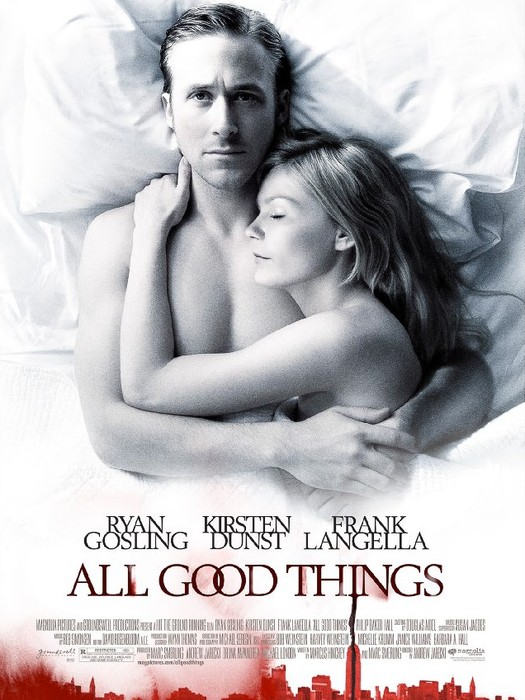
Andrew Jarecki, whose first film was the award-winning documentary “Capturing the Friedmans,” has made a feature film starring Ryan Gosling and Kirsten Dunst called “All Good Things.” It is based on the real-life story of Robert Durst, the son of a wealthy New York family, who is connected to two unsolved murders and was acquitted of a third over an 18-year period. Like “Capturing the Friedmans,” it is an exploration of family dysfunction and the failures of the legal system.
But Jarecki says that his focus in both films is on secrets. “I think it is very interesting to try to understand what people are really thinking.” He spoke about chatting with American tourists in Amsterdam. “They looked like accountants, dressed very conservatively.” They told him they did accounting for jewelry manufacturers. “Maybe I’m always looking for conspiracy but to me that sounded like an answer designed to shut you down. So I said to the guy, ‘C’mon, what do you really do?’ And he looked at me for a second and then looked around and said, ‘My wife and I run a network of pornographic websites and we make a lot of money doing it.’ I thought, ‘I’m so glad I asked him what he really did — that is so much more interesting than the first answer.'”
All_Good_Things_movie_movie_poster.525w_700h.jpgThere was a personal connection that drew him to the story as well. Durst was the son of a wealthy and powerful family whose father tried to keep him connected to the family business even though he wanted to leave New York and run a health food store. (The title of the film comes from a health food store Durst ran in Vermont until his father pressured him to come back and work in real estate. “I had a father who was enormously successful and wanted me to go into the family business and I had other ideas. There was something about that that appealed to me.”
It was a challenge to take a story that happened in fragments over a long period of time. “This is a story that perks up over the years, you see little bits of it. A good scandal happens over a few months, usually.” The movie follows the Durst character (called David Marks in the film) from the 1970’s to the 2000’s. He was “quirky but charming, the interesting eldest son, everyone expects him to go into the family business. By accident he meets a beautiful girl and 10 years later she goes missing, she disappears. That was interesting to me when I first learned about that.” We see him meet and marry his wife and watch their relationship deteriorate as she becomes more mature and independent and he becomes more withdrawn and controlling. Then she is gone.
David is a likely suspect, but without any evidence, his wife’s disappearance remains unsolved. For almost two decades. “There was this missing girl and there was a lot of speculation. And then the whole thing went to sleep for a while. it didn’t become a national story because nothing happened for a while. Eighteen years later the new prosecutor got a tip and re-opened the case, and suddenly there’s a new story, which his that someone is thinking the same thoughts as other people have for a while but it is someone who is motivated to do something about it.”
“And then nothing much happens,” Jerecki continued. “They somewhat lackadaisically get themselves organized to pursue the case. They decide to go and find out what this one witness has to say and almost immediately she is found murdered. This thing keeps re-emerging. The New York police lets the LAPD know that they think it may be connected but they ignore them to pursue another suspect who turned out not to be a good suspect. The OJ case made them very nervous about high-profile defendants. They didn’t pursue it, didn’t get an indictment. And within a year of that, this body washes up on shore near Galveston, Texas, and that’s another chapter about Bob’s life. So either you look at this guy and say he is the unluckiest guy in the world or he was involved. He lost his wife, he was accused of her murder, he lost his best friend, he was accused of her murder. Then he loses his sort of roommate in Galveston, also to a terrible fate, and he is indicted and that’s when things start to get interesting.”
Durst acknowledged that he killed and dismembered the man, but plead self-defense and a panicked disposal of the body. “The case was so badly handled he would never have gotten convicted in any meaningful way,” Jarecki explained.
The true story is so strange (for example, Durst lived for a time as a mute woman) that “The toughest thing always is figuring what to take out,” Jarecki said. “You treat the audience as intelligently as you would want to be treated by the film-maker. At one screening, someone asked why we didn’t know what happened to the mother. I asked if anyone else in the audience wanted to see that. We know what that scene’s going to be like; that scene’s in another movie. If you’re just phoning it in, if you’re writing some scene just to show them going somewhere, if you can write it quick…it’s probably going to not be that complicated and therefore not that interesting. You want to see a lot of of layers going on at the same time if you can. That’s what makes a film watchable multiple times.”
As outlandish and unwieldy as the story is, Jarecki and his top-notch cast make it into a coherent, compelling narrative. “If people say, ‘Why did you have her do that?’ We can say, ‘It actually happened.’ If they say, ‘It isn’t realistic,’ I say, ‘It happened. What’s your definition of realistic?'”

Related Tags:


Directors Interview

Interview: Fionnula Flanagan of ‘Three Wise Women’

Posted on December 14, 2010 at 3:54 pm

The Hallmark Channel’s Three Wise Women stars the great Irish actress Fionnula Flanagan in the story of a doctor named Liz who is about to make a terrible mistake. Her guardian angel has to bring in some very important advisers — Liz herself as a young girl and an older woman — to show her the way.

Ms. Flanagan, who also appeared in “Waking Ned Divine” and “Yes Man,” talked with me about making this film — and about her own favorite Christmas tradition.

How did you coordinate with the other actresses who played your character?

One of us doesn’t know that the other two of us are her, older and younger, so therein lies the comedy. We imitated each other, but people change as they grow older and one of them is very young, like 17 years of age and I’m in her 60’s, so people change and their gestures change as they grow older. We didn’t sit down and say, “Let’s coordinate all of this.” But some things came naturally and we all imitated each other.

What was your first major part as an actor?

I did a role in a play in Gaelic for the Dublin Theatre Festival in 1963-64 and was then hired to play it in television in Irish, and that was my first break. I went on to play it in English and then went to the Old Vic where I played leads in “Taming of the Shrew” and “The Playboy of the Western World.”

What do you look for in the parts you take?

I always look to see if the part moves the story along. If it doesn’t do that, it’s just window dressing. In this particular instance it is very much an ensemble piece, with three actresses playing the same person, with the comedy built in because she doesn’t know she is seeing herself much younger and much older. That obviously moves the story along. Do we turn out in later life the way we think we will? The answer is “almost never.” If you, Nell, were to meet yourself at 90, wouldn’t you think you’d be different? We always have fantasies about how we’re going to be; we’d be horrified to see ourselves in the future and say, “Look at all those wrinkles! I wish I’d given up smoking!” This story provided that with all the comedy that lies therein.

Why do the Hallmark channel movies touch people so much?

They make films about things that people care about, things that happen in ordinary people’s lives, not cops and robbers and fantastical stories. Not everyone is wearing a Prada suit. These are backwoods stories that happen out of sight to people who are not always wealthy and powerful. People identify with that. It’s pleasurable because if you treat people well and behave kindly and honor your citizenship, good things will happen.

What is your favorite holiday movie?

I don’t have one but every Christmas I listen to Dylan Thomas’ wonderful recitation of “A Child’s Christmas in Wales.” Many people have read it, but I have the recording of him reading it himself and it is so charming and funny. It’s about ordinary people in a mining town in Wales and I love it for that reason. The child saying, “Get to the presents! Get to the presents!”

Related Tags:


Actors Interview Television
Interview: Jacqueline Bisset of ‘An Old-Fashioned Christmas’

Interview: Jacqueline Bisset of ‘An Old-Fashioned Christmas’

Posted on December 11, 2010 at 12:00 pm

OldFashionedChristmas_UD9-32_COMP.jpg

Jacqueline Bisset stars in the Hallmark Channel original movie, “An Old-Fashioned Christmas,” sequel to the popular, “An Old-Fashioned Thanksgiving,” which was based on a story by Louisa May Alcott. Bisset, an international star for four decades, has appeared in big Hollywood films like “Bullitt,” “Airport,” and “The Deep,” as well as in acclaimed art-house movies (“La Cérémonie” and Francois Truffaut’s “Day for Night”).

I spoke to her about her role as the strong-minded Isabella Caldwell, traveling with Tilly, her would-be writer grand-daughter.

Tell me first of all, what was it like to film in that gorgeous Irish castle?

It was very beautiful, with glorious gardens and a lake in front of the castle. I was thinking there would be a difficult weather experience but we really got lucky. It was a good group, good actors, good director, good weather — I have nothing to complain about!

Was it a challenge to return to the same character?

We had a different actress playing Tilly, and different actresses bring different things. And the characters have been traveling for two years, so they are different, and their relationship has changed. In the first one she wanted my help and in this one she is resisting me quite a lot and resents me interfering in her life as she is at the point in her life when she is becoming interested in young men and all that stuff. There’s a degree of disagreement as she feels cornered or suffocated by me.

On one hand you’re a mentor but there is a struggle about who is in control.

In my relationship to the granddaughter in the story I feel closer to her than I do to my daughter, her mother. There was a lot of anger from her towards me and a lot of misunderstanding. Even though we’ve made up on some level, I am certainly much closer to the granddaughter.

Did you know when you did the first one that you’d be doing a sequel?

No, not at all! And I’ve never been in a sequel before. In this situation, when I went off with her at the end of the first one I never thought there would be a second one. People make sequels a lot in Hollywood and sometimes it feels like there’s never an original thought. But I didn’t feel that way about this. Sometimes sequels are better than the first one and this is fuller than the first one. My character had more aspects. I wouldn’t have done it if there hadn’t been something interesting in it for me. The touch of romance at the end — I haven’t seen it yet and I am looking forward to seeing it!

What do you look for in the projects you choose?

Have I done this before? Have I seen this before? If I don’t feel that, it’s really a good thing. I look for a little bit of juice, is there any possibility to grow subtextually, to create depth, to bring experience to something as a character? Now I am a character actress, which is great, and I am thrilled to be able to explore that. There are a few speeches in this one that moved me a lot, one in particular when she is sitting on the bed with her granddaughter and she explains her love for her husband, who is no longer there. I found that scene very deep and beautiful. I love that scene. She has been misjudged and she is trying to explain her point of view.

Do you feel that you are still learning as an actress?

I am still learning as a woman. I am always learning.

Related Tags:


Actors Interview
THE MOVIE MOM® is a registered trademark of Nell Minow. Use of the mark without express consent from Nell Minow constitutes trademark infringement and unfair competition in violation of federal and state laws. All material © Nell Minow 1995-2026, all rights reserved, and no use or republication is permitted without explicit permission. This site hosts Nell Minow’s Movie Mom® archive, with material that originally appeared on Yahoo! Movies, Beliefnet, and other sources. Much of her new material can be found at Rogerebert.com, Huffington Post, and WheretoWatch. Her books include The Movie Mom’s Guide to Family Movies and 101 Must-See Movie Moments, and she can be heard each week on radio stations across the country.

Website Designed by Max LaZebnik