Interview: Douglas Gresham of the Narnia Movies

Interview: Douglas Gresham of the Narnia Movies

Posted on December 9, 2010 at 9:36 pm

When Douglas Gresham was a little boy, his mother Joy married C.S. Lewis (known to friends as Jack), the author of the Narnia books. There are two different movies about the touching story of the romance between the sheltered British bachelor, an scholar who lived almost entirely within the academic community and the outspoken American divorcee, a Jewish/atheist/communist-turned Christian and an award-winning poet, who challenged everything Lewis thought he knew. Gresham had two sons, and after her death they were raised by Lewis. Her son Douglas is now the literary executor of the Lewis estate and he is a producer of the films. I was lucky enough to get a chance to talk to him about “The Voyage of the Dawn Treader” and what he learned from his mother and step-father.
I know many people have come to you over the years with proposals for Narnia films. What made you decide that Walden was the right group to work with?
I’ve got a secret technique. When we’re making decisions like that within the C.S. Lewis company, where I am one of the leading people, I go inside in a closed room and I pray lots. And then I follow the guidance of the Holy Spirit of God, which is what I’m praying for. And the Holy Spirit of God indicated to me that Walden were the people to go with. So that’s why I went with Walden, and I’m not sorry. As always, the Holy Spirit is right.
Like any other relationship, we have our storms, mostly storms in a teacup. But if you look on the screen, you see what it is like to work with them. We’ve put very good movies on the screen, very beautiful movies. And that’s proof of the pudding.
I was so glad to see how well the movie did in portraying the gallant soldier mouse, Reepicheep.
I love Reepicheep. He’s great! We worked hard on him. He had a relatively small part in “Prince Caspian.” But in “Dawn Treader,” Reepicheep is one of the stars of the movie. They often say you should never work with animals and children. Our whole movie is animals and children! And we have a two-foot-high mouse who steals the show. We had to make sure we wrote his dialogue very carefully and got it right. And we had to make sure that the special effects guys got it right and he looked absolutely realistic and he does come across as a real character in the movie. He’s a star! He’s an absolute star. We don’t have to pay him, but he’s a star.
He’s really the heart of the story.
He’s a pure knight of Narnia, who goes to Aslan’s country without having to die first. That’s Sir Galahad all over again. So we really have to get him right, and I think we did. And Simon Pegg did a wonderful job with the voice, absolutely perfect for him.
One thing I love about the movies is that they are very welcoming. If you are familiar with the books and the other movies you will find what you want to see. But if you are not, you won’t be left out.
That’s largely the part of the books. We don’t make sequels. We make stand-alone adventures that happen to include some of the same characters and places. This one shows us new parts parts of Narnia we’ve never seen before and many new creatures. There’s a continuity of casting but it’s a new story each time. You don’t have to have seen the other movies. You don’t even have to have read the other books.
But they’re also very respectful of the people who are fans, and as you know, those people have very strong views about how everything should look on screen.
I’m probably the most demonically fanatical Narnia purist of all time. So I do try to protect Narnia as much as I can. We do have to make changes in translating a book on screen. But I’m like a dragon jealously protecting the books; they’ll tell you I’m a real nuisance.
The Dawn Treader itself, the ship, looks just like I wish I could have imagined it. the-voyage-of-the-dawn-treader.jpg
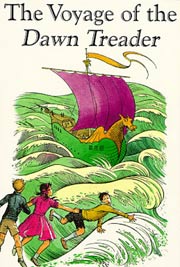
Pauline Baynes, who did the drawings for the Dawn Treader originally gave us these fabulous drawings and gave us a guide from which to work. We took that and wound up with this beautiful ship.
You were essentially raised by C.S. Lewis after your mother died. What did you learn from him?
He was my step-father and the only one who lasted long enough to have any real parental role in bringing me up. I think what I learned most from him is that Christianity is not something you just believe in. It is not enough to just believe in Jesus unless you believe Jesus and do what he says. Jack was someone who lived his Christianity every hour of every day. That was a huge example to me. It took me a long, long time to wake up to it, mind you. I’m trying hard to follow his example but I’m nowhere near as good as he was. But I’ll keep trying until I shuffle off to Buffalo.
What gave him that gift of faith?
Humility. In his 30’s he realized he’d been going the wrong direction. It took me longer. But he suddenly realized that and he turned himself entirely over to Christ. He made no secret of the fact that the Holy Spirit of God was the real author of these books and brought the stories to him. He crafted them with his enormous literary talent. But he was a humble man and that enabled him to follow Christ very closely. I’m an arrogant and conceited man and that makes it harder for me.
I am the man I am today because Jack was my step-father.
What did you learn from your mother?
Courage and the value of courage. She was still making jokes on her deathbed and laughing at her disease. She said, “I have so many cancers I could form a trade union of them.” Once Jack said something particularly pedantic and my mother said, “Could someone please pass the pedanticide.” And once he said, “What do you take me for, a fool?” and she said, “I took you for better or worse.”
What has been the best part of the reaction to the film for you?
Just yesterday, our church was having a baptism at our house because we have a pool. A little girl we know brought a friend over because she told her I was one of the producers of the Narnia films and she didn’t believe there was someone who had been living in Narnia all his life. I met her at the foot of our stairs and her eyes grew as big as saucers. When someone is so enthralled and affected by the movies, it is lovely to see, a rewarding thing. And I heard from an Anglican priest who had conducted a funeral, and then went to the movie and said he was “ministered to” by “The Voyage of the Dawn Treader.” That means a lot to me.
Be sure to watch the movies about Joy Gresham and C.S. Lewis, Shadowlands with Debra Winger and Anthony Hopkins and C.S. Lewis: Through the Shadowlands with Joss Ackland and Claire Bloom. Both are superb.

Related Tags:


Behind the Scenes Interview

Interview: Neil Goldberg of ‘Cirque Dreams’

Posted on December 1, 2010 at 2:00 pm

Neil Goldberg brings dreams to life. As director of Cirque Dreams, he is the man behind the gasp-inspiring live shows that combine music, movement, and visual splendor in shows filled with dance, acrobatics, humor, and the kind of wonder that only happens in theaters. As he prepared to bring his Holidaze show to Washington’s Kennedy Center, he took a break from rehearsals to talk to me about the show the New York Daily News called “so full of energy it could end our dependence on oil.” The Holidaze show features an international cast of over 30 artists costumed as holiday ornaments including gingerbread men flipping mid air, toy soldiers marching on thin wires, snowmen daringly balancing, icemen powerfully sculpting, penguins spinning, puppets caroling, and reindeer soaring — and people singing, dancing, balancing, juggling, and tossing each other around, black light, strobe light, audience participation, and quick change artists who transform in less than the blink of an eye.

The costumes for this show must be quite a challenge.

We design and manufacture all our costumes in our studio in Ft. Lauderdale, Florida. For Holidaze, there are probably more than 500 pieces including the hats and other accessories. It’s important for me as the captain of the ship to keep the process all done simultaneously under the same roof. In more traditional shows a producer will find a costume designer and they’ll shop different shops and you don’t put it together until the rehearsal process. If someone is swinging through the air and something isn’t right around their waist, it has to go back to the shop. Here it all happens simultaneously and under one roof. The singers are learning their songs at the same time the acrobats are doing their performance artistry and the set is being constructed and the costumes are being designed and it’s all being put together at the same time.

What makes Cirque Dreams unique?

Cirque Dreams is an American-based company, since 1993, designed exclusively to be performed on proscenium stages. We’re not affiliated with Cirque du Soliel, which is Canadian and shown in the round. I’m born and raised in New York. I’m a theater guy. My degree is in theater arts. People who love to go to the theater have an expectation of being engaged with the story that’s coming to life on stage and taking the journey as opposed to sitting in a tent or arena and having a circus experience. What distinguishes us is that it’s all English, it’s very relatable, it’s narrated, it has all the components of traditional music theater. But it also has the spectacle of the aerial acrobatics, the unusual and inventive artistry. The cast is very international. We have over 30 artists from 10-12 different countries. They’re all at the top of their game. They’re all world class. In some cases they’re the only ones who do what they do. This year we have over 150 artists in two identical companies touring this season.

Tell me about how you communicate with so many international performers.

It’s a business like everything else, with challenges every day. We have a commissary here on site and we have interpreters for Chinese, Mongolian, Ethiopian, African — it runs the gamut. It’s very exciting to learn about different languages and cultures. But for me, as the artistic director, I only have to learn to count to eight in every language! It’s all musically driven, and music is all about eight counts.

What was so exciting for me is that the journey took almost five years. I told presenters and producers who are our partners in many of our shows I wanted to take this particular genre and set it in the holidays. There’s a certain expectation from the word “Cirque” that the costumes and make-up and artistry are going to be elaborate and bizarre, and that does not seem to go with the holidays.

So five years ago, I came up with the idea for this heavy, metal Christmas tree that’s 30 feet tall, and taking 30 performers from all over the world and costuming them as ornaments. When the curtain comes up on the show, it is a big wow because there is this centerpiece of the tree and all the artists are hanging from the tree, dressed as ornaments. One by one, they come down and tell their particular story through the amazing acrobatics and aerial feats that they perform. The angels are flying. The soldiers are marching but on thin wires that cross the stage. The penguins are balancing and walking on globes and on roller skates. The dolls are climbing 24-foot candy canes up to the ceiling. We build a four-tiered chandelier with lit candles and crystals that is balanced on a performer’s forehead and he climbs up, balancing it, to light the tree with it. It draws people to the edge of the seat and leaves them with a smile on their faces.

What age group are you aiming for?

This show has something for everyone and it brings out the youth inside everyone. You know when you wished for a bicycle for Christmas — we have bicycles that come out of the presents. But they are for 24 beautiful Chinese girls who ride them and go on top of each other’s shoulders jump from bicycle to bicycle. The kids see the visuality and excitement of it. The more sophisticated theater-goer is fascinated by the acrobatic audacity and amazing performance artistry.

What is the music like in the show?

We have some traditional songs like “Rockin’ Around the Christmas Tree” and “Jingle Bell Rock” and “The Most Wonderful Time of the Year.” But we also blend it with original music that has a cold, wintry, holiday, festive, celebratory feeling to it. It ends with a spectacular version of “O Holy Night” that sends chills up people’s spines.

Why is live theater still so important?

People understand that technology lets you do anything. Everything is attainable and reachable. Spontaneity is fascinating and shows real human emotion. This genre takes the art of the human mind, spirit and body and anything can go wrong at any time or any moment so it feels real. Theater feels very human, very real. I still get chills when I watch it, even in rehearsal.

Holidaze touring schedule

Nov 30, 2010 – Dec 05, 2010 Atlanta, GA – Cobb Center
Nov 30, 2010 – Dec 01, 2010 Bloomington, IN – Indiana University Auditorium
Dec 03, 2010 – Dec 05, 2010 New Brunswick, NJ – State Theatre
Dec 07, 2010 – Dec 09, 2010 Waterbury, CT – Palace Theatre
Dec 07, 2010 – Dec 12, 2010 Washington, DC – Kennedy Center
Dec 10, 2010 – Dec 12, 2010 Buffalo, NY – Shea’s Performing Arts Center
Dec 14, 2010 – Dec 15, 2010 Sarasota, FL – Van Wezel Performing Arts Hall
Dec 14, 2010 – Dec 19, 2010 Cleveland, OH – Palace Theatre
Dec 17, 2010 – Dec 19, 2010 Tampa, FL – David A. Straz Jr. Center / TBPAC
Dec 21, 2010 – Dec 29, 2010 St. Louis, MO – Fox Theatre
Dec 21, 2010 – Dec 26, 2010 Pittsburgh, PA – Heinz Hall
Dec 29, 2010 – Jan 02, 2011 Sacramento, CA – Community Center Theatre

Related Tags:


Behind the Scenes Directors Interview
Interview: Robert Vince of ‘The Search for Santa Paws’

Interview: Robert Vince of ‘The Search for Santa Paws’

Posted on November 29, 2010 at 3:56 pm

Robert Vince is the man behind the wildly popular “buddies” movies including the latest, The Search For Santa Paws. They feature adorable dogs and heartwarming stories, just right for family movie night. I spoke to him about the challenges of directing animals and children, what makes a great holiday movie, and why Christmas is his favorite time of year.

I wanted to make a Christmas movie and our lofty goal was to make one that had timeless values, a classic, a perennial that parents could pull out for their children each year.

InSearchOfSantaPaws_Photo_003.jpg

You have some great voice talent — tell me about casting.

Nine tenths of the job is finding talented people who are great at what they do and then they make me look great.

The voice talent people have to have a distinctive voice that comes out of that character rather than being placed into it. They have an ability to project; it’s more like being a theater actor in some ways than a film actor that can use their physicality.

Actors often say that you should never work with children or animals, but that seems to be your specialty! How do you make that work?

We’re making family films because we love them and we’ve been doing it for a long time. Family films and children and animals go “hand in paws,” as I like to say. Children are not acting in a lot of ways; they’re being who they are. That’s where casting is important. You have to choose children for a role that is based on who they are because they really can’t be something else very well or believably. So Madison Pettis really was the big sister figure to all the other girls on the set. And Kaitlyn Maher really is the cutest little thing on the planet is really a sweet little soul with a beautiful voice. I’d like to say it’s great directing but it’s really who they are.

And with the animals, it’s the trainers — they really know how to create characters with the animals. It’s a special talent. I tell them what I want and then with a look or the training, with their connection with the animals, they make it work.

InSearchOfSantaPaws_Photo_006.jpg

Is it important to you to work with Blu-Ray and the other technological advances?

Yes, it makes it possible for the audience at home to see our movie as it was intended to be seen in a theater. It’s such a fantastic technology and really brings the movie to life in the home. With the CGI and digital effects we can create any environment we want to. Anything I can think of, we can do. The film-maker is not limited by the resources available, only by imagination.

The sky’s the limit — literally. You’ve taken the buddies to outer space!

I always laugh when people ask how we got the moon shots. I say, “Well, we didn’t go to the moon!”

What makes a classic holiday movie?

It has to appeal to the most important part of that time of year, the selflessness. This is the one time of year where we suspend our own interests in a selfless manner and take care of others. It has to connect with the heart and music is a big part of that. We have a beautiful song that really connects. You have to have a sense of faith and belief and the importance of the family bond.

To me, the spirit of Christmas is embodied in the hearts of children untouched by the fears, doubts, and disappointments of the adult world. That’s the line that means the most to me in the movie. Before I write a movie I try to write the theme in one sentence and that was it for me in this movie. That one line really says it all for me. As adults we get confused and have disappointments and the like but for a child, in the morning when they get up, their hearts filled with joy, giving to each other, that’s what the spirit of Christmas is all about.

And don’t forget the Santa Paws giveaway!

Related Tags:


Behind the Scenes Directors Interview
Interview: Glen Keane of ‘Tangled’

Interview: Glen Keane of ‘Tangled’

Posted on November 24, 2010 at 6:28 pm

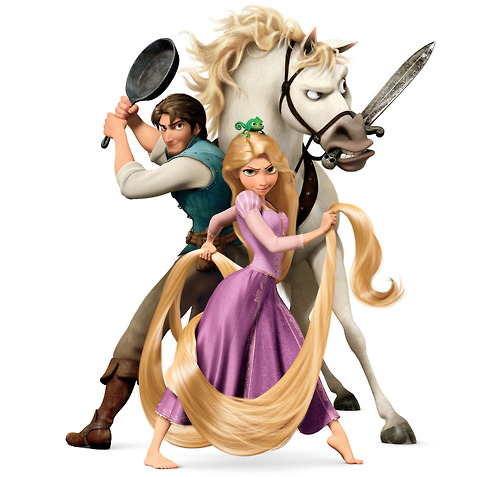
rapunzel.jpgGlen Keane is the man behind some of Disney’s most beloved animated films, including “Tarzan,” “Beauty and the Beast,” and “Aladdin.” As producer of the latest Disney movie, “Tangled,” he guided the project for more than fourteen years. It was an honor to have the opportunity to ask him about some of what went into making the film. We talked about what makes animation special, why the hair was the biggest challenge, and why Disney heroines always have cute animal sidekicks.
My husband and I are both huge animation fans.
There is something about animation that really sinks in deep, isn’t there?
Years ago, at a preview of what was in the Disney animation pipeline, I saw some very preliminary concept sketches for this film and it was completely different from the finished film both in look and storyline. Can you tell me a little bit about how the movie evolved?
I started developing this story in ’96 while I was doing “Tarzan” and “Treasure Planet” and then started to work on it in 2002 full-time. At that point, the studio was looking for more of a twist on the fairy tale. That was the way the wind was blowing and I put up my sails and blew in that direction. That version was called “Rapunzel Unbraided” and I worked on it for three years. It was a fun, wonderful, witty version and we had a couple of great writers. But in my heart of hearts I believed there was something much more sincere and genuine to get out of the story, so we set it aside and went back to the roots of the original fairy tale.
I know one thing that is very hard to animate is hair. In this movie, the hair is like a character of its own. How hard was that to do?
There’s 140,000 individual hairs and hair is the hardest thing to animate in a computer. It’s made up of pixels that bounce against each other. We did early tests. The hair reacted individually with a mind of its own like marbles dropping on a tile floor, the hair would just scatter in every direction. How in the world are we going to figure this out? We’ve been solving artistic problems with mathematics for six years on this film just trying to establish control. We broke it down to 147 different tubes each with a thousand hairs in it. There were much smarter people than I figuring out how to control it. My job was telling them what we wanted it to do. We needed to have rhythmic curves, we needed volume, we needed to twist it, we need to have individual hairs break out. The hair was the most complex character we had in the film.
Probably the most difficult scenes to do were the ones where she was just absent-mindedly touching her hair, the ones you just take for granted. I encouraged the animators to let Rapunzel touch her hair. The computer folks were like, “This is going to be big trouble!” But I told them no one would believe it if she couldn’t touch her hair.
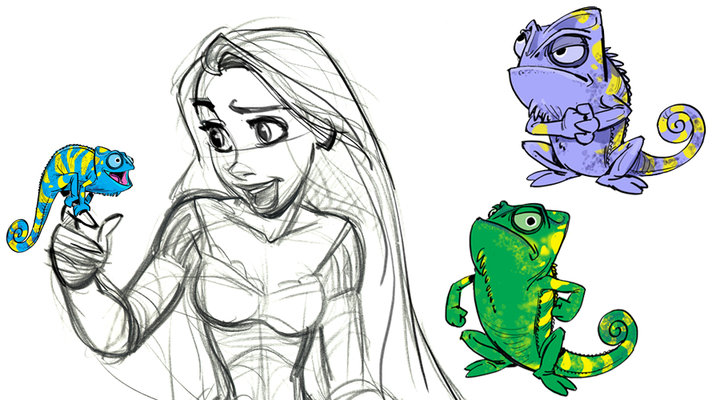
One of the highlights of the film is Rapunzel’s little chameleon friend, Pascal. pascal.jpg
At first we did not have a sidekick. We thought, we’ve done sidekicks before, we don’t need to do it again. And then you realize why you need one. She’s alone in the tower! There’s so much going on in this girl’s mind and if you don’t have her talking to someone you don’t know what she’s thinking. At one point we had her talking to these little objects with personalities but you could start to think she might be crazy.
The little chameleon gave us an feeling of color. He could blend into different paintings and it just fit the idea of this girl who is an artist. It also fit with the idea that he’s just a tiny little character but he always helps Rapunzel take a step further.
You made the male character a much more important and interesting part of the story than he was in the fairy tale.
We had to find the right person to come into the tower. In the original fairy tale, it’s a prince. It’s a lot more interesting to have this girl where her mother is telling her that the outside world has got all these bad people and that what she lets come into the tower is truly a bad person. That makes it a much more interesting story and that was the goal in having this guy have a more colorful background.
I loved the character of the horse and the way his loyalties shift.
He’s the super-cop; he’s tough. Originally, that character was a dog. I had a heart attack in 2008 and stepped back from directing. The new directors took the dog and made it a horse. I was like, “No! You can’t take out the dog!” But it was even better; they had the personality of the dog and the attitude of someone so intent on getting Flynn. He was the ultimate sleuth — and it gave us a chance to take this character who was so dedicated to catching Flynn and have Rapunzel tame him. We were looking for ways that Rapunzel could show the transforming power that she has with the horse, with the thugs in the pub, with the people in the town that she gets to dance with her, and ultimately with Flynn himself.
You gave it a contemporary feeling without getting snarky. It has a lot of heart. How do you keep that balance?
A lot of that is the sensibility of Byron Howard and Nathan Greno, who have this really, really, deep, deep love of the sincerity of Disney films. At the same time, they have an irreverence and a clever sense of humor. They’re always pushing to make it a little bit funnier. We would re-animate scenes a dozen times over, just making it funnier, funnier, funnier. If it was a little laugh, that wasn’t enough. At once point Flynn in the pub is surrounded by thugs who tell him to sing and he says, “Sorry boys, I don’t sing. Suddenly, he is surrounded by swords and we cut to him singing and dancing. Byron says, “I don’t think he should turn his head.” It was funnier. He said, “I don’t think he should look at the swords at all.” And it was even better.
What do you love most about this story?
I love the idea of this girl with this incredible potential being kept back. The more you hold somebody back from who they’re meant to be, the more they have to get out and share it. There was enormous drive in getting that message out. I’ve always felt that hand-drawn has something so wonderful and can affect computer animation in a new way. This whole film was about taking the best of both worlds, infusing the best of hand-drawn and the best of computers. I want to continue to take hand-drawn to a whole new level, to have computers celebrate the artistry of drawing.

Related Tags:


Animation Behind the Scenes Interview
Interview: Jo Newman of ‘Love and Other Drugs’

Interview: Jo Newman of ‘Love and Other Drugs’

Posted on November 22, 2010 at 2:56 pm

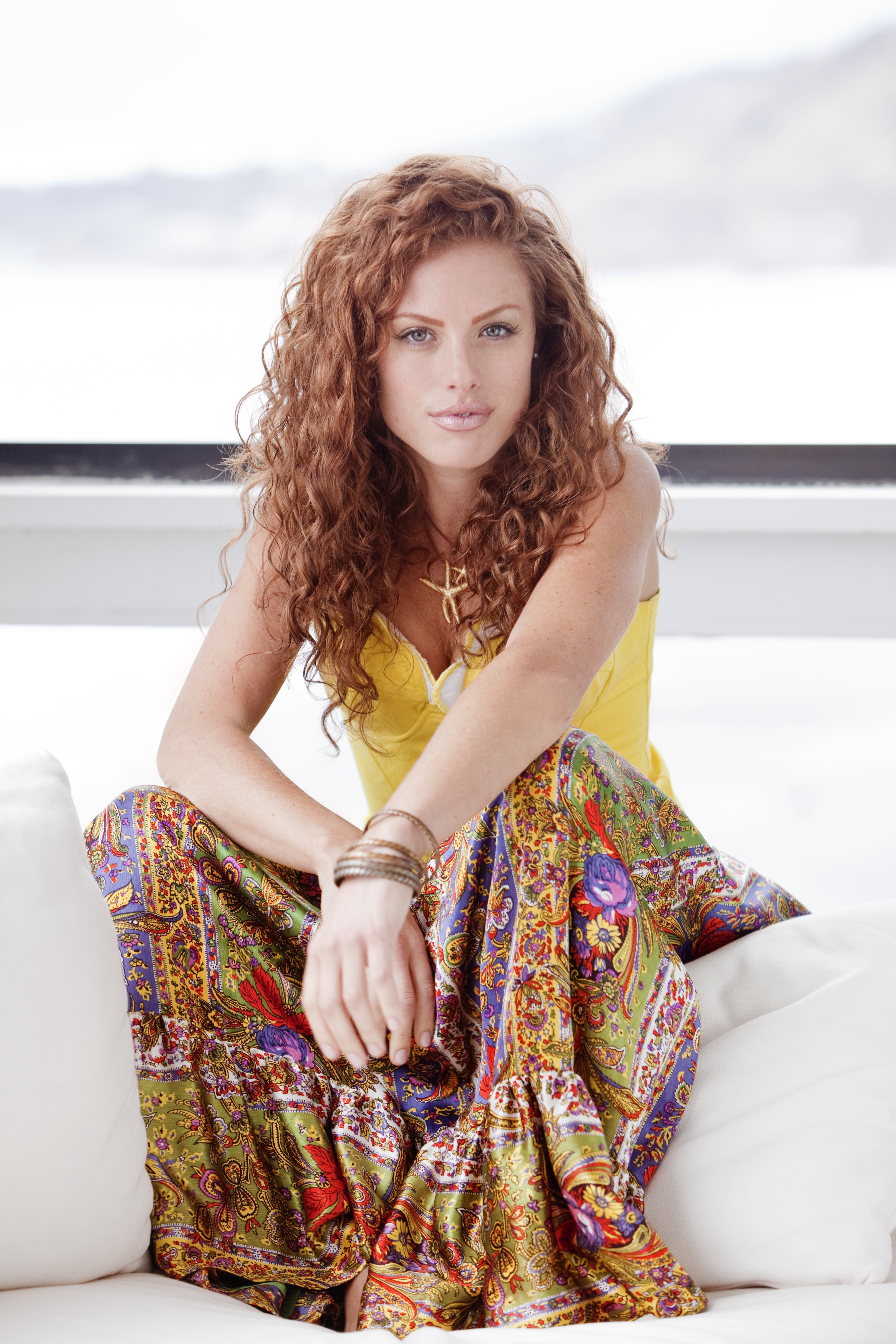
The talented and beautiful Jo Newman makes her feature film debut in one of the year’s best movies, “Love and Other Drugs.” She was kind enough to take time to answer my questions.
Tell me about the audition process for this film. What were you asked to do and how did you prepare?
The initial audition was awkward to say the least! It was a scene that I did not end up doing for the film and it was, um, intimate. There is a tendency to go overboard when you are doing work that requires you to be uncomfortable. If you feel like you are “acting” it separates you from the moment, limiting how affected you can be by the work. Jo_Newman_100610_094-1.jpg
Although this distancing can comfort your ego, it is bad acting and a casting director can feel that a mile away. For the first audition, I really felt like I parked my inhibitions at the door and went for it.
When they called me back and I had to do the scene in front of Ed Zwick, the director, I clammed up and hammed it up. He told me to relax, to respond, to exist solely in the moment. To allow yourself that kind of vulnerability, especially when you are asked to switch it on immediately, can be terrifying but in this business, there is no room for fear. It is in those moments, where you completely forget yourself, where you are wholly absorbed in character, that define us as actors; those moments that push us to wake up every day and put our hearts and egos out there because the ability to see the world through someone else’s eyes is the most profoundly freeing experience I have ever had.
What was was the most unexpected aspect of working on your first major studio film?
I was genuinely surprised by how friendly everyone was. I was only on set for a week and felt like I made some real friends by the time it was over. You are spending a hugely concentrated amount of time with the cast and crew and everyone showed me that to have a positive and creative environment, you have to do your part. No one likes getting up at 5am in the rain, but if you bring the makeup artist some coffee, that crack of dawn call-time becomes a lot nicer for everyone involved. There are so many people involved in a major film and if people don’t work together, it negatively affects everyone involved.
What was the most important thing you learned?
I learned how to be more present on set, to ask more questions and talk to people about their lives and experiences. I used to get nervous to engage a well-known actor on set but truthfully, there is no one who will better understand your struggle as an artist than someone who has been in your shoes. And this movie has some great comedic moments– these actors are truly funny people! I learned to laugh and engage while standing around in underwear that would make my mother blush (correction, that will make my mother blush!)
What advice did Ed Zwick give you about playing the role?
He told me to breathe, to be in the moment, and to have the confidence that I was the one that he picked to play the part for a reason. He is a man who chooses his words carefully and that meant a lot to me.
How did you work with the costume designer to develop the look of the character?
The character doesn’t wear very much! I worked with wardrobe to find a costume that I was comfortable in but also served the story. I practice yoga everyday and did some pretty funny poses for the wardrobe women to make sure that everything stayed in place!
What did you learn about the era and industry depicted in the film?
“Love and Other Drugs” is based on the memoir by Jamie Reidy who worked for Pfizer in the 1990’s when Viagra was introduced to the market. The film address some tough and very relevant issues concerning healthcare and the pharmaceutical industry. Hank Azaria plays a doctor in a seriously conflicted situation and has a scene that will make any audience stop and seriously think about the direction that our health care system is going. It is such a complex issue with so many involved and affected and I believe that this film offers an interesting vision on the whole situations.
What do you think is the most important contribution your character makes to the story?
My character illustrates how Jake Gyllenhaal’s character is a person who embodies both power and a lack of control.
What do you hope to do next?
I am working on a pilot that I wrote and am presently producing entitled “(Greetings From) Sunny Beaches.” It is the behind-the-scenes look at a Reality Show and its hilarious, if I may say so! We are dying to get Joan Rivers to play the mother, an iconic actress who she sends her two outrageous daughters to Los Angeles to star in their own show.
When did you know you wanted to act?
As cliched as it sounds, I have always known that this is what I wanted to do with my life. I certainly didn’t have any grasp of the business or industry but I have always known that I am on this earth to perform. And maybe to cook, I’ve been cooking a lot lately….
Photo Credit: John Hildebrand Photography
Hair By: Erica Birdoes
Styling By: Cece Abel

Related Tags:


Actors Interview
THE MOVIE MOM® is a registered trademark of Nell Minow. Use of the mark without express consent from Nell Minow constitutes trademark infringement and unfair competition in violation of federal and state laws. All material © Nell Minow 1995-2026, all rights reserved, and no use or republication is permitted without explicit permission. This site hosts Nell Minow’s Movie Mom® archive, with material that originally appeared on Yahoo! Movies, Beliefnet, and other sources. Much of her new material can be found at Rogerebert.com, Huffington Post, and WheretoWatch. Her books include The Movie Mom’s Guide to Family Movies and 101 Must-See Movie Moments, and she can be heard each week on radio stations across the country.

Website Designed by Max LaZebnik