Interview: David Talbert and Keri Hilson of “Almost Christmas”
Posted on November 10, 2016 at 3:32 pm
The producers of one of my favorite holiday movies, “Next Christmas,” are back with “Almost Christmas,” another story of the ups and downs of a family Christmas, this one starring Danny Glover, Mo’Nique, Gabrielle Union, Nicole Ari Parker, J.B. Smoove, Romany Malco, and Omar Epps.
In an interview, writer/director David Talbert and actress Keri Hilson talked about their own favorite holiday memories. Talbert said that every year he and his brother would find the toys and unwrap them to see what they were getting before Christmas morning. “One Christmas my mother found out that we did that and she said she was taking all the toys back, ‘You boys aren’t getting anything.’ We were like, ‘Oh, man,’ and so she played that all the way up to Christmas morning. Then we go out and all the toys were there.”
He talked about the difficulty of reconciling the holidays we would like to have with what actually happens. “It’s always better in our minds than it is in reality. The holiday season is funny because it’s supposed to be the most wonderful time of the year but it is one of the saddest times of the year, too. You’re thinking about family members that may not be with you anymore, relationships that may have been broken. We go through so many dysfunctions but it helps to remember that it is the most wonderful time of the year and family is the most important thing at the end of the day. That’s what this movie is about.”
In an all-star ensemble cast, Hilson’s challenge was to make her character vivid in the midst of the group. “That was my objective to show up, be prepared and don’t get lost in the sauce and I think I did a pretty good job. There were a couple of scenes where it was harder than others, one in particular where all of us are present and I had to make sure that I stayed there, stayed present in the moment, in the scene.” “Keri is a competitor,” Talbert added. “So she was going to make no one outdid her in the scene. In the big dinner scene which is a classic scene in this movie she is throwing lines and ad libs that we ended up keeping, that drives the comedy in the scene.” Working with so many talented comedic performers, Hilson was “just a sponge. It was a really good learning experience for me.”
Talbert praised Hilson’s performance. “Keri is such a strikingly beautiful woman. The sensuality just jumps out of the screen and we were able to do that. She did that effortlessly; she did not need any direction.”
A pioneer in taking his theatrical works to movie audiences, Talbert talked about the challenge of moving from the immediacy of plays to a more visual medium. “Writing theater it really is a hindrance as a playwright, a hindrance to directing film because it’s all about the words in theater, where it’s all about the pictures in film. So it took me a couple of years to really find a balance. But in both it’s really understanding the performance and understanding what is true and what is honest. Performance is really what helps me the most in film from a theater world because I can communicate to actors which is what theater is and that’s what I bring to it, I am comfortable communicating to actors and figuring out collaborating on what is the best path to get the best performance.”
As a director, Talbert also had the challenge of balancing all of the characters and moods of the story. “You just hold on. It’s kind of like a bucking bronco and you really hold on and try not to get your ass just kicked off of it because everyone has a specific point of view, everyone is bringing something to the table. And the smart thing as a director is get out of the way and let it happen. You know there was magic that was happening, Keri was bringing her character, she was totally in character, she wasn’t Keri Hilson anymore as she sat at that table, she was the character Jasmine who been invited to dinner, who is just happy to be here. And Mo’Nique wasn’t Mo’Nique; she was Aunt May. All the actors really locked into their characters. So then it was less about me trying to direct a movie, direct lines I had written, and it became about capturing this real life that was happening at the table. I think that’s why people can relate to it the most from Danny Glover down to the kids, everybody was bringing real life to the table and I was fortunate enough to have great camera men and DPs that captured it for me.”
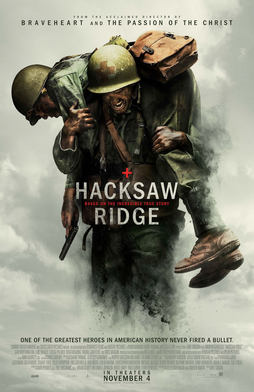
Interview: “Hacksaw Ridge” Mel Gibson, Luke Bracey, Vince Vaughn
Posted on November 6, 2016 at 8:00 am
Copyright 2016 Warner Brothers
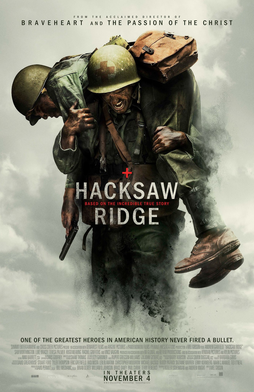
Mel Gibson’s first film as a director in ten years is “Hacksaw Ridge,” the true story of Desmond Doss, a medic in WWII who showed extraordinary courage and devotion, returning over and over again to rescue 75 wounded men under enemy fire in a battle in Okinawa. I spoke to Gibson, and to Vince Vaughn and Luke Bracey, who play soldiers in the film.
The movie’s battle scenes are intentionally brutal. “I don’t think I glamorized war,” Gibson said. “I made it look hard and hopefully realistic, at least that’s what the Okinawa guys told us. There’s not many of them left but it was an experience for them. I think is not really a war film, it’s a love story because a guy went in there through filial love determined never to kill anyone or harm anyone and he kept putting his life on the line to save lives so this is the greatest act of love you could perform, to sacrifice yourself for someone else so it’s a love story. It just happens to be in the worst place on earth.
Vaughn spoke about the challenge of portraying a the sergeant who trains and then takes into battle Doss and his unit.
I have a lot of military in my family and have done a lot of things throughout the years with the USO, so I had a good point of reference for start. And then being in a unique situation playing a sergeant, that you are training a new unit and that you’re actually going to carry them over to the battlefield, you really are going to feel responsible for these kids. You have got a lot of love for them and your job is ready to prepare them to be able to go to their training and as much as possible not kind of freak out during battle and to stay alive for themselves and for their brothers in arms.
Look, you are preparing for war, so the penalty of not being up to the task is death of yourself or the people in the unit. That’s why I think there is a bit of sense of humor in some of it because you want to reach people. You can’t just come and make them tone deaf because you are screaming at them the whole time. I think like everyone has their own unique way of doing it so I think there are moments when you are really hard, you are trying to get your point across to let them know what’s at stake and your intents. And then there is other times when you try to use it a little bit of a sense of humor to try to get them to laugh and to bring them together. And I think that this presents a unique situation. Here is a gentleman who is refusing to carry a gun. You just have to understand that from a military point of view this is close quarter battles you see the depiction of it in the movie, to be in a foxhole at night, sleeping with somebody and them on watch and someone approaches and they don’t have the means to defend themselves, then obviously no one would want to be in that situation. And I think made the true story and what is so powerful about Desmond is he had such a faith such a conviction and a calling and it really transcended the moment. There is something beautiful in that and I think that when you are true to your convictions and you do stay true to what you believe in, not only are you rewarded but actually everyone else around you is rewarded as well and I think you see that resonate in the film.
Bracey talked about the “intense physical aspect to this stuff especially, the battle scenes. You spend about two months filming that stuff and I think preparation for me it was obviously very physical but not just getting in shape. There is a mental aspect to the physical side in that commitment to everything you are doing. If you take the right attitude towards it you can really tolerate it in a positive way where you can try not to give up and everything you do, you know it’s going to hurt but you know there’s so much left to go as well so I enjoyed that aspect of it, and also just kind of delving into what is a man as well. At what point does a man goes from telling another a man to harden up to the point where can empathize with him.”
Filmmaking technology has changed very rapidly, and Gibson appreciated being able to take advantage of lighter, faster cameras and better special effects.
In the old days you had two stops either way for light but now it’s infinite and you can turn day into night with no problem. You can blow frames up without any loss of quality, you can flop the shot. I mean it’s just crazy what you can do with colors and the color palette. So technologically things really advanced and you can move pretty fast and shoot from the hip but I would say filmwise, in the world of films there are restrictions if you want to make an independent film and this is an independent film. So your budgets are restricted, you have less time to do it. This is a superhero movie so don’t get me wrong, but if he’s not wearing spandex you don’t get the budget.
A lot of things had to come together to make the image happen on screen. The thing with combat or war sequences on screen is it that they have to be clear, so clarity is required but within that wider framework of clarity, almost like a sporting or chess game, you have to have a strategy that is at least readable but it has to look like chaos amidst that. So in order for all the pyrotechnics, and the stunts and bullet hits and the camera guys, the actors, the extras, the stunts guys, everything, a lot of things have to come together so that you can catch it all on the screen so that logistically speaking little bit like juggling a few balls at the same time. But there’s a lot of people doing it. You don’t do these things alone and it’s really about synchronizing the departments, the various departments to come together to really get that image that you want. And after that the special effects that was great afterwards. But the earmark of great special effects is when you can’t see them. You don’t know what the practical stuff is from the stuff that you do afterwards. There’s both — there’s a lot of practical stuff like some 800 shots I think where they are special effects. I mean there’s muzzle flashes and tracers and dirt hits and stuff like that that were put in afterwards that really add so much. So technically speaking it’s a real scheduling juggling match.
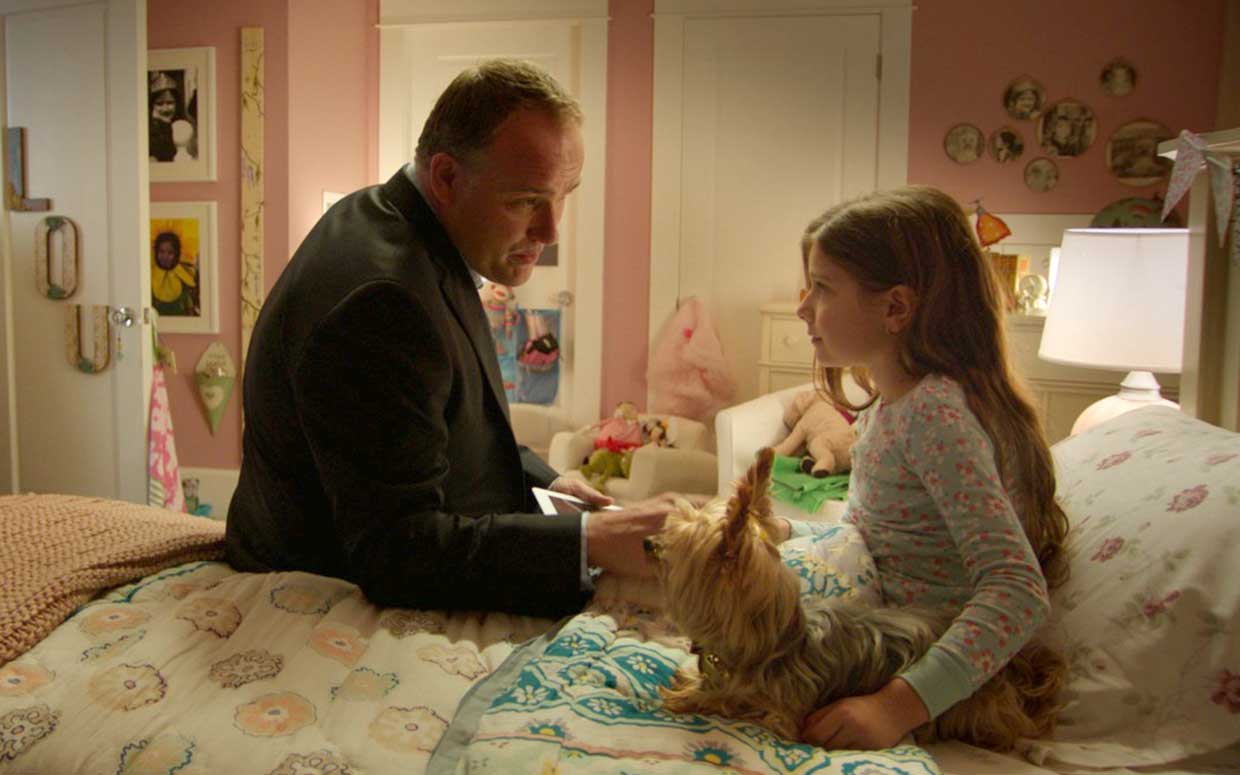
Pup Star is available on Netflix today! It is a cute family movie from the “Air Bud” filmmakers, inspired by “American Idol” and “The Voice” singing competitions.
David DeLuise talked to me about appearing in “Pup Star” and about what he learned from his dad, comedy legend Dom DeLuise.
What is your role in “Pup Star?”
I’m playing the dad. Because I was on Wizards of Waverly Place with Selena Gomez, all the kids see me as the dad. I have two daughters, Riley who is 23 and Dylan who is 18, so that makes sense. It’s not so much a stretch because I know how to do it already. And it’s fun! I like doing that because there’s a lot of heartfelt moments in this movie. It is a big, loving, fun joyride with the kids. And my connection and my interaction with Makenzie Moss, who plays my daughter, makes this part so interesting to me, that connection with my daughter and wanting just anything for your kids.
How do you work with a child actor to create comfort and chemistry on screen?
You want to try to have as much time off set so that you can be familiar and comfortable with each other. And so Makenzie and her mom and Carla Jimenez who was playing the nanny/housekeeper/friend who is the kind of mother energy in the film, we all went out to dinner and we hung out, we went for a walk, we got to know each other. I wanted to know what she likes, what she doesn’t like, how her relationship is with her parents.
I was very lucky, we did get to walk around the neighborhood for a photo shoot that shows our house in the movie and so me and her just got to go play in the park. I’d ask her about her dad. “Oh, he makes movies. He likes movies? Do you like movies with your friends? What do you do? What are your favorite things?” I do this with anybody. It doesn’t have to be a kid. I love getting to know people. I just get in there and I find out as many details as I can so that ultimately she can feel comfortable with me so that she can express her true emotion. I will say I’ve worked with him a lot kids in this business and she is spot on right there, professional, really brings it. Jed Rees who plays the dogcatcher bad guy? We just looked at each other like “Wow! She’s good!” Like, “Oh she nailed that.” She really does know her stuff and it is also very encouraging as a grown-up actor to see someone younger not so much working very hard because it seemed to come very natural to her but working and doing a good job like she wanted to be there.
What was the first acting job you ever get paid for?
Being Dom DeLuise’s son. It’s like I was born into an acting improv class. At the dinner table it was, “Who can make me cry the fastest? Who can make me laugh the fastest?” My godparents were Ann Bancroft and Mel Brooks. We had Carl Reiner coming over and Gene Wilder was there. These are my dad and mom’s friends but they are also these heavy hitters in the entertainment business.
So to answer your question, the first thing that I got paid for was a Dean Martin special. My dad was doing a Dean Martin thing and I think I was in 4th or 5th grade. I had had to be a kid on the golf course. And then a producer said, “Does your son want to get paid $600 or does he want a Go-Kart and of course I said Go-Kart and that was my first paid job. I also did a Disney movie with my dad.
My dad always said to me and my brothers, “You can be this business anytime you want, but you can only have one childhood.” We all went to public school, and had a normal childhood. But we did plays and we also had a video camera when I was younger. That was like a hard thing to have back then. Now the kids have studios with their phones and laptops. They can score it, cut it, everything. We had to do like reel to reel VHS tape and try to put music on it but it was a good education.
And I did this TV movie called “Happy.” It was about a clown who witnessed a murder. I played my dad’s son in the movie and also my dad directed a movie this is a long time ago called “Hot Stuff” with Jerry Reed, Suzanne Pleshette, and Ossie Davis. Then in high school I started auditioning. My first real job was an episode of “Hunter.” That was my first real job on my own acting and I was like, “Oh okay, I’m going to do this.” I did some acting classes but I would go over my auditions with my dad and he always enjoyed it so much. He would always say, “Make it a problem, make something happen, don’t make it easy.” He would say, “Does this guy juggle?” And I would say, “He’s a lawyer; he doesn’t juggle.”
Did your dad give you advice about comedy?
What I learned from my dad is you’ve always got to be thinking, thinking fast. My dad, Jonathan Winters, Rob Williams, all these comics thought very fast on their feet. And you have to trust yourself. You have to trust your instincts and your intuition as to what’s happening. I think there’s something about comedy that you can learn but there is also something just whether comedy is in you or not. You either have it or you don’t and I did get a little piece from my dad. There is a little bit of the comedy gene inside of me, so I’m very happy about that. It’s not so much talking about comedy as it is talking about acting and the feelings so you can do funny and you can do dramatic. It’s all about listening and reacting to what the other person is doing and having a point of view. So it can be a very funny off-the-wall point of view or a dramatic one for that matter.
What do you think families will learn when they watch “Pup Star?”
Family is the most important thing. This movie has a journey to a realization that family is everything. There’s our family, our immediate family, my daughter and our dog Tiny but also Tiny finds her own family on her adventure with Charlie and everyone else. I think the idea is unconditional love will always be there no matter what. You don’t need a house, you don’t need a recording contract, you don’t need things; you just need the relationships that you have in your life, your kids, your parents, your brothers and sisters.
W.C. Fields famously said actors should never work with children or dogs. In this film, you have both plus lots of special effects. How do you hold your concentration with all of that?
We had a three split screen, we’ve got two dogs on the left, the humans are on the middle of the shot, and then we have the dogs running through on the right side. So there is a lot of technical stuff, I could be wrong but I think it was something like 2500 or more special effects shots. They have been doing this so long. Actually, they were editing on set while we were shooting. They could see what was happening so they would not move on until they made sure they did not miss anything. That is really smart because then I can focus on acting; I can focus on the moment and all that stuff because they are not going to move on until it’s right. Everybody on this crew was just so funny. When you make a movie like this you become a family. They are a well-oiled machine and everybody loves the dogs, everybody loves their jobs. But when you’re working with dogs, you can’t connect with them right away; their attention has to be on the trainer. And so over time I was allowed to get to know the dogs but you don’t want them to get to really like you because then you distract them while they are acting.
And the kids were great, so professional and easy to work with.
What’s next for you?
I did a movie called “Believe,” a faith-based film with my friend Danielle Nicolet who was just in the “Central intelligence” movie. We were in “3rd Rock from the Sun” together 21 years ago. I get to do a southern accent. It was really fun to work with my friend and play the bad guy. So in Pupstar I’m like this sweet dad and then in “Believe” I am this southern politician guy with a smile who will steal your candy.
Interview: Nicholas Britell, Composer for “Moonlight”
Posted on November 4, 2016 at 8:00 am
It is always a pleasure to catch up with composer Nicholas Britell, and I was delighted to have the opportunity to ask him about his gorgeous score for one of the best films of the year, “Moonlight.”
The movie includes three very different time periods with different moods and locations as the main character — played by three different actors — goes from child to teen to adult. How do you keep the score distinct, locate the audience in the time and place, and still keep the consistent context?
That’s a great question. It was very important that there be a real cohesion across the chapters in the film. Yet, at the same time, Barry and I wanted to make sure that there was a musical transformation taking place as Chiron’s life unfolds. Early on in our conversations, Barry told me about his passion for “Chopped & Screwed” music. This is a style of Southern hip-hop where you take tracks and slow them way down; in the process of doing this, the pitch goes down and you get this real deepening and enriching of the musical texture and the sound quality. This style of music is really woven into the film’s landscape, and we then had an interesting idea of how to bring it into the score. At one point in our discussions, Barry and I wondered: “What if we chopped and screwed my classical score to the film?” In other words, what if I wrote and recorded instrumental and orchestral music and then we chopped and screwed it? We both got really excited by the possibilities that this aesthetic approach presented. We thus started a two-part process of scoring the film. First, I would write music inspired by the film and record it with live instruments. Then, I would take those recordings and chop and screw then, bending them, slowing things down, morphing the whole audio of the pieces.
The results of that process were fascinating: slowed-down violins started to sound like cellos, cellos started to sound like basses, piano notes started to sound almost like weird bells – the possibilities were just huge.
So, over the course of the film, one element of the score’s evolution is that the recordings are chopped and screwed and transformed. In the beginning, we hear Little’s Theme, which is a piano and violin piece. This comes back in chapter two, as Chiron’s Theme, where it is modulated down, a bit lower and deeper. Then, for the scene inside the schoolyard, Chiron’s Theme is totally chopped and screwed; I slowed it way down and it is pitched about three octaves down. Then I layered the track on top of itself and ran it through a vinyl filter. It comes out almost unrecognizable, and yet you feel it rumbling in the subwoofers of the theater. The result is this total transformation of the piece – at times you might just barely be able to make out Little’s Theme from the beginning of the film within it, but you feel it. So those ideas of continuity and transformation across the chapters of the film were really at the front and center of our collaboration.
The beach and ocean play an important part in the film. How did that influence your score?
That’s an interesting question. Actually, I was very moved by the soundscape of the film when I first saw an early cut. Barry and I spoke at that time about the sound of the ocean. I was very into the idea that there is this symmetry that happens where the movie could start right from the beginning with the sound of the ocean, as you are sitting in the theater, and then at the end of the film you come back to this sound.
The ocean brought to me certain ideas about the sensitivity of the approach that we could take. There’s something so beautiful and hypnotic about that sound of the ocean. And the ocean is significant to Chiron, and is at the center of many important life moments for him.
When I read the screenplay to the film, and after watching an early cut, the first word which came to my mind was “poetry.” There is a true poetry to the way that Barry created this film: there is a feeling of beauty, of tenderness, of intimacy and sensitivity. When I started work on the film, I said to myself “What is the sound of this feeling of “poetry”? “What is the musical analogue to that?” Among the first pieces I sent to Barry was a piece I wrote called “Piano and Violin Poem”, which became Little’s Theme. In some ways, the beach and the sea, the natural world — all of those things were influential in my trying to evoke a feeling of beauty, and tenderness, and poetry.
Do you use any unusual instruments or sound effects?
Absolutely. This is something that I really explored in depth in “Moonlight.” In fact, one of the pieces that I wrote utilizes certain sounds from the world of the characters, not just typical instruments. For example, just before the scene where Chiron is going into school to fight back, we see him looking into a mirror over a sink. Many of the “musical” sounds that we hear in the music are actually sounds that I drew from earlier in his life. There’s this sort of rushing-air texture in the music, which is actually the sound of the water from Chiron’s bathtub from when he’s a little boy in chapter one; I took that sound and wove it into the piece of music that I was writing.
Another example is where there’s a percussive drum hi-hat-like sound that plays with an insistent rhythm throughout the sequence when Chiron is going back into the school. That sound isn’t actually a drum, it’s the sound of Chiron and Kevin high-fiving earlier in the film. I was imagining that he’s about to go forth into this very intense moment of his life, and his memories and his thought processes are so wound up with his relationship with Kevin, so he might almost be hearing certain symbolic sound memories like that in his mind. There were quite a few places throughout the film where would I would take sounds from one part of the film and weave them into the musical landscape of another part.
As for specific musical instruments, to some extent their sounds are linked with the idea of the Chopped and Screwed music, where we were taking real instruments and morphing their sounds into unique textures. There are musical sounds you might not hear anywhere else, because they’re sort of impossible to create in the real world. But, after recording a cello and bending the sound lower and deeper, you get some very fascinating textures.
This film’s main character is silent and isolated for much of the film. How does that affect the responsibility of the composer?
That’s a good question. I was cognizant of the fact that there are many places throughout the film where Chiron isn’t speaking, and the film really embraces the quietness of certain scenes. I think it’s a beautiful thing when characters don’t need to speak in order for the audience to understand them and feel their emotion. There are moments where, for example in the third chapter, Kevin and Black are looking at each other in silence. I find those moments incredibly poignant, and there aren’t any words being spoken. So if there is music in those places it might be able to express an idea of what the characters are feeling. The music can connect us with unspoken thoughts. From the very beginning of the film, I thought about how certain types of music might be able to get us into Little’s point of view.
Along the same lines, while choosing the places where music goes in a movie is important, in many cases, an equally important choice is where doesn’t music go. Where should there be silence? This was something that Barry and I spoke at length about as well.
I have to ask about the theme music you did for Slate’s Culture Gabfest. How did you combine all of their ideas in such a brief piece? Is that harder than creating a feature-length score?
For those who might not be familiar with that theme music: a few years ago, I was asked to write the theme music for the Slate Culture Gabfest podcast show. The specific assignment entailed combining many different “ideas” and creating a sonic identity for the show. It was certainly a fun challenge to try to combine so many ideas into a sonic one-minute “signature” for their show! I would say the main difficulty with combining the ideas into 1 minute is in finding a way for the ideas to “blend together” in an interesting way. This can be tricky, as you don’t want the ideas to just be a noisy jumble! Writing a sonic signature like that and scoring a film are thus really two very different activities. The biggest difference with writing a feature film score is that the approximately 90min-120min of a feature film give you so much space to explore the musical ideas. As opposed to “compressing” them into a short span of time (as in the Gabfest theme’s 1 minute length), with a film score one is able to focus on the architecture of the film and the geography of where the musical ideas go within that architecture. One of the most exciting parts of the process of film scoring is getting the chance to develop ideas over the length of a film. A lot of the joy of the process is in seeing how things evolve.
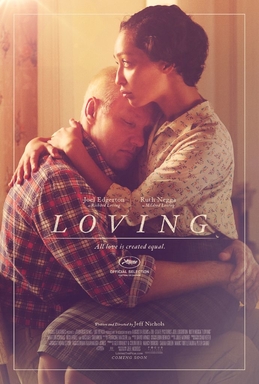
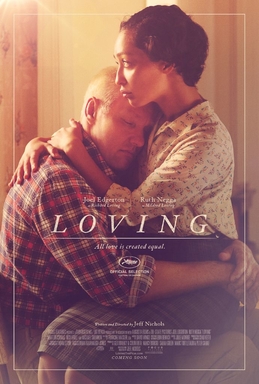
Joel Edgerton stars in “Loving,” the true story of the couple whose 1967 Supreme Court case successfully challenged laws prohibiting marriage between people of different races. In an interview, the Australian actor spoke about playing the quiet man from a small town in Virginia who just wanted the Court to know, “I love my wife.”Copyright 2016 Focus
He said, “I kept seeing the words Loving v. Virginia. I saw those words together and I thought it was a very powerful obviously, the couple felt so fated to be because of their name but it felt like humanity versus the system which is really what the movie is about. I just kept thinking about a human quality, a human desire that we all share versus the system that’s all about everything else.”
The movie’s script, by director Jeff Nichols, includes some of the moments in the powerful documentary, “The Loving Story.” Edgerton said one of his favorite lines was when Ruth Negga as Mildred Loving said, “We might lose the small battles but win the big war.” And a woman who saw an early screening told him that her favorite line was when Richard Loving asked his wife, “What can I do?” “She said every man needs to know that.” Edgerson said, “That says a lot about the relationship, the support, of not presuming to create somebody’s happiness but to see what you can do to contribute to somebody’s happiness by listening to what their needs rather than to presume what their needs are.”
I asked whether it was especially difficult to play a character who does not speak very much. He answered, “I actually thought that it might be the opposite and not because I thought I could be lazy or no homework or anything but I know all too well that film is a visual medium and the camera often gets very close. The camera doesn’t lie and therefore it’s important that we as actors don’t lie and if we are doing it we hide it very well. And so I thought this might be somewhat not easy but a simpler task than I realized it was. And I realized that it taught me a lot. When you have large speeches you kind of choose the surface layer or the subtext and do a dive into that and it kind of gives the audience a guide to what you’re supposed to be thinking as a character. When the audience doesn’t have that guide, that verbal guide then it’s up to you to be very specific about the silence, the reasons for it. That became the real task and I don’t think I’ve ever had to think so specifically about silence. The pause is as much line of dialogue is a line of dialogue is. So Jeff and I would have conversations about the frustrations or the awkwardness or the shyness or looking for an aspect of Richard in those silences and try to be as specific as possible so that they became words we just couldn’t hear or screams that we were unable to express. Just because you’re not speaking doesn’t mean you’re not communicating.”