Interview: Billy Ray on “Secret in Their Eyes”

Interview: Billy Ray on “Secret in Their Eyes”

Posted on November 18, 2015 at 3:58 pm
Copyright 2015 STX Entertainment

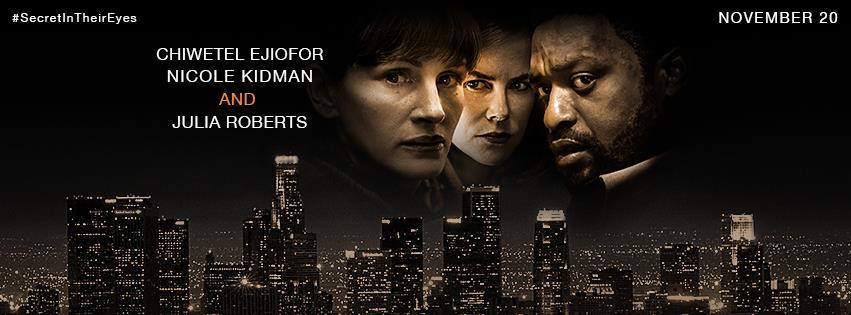
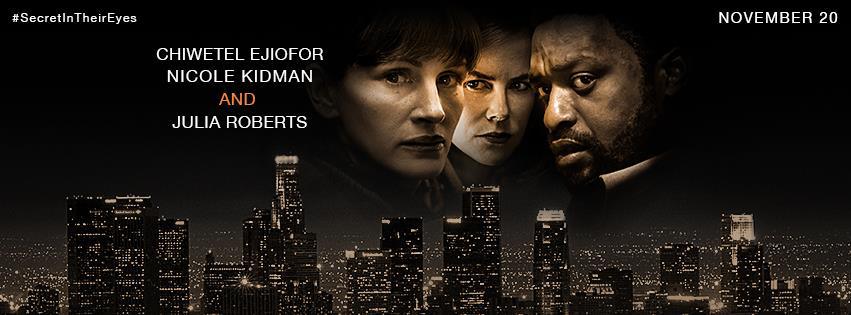
It was a thrill to get a chance to interview one of my favorite screenwriters, Billy Ray (“Shattered Glass,” “Breach”) about the new film he both wrote and directed, “Secret in Their Eyes,” a thriller starring three Oscar winners, Julia Roberts, Chiwetel Ejiofor, and Nicole Kidman. It is the story of a horrific murder and its impact on the lives of three people, a prosecutor named Claire (Kidman), and two FBI investigators, Jess (Roberts) and Ray (Ejiofor). The movie goes back and forth in time, and I asked Ray about the skillful way that he as both writer and director allowed the story to unfold. “The story to me is about the character played by Chiwetel, Ray, he and Jess and Claire played by Julia Roberts and Nicole Kidman, they walked through a minefield 13 years ago and suffered horrible effects as a results. Now its 13 years later and Ray has come back to them and said, “Let’s walk through that again,” and they both know it’s a disaster although they know kind of on different level why it’s a disaster. But they both know as well that it is inevitable that they’re going to walk into that minefield again. And I felt it was really important to paint a picture of how the steps that they are taking now in 2015 completely mirrored the steps that they were taking in 2002. And that there was a certain inevitability to the tragedy in both time periods so you need to show the plot progression in 2002 with exactly the same plot progression now.”

What signals do you use to let the audience know what year we are in?

“You have a couple of cues. You have some hair and the whiteness in Ray’s beard. You have cultural references. If people are talking about 9/11 you know you’re in 2002. You have the character played by by Dean Norris, Bumpy. If he’s limping, it must be 2015. So we tried to drop as many of those in as we could without hammering it. It has always been a movie that requires some attention; I think that’s a good thing. I want the viewers of this movie to be actively in engaged in trying to piece together the puzzle of it. And part of that has to do with trusting your audience enough to know that it might take them 10 seconds into a scene to know exactly where they are but that they would be engaged by that. They will be with us.

This film is based on an Argentinian movie that won the Oscar for Best Foreign Language Film in 2009. In the original film the stadium scene was a big showpiece and Ray does the same here with a chase scene in Dodgers Stadium. Tell me about the challenge of filming that scene.

First let me tell you that I grew up in Los Angeles in the San Fernando Valley and Dodgers Stadium was and is a cathedral to me. It’s one of the most important, iconic places of my entire life. So once I knew that we were going to be shooting the movie here in Los Angeles there was nowhere else I was going to put that scene except Dodgers stadium. It required a lot of begging, it was me personally hammering the LA Dodger organization, begging pleading, cajoling, doing everything I could to get them to say yes and eventually they did. And then of course we had to fight to make sure that we had the money in our budget to shoot it the right way which was its own challenge because we didn’t have an unlimited amount of money to spend on the movie. But it was extremely important to me because there are certain moments in the original that I just felt had to be honored and that soccer stadium sequence was certainly one of them, you know you can’t do that in Los Angeles and put it in a soccer stadium it is not the same thing here in an American context.

So for me to pick baseball which is a uniquely Americans sport and then to put it in a place that’s so well-known like Dodgers stadium with that great LA skyline certainly behind it, I just felt that that was going to be a great image and whatever we were going to do to get it we just had to do it.

So what was it like to film there?

We originally thought that we were going to have three full nights to shoot there. The schedule got compressed so we had to do it in two. So we had to be extremely prepared and very precise. We scouted dodger stadium eight times as a crew to make sure that that we know exactly what you are doing and that the camera was going to be in the right place. The trickiest thing in the world of course was that opening shot, the one that comes from behind hill and then over the parking lot over the stadium and then lands on Chiwetel and Dean and there was a lot of debate about how to do with that. At one point we thought it was going to be a drone but it turned out way too complicated because drones can’t fly at night, they can’t fly in a certain level of wind and they can’t fly in any rain at all. So if any of those eventualities took place were going to be scrubbed and that was going to be a disaster.

But someone invented this thing called the clouds cam which is a camera head that exists on a 30 foot long umbilical cord that hangs out of a helicopter so the helicopter could fly the camera head over the stadium and over the crowd but the helicopter would be high up above the cloud that they wouldn’t get the prop wash to blow their hair. So that’s what we did. It took 14 takes but we got what we wanted and moved on. It was designed actually to fly in between the crevices of ice glaciers so that they can get documentary footage inside glaciers. It doesn’t bounce and it doesn’t bobble at all. It stays very smooth and very steady.

There’s a struggle in the film between those who want to pursue the person responsible for a horrible murder and those who are more concerned with preventing future catastrophes.

Well to me, the movie is about the cost of obsession. And every beat in the movie turns on the idea of obsession all the way down to how they find the bad guys through their own obsession. Ray and Jess and to a slightly different degree Claire have an obsession about this case but they are running into people who have an equally valid obsession about public safety and that is why we set it against the backdrop of the repercussions of 9/11. I felt it was really important that the DA played by Fred Molina and the character played by Michael Kelly, have a valid point of view. And they do have a valid point of view which is that in those months right after 9/11, with the level of terror that was so great that if someone had come to me and said we can guarantee you that there will never be another 9/11 but we’ve got to take your civil liberties and we’ve got to take everybody’s liberties away, I would say, “Great, where do I sign?” You’re still in shock.

When you juxtapose that against the necessity for justice for this one case you then have the makings of good drama because everybody in the room has a completely valid and urgent point of view and they can defend it with great authenticity. That’s where we’re going for. I would love for this movie to be part of a larger conversation about the merits of this one case versus the needs of the public at large to be safe. It’s tricky and it’s nuanced and it’s not easy which is why I like it as a subject matter for this movie.
Related Tags:


Directors Interview Writers

Interview: Johann Johannsson, Composer of “Sicario”

Posted on November 8, 2015 at 7:14 pm

Jóhann Jóhannsson is an Icelandic composer who created the moody, evocative score for the intense law enforcement drama, “Sicario.” Previously, he wrote the score for the Stephen Hawking film, “The Theory of Everything.” It was a pleasure to speak with him about the way the bleak settings and the emotions of the characters influenced his composition and how he used the music to help build the tension of some of the most intense scenes.

This was his second collaboration with the director, Denis Villeneuve, after “Prisoners.” “He involved me very early o,n before he started shooting so I read the script and we had a discussion about the music and then he invited me to the set as well. I was able to go to the set in New Mexico and to sort of observe the locations and the environment of the landscape and to get a feel for the setting.” But it was not until he saw the first cut of the film, “I really started writing basically getting inspired by the images and creating a sound for the film. We talked about the need for the music to uphold the tension and the sort of sense of dread and the sense of moral ambiguity that the characters are facing with these serious moral questions. We see the moral universe fall apart, especially for Emily Blunt’s character. Denny talked a lot about kind of an analogy with a war film. He used this phrase which I liked a lot which was ‘subtle war music.’ It is an interesting contradiction. So we had these percussions on these sort of low tom-toms and those military steel drums as a very big part of the score, creating this kind of throbbing pulse that runs as a thread throughout the score. So that was one thing we talked about, we talked also about a lot of other music coming from below the earth in a way, coming from underground. So the sound of the tunnels and also about the melancholy of the border, the melancholy of the border areas, of the border fence and of the experience of the illegal immigrants and the sadness of the border, and the melancholy of some of the characters like the Alejandro character, the Benicio character, his tragic back story. So there’s a sort of melancholy and sadness also that we had to captured and communicated. So it’s kind of these two poles this sense of tension and melancholy.

He continued: “It is not a war with any heroes. It is kind of a desperate, hopeless war. The music communicates that and it is kind of deconstructive in a way, there are a lot of horns in the score they are just not playing fanfares. They are playing these sort of atonal burst of sounds, a sort of textural burst and flourishes that is the opposite a military flourish.”

When he was growing up, Jóhannsson watched a lot of American and European films and first noticed the scores that Bernard Herrmann wrote for Hitchcock and later for DePalma and Scorsese. “‘Vertigo’ is the best collaboration between a composer and director ever and his music really made me want to write film music. I think his influence can be felt in some way in ‘Sicario’ with my use of low woodwind and these kind of relentless low sounds are something that for me echoes Herrmann very much.”

He says that he drew a lot of inspiration from the landscape as well as the mood and atmosphere of the images. Cinematographer Roger Deakins “showed me a lot of the kind of amazing aerial footage that they had of the desert and of the border area and some of that ended up in the film. That was a huge inspiration for me. And I tend to draw a lot of inspiration from the landscape and from the atmosphere of the images.”

He prefers not to work with synthesizers. “There are electronic elements in there but they are all based on acoustic sources that are treated and processed through effects and through plug-ins and through digital manipulation. But all of it is based on acoustic recordings. So I recorded musicians in Los Angeles and in Berlin where I live. I recorded the orchestra also in Berlin and also in Budapest and it’s a 65 piece orchestra, full string and brass and woodwind and there are number of soloist and some feature players as well.”

One of the tensest moments in the film comes at a scene where a character finally approaches the man he has been waiting to kill when he is at dinner with his family. “Danny and I agreed that it needed something very minimal and something very subtle basically to underline the sense of dread and the sense of tension. And so Danny didn’t want anything complex or anything that was too manipulative. So it was all about scoring it in the most subtle but effective way possible. And I used recordings of a 32 foot organ pipe, the lowest notes on the pipe organ which I recorded in a cathedral in Copenhagen and I processed those sounds as well electronically and combined them with processed orchestra, like the orchestra playing drone, like a sustained note and processed electronically and manipulated. It’s a combination of the many, many elements to create the kind of complex texture textural drone. And a drone can be a very fascinating and complex sound. It’s not just playing one note on a keyboard and sustaining it, it is about creating this very complex sound world that is minimal but has this complexity when you sort of stay with it and when you give it your full attention.”

The music alternates with silence in the opening scene. “We had score right in the beginning when they were driving towards the house and when they burst through the wall and then the rest of the scene has no music and then the score comes back when they discover the bodies and it’s basically a reprise of the armored vehicle music which then develops through high and low strings. And so again it was about evoking dread and the kind of tension and the horror of finding these bodies without it being obvious.”

He will work with the director again on his next project, “Story Of Your Life,” with Amy Adams and Jeremy Renner and Forest Whitaker, a science fiction film. “It is a very strong script and really fascinating story which I have only just started working on couple weeks ago so it’s very early days but it’s a very strong project.”

Related Tags:


Composers Interview
Interview: Sarah Gavron on “Suffragette”

Interview: Sarah Gavron on “Suffragette”

Posted on November 7, 2015 at 4:26 pm

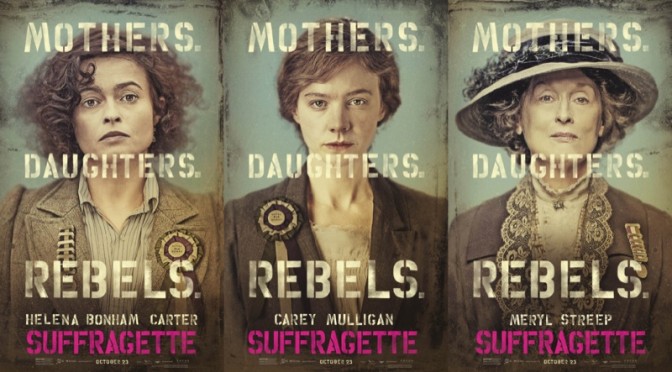
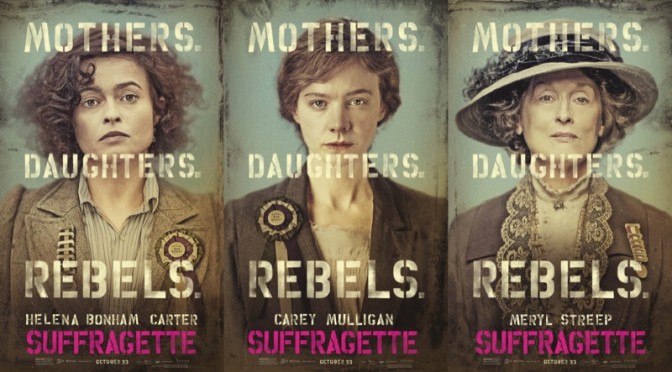
Sarah Gavron directed “Suffragette,” starring Carey Mulligan, Helena Bonham-Carter, and Meryl Streep in the story of some of the women who fought in the decades-long struggle to give women voting rights in the UK. I spoke to her in an especially appropriate location, Washington DC’s Sewall-Belmont House, a museum and archive of the National Woman’s Party and the fight for women’s voting rights in the US.

Copyright 2015 Focus Features

The movie’s main character, played by Mulligan, works in a laundry, as her mother did before her, and the movie’s focus on the participation of ordinary working-class women, and not just the leaders, is based on years of research. “We dove into these archives in the Museums of London and the Women’s Library and discovered these accounts of these working women. And so often women have been marginalized in history books, but working-class women even more so. And it was really striking that this movement brought together women from all categories, despite the kind of class apartheid of Edwardian Britain. They worked alongside each other. The working women had so much to lose and they sacrificed so much. They went to prison, they lost their jobs, they lost their relationships and their families and homes as it was very shaming in that community to go to prison and so they were risking a lot. And they are also very instrumental. There were working-class women in the leadership of the movement like Anne Kenney who was a millworker. And there were women on the ground. We wanted to depict their stories because it felt like to tell a story of the women with no platform and no entitlement would be a way of connecting with audiences all over the world today.

The women fighting for the vote were following in the paths of activists who created the first grassroots political movements, to end slavery and to get universal suffrage for men, which was not granted until . “Emmeline Pankhurst kept saying that previous political movements and charters to fight for male suffrage also resorted to civil disobedience and I think that that was kind of instructive in terms of the tactics that they employed and as we said on the civil disobedience front that the women only turned to it after 40 to 50 years of peaceful efforts. And even then, they would never harm human life; it was always attacking property.” And some of the women in the movement came from families that had fought to end slavery, so they were familiar with political activism, the opportunities and the options for making their case. “I think it was just that campaigning genius which run through these families. Emmeline Pankhurst’s own family had been involved in so there was a connection there. But they were also coming up with original tactics for this movement and pioneering a lot. It’s kind of impressive the way they brand themselves, the way they got their message out, the way they used the media. And it was new media at the time, it was that emerging cinema and photographs just beginning to appear in these newspapers. They knew how to use it and they were employing new tactics a lot of the time.”

It is difficult for us to imagine today, with two women currently running for the Presidency with considerable support, that anyone could argue against the rights of women to vote and serve in government. But the way the issues are argued still has some resonance today. “It’s interesting when you read the debates in parliaments between MPs about whether they should give women a vote. It’s a lot of fear, it is fear of change, it’s fear if women get to vote family structures will breakdown, women will stop having children, women won’t vote for war. And women didn’t have the intellectual capacity, they were two emotional. The counter was what these women were. I mean someone like Christabel Pankhurst who was a Lawyer although she couldn’t practice as a lawyer — she was extremely eloquent and I think her intellectual prowess was proof alone that she was more than capable. So I think that they were just countering it with their speeches and the way they were behaving. They just realized that they had to use whatever they could to make their point.”

At the time depicted in the film, the UK was led a a woman, Queen Victoria. But she opposed women’s suffrage. “I think it’s very different if you were born into power and it’s hereditary and not out of a democratic system and so I don’t think that you can compare that in a way.”

The movie ends with a sobering list showing the years when different countries granted women the right to vote, ending with Saudi Arabia, which just this year began to extend a partial voting right to women, though they still need to be driven to the polls by men. “When we were researching we started to just look up when other countries got their vote and it was kind of extraordinary to realize how recently many of these countries had won their vote for women and it’s a reminder I think of how precarious those rights are and how important it is use our voting rights and how fought for they were and how recently they were won. We brought it up to present day because one of the aims in the film is to say that this is just not piece of history, this is a film that resonates with also issues we’re still attacking in the 21st century. Having the vote is just symbolic. There still many issues on which women don’t have any right and in many countries where women are given very very few rights. Like education. There are 63 million girls worldwide denied education and the correlation between lack of education and babies dying in early infancy. You know education is so key and then sexual violence. There are so many issues we’re still dealing with apart from representation.”

While the movie is grounded in history, the central character is fictional. “We read a lot of accounts of working women and we really she is based very closely on a number of the working women that we read about. So the reason we create a fictional character is to kind of give us leeway in terms of the timing and where we put her with her and how we began into the story but in terms of what happens to her you will find out in the research there are women who went through everything she went through. Some women were writing about their experiences at the time, like The Hard way up – The Autobiography of Hannah Mitchell – Suffragette and Rebel Anne Kenny was also a working woman who wrote a memoir and Anne Barnes another working woman. And female academics particularly have gone and dug into the working class woman’s life now and gone through records and accounts and factory accounts.”

Gavron wanted to make this film for ten years, and there was six years of research to get the script. One of the people they worked with was Anne Pankhurst, a descendent of Emmeline. She was struck by the challenges the women faced. “It was really the length to which they went and the violence they faced and the personal cost, the fact that they were prepared to go to prison, hunger strikes, be forced-fed 49 times Emily ward begged and she was even most forced-fed it was sort of extraordinary we know that’s a form of torture and it was even more so a form of torture with the equipment they used and so it was that that I found most shocking.”

They had to use the “pockets of London” that could still pass for a hundred years ago. “We wanted to film in the house of Parliament. No one ever had filmed in the house of Parliament in the whole history of cinema but we decided that we had to be suffragette about it and we did not give up, we filed a petition and finally got access. So then we had stunt people and vehicles and we were staging this government protest in this very place that barred women for centuries so that was very exciting. The testimony was shot in the very room where women appeared before Members of Parliament to make their case. One of the supporting actors stood up, an old man, and said, ‘My grandmother was a working woman who gave her testimony to Lloyd George.'”

Gavron hopes the film will inspire people to learn about the women who fought for the vote and to join them in pursuing justice and equality. “I hope that people come away remembering or realizing how hard fought for the vote was if they didn’t know and also feeling empowered to speak out against current day inequalities.” What makes her happy is when people come out of the movie saying, “I will never miss a chance to vote again.”

Related Tags:


Directors Interview
Interview: “Armor of Light,” the Documentary about Faith and Guns

Interview: “Armor of Light,” the Documentary about Faith and Guns

Posted on November 4, 2015 at 3:58 pm

Armor of Light is a thought-provoking new documentary with important insights for everyone on all sides of the debate on guns. Documentarian Abigail Disney made a film about two people who are making a faith-based case for addressing gun violence to conservatives.

Reverend Robert Schenck is an evangelical clergyman who has been very active in opposing abortion and Lucy McBath is the mother of a teenager who was shot and killed by a man who tried to claim the “stand your ground” law as a defense.

Copyright 2015 Fork Films

I spoke with all three of them in Washington, D.C. as the movie was opening around the country.

Schenck explained that being raised Jewish and converting to Christianity gave him an appreciation for different perspectives. “My mother was actually a convert to Judaism in order to marry my father and all the children were raised Jewish but that was our story. So already there were boundaries that had been crossed and that brought different cultures into the family. So that’s very important but I think probably more than anything the way my Jewish experience informed this was in the kind of traditional way of approaching a puzzling question. There is a long history in Judaism of asking questions and listening to lots of voices and perspectives. I mean it’s Talmudic, it’s Midrashic but that’s the way it’s done. And it takes sometimes a long time, it can take centuries to come to a conclusion. And I do think even though there is an urgency about this question of gun violence, of course lives are on the line, it’s matters of life and death that brings an urgency to the question. At the same time it’s profound enough to demand at least a period of contemplation. Growing up with the rabbis arguing and not necessarily in hostile, confrontational ways but arguing a question to its conclusion and sometimes hearing scores of opinions on that. You read the Talmud, you read the Torah portion and then the commentary and the commentary on the commentary and the commentary on that. This question is worthy of that kind of investigation so in that way it’s been very, very helpful to me.”

McBath spoke of reaching out to people through their shared faith. “How deeply and morally are they really willing to be the face of God, to walk out their faith? I challenge them all the time in saying ‘What does the Bible say? What does Jesus specifically say we are to do and be and do you really believe that your line of thinking is in line with the moral precepts of Jesus?’ I try to push them and challenge them to think morally about gun violence and not so much through fear.”

Fear is something both McBath and Schenck try to address. Schenck said, “Faith it is a certain antidote to fear and I do think in many cases this is a failure of faith. And of course I include myself in that. I mean I’m not finger-wagging because there are many, many occasions when I fail in faith and when I experience fear, not so much over this kind of question of physical safety. I don’t experience much of that fear but other kinds of fear. So this is really a challenge to faith and I think it is one of the reasons why pastors are key players in this. The pulpit is a place where faith is fostered and gun shops are places where fear is fostered. So I think pastors or spiritual communities in general need to play a key role but it may be the most important for our evangelical community because research shows over and over again that the pulpit, the pastor and the preaching that occurs within the evangelical community is really the most persuasive and important source for that. And one of the problems is of course pastors have been largely silent on this question of gun ownership use, self-defense, all of the questions that surround this gun violence. And that creates the vacuum that I addressed in the film. I’ve always spent a lot of time on is the crisis of fear within the Christian community.”

Though her views on politics and faith have little overlap with McBath and Schenck, Disney said working with them was “Such a pleasure. When I first met Rob of course I was expecting cloven hoofs but I obviously encountered a lovely human being who’s eloquent and intelligent and well read. Shame on me for assuming otherwise. So it was pretty quickly that we were able to put aside differences. It was a conscious decision from the onset. I said, “We could fight or we could just take that and put it aside and choose to inhabit everything else,” and it turns out there’s a lot else. And generally when you choose to inhabit everything but your political differences you find your way up above politics. And because I came from a different kind of childhood than adulthood I live in I’m used that. I think of it as being politically bilingual. I always refer to Thanksgiving dinner because everybody knows about the Thanksgiving dinner. So you still love people, even with the most violent deep disagreements about politics but your values are never all that far apart. So I definitely tapped into my experience growing up at odds almost all the time with my family to sort of discipline myself to remember that I love people and we are different. So it’s been good for me because I have been living in Manhattan for a long time with all the fellow travelers stuck on one island together reinforcing each other’s point of view. It took some discipline for me to kind of not engage sometimes and I wanted to fight about an issue. There were a couple times that I didn’t hit someone over the head but it has been such a pleasure.”

She went on: “First and foremost I wanted to reach people who weren’t already on the same page with me about everything violence related. I mean this is not about guns; it’s about violence and the particular American relationship with violence which is unlike I think another country and any other time. It’s a particular problem and I don’t think we look at it or frankly address it very often and so I wanted all stripes politically and socially to sit down and have a frank conversation about it. So we’re looking to engage with Christians in part because evangelicals are the group of people most likely to want guns and most likely to say that they are pro life but the depth of the inconsistency between those positions is profound and troubling to me. But I also want to engage liberals too because I think my liberal friends have a smugness that needs to be challenged and they’re quite certain about how bad other people are on the other side of the fence or so forth or so stupid or the rest of it and I really want to challenge us on that too because I’m uncomfortable with people being too comfortable. So I just wanted to stir it up.” They are making some screenings of the film free to NRA members.

McBath, whose father was an example of activism through his work with Martin Luther King in the Civil Rights movement, reaches out to the faith community on gun violence. “I just knew as a woman of deep faith that that had to be part of the culture of gun violence prevention specifically from the lobbyist of view, from an activist point of view, that if this was not incorporated in a spiritual way in faith that they were never going to be successful. That’s a huge element that has to be addressed because it is the evangelical and the white conservative Christian community that so entrenched in this gun culture and so specifically in faith. So that’s how I kind of evolved into the faith and community outreach leader in every town. I kind of created my own position.” While she did not always understand as a child what her father was working on, “I knew what that he was doing was important. I did understand from my father the urgency to always make sure that people were protected civilly and humanely protected. I understood from my father very early on that prejudice was wrong and that a segregated country was wrong and that it always had to be addressed, always had to be watched. We always had to continue to fight because my father did teach us that to remain free you always have to be very diligent and protecting that freedom. I know that it’s my role to specifically make sure that the work of God is deeply incorporated in this work. It has to be, there is no other way to do it.” She is working with Everytown and Moms Demand Action for Gun Sense in America.

Reverend Schenck is working with the pastor community to bring the message to their congregations through an online forum called Narrow the Road. “Evangelicals brag about the fact that we don’t have a structured hierarchy to the church, we don’t have bishops and archbishops but then again we have very influential personalities who others will almost obediently follow. Yesterday we met with one of the leading evangelicals in America. He is at the top tier of influence. We received a relatively warm welcome and he indicated the willingness to talk about, to really seriously examine the issue but at this point privately, quietly not publicly, behind closed doors. Well, that’s progress because we hope that we can get to a place where he feels strong enough about it to actually venture his convictions as they emerge in the public setting so that’s one way.” But he has lost friends and supporters over this issue. “Right now is a pretty lonely road for me. So that’s costly and there will be other pastors who will face the same consequences. I hope maybe I can be literally an encouragement to them, I hope I can give them courage, and we can give each other courage and then a create a critical mass where there is strength in numbers and eventually I hope a small group of us can come out and thereby encourage as many many other pastors who in turn have influence on their congregations.”

Related Tags:


Directors Interview
Interview: “Chaplains” Director Martin Doblmeier

Interview: “Chaplains” Director Martin Doblmeier

Posted on November 3, 2015 at 11:15 pm

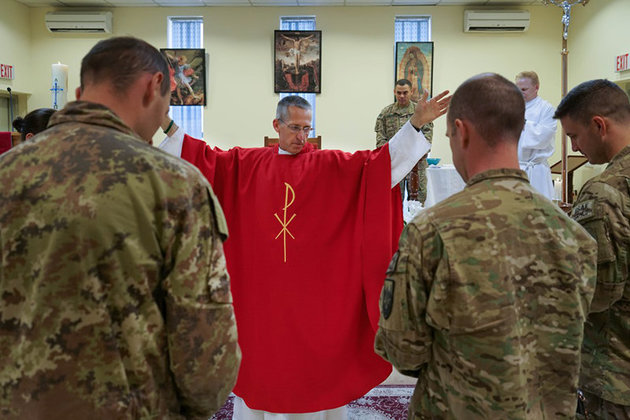
US Army Chaplain Paul Hurley, a Catholic priest, says mass for the troops at a Military base in Kabul, Afghanistan. Photo courtesy of Journey Films
Martin Doblmeier has made more than thirty movies about faith. The latest from his Journey Films is “Chaplains,” showing this month on PBS. It is a profound and moving documentary about chaplains of many different faiths in a variety of settings: war, business, an assisted living facility, prison, the US Senate, NASCAR, and a children’s hospital. It was George Washington himself who first asked for chaplains in the US military. The movie covers Army chaplains representing centuries of tradition as well as chaplains in new and developing roles. In an interview, Doblmeier talked about how the film came about and what chaplains bring to people literally dealing with life and death.

“We have been around this world now for about 30 years making films and I know a lot of chaplains. And I realized that there had not been any kind of significant film that talked about the work that they do. And they work so quietly, under the radar most of the times. And I just felt maybe we could do something that helps to raise the profile and bring some attention to who these people are and the great work that they do. So once we started to dig into it and we realized that it was something that was becoming more common across faith traditions. There certainly had been chaplains dating back to the fourth century. St. Martin of Tours was the one who actually begun what has now become the idea of chaplaincy and it’s been going on now quietly mostly in the military or in a hospital setting but over the last couple of generations has expanded now into the prisons. Even the corporate world is looking at it as an interesting model, that’s why we put Tyson’s in there. We had known about Tysons for many years actually. I keep notes in piles. The foundations liked this idea because it had something of positive value. And with their support we were able to get it up and get it going. For me I think it’s a really interesting storyline about people who want to live out a faith tradition in the 21st century in their particular place. And what a wonderful model for how not just to tolerate the faith tradition of others but actually to honor it, and engage with it and to see it as a way to sort of forming a sense of meaning in our lives.”

Congregational clergy spend almost all of their time with people who share their faith traditions and culture, but chaplains work with people who of all faiths and of no faith. “In a congregation really pretty much the language is common, the rituals are common, the practice is common, and people generally understand that the pyramid of structure is with the pastor or the Imam or the Rabbi being the person in charge of the spiritual growth of that particular community. It’s a totally different paradigm in chaplaincy, most often because they are working in secular settings, they don’t really have a place that you would consider to be a power position in those settings and so they are negotiating every day not only with the institution but how to deal with the individual that they come across. And it’s a very different way of being present in those kinds of environment than it would be in a congregation. I think it’s a wonderful model but it presents its own challenges. One of the things we wanted to bring out in the film is that you’re working in a spiritual realm, that it is very difficult, nearly impossible to somehow document the impact that the chaplain would have in a hospital setting or in a prison setting.” Because they are in secular settings, they constantly need to find ways to demonstrate their value in terms that the people responsible for those settings can understand. “There are implicit success points that you can look at but at the same time in institutions that are under a lot of pressure for accountability and quantifiable data to be able to say this person is actually contributing a lot to our overall mission here in the secular settings is a challenge. Chaplains don’t often have that kind of data. So there is a constant stance of — ‘Will I still have this job? Will I still be able to continue to perform this work after the next review happens?’ I had a real sense of admiration for them, the commitment that they have despite the fact that in many cases the roles that they play in the hospitals or in the prison settings are always being evaluated and reevaluated.”

The movie shows that the work of the chaplains often extends past the boundaries of the community they are serving. “For example in the police department my assumption was the police chaplains would be meeting with perpetrators or prisoners or people who have been arrested or incarcerated for whatever reason. In fact, more often than not the police chaplains were mostly ministering to the police department. And I find that to be the case in a lot of different ways. So in hospital settings the hospital chaplains often ministered to the patients and the patient’s families, the people involved but they also minister a lot and provides support, emotional support, spiritual support to the staff, to the doctors and the nurses. So they do provide this sort of wider setting of what’s going on and I think we tried to show that in each one of the different segments because I think there can be a lot of misunderstanding to what their role is but they continue to sort of be present and available to those people who need them, very different to the settings in the military.”

Copyright 2015 Journey Films
The chaplains in the films are less concerned with rituals and theology than being present in the lives of people who are struggling by showing their faith through compassion and understanding. They are not proselytizing or doing missionary work. “It was nice to be able to put some of the voices in of the soldiers were very young who said that they appreciated the chaplains even though sometimes they are not believers. The chaplains fulfill this unique role because if someone is having a lot of emotional issues in the military about what was happening they would feel more comfortable going to a chaplain because it is not documented in the same way as if you go to the military psychiatrist to speak to somebody about that. So there are a lot of nuances that creates this real need to be able to have chaplains available.”

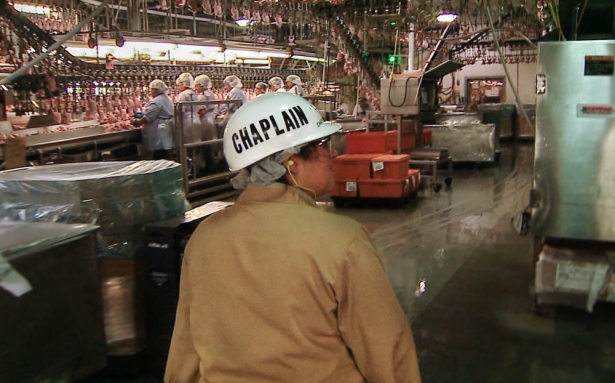
Perhaps the most unexpected setting in the film is Tyson’s Food. Doblmeier says that the success of this program, particularly in providing support for employees from a wide variety of ethnic and cultural backgrounds. “There are companies now that are providing chaplain services like you provide independent IT services. Corporations that have evangelical leadership feel as though it is important for them to be able to have access to chaplaincy. So that they can literally hire in through an agency chaplains to come in and serve their people. We wanted to do it because Tysons Foods is huge publicly traded company and it has not just a handful of chaplains to come in and sort of maybe address some of the spiritual needs. It has 120 full and part-time chaplains and has had them now for you while. So this is a genuine commitment on the part of this corporation. John Tyson is not an evangelical; he is an Episcopalian. He just feels as though this is a good thing for a company. And this is a publicly traded company which comes under a lot of scrutiny; all the dollars that are spent are scrutinized because there is shareholder and stakeholder interest but he still believes that the bottom line is best served by having a team of chaplains there.”

Doblmeier says that what chaplains can do is help people facing challenges like loss, risk, and illness with “a sense of meaning and purpose in their lives. And the role of the chaplain is again not to give them their own meaning and infuse them with the notion of their own spirituality and sacredness but to help the individual tap into innately what they believe is the source and meaning of life. That’s the kind of support that the person is really coming up for. Sometimes there is such a close link between the individual and the chaplain that the individual may start to choose openly, freely the spiritual path of a chaplain and that’s quite okay but a good chaplain doesn’t seek to bring that person into a fold, they seek to have that person find what’s going to really be substantive meaning in their own life. And sometimes it’s very brief. These hospital settings can be just a matter of days and so the skill you have to have is to have the ability to get a quick spiritual assessment. In other cases its long-term, that chaplain is in the prison setting is trying to help somebody who may never get out of that 5 x 8 prison cell that they live in. How do you find purpose and meaning in your life then? They are really to be present to the person to help that person discover or in some cases rediscover what gives them a sense of purpose after a loss, spiritual or emotional loss and then help them get them back on track.”

Related Tags:


Directors Documentary Interview Television
THE MOVIE MOM® is a registered trademark of Nell Minow. Use of the mark without express consent from Nell Minow constitutes trademark infringement and unfair competition in violation of federal and state laws. All material © Nell Minow 1995-2026, all rights reserved, and no use or republication is permitted without explicit permission. This site hosts Nell Minow’s Movie Mom® archive, with material that originally appeared on Yahoo! Movies, Beliefnet, and other sources. Much of her new material can be found at Rogerebert.com, Huffington Post, and WheretoWatch. Her books include The Movie Mom’s Guide to Family Movies and 101 Must-See Movie Moments, and she can be heard each week on radio stations across the country.

Website Designed by Max LaZebnik