Interview: John Turturro of “Fading Gigolo”

Posted on April 14, 2014 at 12:00 pm
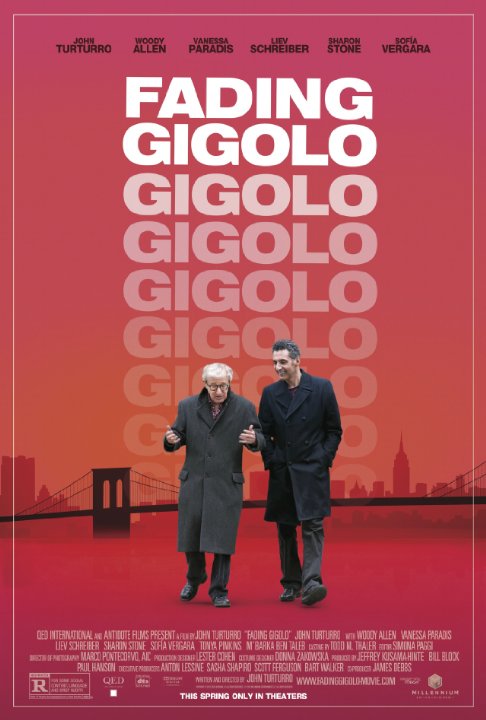
fading gigoloJohn Turturro may be the most versatile actor in films.  Who else has worked so often with such a wide range of directors, from the Coen brothers (“The Big Lebowski,” “Barton Fink,” “O Brother Where Art Thou?” and “Miller’s Crossing”) and Spike Lee (“Do the Right Thing,” “Jungle Fever,” “He Got Game”)  to Woody Allen (“Hannah and Her Sisters”), Adam Sandler, and the Transformer movies?

Turturro wrote, directed, and stars in “Fading Gigolo,” the story of a gentle florist named Fioravante who works part-time in a rare book store that is closing down.  The owner, played by Woody Allen, tells Fioravante he can sell his services as a sexual partner.  Soon Fioravante is being paid to have sex with a beautiful doctor (Sharon Stone) and other highly desirable ladies.  But his most intriguing customer is a young widow from the ultra-Orthodox Satmar community, played by Vanessa Paradis.

I spoke to Turturro about his music choices, his inspirations and influences, and the advice he got from Woody Allen.

I thought the music was so well chosen.  Where did it come from?

When I was writing it, I wrote to this one album,  Boss Tenor, with Gene Ammons playing, which I grew with and that’s the Canadian Sunset, the opening and closing song. So I wrote a lot of it to that and also to this album of this woman Dalida, she sings La Violetera which is a song that was used, I think in a Charlie Chaplin movie, “City Lights,” the one with the blind girl. it’s the Spanish song La Villa.

It’s an old famous Spanish song but she was born in Egypt and she was Italian but she sang mostly in French. She was a real popular singer. I didn’t know who she was and she’s an amazing singer and I fell in love with a lot of the songs while I was writing and I didn’t know always what songs, what they meant but once I liked the melody then I would look up the translation and the song I chose it was like all about, like a woman’s independence. And I played it over that. I had no idea and I would play it on the set, when Vanessa was walking down the street or when she wasn’t talking and because I wanted the crew and everybody to get in the spirit of it and people just loved it.

And it took me a long time to get it right too because it’s one thing getting the performance, it’s another thing to getting the rights, very complicated. But then once that became the template for the film I experimented with really Sephardic and Hassidic type of music but I just felt in the melting pot city it was just too didactic.

I did this musical documentary, Passione, about Naples and when they were releasing the album they gave me all this music in LA, all different kinds of music, and they gave me this big Dean Martin album, and I kept listening. I always loved Dean Martin but there’s a really Spanish influence in it somewhere in their version of it, of sway, and it just seemed to work really well over all this melting pot stuff with the Hassids and the people in my neighborhood.

So I like music that kind of invites you in and brings you into a world and kind of put into a certain mood but is not didactic or saccharine or tells you how to feel. And most movie music is like that. I have a couple of tiny cues. There’s one Neapolitan song Tesino Casagrande that you hear a couple of the strands in the park scene and then when we’re on the phone. And then Vanessa learned the song, Neapolitan, and it’s a beautiful love song, “you know do you realize what a great thing you are,” and it says “just one time tell me once that you feel the way that I feel” and all that stuff. And so that was a song I didn’t use and I loved it and Vanessa liked it and then she wound up doing it a cappella and then she did her own version for her album which has come out in France called Love Songs. So it was a combination but those things are part of the DNA of the film, completely.

Do you listen to different kinds of music as you work on different projects?

Yes, absolutely, I tried classical things, I tried things that were right on. There’s Trombone Shorty who is really cool group. When I played that I thought, “Wow, this would be a really great one!” You know he goes to Williamsburg because it’s a collection of cultures anyway and New York and most big cities are a collision of cultures. You ride around the park and you see the world and sometimes the world doesn’t interact and sometimes it does and I thought it be nice to see how, usually there’s certain things in movies but there’s either movies of the white world and the black world or Hassidic world and it’s nice to see the secular and religious and all that stuff togethr. Just as far as the setting goes, as a setting, if you’re gonna sit it there than that’s what you could take advantage of.

The costumes are also very well chosen to help us understand these characters, especially the Satmar policeman.

The costume designer is Donna Zakowska. I used to be roommates with her at Yale and also we shared a workspace together. And my mom used to make dresses all the time and so I grew up with a dressmaker and I used to help her cut the patterns, I use to model the dresses for her and I was really skinny and I was really tall and my father didn’t like that so much. But that’s all specific like there’s a lot of stripes in the Hasidic community and so then we decided that I would wear stripes too. You know in the flower shop.

One of the reasons I chose the Satmar was because I like their aesthetic. I like their hats better than the Lubavitcher which are the Borsalino. And then I spent a couple of years doing research about all their police forces. I met with people not from the Satmar community more from the Lubavitcher community but I met people from the Satmar community that had left. I went to a place called, I forgot the name, it’s a dish that you make. And that’s what it’s called, it’s like a potluck thing, it’s a lot of different elements. There are all these people who had left and they all come together and they share and they talk. So I met people that had left. I try to be respectful because there are people in the community who are happy and there are people aren’t so I just thought in a movie about sex you have to have religion.

Many woman, great actresses or actresses throughout the years have made a name playing a prostitute from 1930s. This is the role they get. Or a nun.

I’ve always liked movies about religion because it’s all the about suppression and it’s actually quite alike sometimes Originally I wanted to have a nun also in there. Like “Black Narcissus,” from Powell and Pressburger. I just saw their The Life and Death of Colonel Blimp, the best movie I saw all year, by far.

So those are just influences. And when I first was writing it Woody said, “That’s interesting, you should really look into that and read Isaac Bashevis Singer?” And I said, “I’ll read some of those.” They’re fantastic! I have a friend who has a rare bookstore, who that was the inspiration and he was the one owned that business and he was Woody’s age. And so turned me on and he was actually a lot more pointed. That scene was much longer but I cut it down to where he said, “You know, my grandfather opened it, my father ran it, now I close it.”

That says it all.

And life goes on. You know it’s very touching and you know those things are going away. So I try to set it in these places that have a sense of something real, something that’s gonna have like a human comedy is gonna to come out of it. But I just got interested in it and I found it to be a really potent exploration.  A lot of times there are wonderful films made about that world what they don’t intermingle with the secular world. And this girl that I met she actually looked like Vanessa and they really bonded, I don’t know they just bonded.

That first scene with Sharon Stone — it would be so easy to make that awkward and to make fun of either one of them, but it was really respectful of them and when they danced together, really sweet, tender.

I think the idea is that these people in our age range, okay, you put them in a movie, and usually it is a situation where they are the mother or the father or whatever. But here is a situation there are men like the guy I played who never had kids, they had never married, maybe they lived with someone for a year or whatever. I know plenty of people like that or people who are divorced or people who have lost someone and so you start again. And so with that situation is, they are in a high school situation. She doesn’t know how to do it, he doesn’t really know how to do it

You have to start again. People do that all the time. Now you put the metaphor of them paying for it. Some people do that because they think, “I don’t want to get involved. I just want to go and have the massage, get it over with and I’ll feel better.” Or, “I want to do something without having to go through all the machinations of that.”

And so I would try to do that again and with the Satmar girl. She has never been in that situation you know, she won’t shake hands and yet she lies on the massage table. I thought it would be interesting to put the characters in that situation because once you hit 50 or approaching 50 or before or over, you’re starting to look at your life in different ways and a lot of times you have to reinvent yourself. I could have written like 10 hours on this subject really because I did all kinds of drafts of different things, and  trying to figure it out and get Woody to be comfortable with it and for me to become comfortable with it. But I realized it was very rich because people, you are always in that state to stay alive; well what are you going to do, say it is over?

So this whole thing about this oldest profession, I know there is a real exploitative dark side. I really wasn’t that interested in that for this particular film but I did say there is a transaction that goes, that happens and I talked to a bunch of sex workers and they say, “Hey, sometimes you feel like you are going to help somebody. I am like a therapist and I have to perform but then people get dependent on you or whatever, there are good things that happen too.”

You have been an actor directed by Woody Allen and now you are directing him as an actor. What was that like?

Woody helped me. He said, “don’t go for the broad humor.” Because my initial script was much broader and more sexual and he said, “I think the more sophisticated you could be, the stronger I think it could be.” And first I thought about maybe they were in the business, they were trying to get out and then he suggested, “why don’t you start from the beginning? Try that and see.” And he gave me some very good, brutal but strong, very direct criticism and I would listen to it and I would say even if I didn’t like it I would think about it and then I would go back; let me try this and let me try that. And he encouraged me to develop the woman character and so did my son when he read the first draft. That’s something that we haven’t really seen in a movie that straddles both worlds. When I sold the movie, I just said listen, the Satmar woman is a metaphor for any woman because you know, women are always surrounded by restrictions. Maybe because I have a good relationship with my wife, or maybe because I had a good relationship with my mother, I like listening and I find it really interesting because that shaped my life. And I know there is all these men walking around saying well, “I’m in charge” and this and that so that interest me but to make a movie like this, you know I had to protect that in a way.

I was holding my breath hoping that it was not going to be disrespectful of the religious community. And it’s quite the contrary.

It’s a metaphor, it has to work like a metaphor for other communities, other religions or people. When you have a woman with all these men deciding for and about her her, once we actually saw that, you realize that, wow. Then we took a lot of comedy things because we saw that we have to have a balance and that’s the point of the movie: Everybody’s lonely, everyone needs a gentle touch or someone to listen to them or see them or whatever and you know to me that’s worth doing the whole movie for.

To me it was really a movie about touch.

That’s what the movie’s about; it’s about the need for touch.

Related Tags:


Actors Interview

Interview: Charles Humbard of UPTV on “The Passion of the Christ”

Posted on April 10, 2014 at 12:09 pm

Charles “Charley” Humbard, Founder, President and Chief Executive Officer of UP, is a 32-year entertainment industry veteran.  Since the network’s inception, he has led the channel’s overall business strategy and growth and maintained the network’s mission to uplift, inspire and entertain viewers through quality entertainment programming.  Launched as the Gospel Music Channel and later known as GMC TV, the network changed its name to UP on June 1, 2013 to better reflect its programming mission of Uplifting Entertainment.
Son of the country’s first television minister, Charley Humbard began his career writing music, performing and producing gospel music for Rex Humbard Worldwide Ministries. Today, Mr. Humbard continues to be committed to bringing uplifting family values entertainment to viewers across America through UP.  He took time to talk with me about UP’s Holy Week programming, especially the first network television showing of Mel Gibson’s “The Passion of the Christ.”

Will this very intense and involving film work well on television?

It is an intense and involving experience. I really believe “The Passion” is most of all a love story, really a love story of a son for his heavenly father and a mother for the support of her son. It is a depiction of what was probably the worst thing that could happen to human being — crucifixion. I mean the Romans did that for a reason, right? It wasn’t the easiest way to kill you but it was definitely a way to make others pay attention. And try to dissuade them from doing things the Romans didn’t want them to do.

So the movie has a lot of very difficult, very tough and challenging scenes. But for all audience and for people out there who really understand the Easter story and try to live their lives and follow the teachings that comes from Christ and from the Easter story, who really feel like it, it is such a powerful movie that can move hearts.

It’s also an opportunity for people to invite other people to church.  I really believe this is a moment when you can invite maybe a non-believer to watch and really, I think move their heart in a good place. I think the movie is very powerful that way and as you look back ten years ago when it came out and after some $616 million in the box office, the biggest independent film ever made. People weren’t going to watch just because somebody in it got crucified. People went to that movie because of the real story it tells and the impact it has on peoples’ lives to truly understand the depth and the importance of that story.

So for us I think it’s a perfect way. We like to say that “Easter lives here.”  It’s our way of saying to our viewers and others that we get Easter just like we do Christmas in a way you really want to celebrate it. We understand what Easter is really about. It’s kind of a little secret handshake in a way that say it lives here right? So I think this is the perfect movie to be one of the pillars of the entire two weeks. We are on this on Palm Sunday right in the middle of  the two week Easter celebration of one of the biggest Bible movies ever.  Every night a good Bible story is on, and  it would be remiss almost not to have “The Passion of the Christ,” right? 

Are you going to be showing it with limited interruptions?  Are you editing it at all?

We’re showing it with limited commercial interruptions.  The guidelines on how this movie is allowed to be aired is really set by Mel and the distributor. And they have very specific guidelines for us on how many commercial breaks they will allow us to air. We didn’t want to do it with a lot anyhow so it kinda fit beautifully, I think there’s only four breaks in the entire two hours so that fit very well with how we would have desired to have it.  And they also will not allow you to edit past the re-edit they did, so the second edit Mel Gibson had done back when he first released the movie to make it more appropriate for a television audience is the version we are airing.

What are some of the other movies that you are going to be showing during this week?

All week, two weeks really, beginning the week before “Passion” and going all the way through Easter, we’ve got the greatest stories of the Bible: “Peter and Paul,” “Solomon,” “The Story of David,” “Barabbas,” “Jeremiah,” “The story of Ruth,” “The 10 Commandments,” “The Book of Ruth,” “Esther,” – it’s just like mega Bible movie mania! “The Greatest Story Ever Told,” “The Passion of the Christ,” “Mary, Mother of Jesus,” “The Story of Jacob and Joseph,” “Judas,” “King of Kings,” and “Jesus,” which was a great miniseries and our highest rated ever on our network that was aired last year for Easter.  Also “The Robe,” “Demetrius,” “The Gladiators,” “The Apostle Peter,” and “The Last Supper.”

Is there a Bible story that has not been made into a movie that you would like to see?

I have never really thought about it at that angle. We in the past have traditionally made these types of movies, these are movies we acquire. The movies we make a more modern and contemporary in theme. Though next year, in 2015 we’ve partnered with the BBC and we are creating “Noah.”  So that will of course be a real Bible movie. We were kind of timely with Noah coming out this year as a theatrical release.

How do you see your audience? Do you see your audience as believers? 

Here’s what we know from research. Our research tells us that faith is very important to our viewers. Our viewers, people who watch us today, faith is an important part of their lives and how that faith plays out in their values and therefore their entertainment choices. That we know. We know our audience, from the recent Nielsen research, is the audience that believes those things and is seeking programming like ours is in excess of 42 million. So that’s a substantial… It’s a huge audience. As a matter of fact, in the three groups that Nielsen identified, they are the largest group, bigger than the reality seekers, bigger than what I would like to call my “Breaking Bad” audience out there that is kind of anti-this kind of programming. I think that shows in the success of our growth and distribution and also in the continued ratings growth, quarter after quarter year after year. So we know our audience is seeking programming that aligns with their faith and values right. But is also seeking programming that affirms and inspires those values. So we do know that our audience is a more faithful audience but the thing that’s nice about the programs that we would like to use and maybe the movie “The Blind Side” as a good example, what’s nice about the movies we make; even if you are not someone who is practicing faith in your life every day, who doesn’t like a great inspirational story?

Related Tags:


Interview Television

Interview: Tom Allen on “The Passion of the Christ”

Posted on April 9, 2014 at 6:36 pm

The Passion of The Christ is making its commercial television debut on UP TV on Palm Sunday night, April 13, with limited commercial interruptions and edits approved by the producers.  I spoke to Tom Allen who worked closely with Mel Gibson on the distribution and marketing of the landmark film ten years ago and co-wrote A Guide to the Passion: 100 Questions About The Passion of The Christ, which became a million-selling NYT bestseller and served as the tip-of-the-spear of the film’s historic grassroots marketing campaign.  He said that the old Bible epics of the 40’s, 50’s, and 60’s, were followed by “such a dearth in the intervening decades,” but that “there is so much excitement, so much pressure building on the part of the faith community for serious Hollywood movies” that explore the Bible.  What made “The Passion of the Christ” possible was the involvement of a major Hollywood figure, Mel Gibson.  While there were concerns about the violence, the portrayal of the Jews, and the use of Biblical-era Aramaic for the dialog.  But “the controversy added to what I contend was a condition of great excitement.  It broadened interest beyond the faith-based community to general audiences.” The language was “another brilliant choice, adding another element of authenticity.”

He is especially proud of the cinematography, “like a Caravaggio painting,” which also added to the film’s feeling of authenticity and reality, adding to the sense of the history and the teachings behind what was portrayed on screen.  Ten years after it was released, it “holds up very well.  It is the gold standard, and its influence has been significant.”  He is proud that it will be shown on UP TV during Holy Week.


Related Tags:


Interview

Interview: Amy Powers on the “Heathers” Musical

Posted on April 6, 2014 at 3:42 pm

Can it be possible that “Heathers,” the highly quotable ultimate mean girl story, was made 25 years ago? As Entertainment Weekly dishes with the actors and filmmakers to mark its anniversary and The Atlantic’s Alan Zilberman considers its impact, a musical based on the movie has just opened off Broadway. I spoke to producer Amy Powers, a Harvard Law grad turned writer, lyricist, and theatrical producer, about the show, how she left law for show business, and how being a lawyer helps her do her job.

Who came up with the idea of “Heathers” as a musical?

That would be our visionary co-producer, Andy Cohen, President of the management and production company Grade A Entertainment. My husband (J. Todd Harris) and I met Andy through a philanthropic networking group for Jewish Los Angeles entertainment professionals,created by my great Harvard Law School friend Steve Price. We loved Andy’s idea… and Todd brought in Andy Fickman, our wonderful director. Andy took it to his Reefer Madness! Lyricist/bookwriter, Emmy winning showrunner Kevin Murphy… and we all courted Lawrence O’Keefe (Tony nominated for Legally Blonde, The Musical).

Is it still set in the 1980’s or is it updated to the era of texting and Snapchat?

It’s proudly faithful to its original 80’s setting. (Technologically, this is the equivalent of “once upon a time”… the better to underscore the universality of bullying, peer pressure and self doubt). So yes – there’s a VCR. A teacher passes out mimeographs of Heather Chandler’s suicide note. We even have corded telephones (remember those?).

Why does the extreme situation of “Heathers” feel so true to the experience of high school?

Because it pretty much is, emotionally. The social politics of high school often feel like life and death. Insecurity is the norm, boundary testing reflexive. Allegiances can feel like they are built on quicksand. People wish other people would just, well, die. As my husband says, very essence of successful drama takes a magnifying glass to reality, and that’s what HEATHERS does.

Who becomes a mean girl and what happens to them?

My personal opinion is that mean girls are born, not made. You’re either a Queen Bee or you’re not. To quote that veritable source, Wikipedia, “When a young virgin queen emerges… she will generally seek out rivals and attempt to kill them.” As a parent, I saw that happening in nursery school! Most mean girls are feared, worshipped, hated, …. and eventually left behind, as people grow up and there is life outside the hive. Nice girls win. Mean girls put away their stingers or become bitter, lonely old ladies.

What made you decide to leave law?

The Universe. First It smacked me upside the head (I got Chronic Fatigue Syndrome literally a month after joining the Real Estate Finance Department at White & Case). Then It kissed me on the lips (while recovering, I wrote my first song — about a paralegal, no less — and the rush was addictive). There’s a big difference between doing something because you can, and doing something because you must. It didn’t feel like a decision — it felt like a mandate.

How does your background as a lawyer help you as a producer? As a writer?

Well, it certainly is a boon in understanding and navigating the nuts and bolts of the rights situation, and all of the agreements (investor, theater, creative). And, as every single issue in producing theater is a negotiation, I still utilize the skills learned during my HLS class with Roger Fisher (Getting to Yes: Negotiating Agreement Without Giving In).

As far as songwriting goes, my legal background was actually a challenge. I actually spent my first 5 years “unlearning” how to “think like a lawyer”… to let go of logic and simply become a creative channel.

Which classic high school movie comes closest to your own teenage years?

It hasn’t been written yet. I actually had a great time in high school (I know, I’m the only one). The worst thing that happened to me – moving and starting a new school in 10th grade – was actually the best, too, because I got to write my story over from scratch. When someone shoots the suburban ‘new kid’ story about the happy, sappy heroine who hangs with jocks and nerds alike, stars in the school show, writes her college application essays in limericl, and whose biggest claim to fame is as President of the Friday Afternoon Pseudo-Intellectual Elitist Wine Group (which serves Almaden), I’ll gladly watch.

What surprised you most about being a producer?

It’s only glamorous on Opening Night. Otherwise, it’s basically a daily deluge of decisions. Luckily, we’ve been working with a fantastic team of co-producers, including Scott Prisand (Rock Of Ages), Jamie Bendell (A Gentleman’s Guide To Love and Murder), Big Block Theatrical, and Stage Ventures (Rock of Ages, Million Dollar Quartet and more).

What was the best advice you got?

When a New York theater opens up, jump at it… even if you have no cast, no funds raised, and only four months to make everything happen!

What are you hoping the audience will see in this show?

Themselves… and everyone they knew.

Related Tags:


Interview Live Theater Writers

Interview: “Island Of Lemurs” Filmmakers

Posted on April 5, 2014 at 8:01 pm

I spoke with the humans behind the gorgeous new IMAX nature film, “Island of Lemurs 3D: Madagascar,” Drew Feldman (writer/producer), David Douglas (director/cinematographer), and Dr. Patricia Wright, about the challenges of making the film and the more daunting challenges of saving these precious creatures.

@ Warners
Copyright Warners

How do you get so close to the lemurs? What are some of the challenges that you face?

DD: We spent a lot of time scouting and looking for lemurs that would allow us to get somewhere near them.  We obviously picked the easiest ones we could find because our gear is big and heavy and it doesn’t take well to running after lemurs. So we found places where their movement was constricted by geological or geographical limits and that helped us to get closer to them and that often meant that we were working with the same lemurs scientists were studying.  Those lemurs had some experience with human beings already.

Patricia tell me a little bit about lemur families and the role of the females.

PW: There’s over 100 species of lemurs.  Each is a little bit different in their social structure except for one thing: they are all female dominant. The females are the leaders. They are the ones that call the shots.  When you watch a group, you can see the females are the first one to say “We’re going to move.”  Then she moves off and everybody just follows. And they follow her into a fruit tree and then she starts to eat the best fruits available at the tops of the trees and the males are required to just wait outside the fruit tree until the females have eaten the best fruits and then the males are allowed in. And if they don’t obey the rule, well then they are reprimanded. Sometimes it’s a slap across the face. Sometimes it’s just a vocal sort of “Don’t do that.”  And sometimes they bite them.

What other kinds of animals are unique to Madagascar?

PW: We have carnivores that are all related to the mongoose family. And they are very special to Madagascar, found nowhere else. There’s or no cats or no dogs on Madagascar. So instead, these kind of weasel-like creatures that have evolved into these much bigger predators. And most of the birds are found nowhere else either.

What is the Malagasy community doing to support the lemurs?

PW: When I first got there which now is well over 20 years ago, the Malagasy sort of had no idea that lemurs were special. And we spent, not just me but the environmental movement, spent a lot of time developing a National Park Service. There wasn’t anything like that before.  We also train tourist guides and work on getting the people themselves to really value the extraordinary wildlife that they have.  We have a education team that goes out to talk to the local villagers. We have a health team that helps them get healthier than they are now and we basically visit and talk and have meetings with the village elders and they get some jobs. Because at the end of the day it’s economics isn’t it? So we have been training them as artisans. We have been training them as construction, teaching them computers. The local people have really enjoyed the fruits of having a national park in their backyard.

You have a background in anthropology as well as primatology so I guess that applies to your work with the humans as well as with the primates.

PW: My first job was actually as a social worker. And then later, I got my PhD in anthropology. And I’ve always been interested in humans as well as primates. We are all kind of have the same emotions, the same goals and lives really. But to me, when I first got to Madagascar I realized that the lemurs lives are very closely related to what the humans are doing; partially because they’ve got both looking for natural resources. And if we can make some way that both humans and lemurs can live together peaceably and happily, that would be my goal for Madagascar.

Drew, tell me a little bit about how you first came to be interested in lemurs. 

DF: I’ve always been fascinated about Madagascar but to be honest I never really knew that much of lemurs growing up. Maybe they are just overshadowed by monkeys and apes and they’ve never really had their moment in the sun. And right after Dave and I finished Born to Be Wild I had a chance to meet Pat kind of by coincidence at some party. And after I heard her stories about lemurs, Dave cornered her and was like, “we’ve got to make a movie about Madagascar and lemurs.”

So, she invited us out and we went and she took us all around Madagascar for a month and showed us how extraordinary, fascinating, and just adorable lemurs were.

I was so struck by the eyes of these lemurs.  How do you capture that on screen?

DD: And it’s every color. The project that didn’t get done on this movie was that I wanted to do was a poster that was just pairs of eyes of those lemurs because there’s red, gold eyes and green eyes and blue eyes and every shade of in between. Crazy! Jewels! And yeah, just marvelous! So expressive also and of course because of the way they get around, they really need highly evolved stereo vision because they need very good depth perception to go blasting through the trees the way they do. They leap for long distances and actually get where they thought they were going to go. So they have a very, very well developed sight sense for sure as well as being pretty exotic and beautiful to look at in the eye department.

You had a big transition in technology between the last film and this one.  How did that affect the filming?

DD: This is a big thing. There’s three minutes in an IMAX film magazine but we’ve now transitioned to digital.  It makes an enormous difference; especially in 3-D because a 3-D film camera is almost a 300 pound instrument.  Two cameras built into one, enormous cost and weight and everything and in ways everything and noise. But now we’ve come up with a camera which is about 50, 55 pounds. So that’s like our old 2-D film camera and it’s a new kind of 3-D actually. We could put it on our backs and carry it down into the jungle as a single unit and put it onto a tripod and use it in a way that seems familiar.  The other thing that it has is the capacity to not run out of film.  When you’re working with wildlife, that’s a really good thing. The likelihood is if they do it and are pointed that direction, you’re going to get it. And that lets you plan for things and it also lets the crew relax. One of the things that I notice is that when the crew is all working, the crew is tensed up hoping an animal is going to do something in the near future that you want. Everybody gets a bit tense because once you can that big camera on, you’re basically spending a thousand bucks a minute as that camera is running and hoping that before three minutes, before $3000 goes by, that they did something that you like and they somehow ignored that floundering machine that you are standing with.  And not while you are changing magazines, which is the normal time for them to do things.

Drew, how do you go about imposing a narrative on this story?

DF: David and I spent a lot of time talking about that. Our first trip to Madagascar, I remember at the very end, we had some pretty interesting conversations about the just trying to piece together what this story is like about at its core; because obviously it’s about lemurs and the lemurs are amazing and all that but we are trying to make films that aren’t necessarily straight wildlife films that are more cinematic that have a sort of real cinema story to it. The thing we kept coming back to, really the defining characteristic of the lemur story is that they are really these accidental creatures in a sense. They came to Madagascar by accident. They found this Garden of Eden with no snakes and no apples and they flourished there for 40 million years before predators showed up.  It’s kind of this alternate reality of what happens, primate development in Africa. And the danger has finally reached them. All the troubles in the world after millions and millions and millions and millions of years have finally reaches their shores. And how are they dealing with that? And how are we going to deal with that? 

What have we learned about humans from studying lemurs?

PW: We have learned a lot of things. First of all, being primates, they live very long, maybe 30, 35 years in the wild.  So we begin to look at old age, what is old age in the wild? Does it slow them down? Are the older ones out-of-favor? Are they good grandmothers?  It was very charming to see they have great respect for their elders.  They don’t cast them aside. So that’s good and we’ve learned a lot about different kinds of social systems because some of that lemurs are monogamous pairs and others are kind of groups of males and females in one group. And we’ve learned about parent-offspring conflict and growing up.

Lemurs are good parents but they do it in different ways. I originally studied father care. I was very interested in that and we saw that a lot of these animals that lived in pairs and the father wasn’t doing anything at all for the first month. But then suddenly, when the baby got to be a certain weight then the dads chipped in and started carrying the babies which was very nice. And then if there was twins or triplets then they helped, so that’s definitely true.  The black and white lemur, the one that relaxes on that branch, they actually have day care, like kindergartens; where all the mothers come together and they put all the babies into this one nest and they let dad watch it while they go out and have food and have a good time and then they come back in a few hours.  We’ve never seen that in other primates. This is the first time it’s been described so that’s major news.

Anybody who sees this movie is going to be utterly enchanted by the dancing.

PW: Lemurs are extraordinarily leapers. I mean they are just really going from tree to tree and then if there is not a tree, they just come down to the ground very gracefully.  But it is the music that makes them seem to be dancing.  They are basically getting from one place to another and that’s just natural for them. They are just natural acrobatic dancers, just the way they move. It’s beautiful!

DF: Music choices are totally fun and we certainly threw a lot of choices up against that to see what stuck. I mean we went through James Brown and all sorts of things. I remember asking one of the researchers in Madagascar who works with (19:45 inaudible), “what type of music do you think they would dance to?” She was like, “Jazz, they would dance to jazz.”

Related Tags:


Animals and Nature Behind the Scenes Documentary Interview
THE MOVIE MOM® is a registered trademark of Nell Minow. Use of the mark without express consent from Nell Minow constitutes trademark infringement and unfair competition in violation of federal and state laws. All material © Nell Minow 1995-2026, all rights reserved, and no use or republication is permitted without explicit permission. This site hosts Nell Minow’s Movie Mom® archive, with material that originally appeared on Yahoo! Movies, Beliefnet, and other sources. Much of her new material can be found at Rogerebert.com, Huffington Post, and WheretoWatch. Her books include The Movie Mom’s Guide to Family Movies and 101 Must-See Movie Moments, and she can be heard each week on radio stations across the country.

Website Designed by Max LaZebnik