Interview: Keke Palmer of ‘Joyful Noise’

Interview: Keke Palmer of ‘Joyful Noise’

Posted on January 10, 2012 at 8:00 am
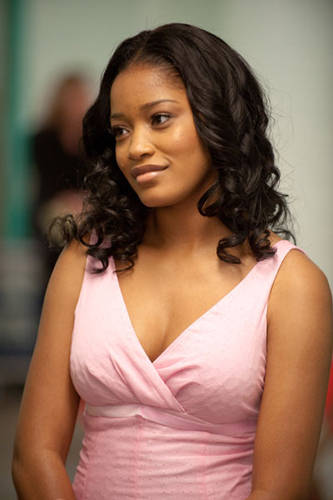
Keke Palmer has been one of my favorite young actors since Akeelah and the Bee.  She has a warm and relatable screen presence and a purely delightful personality with a lot of energy and enthusiasm.  That’s more than enough to build a career on.  But she also has extraordinary discipline and ability as an actor with remarkable range from the sitcom “True Jackson, V.P.” to appearing opposite Kevin Spacey in Shrink.  In “Joyful Noise” she co-stars with powerhouse performers Dolly Parton and Queen Latifah and more than holds her own.  She also sings, dances, and has a very sweet romance with Broadway star Jeremy Jordan.  Keke spoke to me about singing on screen for the first time and the lessons she learned from co-star and producer Queen Latifah.

I loved the movie!

Thank you so much — that means a lot!

You were terrific with Queen Latifah and Dolly Parton.  What did they teach you?

I learned a lot from them.  Working with Queen Latifah for the second time , I really got to understand how she creates this empire for herself.  The people who surround her now are the same team she’s been working with since high school.  So I learned from her that if you surround yourself with good people who want the same things you do, these are the kinds of things that you can do.  And from Dolly — just watching her kindness to everyone, her openness, not guarded at all, how she treated people.  She’s amazing!

Writer-director Todd Graff made his third film in a row about teenagers.  Does he have a particular understanding of that stage of life?

He is a very empathetic person.  He is very gifted in that way.  He can get inside people’s heads, not just teenagers, everyone.  The character Queen Latifah plays is so much like my mother!  He didn’t know my mother; he’s not a black woman; but he was able to create a character so genuinely, that people can relate to.  He can look at people and disect them and create them for the screen.  When I read the scene where my character’s mother tells her about what it is to be beautiful, I said to him, “This is brilliant!”

Was this your first time singing on screen?  How was that?

We recorded the music before we went to Atlanta.  We had to lip-sych, which is harder — I ended up blowing my voice out because I had to sing over me!

Why is gospel music so powerful?

It is the soul that’s put into gospel music and the passion the singers have behind it.  You can often tell the difference between a singer that grows up in the church and one that just can sing.  There’s a connection to love and support and care.  You feel good when you hear it.  You feel the people have so much conviction in what they’re singing.  They believe it so you believe it.  Not that you can’t find that in other music or other singers.  But a lot of the time when you see someone that makes you feel something when they sing, they will tell you they grew up in the church.

Tell me about working with your co-star Jeremy Jordan.

He’s an amazing singer and did a great job in the film, which was his first.  It’s hard being a Broadway actor going into film where you have to tone everything down.  In theater, everything you’re taught is to be big and broad and make everyone feel like they are right next to you even in the last row of seats.  In our conversations with Todd he would give us ideas and background about our characters and what they had when they knew each other before.

Do you have a favorite scene?

The scene with my character and her brother makes me cry every time.  When you’re down and out or suffering a disability or something has been taken away from you you can question things.  In order to pick it back up you have to realize as Queen Latifah says that God is like a parent.  We may not understand why we go through things but and there is a brighter and bigger lesson to see.  God wants us to overcome all of the obstacles.

What’s next?

I’m working on a movie called “Virgin Mary” with Abigail Breslin.  I’m also in “Ice Age 4: Continental Drift.”  And I have a television movie coming on Nickelodeon that I worked on with Nick Cannon.  I acted in it but I am more excited about being a producer!


Related Tags:


Actors Interview
Interview: Tom Shadyac on the DVD Release of ‘I Am’

Interview: Tom Shadyac on the DVD Release of ‘I Am’

Posted on January 2, 2012 at 12:03 pm

I spoke to Tom Shadyac last March about shifting from big Hollywood films like “Ace Ventura: Pet Detective” and “The Nutty Professor II” to a small and very personal documentary about just about everything called “I Am.”   Shadyac was one of the most successful directors in Hollywood when bicycle accident left him in terrible pain, physical and spiritual.  He began to think about the emptiness of his form of success and he began to study two questions: what’s wrong with our world, and what can we do to make it better?  He documented his own journey, including fascinating encounters with people who are questioning some of our most fundamental assumptions about the way we interact with each other and the universe, from cutting-edge scientists to people who study history, culture, and theology.

It’s my DVD Pick of the Week and I am delighted to have a copy to give away.  Send me an email at moviemom@moviemom.com with I AM in the subject line and don’t forget your address.  I’ll pick a winner at random on January 8.

Good to talk to you again!  Tell me what the reception to the film has been since we spoke in March.

We went on a little show called “The Oprah Winfrey Show” with her audience of 20 million.  So that changed the awareness of “I Am” and we began to get a lot of requests for seeing the film because it wasn’t available in every city.  We’re finally meeting that request with the release of the DVD on January 3.  She’s such a powerful voice in media and such a supporter of the film that we decided to have the broadcast debut on her network, OWN.  We’ve continued touring the country and doing Q&A’s and trying to start the conversation wherever we could.

What are some of the questions you get asked by people who have seen the film?

Are you crazy? That’s one I get asked a lot.  No, the most common questions are things like “What do your show business friends think of this?”  As though that’s an indictment!  What do you do when people don’t see what you see?  How do you change those people?  It’s not my job to change anyone.  It’s my job to share what I know and feel passionate about.  Are you a communist?  Are you a socialist?  Those are some of the questions I get asked.  Many people take exception because they think my ideas are utopian and not grounded in reality.  But I did a film about the ultimate reality.  I call it the ultimate reality show.

Have people brought their own stories to you?

Of course!  I hear all the time from people whose lives and perspectives are changed by the film.  Some meet the film by brain injury so they tell me they were suffering from something similar or some other life challenge physically.  I hear from people who are simplifying their life or stepping more into their passion, people who are leaving money for meaning.   There are also some schools creating curriculums around “I Am.”

That’s great!  I especially like exposing students to your integrated approach of looking at issues from the molecular level up to the cosmic level.

It’s all the same.  When I began to explore different disciplines I realized that the academics, the poets, the mystics, the scientists, the spiritualists are all saying the same thing, telling the same story.  Life is life.  Life shows up everywhere, science and poetry.  The truths that undergird life transcend all boundaries.

What are you reading now?

Thomas Merton‘s philosophy was that you can read every book or you can read a handful of books and become those books.  I continue to read the people who light up my soul are writers like Daniel Ladinsky’s translation of Hafiz and Rumi — Coleman Barks’ translation, Mary Oliver, Emerson, Rilke, I just hover in those worlds.  I do dust jacket reading on a lot of things but I keep going back to those.

And what about music?

I’m not the hippest cat in the room, but I love music.  One of my favorite parts of the movie business is scoring — it’s just an opportunity to add a beautiful piece of music to the world.  I even listen to what the young folks are listening to!

What was it like for you, after directing supremely confident performers like Jim Carrey and Eddie Murphy, to step in front of the camera for the first time — as yourself?

It was really awkward at first.  My 20-year history in show business had always been talking to that person in front of the camera.  But we worked so quickly, shooting and then editing, that it was surprising how quickly I could look at that long-haired freak in the film and see him as a character.  Not “I have to protect something here,” but let’s let him be flawed, be unsure, like any character.  Like Jim Carrey or Eddie Murphy minus the brilliant comedic gifts!

Last time we spoke, you talk about the pleasures of filming with a three-person crew.  How has that experience affected you as a director?

I have yet to direct again in the 200-person-crew world but it is very freeing to know you don’t need all the bells and whistles.  You can go out with a couple of people like in film school and do something that has dramatic, comedic, emotional value.  How we make movies in show business is very inflated.  One crew member can move a plant and one can water the plant and one can light the plant.  But when you’re a student the director is doing all of that.  It’s less weighted, more improvisational.

What’s next?

We’ll see.  Let some more people into the conversation.  I’m writing a book, I have a deal with Hay House, and I am deep into that, and we continue to pursue a talk show possibility.  And I’ve got a couple of film comedies and a drama we’re getting up off their feet.  I think a sequel will happen in one form or another, maybe through the book or the talk show rather than a movie.  Of course there were people I wanted to get to talk to that we did not get to include but I don’t think they would have revealed any essentially new or additional points.  But I wanted more color, more diversity, more feminine energy. I wanted to interview Arundhati Roy, author of The God of Small Things, Maya Angelou and Mary Oliver and Vandana Shiva and the Dalai Lama.  I tried to talk to all of them but for one reason or another they were not available at the time.  They are all people who have seen something and what they see parallels very closely what you see in the film.

What do you want families who see this film to talk about afterwards?

Every family will see it from where they are.  Maybe there’s a conversation about possessions, let’s think about where these toys come from, or finding a wealth in sharing, what it means to have enough.  Maybe a conversation about including the greater good in how we do business, about how the family includes all of life.  Love is not an idea but a force.  I don’t see it as okay but essential.  We’re getting there but we haven’t gotten there yet.

Related Tags:


Behind the Scenes Contests and Giveaways Directors Interview

Interview: Sarah McCarthy of ‘The Sound of Mumbai’

Posted on November 23, 2011 at 12:42 pm

The Sound of Mumbai,” premiering tonight on HBO2, is a touching documentary about the most unlikely of productions, a concert performance of “The Sound of Music” featuring the “slumdog” children of one of the poorest communities in India.  These children have so little contact with the world outside that they had to be shown a photograph of a mountain to understand what “Climb Ev’ry Mountain” was about.  But they thrilled to the music of Rodgers and Hammerstein and the opportunity to perform in front of an audience.  I spoke to director Sarah McCarthy about making the film and a young singer named Anish whose confidence and spirit are especially endearing.

Does everyone in the audience cry when they see this movie?

Lots of people do.  The sniffling in the theater when Ashish sings his solo, and then others hold out until the end.

It was interesting that the conductor was an Austrian.  It was a culture shock for him.  How did he feel about working with songs set in Austria but written by Americans, about a family that escaped from Austria?

He was invited because of the connection with “The Sound of Music” and he really didn’t know what to expect.  He was kind of overwhelmed by the whole experience of the slums and running around with Ashish and seeing how the kids live, about how they sleep on the floor and about how one of them was nearly sold for adoption and he couldn’t really believe it.  He’s talking about going back in a year or so.  It was an extraordinary and overwhelming experience for him.

I think Austrians have mixed feelings about the show, “The Sound of Music” because they were compliant with the Nazis.  The first production they have ever put on in Salzburg is going on at the moment.  For a long time they rejected it and it’s only now that the new generation is embracing what is, after all, the biggest musical of all time.

How did you come to this project?

My producer, Joe Walters, sometimes conducts the Bombay Chamber Orchestra and was always at me me to make a film about it and I thought that sounded really boring.  He sent me the announcements of the concerts they were doing and one was about children from the slums singing songs from “The Sound of Music.”  My ears really pricked up because I thought how strange to hear these iconic songs that make you think of mountains and green space and rivers sung by these kids — that audio/visual disconnect would be quite cool for your brain to try to make sense of.  Off we went to India and made a trailer and fell deeply and instantly in love with every one of the kids.  We came back to London to try to raise money, failed, and went back anyway, with the tiniest most ridiculous budget, running out of money on the shoot and working off of credit cards.  It wasn’t until we showed the film at the Toronto Film Festival and sold it to HBO that I could pay our cameraman.

What is your background?

I’m Australian and went to film school in Australia and then came to London and worked in development at the BBC and an independent channel.  I made a movie called “Murderers on the Dance Floor” about the 1500 inmates at the maximum security prison who performed to Michael Jackson’s “Thriller” and became an internet sensation.  The prison governor is really deranged.  They practiced 8 or 9 hours a day.  He also had them do Vanilla Ice’s “Ice Ice Baby!”  Then I made a film for the BBC about a 77-year-old “killer granny” who killed her husbands for the life insurance money. I’ve just come back from a month-long shoot in Russia and the US about an American family that adopted three Russian children.

How did Ashish become so confident?

It comes from his family unit.  He’s genetically engineered to be that way but his mom and dad and brothers and sister are very close-knit.  Those places can be dark and dangerous but they all live on top of one another and have to learn to be friends.  There’s a real community there and the kids thrive on that.  I was blown away by how socially sophisticated these kids were.  These kids have a close family but not a safe place to live or enough to eat.  The kids in my next film have had a safe place to live but no family ties or community.  Ashish’s school is also very encouraging, though they’re not academically rigorous.  It’s pretty tough to be on such minimal resources.  That is the biggest struggle for us.  We’re interested in using the film to further these kids’ education.  We’re working with the school to raise funds to put these kids through university but they also need to catch-up support to be able to do the work.  We talked about putting him in a different school but decided it would be too tough for him.  They don’t have the basics — a quiet place to study, a structured lesson plan, a desk.  You can have all the determination and commitment in the world and it is still really hard.

Ashish has moved to a better place.  He now lives in an apartment with a door that locks and a tap he shares only with about 30 people instead of 300.

How did you gain the trust of the kids so they could be so candid with you?

I have two younger brothers.  And I love kids.  I love hanging out with them.  Ashsish and I became friends very quickly and played a lot of games.  He almost became part of our crew.  I’m in touch with him all the time.  We Skype at the school principal’s office and I remind him not to show off and brag all the time.  But he remembers that concert very clearly.  He snuck into his neighbor’s apartment and watched it three times in a row.

HBO’s teachers guide is available for download.


Related Tags:


Directors Documentary Interview Television
Interview: Chris Juen of ‘Arthur Christmas’

Interview: Chris Juen of ‘Arthur Christmas’

Posted on November 23, 2011 at 8:00 am

It was a special treat to speak to Chris Juen of this week’s release, “Arthur Christmas,” because he also worked on one of my favorite animated films of the past few years, Surf’s Up, as well as the delightful Cloudy With a Chance of Meatballs.

What brought you to this project?

Sony and Ardman had a partnership and I could not pass up a chance to work with Ardman.  The story reel was super charming and you could tell right away the story was really solid.

The actors in this film are superb, especially Hugh Laurie as Santa’s super-efficient techno-wizard son, Steve.  How did you think about voice casting?

Casting is tricky.  So-and-so’s a great actor and then you put him next to a character and it doesn’t quite work.  We get a group of people we think will work and test them out against scratch models to get rouch performances to see if we can imagine that voice coming from that character.  When we find one we really like, we show them the test.  Hugh has such a distinct, great voice and it helps to get actors that Ardman is so beloved.

How did Justin Bieber get involved?

Justin Bieber is a late add, but with his Christmas album the timing was a great boost for the film and a great opportunity to show his video.

What is your role on the film?

I’m the co-producer so I worked for Sony pictures and am kind of the day to day operations guy.  I have about 15 years with Sony so I am pretty good at knowing how to build the digital pipeline, how to make a movie inside a computer.  We had a crew of about 450 to manage.

What makes Ardman (the people behind “Wallace & Gromit”) different?

They’re not afraid of having flawed characters.  They love very humanistic flaws.  People aren’t perfect.  We were trying to figure out how to get that Ardman quality into a CG film.  A lot of time in CG you make a perfect character.  A lot of time was spent making our characters imperfect.  So one side was offset a little bit or one side bigger than the other.  It doesn’t feel like it’s clay, but it feels real.  I think they do that not only in design but in character.  The characters in this movie are very rich.

I loved Mrs. Santa because she kept surprising you.

I wish she had more screen time!  She’s the magic behind the magic.

What was the most difficult technical challenge you had on this film?

I think it was the elves.  The director wanted a lot of diversity and a lot of options to make it look large scale, millions of elves.  There was a logic to it, with the different kinds of elves, their costumes and assignments.  It’s what we call a variation pipeline and it was unbelievable.

You have a real commitment to family movies.  Where does that come from?

I was lucky enough to work on “The Polar Express” when I was working in visual effects and it was my first chance to work on a whole story.  I just loved that process.  It’s a more creative process than just visual effects.  And it’s amazing what having your own children will do.  I want to make films I can take my daughters to see and be proud and have them get something out of them.

What should parents know about this film?

It’s a family movie about families, about characters people will relate to because they’re in they’re own families.  And a reminder not to get too wrapped up –

Literally!

(laughs), that’s right, not get too wrapped up literally or otherwise in the hustle and bustle of the holidays, just do what’s right and spend time with family.


Related Tags:


Interview
Interview: Punk Rock Parenting with the Moms Behind ‘The Other F Word’

Interview: Punk Rock Parenting with the Moms Behind ‘The Other F Word’

Posted on November 10, 2011 at 8:00 am

Copyright Oscilloscope 2013
One of my favorite documentaries of the year is “The Other F Word,” a film about what could be called Extreme Parenting.   It is the story of punk rockers and other men who have made careers out of rebellion and outrageous behavior and the way they cope with the challenges of fatherhood.  I spoke with the two women who made the film, writer-director Andrea Blaugrund and producer Cristan Reilly, two mothers who told me that what drew them to the project was the way it illuminated the adjustments that everyone makes to parenthood.

The heart of the movie is Jim Lindberg, lead singer of the punk band Pennywise, and author of Punk Rock Dad: No Rules, Just Real Life.  Reilly said, “I grew up knowing Jim in high school.  We were friends but lost touch.  I heard he had written this book and knew I had to read it.  I read and loved the book, and thought it would be an amazing documentary and Jim needs to be in it.  I gave it to Andrea because we have the same world view and laugh at the same things.  She called me back and said, ‘I’m in.’  I  dragged her out of her semi-retirement.”  Reilly told me that, “We made this on a shoestring, did a whole DIY.  Some people offered money but we didn’t want anyone else weighing in.”  A large part of the small budget went for the rights to the punk songs on the soundtrack.   Blaudrund said, “There were 44 sides we needed to clear of music, over a third of the budget, but we had to have it.”  The use of the songs was more than background.  The content of the film reframes them.  “It is such an opportunity to listen to these songs you have one opinion of and hear them a different way.”  They told me about a 15-year-old punk fan who went to the film with her mother and said she heard the Everclear song “Father of Mine” in an entirely new way because the movie made its wistfulness come through.

Reilly has 13 year old twin boys and a 7-year-old and Blaugrund’s children are 12, 9, and 6. They made the movie while juggling carpools and play dates, just like the punk dads in the movie.  It is Reilly’s first film but Blaugrund said, “She learned how to be super-efficient by being the mother of twin boys.  I had worked at ABC news and NPR and written for newspapers and the documentary unit for Peter Jennings and made a short that got an Oscar nomination.  There was something about that accolade that gave me permission to hang up my hat for a couple of years.”  Blaugrund added, “I was being super-mom and was making babies and dealing with schools, but when Cristan brought this to me my youngest was starting pre-school and what better way to come out of my supermomness than  a movie about parenthood?”  They knew very little about the punk world but did a lot of research and insisted on a cinematographer/editor who was a punk fan and who could give the film a genuine punk energy and vitality.

And yet, the core appeal is from the universal themes.  “They’re coming from so far on the other side.” said Reilly.  “We all go through this of course, if you look at it from the most extreme you can get the largest swath and you can relate to the most people.”  Blaugrund said, “One of the greatest surprises about this whole process for us is how many different types of people it’s touched.  Lawyers and accountants tell us ‘this was my favorite band growing up,’ or ‘you’ve awakened the sleeping punk in me’ and even people who can’t relate to punk at all, especially men who say, ‘These are the guys I used to try to avoid, but dude, I get exactly what uyou’re going through, let me buy you a drink.’  There are so many things people can relate to with their own parents and their children.  We get to see plenty of bad examples of fatherhood, but here’s something in the more positive column.”

The charm of the film is the way it breaks down stereotypes, and it is enormously fun to see a guy with tattoos tenderly singing “The Wheels on the Bus” to a child in a car seat or Lindberg packing to go on tour and explaining he only has room for one Barbie in his suitcase.  But what is moving about the film is the way these men speak of having no fathers of their own.  They are, in Blaugrund’s words, “creating their own templates and trying to figure it out.”

I wondered if it was hard to get the men to speak candidly about how transforming fatherhood was for them.  Reilly told me that, “Andrea was asking them questions they don’t normally get asked. ‘You don’t want to talk about my bass player?’  Falling down this rabbit hole we could ask whatever we wanted; there was no sacred ground.  It was a whole different side of their personalities and they were glad to show it.”

The film is open in New York and LA and expanding around the country.


Related Tags:


Directors Interview
THE MOVIE MOM® is a registered trademark of Nell Minow. Use of the mark without express consent from Nell Minow constitutes trademark infringement and unfair competition in violation of federal and state laws. All material © Nell Minow 1995-2026, all rights reserved, and no use or republication is permitted without explicit permission. This site hosts Nell Minow’s Movie Mom® archive, with material that originally appeared on Yahoo! Movies, Beliefnet, and other sources. Much of her new material can be found at Rogerebert.com, Huffington Post, and WheretoWatch. Her books include The Movie Mom’s Guide to Family Movies and 101 Must-See Movie Moments, and she can be heard each week on radio stations across the country.

Website Designed by Max LaZebnik