Interview: Sam Childers, the ‘Machine Gun Preacher’

Interview: Sam Childers, the ‘Machine Gun Preacher’

Posted on September 23, 2011 at 8:00 am

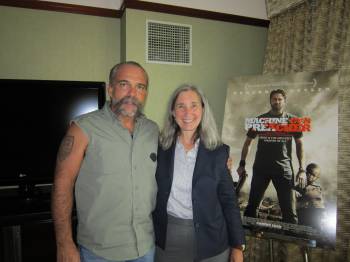
Sam Childers is the “Machine Gun Preacher” who inspired a movie by that name, starring Gerard Butler.  His book, Another Man’s War: The True Story of One Man’s Battle to Save Children in the Sudan tells the story of his journey from biker to builder to preacher to protector of African children.

What have you learned about people’s reactions to the movie?

We’ve had over a thousand people email us or Facebook us or call our office because they’ve seen the movie.  The message is coming across what we were hoping would happen.  They’re going to the movie because of Gerard Butler or because it’s the true story of Sam Childers.  But it turns out the movie is about them. That is the ultimate thing I was wanting to see.  It’s making them think, “What am I doing?”  It’s motivating people that might have never done anything in life to save children, not just children in Africa but children around the world.  I think people will be inspired to walk away from habits and addictions and even people that don’t have addictions are going to want to end up doing something good in life.  Thousands of children will be rescued around the world by people who have seen this movie.
How do you keep yourself from being spiritually exhausted by the devastation in this tragic place?

I believe that the average American when we look at what’s going on in Africa will say there is no way we can fix the problem so we do nothing.  We have a serious drug problem in America but I won’t allow people to sell hard drugs in my home town.  I will shut them down.  If we say to ourself “there’s nothing we can do” it keeps growing and growing.  But even if you manage to do something small, you’ve done something.  Even the smallest thing can change someone’s life.  I always encourage people — don’t look how big the problem is.  Look at the little thing you can do on your own.

I started out doing something little.  I went to Africa to spend five weeks putting roofs on a building.  I seen the small child that stepped on a land mine.  Three months later I’m back helping pull the land mines out.  Little things just kept getting bigger and bigger and bigger.  And now look, there’s a movie!

I tell people all the time, don’t give up.  We get almost to our blessing, whether you believe spiritually in God or in a good force and an evil force.  We get almost to our blessing and we quit.  Don’t stop.

Do you have a favorite Bible verse?

James Chapter 4, verse 17.  If you know you should do something and not do it, then you’ve sinned.  I use it a lot.

How do you divide your time?

I spend about seven months of the year overseas and the rest of the time on the road.  God has given us the opportunity to speak to bigger and bigger — I don’t like to say audiences or congregations, but the crowds are getting bigger.  And we’ve had over 15,000 people make life commitments.  I don’t like to consider myself a normal preacher.  When you look at religious people, they’re the ones who hung Christ from the cross.  I look at myself as a man carrying a message of hope.  I don’t care who you are, if you don’t have any addictions you still want to hear your message of hope.  And if you do have addictions, you need to hear that message.

The movie indicates that you had some rough times and got in trouble before finding your way.

That’s Hollywood’s way of amping something up.  I was in jail, not prison.  Did they give me a uniform?  Yeah they did.  My dad was really a hard person and if was ever to rob somebody, oh, man, he couldn’t handle that.  All the times I was in jail it was for fighting.  And robbing drug dealers, I done that.  I thank God that I’m alive to this day.

In the movie, there is some conflict with your family about money.

My family did suffer but they never went without.  The more we get, the more we want, the more we want the more we think we deserve.  If you would come and see the simple home I live in you would see I am not in this thing for money.  I got paid less than $45,000 last year.  I could pay myself more but it would mean less money would go where it is needed.

What made you decide to trust someone to make a movie about you?

After we were on Dateline we got so many hits it crashed our website.  We got over 300 offers for books and movies and documentaries.  I wasn’t even thinking about that.  I was scared.  I didn’t want it and tried to stay away from it.  But a lady convinced me to put my story in a book, and the book has saved thousands of lives, even people who were going to commit suicide.  The movie only shows you a small fraction of who Sam Childers was, how awful a person I was.  No sooner than the book was done but it wasn’t published yet.  It went to a ghost-writer and he said, “I can’t change the way this guy talks.”  So he just put it in chapters.  Then I met Jason Keller and I put him to the test.  I was hard on him.  My life is all about what Christ has done for me, but that’s too much Christ to write for Hollywood.  I told him, “Then I’ll die with the story.”  So he done his best to keep what was in it, in it.

How many kids are you caring for now?

I have 179 children that I take care of full-time, close to 40 in Uganda and the rest in Sudan.  They’re coming close to university age now and the better schools are in Uganda.  My biggest problem now is school fees.  I have the only library in Sudan.  It has videos, DVDs, computers, and we’re just starting to finish a school we built off the compound, to be given to the community.  The children have been amazing.  It’s been a hard road for them as you can see in the movie.  The children even down to this day have a lot of trust with me.  There hasn’t been any killing around the orphanage in two years but when it was bad they would just come and hang me me, as I’d walk around with my gun at my side.   Sudan got their independence but they have no infrastructure.  If anything happens and fighting breaks out again, they will bring the kids to us to care for.  And we now have places for children in Ethiopia, too.

What do they want to do when they grow up?

Doctor, pilot, woodworker.  It’s amazing what you’ll hear them say.


Related Tags:


Interview
Interview: Jason Keller of ‘Machine Gun Preacher’

Interview: Jason Keller of ‘Machine Gun Preacher’

Posted on September 22, 2011 at 3:56 pm

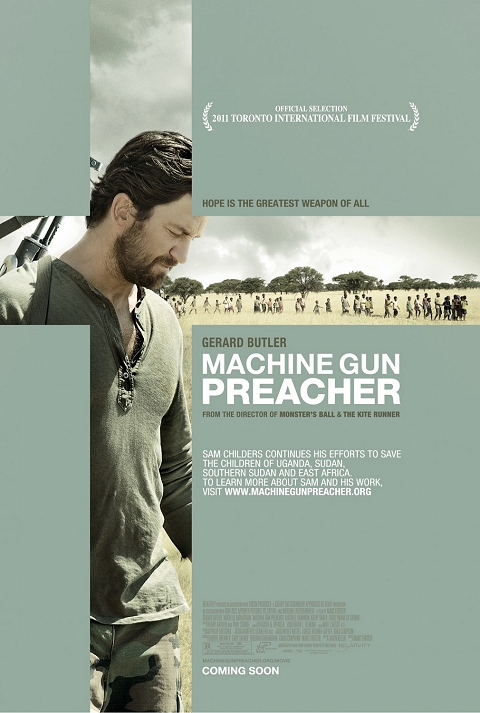
Jason Keller wrote the screenplay for “Machine Gun Preacher,” based on the true story of Sam Childers, whose book, Another Man’s War: The True Story of One Man’s Battle to Save Children in the Sudan, tells the story of his journey from biker to preacher to fighting to protect the children of Sudan and Uganda from genocide.
How did you get involved in this project?

Almost four years ago one of the producers called me and said, “I just heard the most amazing story.”  Sam was coming to Los Angeles so we met.  I didn’t know if I wanted to do the movie at first, as electrifying as the story was.  What the story let me to was Central Africa and I wanted to drill down and understand what the LRA is and about the child soldiers, and I couldn’t not write the movie.

That is such a large, overwhelming topic — how do you create a movie script out of that?  How do you decide what to leave out?

I didn’t want to write a political movie.  That wasn’t what touched me as I started to learn about Sam’s life and Central Africa.  I think of myself as fairly well-informed.  I read the newspaper, I’m constantly watching the news, I always challenge myself to learn about things that are not easy to learn about.  And here was a part of the world I thought I knew and as I got deeper into it there was an emotional response to what I was learning.  Innocent civilians being slaughtered and no one was doing anything about it.  I wanted to do a movie that would make people inspired, even angry, but not clutter it with politics.

What I’m proud of is that it isn’t so neat and tidy about Sam or about Central Africa.  There are no easy answers.  Sam’s not a great guy, even now.  It’s not a story of a bad guy turned good guy.  It’s about a human being who decided to make different choices, but he’s still flawed.  He’s still violent.  He’s still intimidating.  He’s still making mistakes.  It’s that messiness I responded to as a fellow human being.

You had quite a challenge with making this a movie that will appeal to a mainstream audience.  You have a religious conversion and you have problems in Africa.  How do you make those accessible to a wide audience?

Both of those issues are scary for Hollywood and to some degree to audiences.  We didn’t avoid those issues but we told a story that didn’t try to tell you what was right or wrong.  I didn’t take this project on to defend the way Sam does things.  Do you agree with him?  Let’s talk about it.  You might disagree with the religious components of this movie but let’s talk about it.  Let’s spark a conversation.  That’s the only way that we’re going to stay vigilant about these issues that are so vital.

Gerard Butler gives an extraordinary performance.

He has the physical presence for the role and like Sam he comes from a tough background, was going down a bad path early in his life.  He’s a perfect fit.

You lived with the family for a while in Pennsylvania.  What was that like?

It was crazy.  Every time he’d come to LA, we would meet.  As I was being pulled deeper and deeper into the story I realized I needed to go where this guy lives, see the church he built with his bare hands, meet his family.  I slept in their very modest house tucked out of nowhere in Pennsylvania.  I even slept in the church once, just to get the feeling of it.

That was the thing that really hooked me when it came time to commit to writing Sam’s life.  There are far too many amazing tales and he could tell you stories that would make your head spin around.  I listened to those, eagerly, for months and months and they were interesting and important.  But it wasn’t until I grasped the price that that man pays and that his wife paid and continues to pay for what he does over there.  Once I got that, it punched through all the other stuff and I was able to see that raw truth, that’s when Sam and the family came into focus for me and I knew this was the story I had to tell.


Related Tags:


Interview Writers
Interview: Paige Hemmis of ‘Extreme Makeover: Home Edition’

Interview: Paige Hemmis of ‘Extreme Makeover: Home Edition’

Posted on September 22, 2011 at 8:00 am

Paige Hemmis of “Extreme Home Makeover” has enough warmth and enthusiasm to power the show’s bus across the country.  It was a lot of fun to talk to her about the show’s 9th season, which starts this Sunday with a two-hour special featuring First Lady Michelle Obama and moves to Fridays in late October.

What’s going to be different this year?

We’re going into Season Nine, which I can’t believe!  We’re trying to go bigger and better and really help families that turn around and help everyone else.  We just got back from Delaware, where for the first time in our history we had to shut down production because of the hurricane and then go back.  That family runs a soup kitchen out of their tiny house and they give out 1000 meals a week.  We gave them an industrial kitchen and tons and tons of space so that they can continue to help the community.  That’s what we’re really trying to focus on, those people who look beyond themselves so that if we help one family that will help thousands of families in the future.

Did you get to go to the White House?

We film two shows at once and Ty flies back and forth.  So while they were working with Michelle Obama, we were in Utah on another project.  It was a fabulous experience.  The other team got to meet Michelle Obama and Rhianna in the same week!

Any other special guests coming this season?

It’s fun for us to have them, and we become fans and get all giddy and turn into little schoolgirls when the guests come on.  This week we have Chris Powell from “Extreme Makeover Weight Loss Edition.”  He’s helping me create a boot came for this mom who’s into fitness.  She works with mothers of kids with autism and she runs this boot camp for free.  I am so sore, even talking to you now, I am hurting in places where I didn’t know I had muscles!  He’s helping the mom but he’s also kicking my booty and getting me in shape and that’s fun!

Tell me about the special chair you had created for the wounded veteran.

Last year we brought in a company from Los Angeles.  They call themselves dorks but they are the nicest, sweetest guys.  They’re brilliant of course. They have created all this technology and last year they created a sip and puff system that allowed a father to pitch a baseball to his son.  This year, they created a chair that looks like an egg if you saw if from the back but it’s a sensory chair.  If you press “beach” a beach scene comes up in front of you and you hear beach sounds and even smell beach smells like salty air.  He was suffering from post-traumatic stress disorder so this helps him relax.  I snuck away and sat in it a couple of times and it’s really fun!

I understand that you are entirely self-trained in home repairs.

I feel like I am still learning.  About 15 years ago I had a rent-to-own program to help people get into their first home and save them money.   I would buy the homes and fix them up.  I was a wedding planner at the time and could not afford to bring in people to do the repairs.  I went to home improvement stores and got the books and try and try and I made a lot of mistakes but learned a lot.  At first I could repair a hole in the wall but by the end I was redoing electrical and doing roofing and bathrooms.  If you mess up, it’s wood or drywall — you can replace it.  Then on the show, I said, “I know how to fix stuff but to demolish and start over, that’s something else!”  But now we get to do the fun stuff.  Before I would fix an old toilet.  Now, I get to start from scratch, which keeps me learning all the time.

Related Tags:


Interview Television
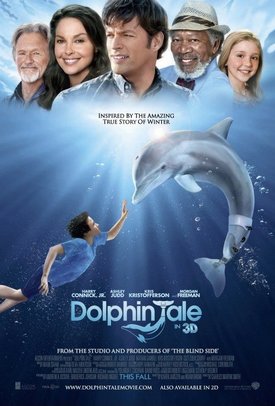
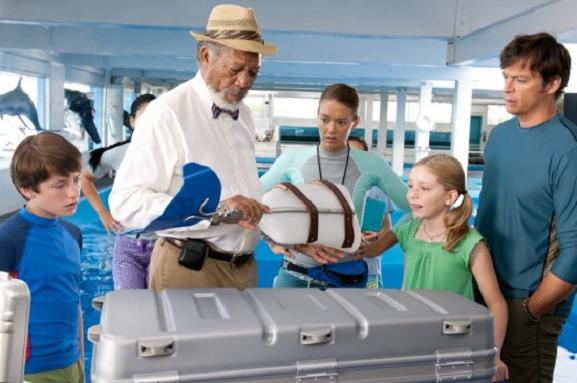
Interview: Charles Martin Smith of ‘Dolphin Tale’

Interview: Charles Martin Smith of ‘Dolphin Tale’

Posted on September 21, 2011 at 8:00 am

Before he was a director, Charles Martin Smith was a teen actor who appeared as “Terry the Toad” in “American Graffiti.”  He starred in Carroll Ballard’s “Never Cry Wolf” and appeared in films like “The Untouchables” and “Starman.”  While he continues to appear as an actor, he has most recently been more active as a writer and director.  He did both for his new film, “Dolphin Tale,” opening this Friday, inspired by the true story of Winter the dolphin, who now has a prosthetic tale.   It was a delight to talk with him about breaking the first rule of show business (“don’t work with children or animals”), what he learned from George Lucas, and why the color blue is so important in this film.  He made me laugh as soon as we met because he started “directing” where we would sit.  “I often say I became a director because I like to boss people around,” he told me, “but it’s just a line.”

They say it’s always a problem to work with kids and animals, but in this movie you did both.

I might be the only filmmaker that really gravitates toward that.  I really like working with kids.  And I really like working with animals!  They’re so pure and honest and they’re never really acting, at least not in my movies.  Well, maybe Rufus .  People sometimes try to impose things on them, a character they have in their own mind.  I think it’s much more interesting when working with an animal to find out what that real animal does and try to capture their essence and their behavior.  It’s almost a little bit of a documentary type feel.  We’ve got the real Winter playing the real Winter.

Have you worked with dolphins before?

I haven’t.  I’ve been interested in them and interested in science.  You hear all about how intelligent they are but you can’t comprehend it until you really spent time with them.  They’re certainly as bright as we are.  The first thing I did when I got involved with the movie was go to Clearwater, Florida to spend time with Winter, just to observe her behavior.  She does all kinds of interesting things.  She’s very playful; she loves toys.  She’s still young, the equivalent of a 10-year-old kid.  She loves her blue mattress and her rings.  So we put that in the movie.  I wanted to give her a special ring with something cute and iconic so I thought we’d give her a yellow duck — do you know how many different versions of rubber ducks there are?  We spent months designing this thing.  The expense we went to!  She makes that Tweety Bird sound all the time, so I said, “Put it in the movie!”

And working with kids?

I like kids.  I find them fascinating.  They give you real things.  Since I began as a child actor I understand what they’re going through and it’s great to see them blossom and learn.  I am not just a director but an acting coach and teacher on set and I love that.  I really made an effort to keep the kids real, to act like real kids.  So many movies have “movie kids.”  I didn’t want to do that.

There were no kids in the true story but when Alcon developed the project they wanted it to be kid-centered to make it more accessible.  I wanted to bring something of a magical quality to it, some wish fulfillment.  How many kids have their own dolphin?  Having the aquarium be this grand, mystical place that Hazel has complete run of and where she knows all the turtles and dolphins.  And the houseboat, so she had a fun place to live with a crows nest she could decorate herself.  And Rufus.  All to bring a slightly magical fantasy element.  I originally conceived Rufus as a seagull, but Alcon suggested a pelican — a true collaboration. 

And two 11 year olds save the day.  It would not really happen that way, probably, so that is a little bit of a fantasy, too.  But that made it even more important that the kids were grounded in reality and acted like real kids.  When Clay tells them he has to close down, Hazel runs.  Kids don’t want anyone to see them cry.  Cosi (who plays Hazel) is amazingly gifted, so good, so real, as good as any adult actor I’ve ever worked with.  She had just been in community theater, never done anything in movies or television.  And she’s a good kid; they both are.  They both come from very religious families, Christian families.  They’re such good kids.  I’ve never had a set before with no profanity, not even from the crew!

You did an amazing job of achieving a really sun-drenched look that really felt like Florida.

The wonderful cinematographer was Karl Walter Lindenlaub.  He did a lot of big sci-fi films like “Independence Day” and “Stargate” and he did a Scottish film, “Rob Roy” that showed he could do lovely things outdoors.  We talked a lot about the hot look and we certainly had hot weather.  I wanted a sort of sci-fi feeling to the movie, that first scene, under water.  We meet the pod under water and see how inquisitive Winter is.  I wanted to see the world she comes from. In a way, it’s like another planet, an alien from one planet that washes up, stranded, on another and is rescued by a boy.  I wanted to do that with the look of the film, too.  I wanted the underwater to be all blue and rich.  And then we made the neighborhood drab, and took all the blue out of it, all oranges and rusts and earth tones.  And then the aquarium is a blue building — which it really is.  And inside, that’s a set actually, he walks in and sees all the blue, watery, rich look and it’s like he’s underwater.  Then he goes back to his world and it’s all brown again.  But gradually we had some blues show up in his clothes to show how his worlds were coming together.

What did you learn from the directors you worked with as an actor?

I picked up stuff from everybody.  I worked with a lot of great directors.  George Lucas was very good in the way he directed young actors on “American Graffiti.”  He’s not generally thought of as an actor’s director.  But one of the things he did was cast good actors and get out of our way.  I learned so much about the importance of casting.  But he said, “I wrote the script; you can change any line you like.  I have an in with the writer!”  Some directors want every single word done the way it was written but that’s too stultifying to a child.  And he would ask us what was comfortable and organic and honest for us he wanted to do and he would build the scenes around that.  But the one I learned the most from was Carroll Ballard.  No one deals better with the subject of nature and man’s collision with wildlife than he does.  The way he edits, structures things, he’s always been my hero.  Every day on this movie I would think, “What would Ballard do if he were here?”

I loved the real footage at the end.

That was what I saw the very first day, seeing children with disabilities coming and being inspired by Winter.  The editor, Harvey Rosenstock, got the footage and cut it together beautifully.  It was so good we didn’t want to run it with the credits over it.  It works too well; it’s too beautiful.

Related Tags:


Directors Interview
Interview: David Code on How Parental Stress is Toxic for Kids

Interview: David Code on How Parental Stress is Toxic for Kids

Posted on September 20, 2011 at 8:00 am

Many thanks to author David Code for answering my questions about his new book,  Kids Pick Up On Everything: How Parental Stress Is Toxic To Kids.

As featured in The New York Times, Wall Street Journal, CBS and Fox News, David Code is an Episcopal minister and award-winning author who draws on the latest research in neuroscience and his own study of families in more than twenty countries across five continents.

What inspired you to research and write this book?


Since I grew up with few resources, I always assumed what many others assume: Families with more money and education must be more secure, more relaxed and just plain happier. But when I was ordained as an Episcopal minister in 2003 and served two wealthy parishes near New York City, I was surprised at what I found.

The wealthy families I counseled almost seemed to suffer more. For example, a successful graphic designer had a daughter with ADHD who had been rejected by several private schools she had applied to. An entrepreneur practiced attachment-parenting with her son for years, including “babywearing” the child on her shoulder or back, and sleeping with him. But her son constantly threw tantrums, and his parents later divorced. Several successful company presidents had children who barely finished high school. Even the relatively normal families I visited often had children with allergies, asthma, learning disabilities, ADHD, or mood disorders, and many were on medication.

This made no sense to me. These kids had well-educated, well-intentioned, self-sacrificing parents who were doing what the experts told them to do: shower your kids with love and attention, help them find and pursue their inner passions, never raise your voice, protect your child at school and defend them on the playground, etc. Yet, their children weren’t turning out as expected. Why would kids with loving, dedicated, successful parents and all their advantages end up as troubled as children?  

One clue was that in many of the homes I visited, the stress was palpable and many couples had drifted apart emotionally. As I listened to parents’ kitchen-table confessions, I felt a kind of frenetic, jangly tension that was so thick in the room that one could almost see it. I assumed, like most people would, that these households were tense because their child’s problem had left everyone on edge.

Then, I read something that made me look at these families differently.

A psychiatrist named Murray Bowen had conducted an experiment in the 1950’s at the National Institute of Mental Health, observing how schizophrenic youth interacted with their families. For 18 months or more, several patients lived with their entire families in a ward where Bowen and his staff could observe and record their behaviors 24/7.

How brilliant, I thought: he observed our species the way Jane Goodall observed our chimp cousins in Tanzania!

As Bowen observed and compared the behavior of these families, a certain pattern emerged. He described “a striking emotional distance between the parents in all the families. We have called this the ’emotional divorce’…. When either parent becomes more invested in the patient than in the other parent, the psychotic process becomes intensified.” In other words, the parents didn’t drift apart because they were too busy caring for a schizophrenic child. Rather, the drifting apart of their marriage came first, and it had somehow affected their child’s mental health.

I wasn’t sure what to make of Dr. Bowen’s quirky little experiment, but his concept of the “emotional divorce” forever changed my pastoral counseling to families. For the first time, I noticed my own assumptions and began to question them.

Like most people, I had assumed that a child’s health or behavioral problem makes a family tense, which of course it does. But now I asked myself, “What if that couple was tense even before the problem, and their tension somehow contributed to the child’s symptoms? If the old saying is true that kids pick up on everything, what if there’s some kind of mind-body connection between a parent’s anxious mind and a child’s sensitive body?”

I began to ask doctors, nurses, teachers and therapists about this mind-body connection between parent and child, and they poured out stories of how overwhelmed they feel by today’s seeming epidemic of stressed-out parents and troubled children. As I continued to read more medical studies and interview more experts, my conviction that there is a mind-body connection between a parent’s mind and a child’s body became stronger. It almost seemed as though children become barometers for their parents’ state of mind. Could it be that children are “canaries in the coal mine,” indicating when a family’s levels of stress have become toxic?

The answer is yes. Here is what every parent needs to know:

1) Kids pick up on everything, especially our stress and anxiety;
2) This happens both in the womb and throughout childhood;
3) The mind-body connection is a primal link between every parent and child;
4) This mind-body connection contributes to problems in every family—it’s just a question of degree: from colic and food allergies to asthma and autism;
5) This pattern is already epidemic in America, and it’s getting worse;
6) This is not the mother’s or father’s fault. Today’s parents are more stressed-out because our social support networks are dwindling, and we don’t realize that, as our isolation increases, it drives up our stress levels.

I feel a tremendous sense of urgency in getting my message out to parents, because every day lost is another child born with disorders that could have been reduced or even prevented. Asthma now affects 1 child in 10, as does ADHD. The national prevalence of autism almost doubled from 2002 to 2006, and now it is 1 out of 110 children, according to the U.S. Centers for Disease Control and Prevention. But among military families, the rate is a startling 1 out of every 88 children, and in Silicon Valley the rate is roughly 1 in 77.
I want parents to see the urgent medical imperative to reduce their stress now.

(more…)

Related Tags:


Books Interview Parenting
THE MOVIE MOM® is a registered trademark of Nell Minow. Use of the mark without express consent from Nell Minow constitutes trademark infringement and unfair competition in violation of federal and state laws. All material © Nell Minow 1995-2026, all rights reserved, and no use or republication is permitted without explicit permission. This site hosts Nell Minow’s Movie Mom® archive, with material that originally appeared on Yahoo! Movies, Beliefnet, and other sources. Much of her new material can be found at Rogerebert.com, Huffington Post, and WheretoWatch. Her books include The Movie Mom’s Guide to Family Movies and 101 Must-See Movie Moments, and she can be heard each week on radio stations across the country.

Website Designed by Max LaZebnik