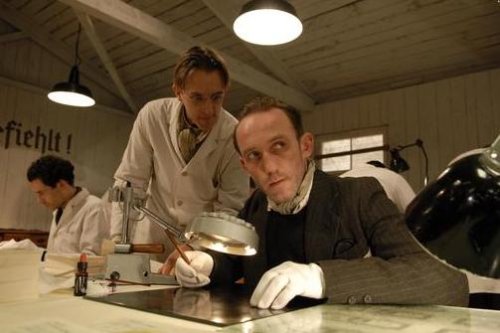
It was great to see “The Counterfeiters” win the foreign language Oscar last night. writer-director Stefan Ruzowitsky and lead actor Karl Markovics told me how thrilled they were to be nominated, and how much they were looking forward to attending. I enjoyed Ruzowitsky’s graceful acceptance speech, and I hope Markovics got his wish to meet Gene Hackman!
Interview: “The Counterfeiters” writer/director and star
Posted on February 21, 2008 at 8:00 am
“The Counterfeiters” is the Oscar-nominated true story of the biggest counterfeiting operation in history — one that was run out of a concentration camp during WWII. The Nazis took prisoners who were expert in engraving and printing and put them to work counterfeiting British pound notes, so that they could destabilize the British economy. The film is based on a memoir written by Adolf Burger, a printer and communist who worked on Operation Bernhard and helped to sabotage its efforts to counterfeit dollar bills.
I spoke with writer-director Stefan Ruzowitsky and Karl Markovics, who played the leading character, master forger Salomon (Solly) Sorowitsch.
It seemed to me that the title of the movie had many layers of meaning. The prisoners were making counterfeit currency but everyone in the movie was counterfeiting in some way. The prisoners and even the Nazi in charge of the operation were all pretending to be something they were not.
SR: This is something interesting, the thing that intrigued me for the first time about the story and the main character of Solly: Will he be able to counterfeit reality himself?
How did the idea of this movie get started?
In Germany and Austria this is not a well known story. It was a strange coincidence. Two producers within a couple of days approached me with the same story, each not knowing about the other. I felt this was destiny. This is how this German-Austrian co-production came about. The German producers bought the memoir of Berger but I right away loved the idea of , a crook, a jailbird in a concentration camp; this is a perspective that I don’t know yet that would be interesting.
The memoir is from the young communist, who was one of the youngest inmates and was a good friend of Solly’s and for the last decades been traveling doing lectures, to tell his story.
Why did you decide to begin the movie the way you did, letting the audience know that Solly survives the concentration camp?
SR: I did not understand why I did it myself at first. It was instinctive. It starts with the ultimate happy ending, a guy after six years of a concentration camp arrives in a beautiful resort, meets a beautiful woman, with pockets full of money, and asks himself “did I deserve it, did I compromise too much, did I get too close to evil?” I wanted it to be compelling and suspenseful but not about whether he will live or go to the gas chamber. I wanted to make the suspense in how he will survive.
How has the movie been received in Germany?
SR: They don’t . The only country where it does not work is Germany. It made three times as much box office in the UK as it did in Germany, which is remarkable given that it is a German movie, German language, German actors. It is a misconception to say that they do not want to face the guilt. These are the grandchildren. Our generation is aware of the dimension of the crimes. We know there is a responsibility but it is difficult to know how to deal with it. “What do I do with this knowledge?”
Karl, tell me about Sally, the character you play.
KM: I loved him at once. Really, I loved the script and I loved the character, as if I had waited a lifetime to get a character like this one, a real gift. Normally you get even in good scripts a raw model and you have a feeling there is much room to create. Here it was rather “Can I get familiar with the person which is done? It is really here in front of me. How can I be able not to seem but to be this character?”
And how do you approach that task? Do you do a lot of research?
I was delighted to have a chance to talk to illustrator Paul O. Zelinsky, who was given the Caldecott award highest honor for children’s book illustration for his work on Rapunzel. Paul talked with me about working with animators to convert his book The Wheels on the Bus into a movie, with a musical score by Kevin Bacon and his group, The Bacon Brothers. And he described his own experience making a short animated version of his recent book, The Shivers in the Fridge.
USA Today has a terrific movie quiz. If you can recognize phrases like “La de dah,” “Show me the money,” “I see dead people,” and “If anyone orders merlot, I’m leaving,” you should be able to rack up an impressive score. The best thing about the quiz is that a right answer gets you the movie clip!
A 1940 film starring Joan Crawford and Clark Gable and set in a penal colony is an improbable candidate for Biblical allegory, but Strange Cargo is a moving film that draws its power from an inspiring, Christ-like figure and its echoes of Biblical themes, spiritual without being preachy. Gable was Crawford’s all-time favorite co-star, and this was their eighth and last film together. Their strong chemistry and the way their characters interact with the mysterious prisoner who gives them a glimpse of their best selves is part of what makes this movie work on many levels. It is beautifully directed by Frank Borzage, who was a master of mood and symbolism. For the first time, the movie is available on DVD, as a part of a new boxed set, The Joan Crawford Collection, Vol. 2, and it is well worth adding to your Netflix queue.

 . Paul talked with me about working with animators to convert his book
  into a movie, with a musical score by Kevin Bacon and his group, The Bacon Brothers. And he described his own experience making a
  .
. 
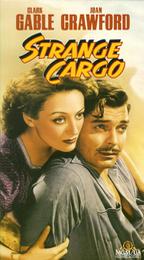 A 1940 film starring Joan Crawford and Clark Gable and set in a penal colony is an improbable candidate for Biblical allegory, but
  is a moving film that draws its power from an inspiring, Christ-like figure and its echoes of Biblical themes, spiritual without being preachy. Gable was Crawford’s all-time favorite co-star, and this was their eighth and last film together. Their strong chemistry and the way their characters interact with the mysterious prisoner who gives them a glimpse of their best selves is part of what makes this movie work on many levels. It is beautifully directed by Frank Borzage, who was a master of mood and symbolism. For the first time, the movie is available on DVD, as a part of a new boxed set,