MPAA Makes Unannounced Change to Trailer Content
Posted on September 4, 2009 at 8:00 am

As I describe in an exclusive story today’s Chicago Sun-Times, The Motion Picture Association of America’s Ratings Board made an unannounced change in April of this year that eliminated almost all restrictions on the content of movie trailers, the brief previews of upcoming films that appear before the feature in theaters and in promotional websites. This was done so quietly that my article is the first public notice of the change.
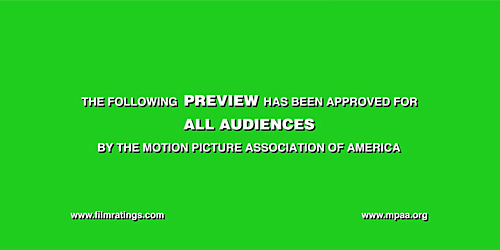
Whether a film is rated G (general audiences), PG (parental guidance suggested), PG-13 (parents strongly cautioned), and R (restricted to ages 17 and up), the “green screen” trailers shown in theaters and online were always preceded by a notice on a green background noting that “the following preview has been approved for all audiences.” A movie could have violence, strong language, nudity, drug use, or other mature content was included in the movie, but the trailer would at most imply it.
That is, until April, when the green screen trailer language quietly switched from “approved for all audiences” to “approved for appropriate audiences.”
“Appropriate?” Even with context, that word has almost no content. Without any context, it is positively Orwellian.
 This comes as the MPAA has included increasingly more specific descriptors since 1990 to explain the basis for its movie ratings, after pressure from the Federal Trade Commission, public interest groups, and even the movie-makers like the Directors Guild.
The MPAA does not reveal much about its ratings board, even the names of its members. And its processes and the ratings themselves are still often confusing and inconsistent as demonstrated in the documentary “This Film is Not Yet Rated.” Material that would get an R in a drama gets a PG-13 in a comedy. The F-word can be used twice in a PG-13 as long as it does not refer to sex. The MPAA has improved its descriptors, especially for tobacco and substance abuse. The raunchy comedy “Land of the Lost” was based on a family-friendly 1970’s television show but it was rated “PG-13 for crude and sexual content, and for language including a drug reference.” “Shorts,” a family film about a wishing stone from Robert Rodriguez is “Rated PG for mild action and some rude humor.”
But those descriptors can often be Delphic. You would need a PhD in semiotics to figure out what the often-used “mild thematic elements” is supposed to mean. Last year’s PG-rated “Marley & Me” was marketed to kids as a cute puppy movie, but its “thematic material” included postpartum depression and the very sad death of the dog in the title. A much more kid-friendly pooch movie, “Hotel for Dogs,” is also rated PG for “brief mild thematic elements, language and some crude humor.” “Brief mild thematic elements” in that film presumably refers to the mean foster parents of the orphan characters and some law-breaking by the children.
It used to be that trailers were all essentially rated G. Until this year, there have been basically two categories of MPAA-approved trailers. The “green band” trailers, with the MPAA’s approval on a green background, were approved for audiences of all ages. “Red band” trailers, to be shown in theaters only before R-rated movies, included R-rated material, thus ensuring, the theory went, that they would be seen only by adults who were by definition interested in movies with mature content.
Since the internet has become a key element of movie marketing, however, it has been impossible to limit red band trailers to adult audiences. On the contrary — teenagers are naturally very interested in seeing red band trailers and very good at using the internet to find them. They are also very good at getting around the wispy “restrictions” that at most ask for a name and birth date in order to be able to access the mature material.
“Green band” trailers disclose what the movie’s rating was, but before April of this year, the clips from the movie in the trailer itself would in theory not include anything inappropriate for general audiences. This has had some absurd, even misleading results. The trailer for the raunchy 2001 comedy “Saving Silverman” (“Rated R for sexual content and language”) put CGI underpants on actor Steve Zahn; in the movie itself, he was nude. Despite the “green band” assurance, the trailers often include material that is hardly G-rated. The trailer for the upcoming comedy “Extract” (“Rated R for language, sexual references and some drug use”), which for some inexplicable and inexcusable reason still carries the original green band “approved for all audiences” language, includes references to a part of the male anatomy and marital sexual frustration, and it depicts the main character smoking marijuana.
Now MPAA will make some effort to ensure “appropriate” audiences by matching the content of the trailer to the film it precedes in the theater. However, a trailer for a film rated PG-13 for violence may appear before a movie rated PG-13 for language, so that might not be an “appropriate” audience. And since most young people watch trailers online, there will be no controls whatsoever.
I asked the MPAA about this change. Elizabeth Kaltman, Vice President for
Corporate Communications, acknowledged in an email that they had not made any public announcement of the change, which was “intended to allow motion picture distributors and exhibitors greater freedom to accurately promote motion pictures to appropriate audiences while honoring our pledge to American parents that stronger advertising material will not reach inappropriate younger audiences. Whether a movie is rated G or PG, the appropriate audience tag still maintains that the trailer is appropriate for the viewing audience.”
There are still some glitches in the system. In addition to the PG-13 “Extract,” the trailer for the R-rated horror film “Sorority Girls” mistakenly has the “all audiences” green band but includes some material that is highly inappropriate for children. And it is available to anyone online.
I understand the frustration of the movie studios in trying to convey an accurate and appealing sense of a PG-13 or R-rated movie within the confines of an essentially G-rated trailer. And I recognize the way that the prevalence of almost-universally available red band trailers online has opened the door for previews that provide a more accurate sense of what is in the film. But it is absurd for the MPAA Ratings Board advertising rules to be so obfuscatory and coy with the “appropriate audiences” language. If the material in the trailer is judged to be at the same level of the feature it precedes, there is no reason not to assign a rating and descriptors to the trailer. The “Extract” trailer should begin with a caution that it is rated PG-13 for crude humor, sexual references, and drug use. That is my definition of appropriate.
To express your concerns about this change and ask that trailers reveal their rating, contact Chairman/CEO Dan Glickman:
MPAA
1600 Eye St., NW
Washington, DC 20006
(202) 293-1966 (main)
(202) 296-7410 (fax)