I’ve written more than once about the Bechdel test for movies: Are there at least two named female characters who have lines and do they talk to each other about anything other than men?
Unsurprisingly, they’re trumpeting the prominence of Google-owned YouTube, noting that four out of five moviegoers “use video sites to look for more information about a film” (well, duh). Thirty-nine percent report the official movie trailer influences their decision most — a factor more than three times as important as the runner-up, “information on the cast” (11 percent). “A friend’s opinion” is third (with eight percent). Reviews are somewhere below that, perhaps right around “Ugh, it’s what he wanted to see” and “Hunger Games was sold out.”
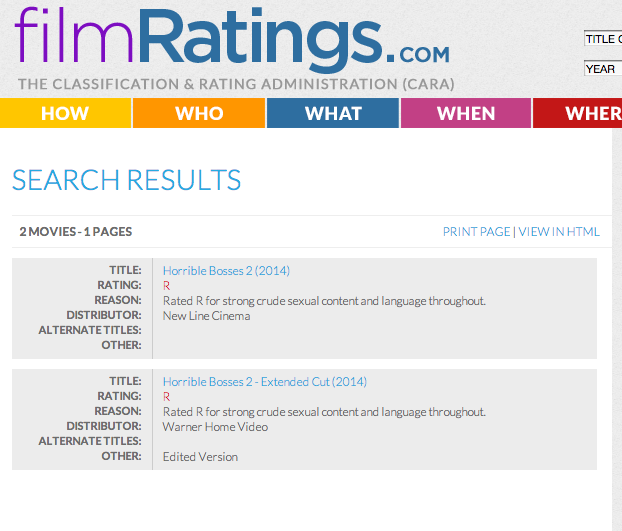
Copyright CARA and MPAA 2014In yet another example of the inadequacy and the deliberate obfuscation of the MPAA ratings systems, we have the ratings for both the theatrical release of “Horrible Bosses 2” and the upcoming unrated DVD. Not only does the explanation omit the violence in the film (including a deliberate murder by gun), it makes no distinction between the theatrical release and the presumably raunchier DVD, with whatever scenes were omitted to get an R rating.
Susan Wloszczyna on the Prospects for Women at the Oscars
Posted on November 18, 2014 at 3:57 pm
My friend and fellow critic Susan Wloszczyna is covering the run-up to the Oscars for Women and Hollywood, and I particularly appreciated her thoughtful essay on the prospects for women nominees this year. Noting that only one woman has ever won the Best Director Oscar (and only a handful have been nominated), we may see some improvement as both Angelina Jolie (“Unbroken”) and Ava DuVernay (“Selma”) are likely to be nominated. She continues:
here are two other Oscar categories where women are also chronically under-represented, even though they have twice as many chances to appear on the ballot: adapted and original screenplay.
Since 1929, women — both solo and as co-writers — have won Academy Awards for an adapted screenplay just 10 times. Ruth Prawler Jhabvala triumphed twice, for 1985’s A Room With a View and 1992’s Howards End, and Phillipa Boyens and Fran Walsh, with director Peter Jackson, shared the honor for 2003’s Lord of the Rings: Return of the King.
As for original screenplay, a category that began in 1940, women have taken the Oscar just seven times — three as co-writers and four solo….This year, sadly, only one script by a woman is seen by Oscar pundits as a likely candidate to make the ballot.
That would be Gone Girl, the psychological thriller based on the literary blockbuster by Gillian Flynn. The best-selling author wisely included a clause in her film-option deal that she would get first dibs on doing the initial draft of the screenplay. Instead of the studio simply placating her wishes, then shoving her aside — as is often the case — director David Fincher (The Social Network, The Girl With the Dragon Tattoo) used his considerable industry clout to keep her on board through the whole process.
Alan Turing, Copyright 2014 BBCStephen Hawking, copyright 2014 The Guardian
November 2014 may just be the greatest month in film history for the portrayal of heroes and heroines whose achievements are not about athletics or fights but about equations and science. Last week we had two blockbuster hits featuring fictional scientists. In Disney’s animated “Big Hero 6,” a group of young robotics whizzes (and one amiable slacker) save the day with their inventions. And in “Interstellar,” despite a society that has explicitly rejected science and technology as a way to solve problems, a small group of brilliant scientists use their skills to try to find another planet for humanity to inhabit. To hear a physicist on the science behind the film, take a look at “Cosmos” host Neil DeGrasse Tyson’s explanation.
The physics advisor on “Interstellar” was Kip Thorne, who is portrayed on screen by Enzo Cilenti, a colleague of Stephen Hawking, perhaps the greatest mind of our generation, “The Theory of Everything.” For more information, see Stephen Hawking’s Universe.
And coming up soon, we have the story of the man Winston Churchill said did more than anyone else to make it possible for the Allies to win WWII, the brilliant Alan Turing, portrayed by Benedict Cumberbatch in “The Imitation Game.” Turing was one of a group of mathematicians and cryptologists brought in to decipher the Enigma Code, widely considered to be unbreakable. Even though we know how it came out, the story is gripping.
Turing knew something about secrets. He was gay. At that time, gay men could be imprisoned — or ordered to undergo chemical castration via hormones. And the movie also portrays the difficulties faced by the women codebreakers. For more on this story, see Breaking The Codes.
It’s great to see heroes in popular culture who accomplish their goals by being smart and persistent. Maybe sometime the #breaktheinternet hashtag will be assigned to the scientists who landed a probe on an asteroid instead of pictures of kittens and naked celebrities. Meanwhile, this month, we also have “Dumb and Dumber To.”



 .
. .
.