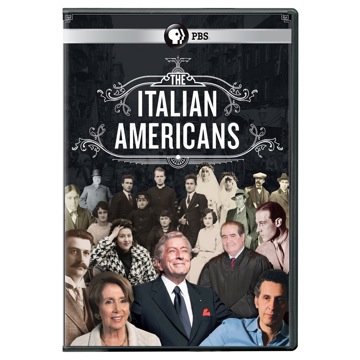
The PBS series Italian Americans is available this week on DVD. The documentary reveals the unique and distinctive qualities of one immigrant group’s experience, and how these qualities, over time, have shaped and challenged America. Unlike other immigrant groups, many Italians did not come to America to stay. At the turn of the 20th century, most came to work, earn money to support their families, and eventually return home. Nearly half of the first generation Italian immigrants returned to Italy. For those that made America home, their struggle to maintain a distinct Italian culture was guided by ideals of family that had always been at the center of their lives. In the Italian family, the needs of the collective came before the individual – a value system often at odds with American ideals of freedom and personal choice. While the power of the Italian family became a source of strength, it also bred suspicion, popularized in popular media as a dark, criminal element. The Italian gangster group known as the “Black Hand” was able to prey on the insularity of the Italian immigrant community’s distrust of authority and outsiders. This clash of culture echoed through generations of Italian Americans and, as they entered positions of political, social and cultural influence, left its mark on the American landscape.
Through extensive archival materials and interviews with scholars and notable Italian Americans such as Tony Bennett, Dion DiMucci, David Chase, Gay Talese and John Turturro, who speak from personal experience, “The Italian Americans” tells the story of those who played vital roles in shaping the relationship between Italians and mainstream American society. These include the stories of:
· Amadeo Giannini, who founded the Bank of Italy in 1904 in San Francisco to help Italians who could not secure loans or financial assistance elsewhere. He would later build it into the largest financial institution in the country and rename it Bank of America.
· Arturo Giovannitti, the union activist and poet who led the Lawrence Textile Strike in Lawrence, Massachusetts in 1912.
· Rudolph Valentino, who introduced a new image of the sex symbol to movie audiences of the 1920s, yet still endured the prejudices directed at Italians of southern extraction.
· Joe DiMaggio, who became one of the most celebrated baseball players of his generation, but whose parents were labeled “Enemy Aliens” during World War II.
· U.S. Representative Nancy Pelosi, New York Governor Mario Cuomo and Associate Justice Antonin Scalia, who each broke new ground for Italian Americans in public service.
The series also presents the expertise and insights of historians, scholars, journalists and authors including Donna Gabaccia, Thomas Guglielmo, Gerald Meyer, Robert Orsi, Mary Anne Trasciatti, Lawrence DiStasi, Bruce Watson, Stephen Fox and Selwyn Raab.
Interview: Dogs on the Inside, Documentary About A Prison Program for Rescue Dogs
Posted on February 10, 2015 at 7:00 am
“Dogs on the Inside” is a profoundly moving documentary about a program that teaches prisoners how to care for rescue dogs. Seeing the dogs and the men in prison learn patience and trust from each other is touching and inspiring. I imagine it will attract the attention of Hollywood as it would make a great feature film.
BC: Doug and I were looking for a story about dogs that we wanted to be both compelling and kind of informative about how great dogs are. But we wanted it to have a little bit of an edge and we discovered this prison dog training program and thought it was both a no-brainer in the sense that the program existed and taking stray dogs and pairing them with prison inmates, I thought it was interesting. I think that was the story to bring to life on film.
What did the inmates learn from the dogs?
BC: I think the biggest thing that they learned was understanding, kind of getting outside of their own heads and learning about the benefits of helping others and in this case it was dogs.
DS: I think the most important thing they learned was that they are still human. If an image were to pop in your head of an inmate you might just think that of something negative and I think what this film does is remind people that wherever you are, if you are even an inmate it does not matter, you’re still human.
CS: From an inmate’s point of view, it was more often learning how to cope and deal with not only the other cons but also with dogs as well and growing with them as well as a person.
What are the qualities that are required for the inmates who participate?
Copyright 2015 Bond/360
DS: Before they can be allowed into the program, each of the inmates is thoroughly screened. What they are looking for is patience, responsibility, and trust, and most importantly caring. And overall they cannot be violent, they cannot have any type of violent history.
Are there other programs like this throughout the country?
DS: There are and since we started filming over three years ago they have been continuing to pop up all over the country.
And are there any studies being done of how effective they are or monitoring the participants after they leave?
BC: Yes. There is a great program called New Leash On Life USA, based in Philadelphia. And they are the gold standard for this type of prison program because they have measurable results and the recidivism rate for prison inmates coming out of Philadelphia prison system goes down about 50% by comparison to the average. These guys are actually staying out of jail because of what they do helps them get internships, help get them placed in jobs in animal care and those kinds of things. So it is much about a person as it is about an animal.
Do many of them chose to continue professionally with animal care when they get out?
CS: I want to be a zookeeper. I love animals in general. The person that gets into these dog programs, they have got to love animals first and foremost. If I could, I would own a farm and adopt all of them. Because I love animals in general but reality is that I can only take the step of helping the dogs that are in shelters. I’m going to be donating my time doing that in a shelter out in Springfield, Massachusetts. I’m going to get my education and try to see if I can become the very best zookeeper that there ever was in history.
Candido, tell me a little bit about your first experience in working with one of the dogs.
CS: My first experience was with Sam, who was a very scared dog, he was very skittish, he used to tremble when he first got there. He used to growl when anyone got close to him and it took me a little bit of time to actually get him comfortable with me. What I mean by that is, it took me a few days but I got half my body inside the crate in order for him to feel comfortable with me. Then once I was able to finally caress him and rub him, I guess he looked at me like “Wow! You are not what I expected.” So with that being said I carried on and everything, he was a Chihuahua and by the end of the term he got adopted to a very young, very beautiful kindhearted person. She got married, the lady that is Sam’s owner and they sent me pictures of Sam in a tuxedo, so I’m guessing he was the Best Dog.
When an animal has been abused and is afraid of people, how do you gain their trust?
CS: I know that for me it took a lot of patience first. I looked at Sam the way I looked at my own life. I could relate to the way he felt, the way he thought probably. And in the beginning when I tried to get close to him and he growls, I got up, kept walking around doing whatever I had to do in the room but I still talked to him and I told him “Don’t worry about it. I got you, I’ll take care of you, sooner or later you’ll come around.” And that’s basically it, you have got to have a lot patience and a lot of love for any animal that goes through something like that. I mean it’s horrendous to begin with but you have got to have a lot of understanding too behind it. I’ll say this too, it took a little bit of bribery too. I used to give them treats, and I mean, who doesn’t like treats? I love treats. I love candy bars so you give me a candy bar and I’ll do anything for one bar, how about that?
So you can identify.
CS: Yes, I could definitely, with Sam and with every dog that kept coming through there.
And what was the most important thing that you learned from the training that you got about working with the dogs?
CS: I learned a lot actually. The trainer that we had, her name is Paulette, she is a very good trainer. She taught us and it was installed in me by her to have patience but be firm, to be loving and caring at the same time. But also to try to understand their point of view as much as possible. It’s about them primarily, you’ve got to put them first before yourself. It’s like having a baby, when you have a baby, your baby comes first before yourself.
What do you want people to learn from this film?
DS: If they could adopt a dog that would be wonderful but that’s a lot of responsibility so I think one of the things that people can take away from this film is that they have the opportunity to make a difference on their own. And it is attainable for them, it is not too far out of reach for each person. And not only that but to remind people that everyone is equal and to believe in second chances.
BC: I think for me it is to remind people that there’s some really good things going on around the world. That is one of the motivations we had in looking for a story. It just goes to show that with effort and the right thoughts we can really create the magic in this world.
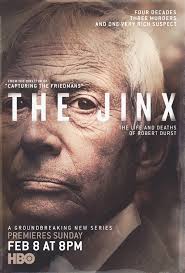
Copyright 2015 HBORobert Durst, heir to a vast fortune from New York real estate, has had a life has been punctuated by tragedy. When he was seven years old, his mother was killed when she fell off the roof of their home, a possible suicide. He says he saw it happen, but as with much of what he says, it is not clear whether that is true. The other tragic deaths around him may have been murders he committed, though he has only admitted to one and for that one he was found not guilty by a jury.
Durst’s beautiful young wife, a medical student, disappeared in 1982, and her body has never been found. Eighteen years later, the case was reopened but the key witness was murdered. That case has never been solved. In 2000, Durst moved to Texas and began dressing as a woman, apparently not to transition but just as a disguise. The following year, his neighbor in Texas, an elderly man named Morris Black, was murdered, cut into pieces, and thrown into the bay. Durst, who was later found to have the neighbor’s drivers license, was tried for murder. He acknowledged that he had In 2003, used a paring knife, two saws and an axe to dismember Black’s body before dumping his remains in Galveston Bay, but said he had killed the man in self-defense. The jury found him not guilty.
“The Jinx” is a new HBO documentary series from director Andrew Jarecki (“Capturing the Friedmans”) about the strange and murderous, probably multi-murderous, life of Durst, who was played by Ryan Gosling in All Good Things, also from Jarecki, who spoke to me about making the film. “If people say, ‘Why did you have her do that?’ We can say, ‘It actually happened.’ If they say, ‘It isn’t realistic,’ I say, ‘It happened. What’s your definition of realistic?’”
“The Jinx” is Jarecki’s documentary version of the story, with first-time interviews of Durst and his brother. It premieres tonight, February 8, 2015.
Interview: Nancy Spielberg and Roberta Grossman of “Above and Beyond”
Posted on January 28, 2015 at 1:26 pm
Copyright Paramount Productions 2015
In 1948, a group of World War II pilots volunteered to fight for Israel in the War of Independence. As members of “Machal” (volunteers from abroad), they not only turned the tide of the war, they also laid the groundwork for the Israeli Air Force. “Above and Beyond” is the first major feature-length documentary about the foreign airmen in the War of Independence, featuring new interviews with pilots from the ’48 War, scholars and statesmen, including Shimon Peres, to tell their story. I spoke to producer Nancy Spielberg and director Roberta Grossman about making the film and why this story mattered so much to them.
Why tell this story now?
NS: First of all the, “Why now,” is any of the stories that are coming from this generation of World War II veterans and Holocaust survivors, that whole generation, whatever they did, are things that if we don’t grab them now, we’ve lost them and they are slipping through our fingers. And I think we’ve all seen that that the way that people learn, mostly way the the younger people learn is visual. They don’t read books, they don’t like history books, they don’t want black and white on a page. The best way to teach it, to capture it, is through a visual format. And I think that the urgency of getting stories like these, is that the stories are just incredible. To me it’s a study in character, in human nature. What makes these heroes? What makes these veterans, these World War II veterans that served their country, survived; one of them was shot down and wandered for a couple of months, another one almost crashed his plane. What made these people come out of war, get back to their normal lives or be supposed to be getting back and then drop everything to go help somebody else? And it is just sort of amazing because I think they are very matter of fact about it but it is a wonderful lesson for all of us. To what degree, what extent would you undertake such personal risk to help somebody else? And I just think that is a lesson that we all have to hold onto.
What was it like doing the research and finding the archival footage for the film?
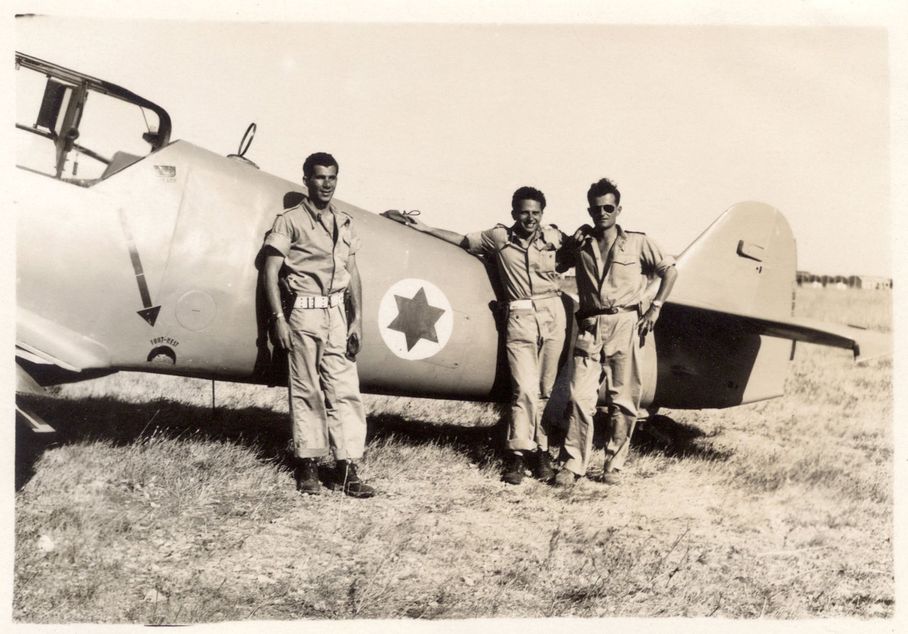
Pilots Lou Lenart, Gideon Lichtman, and Modi Alon in Israel in 1948. Copyright Paramount Productions 2015
RG: Well, first of all I should say that there is a lot of archival footage in the film that was drawn from a lot of different archives around the world, primarily of course Israel and the United States. But there is a lot of footage in the film that is unabashedly made to look like archival footage and blend with our footage that is actually re-creations that we did in conjunction with Industrial Light and Magic. So the conceit was to make re-creation look like archival footage when the fact of the matter is there were gun cameras. There were cameras on pretty much every American plane in World War II but in the the ragtag Israeli Air Force in the 1948 war, there were no cameras since the planes could barely fly. So we pretended that there were those cameras there and created sequences that would match or illustrate the stories they were telling. I strongly believe that documentary filmmakers get to use all the tools of cinema and using those tools as historically accurately as possible or else you lose the trust of the audience.
NS: Roberta, you have these connections more than I do with the archivists and people were so engaged with the story that they really dug around it. There is one shot we have which is authentic archival footage of this Egyptian spitfire that kept flying and bombing over Tel Aviv and all they could do on the ground was run in their houses and get the camera and film it because there was no fighting back. They had no planes, they had no way to defend themselves, it was duck and cover. And the idea that this plane could just keep flying over at will, bombing whenever it wanted must have been a feeling of being so exposed and vulnerable for these people. But like Roberta said, this wasn’t World War II with a rich camera crew going off. This was people running for their lives that have nothing. So I think that finding that footage was huge and it really was the efforts here in America and over in Israel, and we had footage archives in Czechoslovakia, really all over.
RG: We really like to try to dig as deeply as possible as time and resources would allow because a lot of footage or archival footage gets recycled all the time because it is the stuff that bubbles to the top, we see the stuff over and over and over again. So if you want to find interesting material you have to keep digging. Our editor, Chris Callister is really great with archival sequences, to really make scenes out of that footage, that’s the idea.
You touched on one of the key differences in aerial combat between the experience that these men had in World War II and the resources available and the documentation of the effort in Israel. Were there differences in strategy as well? What were some of the differences that these men had to adapt to?
RG: The differences were tremendous. In World War II, the American pilots that flew in that war were part of a giant machine. And in Israel there were so few that they each became their own machine and probably made much bigger strides in the overall war efforts.
Because in fact in May 29, that one battle where they were just right outside of Tel Aviv, there were supposed to be five planes to fly against them and these planes had been brought in in pieces and assembled and one plane wouldn’t work so instead of five they had four and they had five pilots. I mean working with bare-bones. So only four planes could go out and try and stop an army.
And in that battle, one of the men died. So in the very first aerial battle, 25 percent of the Air Force was lost. So it was sort of incredible because it’s such a smaller fishpond and so these guys were bigger fish and I think that strategy wise, I think their training supposedly helped a lot but they had to wing it a lot because it’s not like this is a wealthy country with lots of supplies. They had to be pretty versatile. There was a 26-year-old put in charge of the Air Force and there really were only two Israeli pilots that were experienced enough to be able to take command but there wasn’t a lot of order back then. There weren’t manuals and operational guides. It was really sort of “fly by the seat of your pants.”
So they had a young guy who tried to keep it together. But what he was trying to keep together was also a group of foreigners that spoke different languages. Most of them spoke English and English was the official language of the Israeli Air Force. It’s the language almost everybody knew. The Israeli Air Force was really molded from the British Royal Air Force and American Air Force and South African. So they had access to those manuals and later on they used those as guidelines.
When you interviewed the men, was this a story that they had told before or was it something that was a surprise to their families?
RG: It certainly wasn’t a surprise to their families, their kids knew about it. But I think in some cases when their kids saw the finished film, they saw a fuller and heard a more wonderful story than they had heard before because they heard not only their father’s story but they heard about it in an historical context and they heard of the entire efforts. And so I think that a lot of the kids, the children of the pilots were really, really so excited and so happy about the film not only because the film honors their fathers in such a wonderful way but because it gave them a fuller picture of what their fathers had done during the period.
NS: The grandchildren actually love it. They think that their grandfather is the coolest dude around. They really related to him in a different way.
RG: But some of these stories are new because the interesting part of the question is that there wasn’t a lot of talking about this chapter because of the legal ramifications of it. And when the guys first came back and I think many years afterwards, they didn’t go around boasting about it because it was illegal to fight for a foreign country, it was illegal to smuggle a plane. Some people did go to jail for it, one lost his citizenship. It wasn’t something that people talk about a lot. It’s been really interesting everywhere that we have gone and shown the film. People just kind of came out and said, “Oh, my uncle smuggled machine guns,” or, “My grandfather was part of this.” Just on and on and on. It was just like people just are very excited to put all the pieces together.
NS: In fact one person said to us he thought the FBI were going to come always knocking on the door so he really never wanted to share these stories. And another gentleman brought a personal photo album that had never gone out of the house. We used some of those pictures in the film.
Do you think today’s audiences have an understanding of the origins of Israel? And do you think this movie will change their ideas about Israel?
NS: I do not think that people bother too much to think about origins of Israel. And I say that in this sense because I think people are caught up with a CNN version of Israel and don’t go beyond that. When you stop for a second and go, wait a minute, there was a partition plan for a two state solution and the Jews agreed to it. I don’t know, I am not naïve but that could have changed a lot of things and so in some ways the idea that Israel was there, Israel was interested in a two state solution. Israel was attacked, Israel defended itself. I think those things just have to be emphasized again.
What do you want people to learn from this film?
NS: I hope that they will consider a few things. First of all the idea that these guys went to help somebody in trouble, that’s a great universal lesson that we should be there for other people, we should be there to help each other. I also do hope that people will just go, “Hmm, let’s not be so harsh about Israel and Israel’s right to exist.” That is personally important to me but my most important thing is sort of focusing on some feelings of American pride, of Jewish-American pride, of the idea that being a volunteer is a good thing and that you should do it because it is the right thing to do, not for the glory necessarily.
RG: I hope they understand how urgent the situation on the side of Israel was at the time of its creation, how right and necessary it was, how different things might have been if the partition plan had been accepted and how tenuous the state was in its beginning, how it could have easily gone another way and how threatening the issue was in 1948. I think just to take another look. Obviously it is a very fraught issue but I really think that the discussion is so one-sided these days. We’ve got sort of frantic anti-Israel sentiments; believe me I understand why, but it is really nice to have a story that talks about what the intentions were, what the need was, what the spiritual standing of the state was.
Interview: Lacey Schwartz on Her Family’s “Little White Lie” — No One Told Her She Was a Black Daughter in a White Family
Posted on January 5, 2015 at 8:00 am
Lacey Schwartz grew up as the much-loved only child of warm, loving parents in a close-knit middle-class Jewish family. She did not resemble her parents, but they reassured her that she had a Sicilian grandparent who was the genetic source for her dark eyes and kinky hair. When she went to college and was invited to join the Black Students Alliance, she realized that she had find out the real story. That led to a documentary called Little White Lie.
Schwartz talked to me about making the film, including inviting a camera into the most intimate family conversations.
How did you get your parents to agree be filmed in such personal and intimate moments?
It’s a few things. One is I always try to acknowledge my own privilege in life and I think the biggest one I have is coming from a loving, supportive family – a family that you can definitely argue with and make mistakes in but nonetheless they have been in support of me for my whole life. And so I would say that’s the first part. The second part is that when I decided to do this film, I had to first go through the process of really having the conversation with myself about whose story is this to tell. And realizing that there’s always many different takes on one situation and that if I was going to make a film; I was setting up to tell my story. I wasn’t setting up to tell my parent’s story. And so what I did with not only just my parents but with my extended family is to tell them that them that I’m going to make a film about my life.
That kind of made it clear that I was going to do it no matter what. And I was asking everybody individually if they would participate and they would talk to me, and I was super lucky and again I am glad that everybody in my family was willing to do that. No one said no.
And we shot over the course of three years primarily and I would say a very high percentage of that footage was shot with one person shooting it who in the beginning he stayed at a hotel but by the end he was at my parents’ house for large periods of time. And in the beginning we didn’t have intense conversations it was the holidays, it was just hanging out. And so everybody really got to know him in a way that they became used to having conversations in front of him. So it wasn’t something where I just dropped in with a camera and asked them to talk about the stuff we had them talk about in a really personal way. It really took a long period of time and in the process of filming, it really worked in our favor.
At first, I thought, “Oh when we could afford it we are going to crew up.” I thought we would have a sound person and a producer there. That was the goal when I set out but from the beginning I couldn’t afford it. But it worked out for the best. He also was the co-director of the film because I’m a subject of the film. I can’t be directing and also be authentically living my life so when we actually shot I would step back from directing while the camera was rolling. And so he was the person who had to track what we were trying to get and figure out if we were getting it during the actual shooting. So he was really doing sound, he was shooting and he was really playing a crew director role. In retrospect I think it really worked in our favor because it did make it more intimate.
If you got a census form in the mail today how would you describe yourself?
When I’m checking off boxes I’m very aware of why people are asking the questions they are asking so I answer based on that- what will the information be used for. Also the forms have evolved since I was younger. For instance with the census form that gives you options to identify yourself in more than one way. But because I know the census is about how making sure that a community is counted I would check “black” because I want to make sure the black community is accounted for. I mean the President checks “black” right? I assume for the same reason.
copyright Lacey Schwartz 2014
Your participation in the Black Students Alliance in college was a real turning point for you. Did you ever experience any issues of not feeling fully accepted or connected to the other students in that group because you grew up in a white family and saw yourself as white?
That whole period of time for me, from when my parents got divorced until when I sat down with my mother and she told me the truth of why I look the way I do which is give or take about three years, was an incredible time, a positive, crazy time of discovery for me. One of the big themes that I look at in this film is denial. And not just the power of denial but the anatomy of denial – what does denial really look like? So one of the things I’m really trying to do is examine all the different elements. Every individual has their own timeline of denial including me even though it was learned behavior. And the way I break up the timeline is there is a period where you are really lying to yourself and you really can’t believe it. But there is sometimes the period where deep down you know that something is not right but you are not really yet ready to admit it. And I think that that period of time was those three years that I’m talking about for me.
Deep down I was like, “Something doesn’t make sense.” But I was getting to that place of build-up where I could ask the question. So in certain ways, getting to Georgetown and getting invited to the Black Students Alliance meeting, having black friends and being part of the black community for the first time although I wasn’t actually identifying with being black, I was just kind of mingling and connecting with them — that was such a interesting time. When that invitation came was like the first moment of awareness. My parents splitting up kind of opened up my consciousness, but the letter from Georgetown gave me some answers to try on and to get more comfortable with.
How did the students there welcome me? I know many people in my situation being biracial or whatever maybe didn’t always feel quite as accepted by the black community as I did. But I think a lot of it has to do with the fact that I came into connecting with the black community at institutions of higher learning like Georgetown University and then like going on to Harvard Law school where it was so diverse and people were very educated about the diversity within the black community. I wasn’t the only person in the black community who really had not grown up around a lot of other black kids as well. I went to speak at Princeton recently in front of a bunch of students and a black guy from Toronto said, “I was like one of four blacks at my high school.” And he said, “So now the diversity at Princeton to me is like super diverse.” So I was not the unique person in that experience.
Why was it so important to begin and end with your wedding?
I think the wedding for me signifies how I was being held back by these family secrets. It is just the idea of ultimately a “coming of age story,” this idea of growing up for me. And I think for many other people, although not everyone of course, the first part of your life is until you go away to college and go out on your own, when your parents for a large part define who you are- that is what happened for me. And then for the second section of my life I was defined almost I would say in opposition to what my parents were. I think that’s the kind of quintessential coming of age experience and then the third section, although I know obviously there are other sections to come, the third section is how do I reconcile those two pieces? When I was editing this film, I was preparing for my own wedding and I was really thinking about my parents marriage. So I think the wedding really represents for me the fact that I had to get past this stuff before I could move forward in my life and be able to combine my life with somebody else and combine our families and to come to terms with my family.
Do you have a relationship with your biological relatives? In the movie you seem to relate more to your classmates than your half-siblings.
I do to a certain degree, but we are not very close. I wanted to be honest about it because I think that in certain ways people almost expect you to feel that connection. I think that with my classmates I met them while discovering the black community, but in the end I wasn’t friends with them because they’re black. And it’s the same thing with my family, I’m not going to connect with them because they are black. And the other thing is that families are much more loaded than friendship relationships. You opt in to your friends in a whole different way than your family. The sister you see in there, I continue to connect with her and we certainly have a relationship. In this day and age of Facebook and all that it is much easier.
What do you hope people will talk about after they see your movie?
I hope they talk about their own experiences. I really want the film to be a tool for conversation and to get people talking about their own stories with friends and also with families. I look at families as a building block to society and it’s really difficult I think for society to move past some of the difficult issues we are dealing with until we are having these conversations in real ways within our families. So that’s what I really want. I want people to talk about what they are not talking about and the things that are holding them back in whatever way and having a negative effect on them. I think by having these conversations in their families it reverberates in their communities and then it goes out to society so that’s what I want.