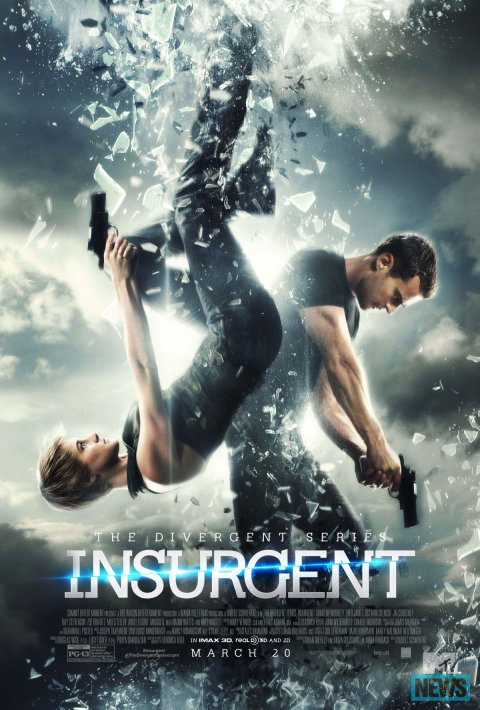
Insurgent

Posted on March 19, 2015 at 5:52 pm

B-
Lowest Recommended Age: Middle School
MPAA Rating: Rated PG-13 for intense violence and action throughout, some sensuality, thematic elements and brief language
Profanity: Several strong words, one f-word
Alcohol/ Drugs: Drugs used for suppression and torture
Violence/ Scariness: Extensive peril and violence, disturbing images, many characters injured and killed
Diversity Issues: A theme of the movie
Date Released to Theaters: March 20, 2015
Copyright Summit Entertainment 2015

This second in the “Divergent” series suffers from sequel-itis. The exuberance of the premise buoyed the first episode, as we and the central character, Tris (Shailene Woodley) explored the post-apocalyptic world that divided all citizens into strictly segregated factions. But now that the foundation has been laid, the next steps are not nearly as exciting.

There is Candor (the honest), Abnegation (the selfless), Dauntless (the brave), Amity (the peaceful), and Erudite (the intelligent). The tasks of the society are assigned according to the qualities of each. Amity are the farmers. Dauntless are a combination of law enforcement and military. Candor are the judges. Erudite make the laws. Abnegation care for everyone, even the factionless, and due to their tradition, culture, and ethos of putting the good of others before themselves, they are the governing body.

But over time, the system has eroded. When Tris is evaluated for assignment to a faction, she is found to be “divergent,” with more than one of the qualities, and that is considered profoundly threatening to the system.

At the end of the last episode, she had joined the Dauntless and survived their brutal series of tests and escaped with Four (Theo James), following a battle that killed her mother, as Jeanine (Kate Winslet), an Erudite, is consolidating her power and turning the community into a dictatorship. As this chapter begins, Tris and Four are hiding out in Amity with Tris’ Erudite brother, Caleb (Ansel Elgort) and a member of Dauntless named Peter (Miles Teller).

Tris chops off her hair so that she spends the rest of the film looking like a cross between Peter Pan and Tinkerbell. Her Dauntless side is impatient in the tranquil community of Amity, where people murmur, “Go with happiness,” as they hand out food in the cafeteria line. She is determined to go back into the city and kill Jeanine.

Meanwhile, Jeanine has found a box that was hidden by Tris’ mother (Ashley Judd), and can only be opened by someone who is fully Divergent, possessing in equal amounts the qualities of all five factions. She is certain the box is the key to controlling everyone, and she must get Tris — alive — to get it open.

Four and Tris end up in Candor, where they are given a powerful truth serum. “May the truth set you free,” is not just rhetoric as the serum is administered. It will determine whether Four and Tris are turned over to Jeanine. They are proven to have been telling the truth but it is a painful experience and they end up captured anyway. Tris is forced to endure a series of excruciating “sims” to qualify to open the box (not clear why she couldn’t just try it to see), and the results are not what Jeanine was expecting.

Some of the plot developments, from a book written by an author in her early 20’s, simply cannot hold up to being portrayed onscreen. At times it’s just a weaponized vision of the highly cliquish tables at the high school cafeteria. Even pros like Winslet and Naomi Watts (as a rebel leader) cannot quite put their thinly conceived characters over. But Woodley never lets us forget that the biggest struggle Tris has is not with the repressive regime but with her own fears and regrets. Her sincerity and resolve outshine all the fight scenes and give some depth to the superficiality of the storyline.

Parents should know that this film includes constant peril and intense violence with guns, knives, suicide, and threatened suicide, many characters injured and killed, some disturbing images, a sexual situation, a storyline about repressive government and personal and political betrayal, and several swear words.

Family discussion: Why does Jeanine think she is acting on behalf of the greater good? Why does Caleb? How does our society try to categorize people?

If you like this, try: the “Hunger Games” films and “The Giver” and the books they are based on
Related Tags:


Action/Adventure Based on a book Fantasy Movies -- format Series/Sequel

Cinderella

Posted on March 12, 2015 at 5:58 pm

B+
Lowest Recommended Age: All Ages
MPAA Rating: Rated PG for mild thematic elements
Profanity: None
Alcohol/ Drugs: None
Violence/ Scariness: Fantasy violence, tense confrontations
Diversity Issues: Class issues
Date Released to Theaters: March 13, 2015
Date Released to DVD: September 14, 2015
Amazon.com ASIN: B00UI5CTE2
Copyright Disney 2015

Here’s what’s magical — a fairy tale told in 2015 that is true to the spirit of the classic story by Charles Perrault but is still fresh and real despite the dozens of re-imaginings and the seismic shifts in culture in more than a century since it was first published.

Director Sir Kenneth Branagh and screenwriter Chris Weitz have done just that, and the result is enchanting. Recent post-modern versions like Drew Barrymore’s “Ever After” and Anne Hathaway’s “Ella Enchanted,” deftly took on the question of why Cinderella stayed in a home that had become abusive and added a bit of “Shrek”-style post-modern air quotes. But as its title suggests, this version of “Cinderella” is fundamentally traditional, neither po- nor mo-, and entirely comfortable as a fairy tale.

They get a lot of help from the design team including triple-Oscar winners Sandy Powell on costumes and Dante Ferretti on the sets and overall look of the film. This is Disney at its Disney-rific best, a magical setting so arrestingly imaginative and comprehensively envisioned that it is easy to imagine that it is a peek into a gloriously gorgeous world that really exists, if we could just find out way to it. And Ella herself is a winning heroine, kind and wise.

For a fairy tale, though, the actual magic is pretty limited. In the early scenes, magic would be superfluous, as Ella lives a real-life happier and more filled with love than any wish could grant. Her doting parents (Hayley Atwell and Ben Chaplin) make her feel cherished and understood. Her natural sweetness is enchantment enough, and the world around her seems safe and understandable.

But her mother becomes ill, and has just time to give Ella one piece of advice before she is gone: kindness and courage will bring her anything she needs. It is her natural generosity and her wish to obey her mother as well as her longing for family that lead her to stay with her wicked stepmother, Lady Tremaine (Cate Blanchett), and simpering, mean girl stepsisters (Sophie McShera and Holliday Grainger), after her father’s death.

We get a brief glimpse of what is behind Lady Tremaine’s misery and why she takes it out on Ella, but this is no revisionist “Maleficent.” Lady Tremaine may be more angry and desperate than evil but she is all villain here as she insults and humiliates Ella and forces her to wait on her spoiled, arrogant stepsisters.

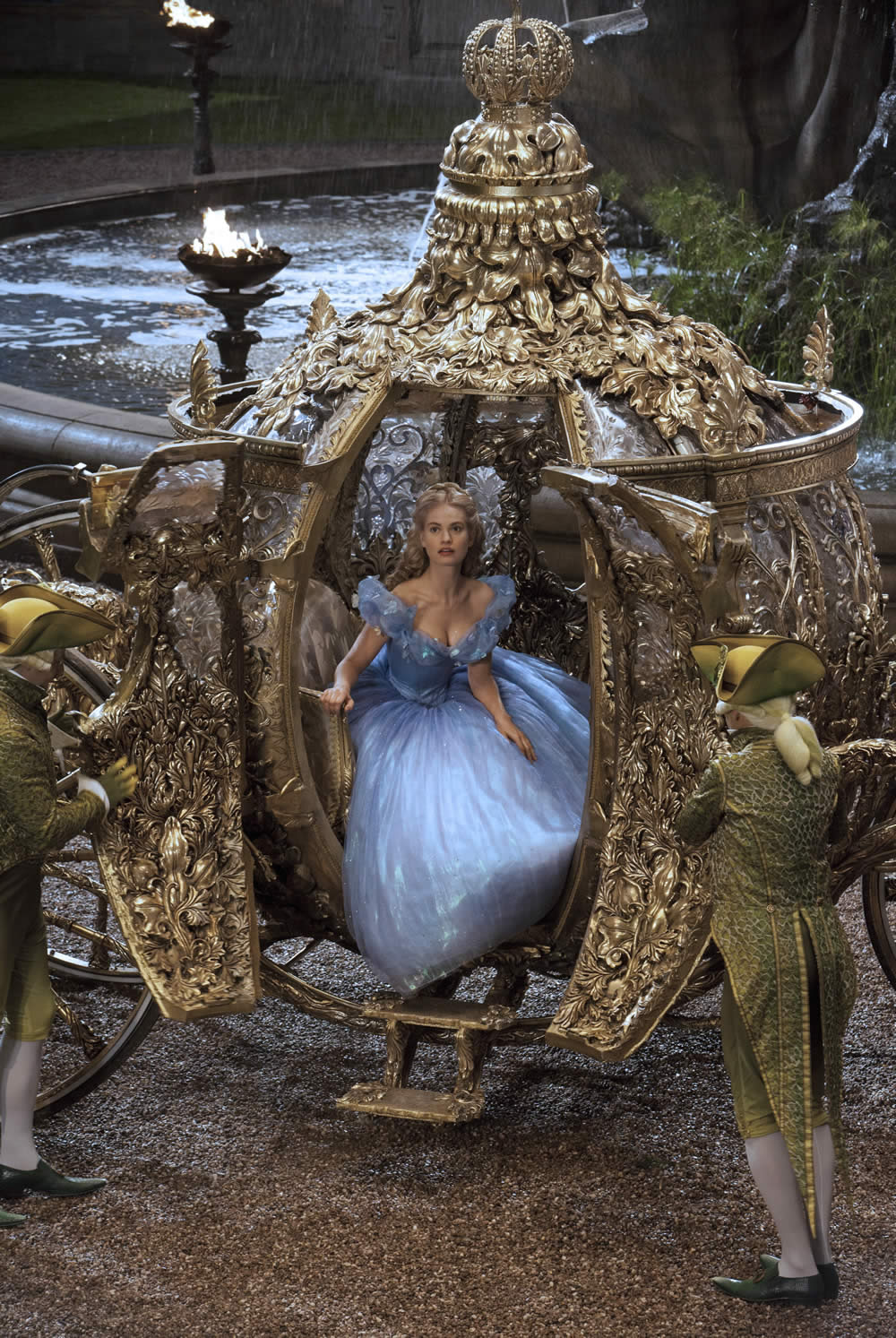
When her kindness is met with cruelty, Ella does not know what to do. And then, just when she is utterly devastated at being left behind on the night of the prince’s ball, her mother’s dress torn to shreds. Her fairy godmother (Helena Bonham-Carter) appears just in time to transform the servant girl into a radiant princess. The special effects for the transformation are dazzling, especially the pumpkin coach and the lizards and mice who become her human attendants. No more magic is needed after that. She’s on the way to happily ever after.

Be sure to arrive on time as before the film there is a seven-minute mini-sequel to “Frozen,” complete with new song, and it is pure joy. I won’t spoil it; I’ll just say that when Elsa gets a cold, she has very funny frozen sneezes.

Parents should know that this film includes sad parental deaths and an abusive stepmother.

Family discussion: Why did Ella allow her stepmother to treat her so badly? Why didn’t Ella’s fairy godmother come back to help her again? How can you show courage and kindness?

If you like this, try: other versions of the story including Disney’s animated “Cinderella,” “Ella Enchanted,” and “Ever After”

Related Tags:


Based on a book Date movie DVD/Blu-Ray Pick of the Week Fantasy For the Whole Family Remake Romance

The Second Best Exotic Marigold Hotel

Posted on March 5, 2015 at 5:55 pm

A documentary called “Young @ Heart” had a choir of singers in their 80’s performing contemporary rock songs.  The very fact of their age and experience gave an unexpectedly profound meaning to the words.  And in “The Second Best Exotic Marigold Hotel,” a plot that ranges from silly to very silly still resonates, because the people in the silly situations are running out of time.  And because they are played by actors of such superb skill that they give power even to fortune-cookie aphorisms like “There is no present like the time.”  The characters in this film have more romantic complications and far more opportunities than the average teen sex comedy — and a lot more sex, too.  But their situation gives it all grace and poignance.

You could give Maggie Smith “Mary Had a Little Lamb” and she would make it sound like repartee written by Oscar Wilde. Here, she has a couple of very good insults and delivers them with wit as dry as a martini made of gin over which the word “vermouth” has just been whispered.  Just listen to her crisply explain that tea is an HERB requiring boiling water to release its flavor.  No tea bags limply dipped in lukewarm temperatures for her.  “How was America?” she is asked on her return.  “It made death more tempting.  I went with low expectations and came back disappointed.”

In the original The Best Exotic Marigold Hotel, a group of expatriate Brits came to India, mostly because they could no longer afford to live in the UK.  The energetic and eternally optimistic young owner of a dilapidated hotel decided to “outsource old age.”  Just as he saw the beauty of the ancient, crumbling building, he saw the grace, and the revenue stream, of people no longer valued in the place they had lived their lives.

This sequel, with all of the surviving main characters returning, takes us from Sonny’s engagement party to the family party, and then the wedding.  

As it begins, Sonny (Dev Patel) and Mrs. Donnelly (Smith) are driving through California (in a convertible!) to make a pitch for financing to Ty Burley (David Strathairn), so the hotel can expand. Burley promises to send an undercover inspector to check out the hotel. When an American named Guy Chambers (Richard Gere) arrives, Sonny assumes that he is the inspector and lavishes attention on him, ignoring another recent arrival, Lavinia Beech (Tamsin Greig of “Episodes”), who says she is checking out the place for her mother.

Meanwhile, Sonny is frothing with jealousy over another arrival, a friend of his fiancee’s brother who is handsome, wealthy, and very attentive to Sunaina (Tina Desai). Evelyn (Judi Dench), who has not quite managed to move things ahead with Douglas (Bill Nighy), is so successful in her free-lance work as a scout for textiles that she is offered a big promotion. Madge (Celia Imbrie, whose lush figure prompted Helen Mirren’s call for “bigger buns” in “Calendar Girls”), is happily “dating” two wealthy men and having trouble deciding between them. And in the silliest of all of these flyweight storylines, Norman (Ronald Pickup), who is trying out monogamy for the first time, thinks he may have accidentally put out a hit on his lady friend Carol (Diana Hardcastle).  There are some nice, quiet touches, though, as we see our friends more at home in India, including interacting more with the locals for friendship, business, and romance.

The movie gently disrupts all of the happy endings of the first film just enough to allow for some minor misunderstandings, some pithy and pointed commentary, and another round of even happier endings, leaving, I hope, the possibility of a third chapter.  Fans of the first film will arrive with high expectations and come home happy.

Parents should know that this film include brief mild language and many sexual references including infidelity and multiple partners.

Family discussion: Why was it difficult for Evelyn and Douglas to reach an understanding about their relationship? What was Sonny’s biggest mistake?

If you like this, try: the original “Best Exotic Marigold Hotel” and “The Lunchbox”

Related Tags:


Based on a book Comedy Date movie Drama Family Issues Romance Series/Sequel

Fifty Shades of Grey

Posted on February 12, 2015 at 5:50 pm

The Fifty Shades of Gray trilogy by E.L. James became an international blockbuster best-seller because it satisfies the deepest, most passionate, most secret longing of the female spirit. It has nothing to do with being tied up or spanked, but it is about domination.

I am not referring to the domination in the bedroom — or the red room of pain. I am referring to the fantasy of having a bad boy love you so much he turns into a pliable good boy. As a friend of mine once put it, “A lot of women dream of marrying Han Solo, and then spend the rest of their lives trying to turn him into Luke Skywalker.” From “Beauty and the Beast” to “Jane Eyre,””Wuthering Heights,” “Gigi,” “Jerry Maguire,” and “Pride and Prejudice,” the fantasy is of the female beauty and purity of spirit that are strong enough to tame a cold-hearted man (whose cold heart is of course the result of being lonely, misunderstood, and never having met the right woman, not in any way because he is a psychopath, a sociopath, or just a terrible person).

Beauty and purity are here in the person of the lovely and virginal Anastasia Steele (Dakota Johnson), an English lit major about to graduate from college. The role of The Beast is taken by uber-taker Christian Grey (Jamie Dornan), handsome, wealthy, successful, and equally adept at piloting a helicopter and playing classical piano. Ana arrives at Christian’s office with a list of questions from her roommate, who was scheduled to interview him (for an allotted ten minutes) but who is home with a bad cold. Though she trips over the doorway and forgot to bring anything to take notes with, Christian, a self-described superior judge of people, immediately and accurately spots some, well, steel in Ana. It is not her weakness that attracts him; it is her strength. “I Put a Spell on You” we hear sung over the opening moments, “because you’re mine.”

Who is the “I?”

Ana.

After one “vanilla” sexual encounter and a signed non-disclosure agreement, Christian shows Ana his special chamber stocked with every possible kind of whip, riding crop, handcuff set, and binding material, explaining, “I do this to women, with women, who want it.” He offers her a detailed contract spelling out the duties and restrictions expected of a submissive. Ana shows that, sexual inexperience aside, she and Christian have a lot in common. Their highly charged but playful “negotiation” in an office conference room is more erotic than the many sex scenes.

Ah, the sex scenes. Very Skinemax, very perfume commercial, not very non-vanilla, not, to my mind anyway, very exciting. Dornan never seems particularly passionate or tortured. Even the big whipping scene (six lashes, discreetly portrayed with no images of the whip hitting the skin or any marks left) comes across like another item to be crossed off a busy executive’s to-do list. For most of the movie, the porn-iest parts are the loving depictions of the trappings of wealth. Christian has a spare but luxurious office, staffed with women built like human whippets, all with tight blonde ballerina buns and impeccably tailored grey suits. His cars, his apartment, it’s all like the pages from a glossy shelter magazine. There’s a lot more kink in any given episode of Dan Savage’s podcasts, and more intensity, too.

Dornan has some appeal but never makes Christian seem dangerous. Johnson is the movie’s greatest asset. For a role that requires a lot of lip-biting, she has the two most important qualifications — a lovely lip and the ability to make biting it look natural. She has a natural warmth, intelligence, and humor that come across on screen and go a long way toward making the movie less silly than it could have been.

Parents should know that this movie includes very frank and explicit sexual references and situations including domination, bondage, and infliction of pain, nudity, drinking and drunkenness, and very strong language.

Family discussion: What made Ana different from Christian’s previous girlfriends? What do their names tell us about the characters? How can giving up control feel freeing?

If you like this, try: “9 1/2 Weeks” and the books by E.L. James

Related Tags:


Based on a book Drama Romance
THE MOVIE MOM® is a registered trademark of Nell Minow. Use of the mark without express consent from Nell Minow constitutes trademark infringement and unfair competition in violation of federal and state laws. All material © Nell Minow 1995-2026, all rights reserved, and no use or republication is permitted without explicit permission. This site hosts Nell Minow’s Movie Mom® archive, with material that originally appeared on Yahoo! Movies, Beliefnet, and other sources. Much of her new material can be found at Rogerebert.com, Huffington Post, and WheretoWatch. Her books include The Movie Mom’s Guide to Family Movies and 101 Must-See Movie Moments, and she can be heard each week on radio stations across the country.

Website Designed by Max LaZebnik