Paddington

Paddington

Posted on April 15, 2015 at 5:55 pm

B +
Lowest Recommended Age: Kindergarten - 3rd Grade
MPAA Rating: Rated PG for mild action and rude humor
Profanity: Some schoolyard language
Alcohol/ Drugs: Drinking and drunkenness
Violence/ Scariness: Peril and mostly comic violence, offscreen death
Diversity Issues: A metaphoric theme of the movie
Date Released to Theaters: January 16, 2015
Copyright 2014 StudioCanal

Michael Bond’s gentle, charming stories about the Peruvian bear named for a London train station has been brought to the screen with almost as much gentle charm as the stories, and certainly far more than the slapsticky trailer suggested.

A generation ago, a British explorer named Montgomery Clyde (Tim Downie) was rescued by a rare breed of bears in Peru. He lived with two of them, Pastuzo (Michael Gambon) and Lucy (Imelda Staunton), teaching them some English, including the 107 ways to describe rain that Londoners like to use, and introducing them to the pleasures of orange marmalade. When he said goodbye, he assured them of a warm welcome if they ever came to London bestowed his red hat on Pastuzo.

Pastuzo and Lucy raised their nephew (Ben Wishaw), teaching him all they had learned from Clyde, developing their own artisanal marmalade recipe, and enchanting him with tales about the far-off land called London where their friend would be happy to welcome him. When Pastuzo is killed, Lucy moves to a home for retired bears and the young cub stows away on a freighter bound for London, wearing the red hat and carrying a suitcase filled with jars of marmalade.

At Paddington Station, he meets the Brown family. Risk-averse Mr. Brown (“Downton Abbey’s” Hugh Bonneville) does not want to have anything to do with him, but warm-hearted and spontaneous Mrs. Brown (Sally Hawkins) invites him home, naming him for the train station where they met. The Browns have two children, Judy (Madeleine Harris), a teenage daughter who never takes out her earbuds, and Jonathan (Samuel Joslin), a budding inventor.

As soon as they get home, the extra-prudent Mr. Brown calls his insurance company to extend the protection of his homeowner’s policy, but it is not fast enough. Paddington’s first encounter with a bathroom ends in catastrophe. Mr. Brown is horrified. But Mrs. Brown is sympathetic, and Judy and Jonathan are delighted. A little chaos can be a good thing. And learning to enjoy the differences we encounter in others is a very, very good thing.

As the Browns warm to Paddington, their neighbor, Mr. Curry (“Doctor Who’s” Peter Capaldi) has only one pleasure — having something new to complain about. And there is a more sinister villain as well. A taxidermist at the natural history museum named Millicent (Nicole Kidman, who also co-produced the film) wants Paddington so she can kill him, stuff him, and put him on display. “Is he endangered?” asks one of the museum staff. Millicent narrows her eyes, channeling Cruella De Vil. “He is now.”

The advertising for the film regrettably focuses on the slapstick and gross-out jokes (Paddington thinks Mr. Brown’s toothbrush is for cleaning out his ears). Thankfully, as a whole the film is true to the gentle humor and sweetness of the books. Wishow perfectly captures Paddington’s innocent friendliness and Bonneville and Hawkins are just right as the couple who only need a slight adjustment to reconnect with each other and their children. A brief flashback showing why Mr. Brown became so worried about safety will be appreciated by the children and parents in the audience, and even Millicent’s motives are revealed to be less about evil than about her feelings of hurt and loss. Paddington remains a most welcome visitor, and I hope we see more of him.

Parents should know that this film includes a sad (offscreen) death and some peril, including a taxidermist who wants to kill and stuff Paddington. Characters use some mild language and there is comic mayhem and peril and some bodily function humor. A woman flirts with a man to get him to do what she wants. A man dresses as a woman for disguise and another man finds him attractive. A character gets a security guard drunk so that other characters can break into a building.

Family discussion: Why did Mr. Brown change his views on taking risks when his daughter was born? Why doesn’t Mr. Curry like Paddington? Can you do a “hard stare” and when would you use it?

If you like this, try: the Paddington books and the “Curious George” books and movies — and taste some marmalade!

Related Tags:


Based on a book Comedy DVD/Blu-Ray Pick of the Week Family Issues Fantasy For the Whole Family Talking animals

The Longest Ride

Posted on April 9, 2015 at 5:53 pm

Another spring, another Nicholas Sparks movie.

I don’t mind (much) that they are so rigidly formulaic. Every one of them centers on (1) water, (2) letters, and (3) somebody dying. All genre films follow some sort of formula, and we buy tickets because we want to see what we expect to see.

Copyright 2014 Twentieth Century Fox

I don’t mind (much) the paper-thin characters and corny dialog. I don’t mind the preposterous plot turns. Much. Or the soft-focus romp on the beach and the cinematography that looks like the camera lens was dipped in honey. And okay, yes, I had to pull out my handkerchief.

Here’s what I do mind: the unrelenting generic blandness of “The Longest Ride.” And what I really mind: the unrelenting length of “The Longest Ride,” which makes its title unfortunately apt.

The most interesting part of the film is that four of its stars come from legendary show business families. The movie I’d like to see is them sitting around off camera talking to each other.

Scott Eastwood, the look-alike but even handsomer son of Clint Eastwood, plays Luke, a 21st century cowboy who grew up on a ranch is making a return to a career of competitive bull-riding, following serious injuries a year before. Britt Robertson (who is pretty much the only one in the cast with no famous relatives) is Sophia, the studious art student with a prestigious internship at a New York art gallery starting in two months. They meet sorta cute when her sorority sister drags her away from her books to see the bull-riding and Luke’s hat falls more or less into her lap. Later, when he asks her on a date, she is all but unfamiliar with this quaint custom. What, you mean he wants to pick her up? And have plans? And not just text here “Wanna hang out?” Ladies, he even arrives with flowers, to the collective sighs of the entire sorority house.

But the dream date gets even better after that. Not only is the dinner another wildly romantic gesture (yes, involving a body of water — this is a very wet movie, even by Sparks standards), but Luke actually rescues an old guy from a car wreck just before it explodes in flames, thus completing the trifecta of movie-boyfriend perfection. The ladies in the audience sighed even more happily than the sorority girls. The guy he rescues turns out to be Ira (Alan Alda, son of Broadway legend Robert Alda). And, ding, ding, ding, there are letters! Sophia rescues a basket of old letters from the car just before it blows up, and when Ira starts to recover she begins to read them to him. These are letters he wrote to his beloved late wife, Ruth, even when they were actually together. Sparks really, really, really likes to get letters into the story, even if it does not make much sense. Cue the flashbacks. Sparks loooves parallel love stories.

Ira (now Jack Huston, of the multiply-Oscared Huston family) falls for Viennese immigrant Ruth (Oona Chaplin, who wins the gene pool lottery with both Charlie Chaplin and Eugene O’Neill in her family tree). The conflict they face is that she wants to have a lot of children and he is wounded in WWII risking his life to save another soldier and cannot father children. (Sparks finds a way to let us know that the problem relates to fertility only, not the Jake Barnes/Sun Also Rises problem.)

This section is mildly interesting though too reminiscent of the vastly better portrayal of the life of a marriage in the first ten minutes of “Up.”

Listening to Ira’s letters helps Sophia think about what it takes to make a relationship work, blah blah. Blah.

Oh, it’s okay. It does the job. It doesn’t kill off the wrong person like some Sparks stories or Gothika rule the ending like “Safe Haven.” It is good to see Sparks include characters who are not imaginarily typical middle-class white Christians — there’s even a consultant in Jewish culture listed in the credits. There are no obvious mistakes, but unsurprisingly the portrayal feels no more authentic than the rest of the film.

But as it drags on, it is impossible to overlook the fact that there is more of interest outside the frame than inside. Sophia’s friend Marcia (Melissa Benoist, “Whiplash,” “Danny Collins,” and the soon-to-be Supergirl) would have been much better as the lead than Robertson, whose most frequent response is a cute little laugh, with a couple of slight brow wrinkles thrown in to show concern or confusion. The briefly referenced story of Black Mountain College’s famous experiment in art is much more intriguing than Ruth’s purchases of paintings and the twist at the end, while it will not surprise most people, requires some unjustifiable misdirection.

Sparks has a formula that is safe in its predictability. There’s always a place for movies about pretty people kissing. But it is time for Sparks to try something new, and maybe time for audiences to try something new, too.

Parents should know that this film has some strong language, a WWII battle, bull-riding peril, characters injured, sad deaths, nudity and sexual situations.

Family discussion: Were you surprised at what Ira said to Ruth when she left? Was Luke’s mother right about the reasons he would not quit?

If you like this, try: “Dear John,” “The Notebook,” and “Nights in Rodanthe”

Related Tags:


Based on a book Romance

A.D. The Bible Continues Begins Tonight on NBC

Posted on April 5, 2015 at 7:00 am

Copyright NBC 2015
Copyright NBC 2015

Roma Downey and Mark Burnett (“The Bible”) have a new series based on the later chapters of biblical history. “A.D. The Bible Continues” picks up where “The Bible” left off, exploring the events that followed the Crucifixion of Christ.  Beginning at the moment of the Crucifixion and the Resurrection, “A.D. The Bible Continues” will focus on the disciples who had to go forward and spread the teachings of Christ to a world dominated by political unrest and the start of a whole new religion that would dramatically reshape the history of the world.

 Jesus (Juan Pablo Di Pace) dies on the cross at the hands of the Romans, deserted by even his most loyal of followers. Peter (Adam Levy) and the disciples are hunted by Temple authorities led by High Priest Caiaphas (Richard Coyle) and Roman soldiers under orders from Governor Pontius Pilate (Vincent Regan). For the tiny band of followers, every day is a fight for survival, and their mission to spread the word to the world seems impossible.

 Yet, they have hope and soon they have power: the amazing miracle of the Resurrection, and the shocking arrival of the Holy Spirit upon them all at Pentecost enables them to inspire more and more people to join. The growing church brings challenges for Peter, John (Babou Alieu Ceesay) and Mary Magdalene (Chipo Chung), and they are pushed to the limit, facing trials and imprisonments, persecutions and punishments, while trying to understand the God-given power granted to them as they transition from the sorrow of Christ’s ultimate sacrifice to the awe-inspiring wonder of the Resurrection and beyond.

Related Tags:


Based on a book Spiritual films Television

The Woman in Gold

Posted on March 31, 2015 at 5:58 pm

B+
Lowest Recommended Age: Middle School
MPAA Rating: Rated PG-13 for some thematic elements and brief strong language
Profanity: Brief strong language including anti-Semitic epithets
Alcohol/ Drugs: None
Violence/ Scariness: WWII-era peril and violence
Diversity Issues: A theme of the movie
Date Released to Theaters: April 1, 2015
Date Released to DVD: July 6, 2015
Amazon.com ASIN: B00VU4YO7K

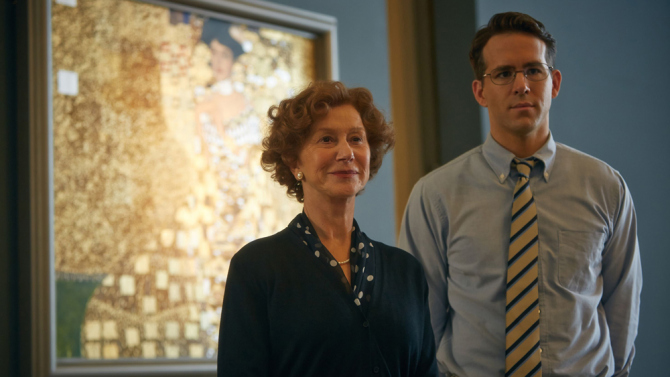
WOMAN IN GOLDThe very title is a form of theft. When Gustav Klimt painted the portrait that gives this film its name, he called it “Portrait of Adele Bloch-Bauer.” She was a warm, vibrant young woman who was a vital part of the extraordinary period of intellectual and cultural life in Vienna known as the Sacred Spring era. Adele Bloch-Bauer died in 1925, and the portrait hung in a place of honor in the apartment her husband shared with his brother, sister-in-law, and two young nieces.

And then the Nazis invaded Germany, their atrocities included stealing the valuables of the Jews they were sending to concentration camps. They took the portrait of Adele Bloch-Bauer and hung it in a place of honor, after they renamed it to remove identity of the subject and the Jewish association of her name. “Portrait of Adele Bloch-Bauer” became the anonymous “The Woman in Gold.” The beautiful choker necklace she wore in the painting was also stolen and given to the wife of Nazi officer Hermann Goering.

More than half a century later, Maria Altmann, the niece of Adele Bloch-Bauer, asked the grandson of her old friend from Vienna if he could help her get the painting back. This film is the story of the painting, the lawsuit, and Maria’s indomitable spirit.

Dame Helen Mirren is radiant as Maria, witty, spirited, an irresistible force who cannot give up. While we never doubt for a moment that she will prevail, Mirren makes us want to watch it all unfold. It is an extremely difficult case, with many arcane legal details, and the real-life story, like all real-life stories, is more complicated and controversial than any movie can convey. Director Simon Curtis (“My Week with Marilyn”) and first-time screenwriter Alexi Kaye Campbell keep the focus on the odd-couple relationship between Maria and the young lawyer (Ryan Reynolds), with flashbacks to show us Maria’s relationship with her Aunt Adele, and then her wedding to a handsome opera singer, just as the Germans are about to invade. Tatiana Maslany (“Orphan Black”) is lovely as the young Maria, and makes us believe she could grow up to become Helen Mirren.

The portrait of Adele Bloch-Bauer now hangs in the Neue Galerie. And now this movie is a part of its story, putting Adele back into the picture and giving us a portrait of the niece who insisted that her story be told.

Parents should know that this film includes WWII-era peril and violence, with references to concentration camps and genocide. There is brief strong language including anti-Semitic epithets.

Family discussion: Why did Maria refuse Ronald Lauder’s offer to get her more experienced lawyers? What was the most important discovery in winning the case?

If you like this, try: the documentary about Nazi art theft, “The Rape of Europa” and learn more about the lawsuit and read up on the real story

Related Tags:


Based on a book Based on a true story Courtroom Drama DVD/Blu-Ray Pick of the Week War
THE MOVIE MOM® is a registered trademark of Nell Minow. Use of the mark without express consent from Nell Minow constitutes trademark infringement and unfair competition in violation of federal and state laws. All material © Nell Minow 1995-2026, all rights reserved, and no use or republication is permitted without explicit permission. This site hosts Nell Minow’s Movie Mom® archive, with material that originally appeared on Yahoo! Movies, Beliefnet, and other sources. Much of her new material can be found at Rogerebert.com, Huffington Post, and WheretoWatch. Her books include The Movie Mom’s Guide to Family Movies and 101 Must-See Movie Moments, and she can be heard each week on radio stations across the country.

Website Designed by Max LaZebnik