Renfield

Renfield

Posted on April 13, 2023 at 8:05 pm

B
Lowest Recommended Age: Mature High Schooler
MPAA Rating: Rated R for bloody violence, some gore, language throughout and some drug use
Profanity: Very strong language
Alcohol/ Drugs: Alcohol
Violence/ Scariness: Extended fantasy peril and violence, vampires, some very grisly and disturbing images
Diversity Issues: None
Date Released to Theaters: April 13, 2023

Renfield
Copyright 2023 Universal Pictures
If I told you to try to imagine a film from the creators of “Rick and Morty,” “The Walking Dead,” and “Robot Chicken” based on the IP (intellectual property) owned by the movie studio behind “Frankenstein,” “Dracula,” “The Mummy,” and “The Wolfman,” you would probably guess that it would be a a very gory but amusingly slanted take on a classic, filled with goofy contemporary references. And you’d be right.

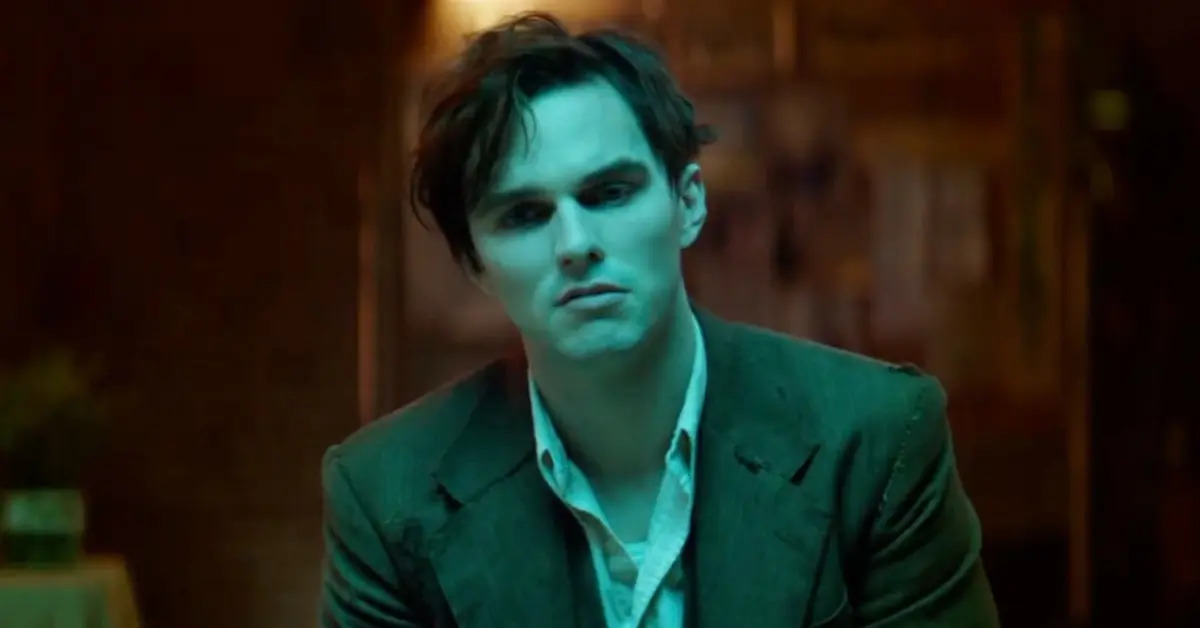
No one every paid much attention to Renfield in the many previous versions of the Dracula story, but as the title informs us, here he is the main character. Renfield is the unfortunate soul who is stuck as Dracula’s “familiar,” somewhere between a sidekick and a servant. Dracula has endowed (or cursed) him with eternal life at a lesser level. While Dracula (Nicolas Cage, having a blast) feasts on human blood, fresh, pure blood from unsuspecting tourists, nuns, and busloads of cheerleaders preferred, giving him some superpowers of strength and flight, blood that can cure injuries, and the ability to transform into bats, Renfield (Nicholas Hoult) feasts on insects, giving him extremely good fighting skills. They both have some vulnerabilities as well. Dracula has his well-known problems with sunlight (it makes him burst into flames) and can be confined within a circle of protection. He also cannot enter unless invited in, giving rise to one of this film’s funniest sight gags.

What would happen if Renfield, utterly in thrall to his master, joined a support group for people in co-dependent relationships? That is where this movie starts, with the contrast between Renfield’s gothic persona (the faux archival footage putting Cage and Hoult into the settings of Universal’s classic Bela Lugosi film are a lot of fun) and the pastel colors, folding chairs, and perky affirmations. The leader of the group is the empathetic Mark (Brandon Scott Jones of “The Good Place” and “Ghosts”). And when others in the group describe the people in their lives as monsters, Renfield can identify. Dracula and Renfield always have to be on the move, with a cycle of Dracula’s being attacked by hunters, reduced in power, and needing to recuperate. Their latest home is in a dank (of course) abandoned building in New Orleans.

It occurs to him that he can change his life by helping others, starting with Mitch (Dave Davis), the toxic boyfriend of support group member Caitlin (Bess Rous). When Renfield goes to confront Mitch, though, he ends up in the middle of a shoot-out with the Wolf gang, the city’s most powerful crime family, led by ruthless Bellafrancesca Lobo (Shohreh Aghdashloo) and her hot-headed son Teddy (Ben Schwartz).

Rebecca (Awkwafina) is the honest cop who has been trying to bring down the Wolfs, but the rest of the police force is on the Wolf payroll. Rebecca’s sister is part of an FBI task force investigating the Wolfs, but they have not made much progress. This is personal for them; their father, also in the police force, was killed by the Wolfs. When she is attacked by the Wolfs, Renfield saves her life. She sees him as a hero and he begins to see himself that way. He wants to keep that feeling. And he likes Rebecca.

Dracula has other plans. He wants total world domination. “There is no more good and evil; only followers and food.” Mark tells Renfield the person co-dependent with a narcissist is the one with the real power in their relationship.

While the trailer suggests that this is a comedy with vampires it is more of a bloodbath with some funny moments. Cage has the role he was born for and he, I have to say it, forgive me, sinks his teeth into it all the way and then some. Hoult deftly conveys the slightly decayed English gentleman, suffused with longing and regret and hoping some inspirational posters will help. Awkwafina is, as always, delightful. It’s good to see Universal making use of its IP, I mean archive, in an innovative and affectionate way.

Parents should know that this movie is extremely gory with lots of carnage and many graphic and disturbing images and sounds. Characters use strong language. The includes drug dealing and drug use.

Family discussion: How do support groups help people who are in toxic relationships? What does Renfield’s apartment tell us about his feelings? How did Dracula get people agree to be his familiars?

If you like this, try: “What We Do in the Shadows,” the film and television series, and of course the many versions of the Dracula story starting with the Bela Lugosi 1931 version imitated in this film’s fake archival footage
Related Tags:


Action/Adventure Based on a book Fantasy movie review Movies -- format Movies -- Reviews
Puss in Boots: The Last Wish

Puss in Boots: The Last Wish

Posted on December 21, 2022 at 12:40 pm

B +
Lowest Recommended Age: Kindergarten - 3rd Grade
MPAA Rating: Rated PG for action/violence, rude humor, language and some scary moments
Profanity: Mild schoolyard language and almost-language
Alcohol/ Drugs: None
Violence/ Scariness: Extended fantasy peril and action, comic "deaths," some scary monsters, a character embodies death
Diversity Issues: None
Date Released to Theaters: December 23, 2022
Date Released to DVD: February 27, 2023

Puss in Boots: The Last Wish
Copyright 2022 Universal/Dreamworks
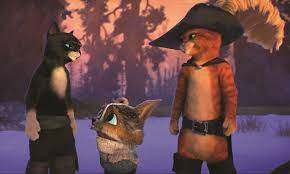
The swashbuckling fairy tale cat Puss in Boots (Antonio Banderas) likes to remind everyone of his heroic, adventurous spirit, his skill with a sword, and his gift for singing. When pressed, as he is in “Puss in Boots: The Last Wish,” by a doctor, he will admit that he is not much at math. And this is relevant because, as we know, a cat has nine lives, and if Puss had been keeping score he would have realized that he has used up…eight of them. It does not require a lot of math skills to figure out that means he is on his last one and has to be careful.

And that is how, after an opening scene filled with swordplay, acrobatics, and valor, including the defeat of a superbly designed tree giant, Puss ends up living with a cat lady (Da’Vine Joy Randolph, warm-hearted with just a touch of dottiness). “I’m always on the lookout for a new lap cat!” she says. Puss sadly buries his feathered hat and boots and resigns himself to the indignities of blue booties, eating cat chow from a trough, and using a litter box.

But then he discovers there is one chance to reboot his lives. It involves a magical map to the location of a fallen star that can grant just one wish. He is not the only one who wants that wish, though. Goldilocks (a hilarious cockney-accented Florence Pugh) and her three bear crime family (Ray Winstone, Olivia Colman, and Samson Kayo) and Big (formerly Little) Jack Horner (John Mulaney in full sneer mode) want the wish. And so does Kitty Softpaws (Salma Hayek), whose fearlessness and swords(wo)manship are every bit a match for PiB, with a history together that makes them both wary and attracted to one another.

And so, Puss is off on a journey and in a race with the other groups trying to beat him to the wish. And as we expect from the SCU (Shrek Cinematic Universe), there will be humor ranging from sly references for the grown-ups to slapstick for the young and the young at heart. And there will be action, adventure, some heartwarming lessons about friendship and a little bit of romance. It is always fun to see or rather hear “Desperado” co-stars Hayek and Banderas together again.

The character design and movement is very well done, especially the tree giant, the wolf/bounty hunter who represents Death, and Goldilocks. And the animation style is wonderfully dynamic and expressive. I especially enjoyed the mix of animation styles. We are all used to the hyper-realism of CGI, with every hair in a cat’s fur rendered individually. So it was especially nice to see the contrast between that realism and a more impressionistic depiction of fur on the coats of the three bears or the bark on the tree giant. The combination works surprisingly well and a slight strobe effect on some of the action scenes gives them a joyfully dynamic comic-book pop.

This new chapter keeps the best of the series’ humor and heart and adds new touches to keep the story and characters vibrant. If they can keep this up, Puss should have many more lives.

Parents should know that this film has some mild schoolyard language and some almost-language, some potty humor, and extended fantasy action with some peril and violence that almost reaches the PG-13 level, including flashbacks of Puss in Boots’ first eight “deaths.”

Family discussion: If you had nine lives, what chances would you take? What was different about what Golidlocks and Jack Horner wanted to wish for?

If you like this, try: The other Shrek and Puss in Boots movies and the fairy tales and nursery rhymes that inspired them.

Related Tags:


Action/Adventure Based on a book DVD/Blu-Ray Fantasy movie review Movies -- format Series/Sequel
Living

Living

Posted on December 13, 2022 at 10:39 am

A-
Lowest Recommended Age: High School
MPAA Rating: Rated PG-13 for smoking and some suggestive material
Profanity: Mild language
Alcohol/ Drugs: Drinking and drunkenness, smoking
Violence/ Scariness: Terminal illness
Diversity Issues: None
Date Released to Theaters: January 7, 2023
Date Released to DVD: April 11, 2023

Living
Copyright 2022 Sony
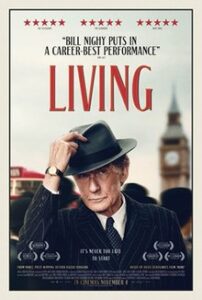
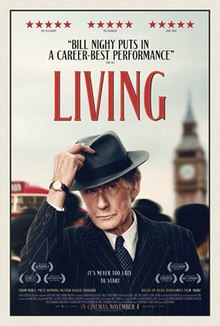
An 1886 novella by Leo Tolstoy inspired Japanese director Akira Kurosawa to create one of the most acclaimed films of all time, “Ikiru,” in 1952. And now those two core works have inspired an extraordinarily wise and touching British film starring Bill Nighy called “Living,” with a screenplay by Nobel Prize-winner Kazuo Ishiguro. What has drawn all of these artist together is that most profound of existential questions, literally the meaning of life. And like the two earlier works, “Living” is superb in every detail.

The story is set in post-WWII London. Mr. Williams (Nighy), a supervisor in a government office, overseeing a group of mostly white men (one woman, one Indian-British) who sit around tables piled high with file folders and documents. The production design by Helen Scott and cinematography by Jamie Ramsay are impeccable. We follower newcomer Peter Wakeling (Alex Sharp) as he begins to learn the way the office works. His colleagues board the commuter train together. “This time of morning, not too much fun and laughter. Rather like church,” he is cautioned by one of his new co-workers after he ventures some mild self-deprecating humor. All conversation is highly professional, quiet, understated, and exquisitely polite.

A group of local women trying to get a permit to turn a small area that was bombed in the Blitz turned into a playground keep coming to Mr. Williams’ department. And every other department in the building, because each one tells them it is someone else’s responsibility. For Mr. Williams, his job is about moving paper, not helping people.

After he gets the bad news from his doctor, Mr. Williams practices telling the son and daughter-in-law who live with him that he only has a few months to live. His emotional vocabulary is so shrunken, so limited, the only word he can think of to describe the situation is, “bore.”

He cannot bring himself to tell them, even or especially after he hears them talking about how they want to move out and live on their own. And then, Mr. Williams, the most methodical and reliable of men, does not go to his office. He finds his way to the seaside and strikes up a conversation in a bar with a bon vivant writer (Tom Burke), one of only two people he will tell about his diagnosis. The writer suggests spending his last months having fun, and they spend a raucous evening together, but that is not what Mr. Williams needs.

The second person he tells is a former co-worker, who spends some time with him, and it is her example that helps lead him to an understanding of what he needs to make the final time meaningful.

Nighy, always superb, has never been better. He is able to show us emotions that Mr. Williams does not even understand he is experiencing. Every moment of this film is exquisite, a poetic elegy to reveal not only Mr. Williams’ purpose but our own.

Parents should know that this movie deals with a terminal illness. There is some mild language, drinking, and drunkenness.

Family discussion: What do you and the people around you to do find meaning? Will the people in Mr. Williams’ office keep their pledge? Why didn’t he tell his son what was going on?

If you like this, try: “The Browning Version” (1951 version) and “Last Holiday” (1950 version), two British films from the era depicted in this film with related themes, and “Ikuru” and “The Death of Ivan Ilyich” as well.

Related Tags:


Based on a book Drama DVD/Blu-Ray Pick of the Week movie review Movies -- format Remake
White Noise

White Noise

Posted on December 1, 2022 at 5:15 pm

C
Lowest Recommended Age: High School
MPAA Rating: Not rated
Profanity: Some strong language
Alcohol/ Drugs: Alcohol and drugs
Violence/ Scariness: Apocalyptic themes
Diversity Issues: Diverse characters

White Noise
Copyright 2022 Netflix
Don DeLillo’s 1985 novel White Noise won the National Book Award for fiction. It was an apocalyptic satire about a couple in an academic community who both have a sense of dread and fear of death, and what happens when a toxic cloud causes a massive evacuation. Pretty much everyone agreed that it was un-filmable because so much of its value depended on the book’s tone, which would be impossible to convey on screen. But Noah Bumbach decided that for his first time directed a script based on a book (he co-wrote but did not direct the adaptation of Roald Dahl’s “Fantastic Mr. Fox”) White Noise would be it.

It’s probably even more of a challenge to translate to film now than it was 27 years ago because some of the wildest exaggerations of the satire now seem to be commonplace elements of our daily life. And its reflections on consumerism and the way we separate ourselves from daily and existential considerations are too well-traveled to be meaningful without some freshness in their presentation.

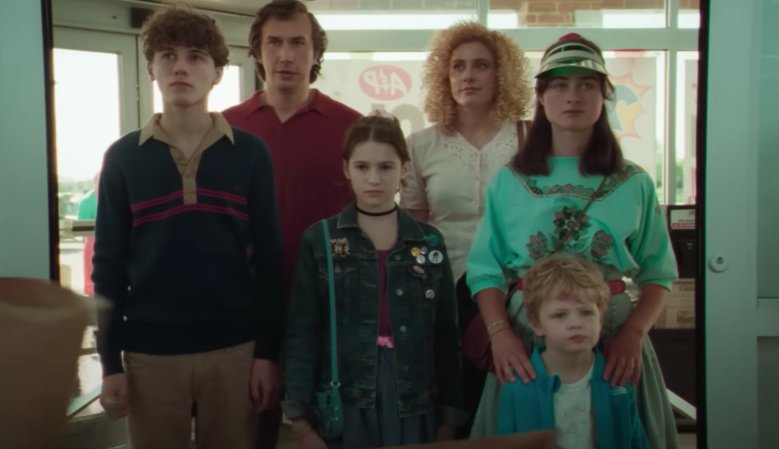
Jack Gladney (Adam Driver) is a professor at the fictional College on the Hill, married to Babette (Greta Gerwig), a warm-hearted woman with intensely crimped hair. Each has been married three times before, and they blended family includes children from the previous relationships and one they had together. They have a loving, intimate relationship, though both are pre-occupied with a fear of death and talk about which one of them will die first.

Jack is a pioneer in Hitler studies, though he does not speak German. He has a new colleague, Murray Siskind (Don Cheadle), who lectures on popular culture themes like car crashes in movies and hopes to be the leading scholar on Elvis Presley. One of the film’s highlights is an almost rap battle after Murray asks Jack to help him by participating in his class.

Some kind of toxic cloud descends, triggering an evacuation. As families shelter in a gigantic warehouse, Jack learns that because he stopped to put gas in the car, his exposure may mean that he has only a short time to live. The bureaucratic obtuseness is briefly touched on, and then the story swings into trying to find out what medicine Babette has been taking.

Bumbach is skilled at intimate, complicated family dramas like “The Squid and the Whale” and “Marriage Story.” He is not able to find a heightened tone for this narrative with the different directions of its three stories and characters who are more symbolic than real. Driver and Gerwig both give excellent performances but they are too sincere and accessible for this brittle material. The credit sequence is the best part of the movie, coming closer to matching the themes than the two hours leading up to it.

Parents should know that this film deals with apocalyptic issues and family struggles over drugs and adultery. There is some peril and violence including guns and attempted murder. Characters use strong language.

Family discussion: How have things changed since this book was written and the era it depicts? Why didn’t Babette tell Jack the truth?

If you like this, try: the book by Don DeLillo and Baumbach’s other films

Related Tags:


Based on a book movie review Movies -- format Movies -- Reviews Satire
Rosaline

Rosaline

Posted on October 12, 2022 at 9:52 am

B +
Lowest Recommended Age: High School
MPAA Rating: Rated PG-13 for some suggestive material and brief strong language
Profanity: Strong language (s-words, one f-word)
Alcohol/ Drugs: Some alcohol
Violence/ Scariness: Some swordplay and fight scenes
Diversity Issues: A theme of the movie
Date Released to Theaters: October 14, 2022

Rosaline
Copyright 2022 20th Century
Most people do not remember that before he met Juliet at the masked ball and instantly fell in love with her as they communicated not just by iambic pentameter but by sonnet, Romeo was in love with Juliet’s cousin Rosaline. She was also a Capulet and a part of the family of his family’s sworn enemies. It’s easy to forget her because Romeo did. Though the whole reason he snuck into the party was to see the girl he described as “the all-seeing sun ne’er saw her match since first the world begun,” as soon as he sees Juliet, it is as Benvilio correctly predicted: “Compare her face with some that I shall show, and I will make thee think thy swan a crow.” Next thing we know he’s telling Friar Lawrence, “I have forgot that name, and that name’s woe.”

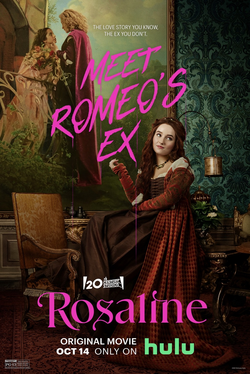
Ever wonder how the story might look from Rosaline’s perspective? Author Rebecca Serle did, with her novel, When He Was Mine, now the basis for a witty romantic comedy starring the wildly talented Kaitlyn Dever (who also executive-produced) as the woman scorned. It is sly, clever fun on its own, but the better you know Shakespeare’s play, the more you will enjoy it.

it begins on a balcony. Rosaline’s balcony. Romeo is telling her about his feelings, in words that will seem familiar. And, as will also seem familiar, their secret tryst is interrupted by a call for her from inside. Like Juliet, she has a nurse/confidant (a terrifically dry Minnie Driver), and a father who is eager to marry her off (Bradley Whitford). Rosaline believes that she and Romeo are meant to be together (though she is not quite ready to say, “I love you”).

And then, while on a boat with one of the suitors her father has foisted on her, she misses that Capulet masked ball, and, well, we know that part of the story. That suitor is Dario, played with full Shakespearian dash, wit, and gallantry by Sean Teale, and in true Shakespearian fashion, when not writing about instant true love, they begin as hostile combatants. He even calls her a shrew. This is a reference, of course, to another Shakespeare play, but no one gets tamed in this one.

But, in this version, Rosaline, the woman scorned, does go all-out “My Best Friend’s Wedding” on her cousin, and tries every way she can think of to get her boyfriend back. She even enlists Dario’s help. Like the recent “Catherine Called Birdy,” much of the humor comes from a very modern sensibility, with contemporary language, pointing up some of the absurdity of the canon.

Juliet is played by sweet-faced Isabela Merced. At first, she is intrigued by what Rosaline has to show her about the bigger world. When she realizes that Rosaline has not been honest with her, she pursues the relationship with Romeo and comes up with a plan to pretend to be dead. Rosaline says what audiences have been waiting to say for centuries. It is a dumb plan. And those audiences will appreciate what Rosaline and Dario work out as a better ending, especially with a mid-credit. sequence harking back to Dario’s description of what he thinks love is. Romeo may be great at poetic speeches on balconies, but you need more than that on life’s journey.

For the record, this movie does not “ruin” or even disrespect “Romeo and Juliet.” The play and its many versions and variations are still with us, from the Franco Zefferelli and Baz Luhrmann films to the Gounod opera and “West Side Story.” They are all still there, intact, and easy to access. What this does is remind us that even minor characters in our stories can have value and agency, that exploring other perspectives can increase our understanding and empathy. And that it can be a lot of fun.

Parents should know that this film includes some strong language and swordplay violence.

Family discussion: What story would you like to re-tell from a minor character’s perspective? What made Rosaline and Dario change their minds about each other? What do you think of Dario’s description of love?

If you like this, try: “Ophelia,” a smart and serious version of “Hamlet” from the perspective of the young woman, “Catherine Called Birdy,” another sharp modern take on a medieval story about a young woman, and “A Knight’s Tale”

Related Tags:


Based on a book Based on a play Comedy movie review Movies -- format Movies -- Reviews Romance Satire Scene After the Credits
THE MOVIE MOM® is a registered trademark of Nell Minow. Use of the mark without express consent from Nell Minow constitutes trademark infringement and unfair competition in violation of federal and state laws. All material © Nell Minow 1995-2026, all rights reserved, and no use or republication is permitted without explicit permission. This site hosts Nell Minow’s Movie Mom® archive, with material that originally appeared on Yahoo! Movies, Beliefnet, and other sources. Much of her new material can be found at Rogerebert.com, Huffington Post, and WheretoWatch. Her books include The Movie Mom’s Guide to Family Movies and 101 Must-See Movie Moments, and she can be heard each week on radio stations across the country.

Website Designed by Max LaZebnik