
The Women

Posted on September 23, 2008 at 8:00 am

It isn’t so much that they have updated or re-invented the brilliantly acidic Claire Boothe Luce play that was adapted for a classic 1939 movie; they completely misunderstood it. The surface details of the original may need updating but its essential message and mordant wit are timeless. This version, in the works for more than a decade, is soft-focus but high-gloss, substituting empowerment for devotion. It is entertaining but it has a bitter aftertaste.

The original, the musical remake with June Allyson, and the new version all center on Mary Haines (Meg Ryan), who seems at the beginning to have it all — a beautiful home, a great job, good values, a loving family, and a lot of women friends, and who discovers that her husband is having an affair with a girl from the perfume counter. The original was written at a time when the daily lives of New York society women were as unknown and exotic to the men in their lives as to everyone who did not live on 5th Avenue. Each character was an example of one of a range of different coping mechanisms for the pampered birds in their silver cages. Without a single male in the cast, the story was told in women-only settings like an afternoon bridge game, a luxurious day spa, elegant stores, and a Nevada ranch-full of women establishing their six-week residency as the only way back then to get a divorce. Most of the characters were silly, selfish, cynical, or alone. And Mary painfully learned that “pride is a luxury a woman in love can’t afford.” Her husband and family must come first.

In this Oprah-fied version, it’s still an all-female story, and sistahs are doin’ it for themselves. The diamond rings on their fingers are gifts the women exchanged with each other. Mary says that she lost her job, her husband, and her best friend, and it is the best friend she misses most. And Mary’s great revelation comes from asking herself not what is best for her family but what she wants.

Some worthwhile thoughts about the way women lose themselves in what Oprah calls “the disease to please” are lost in the new-agey self-absorption of tasks like making a collage of magazine cut-outs to define your dreams and transforming your life by straightening your previously adorably curly hair. In the original, a woman’s heart got a make-over. Here, it’s just her hairstyle. And the actresses, who have the benefit of great genes and the finest cosmetic treatments in the world, have the chutzpah to do a post-credits coda reminding those of us in the audience who are not out at the parking lot already that inner beauty is what matters.

The all-star cast is sublimely watchable, especially Mary’s close friends: Annette Benning as a harried single magazine editor, an ever-pregnant earth mother (Debra Messing), and the spirited gay friend (Jada Pinkett-Smith). Bette Midler shows up as a brassy multi-married agent and the femme fatale behind the perfume counter is Eva Mendes. There are some clever in-jokes for fans of the first version and the able cast knows how to give the dialogue from writer/director Diane English snap. But the script makes the same mistake its characters do — it tries to do too much and to be whatever everyone wants.

This movie is less true to the original than it is to the girlcrush/shopping fetish “Sex in the City.” Instead of wit we get quips. Instead of poignant conversations about love and loss we get wisecracks and shoe shopping. “What do you think this is, some kind of 1930’s movie,” one character asks. We wish.
Related Tags:


Comedy Drama Remake

Sex and the City

Posted on September 23, 2008 at 8:00 am

No spoiler alert is required before disclosing that the very appropriate and deeply satisfying fade-out at the end of this film has its four heroines happily going off into the metaphorical sunset….with each other. That is the great love story of the movie.

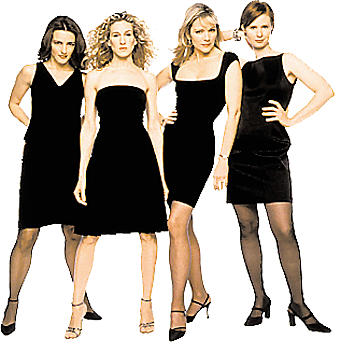
The four women in this movie version of the wildly popular and influential HBO series (off the air for four years but now running in expurgated form on broadcast channels in reruns) may think they yearn for romance. But in reality the men in their lives are there primarily as topics of conversation for the relationships that matter most. It is their friends who make them laugh, their friends that they want to call first with good news or bad, their friends whose lives — and clothes — are their primary concern, their friends who are always intensely interested in every detail of each other’s lives, their friends who reflect themselves and all they might be back to them like a dressing room with a magic mirror. In this woman-centered, fashion-drenched world, men are an accessory. sex20and20the20city1.jpg

Indeed, as with stories like, well “Friends,” “Seinfeld,” “Divine Secrets of the Ya-Ya Sisterhood,” “Steel Magnolias,” and even “Bratz,” the intense connection of those relationships is the essence of the appeal of the series and the movie. While we watch them, we connect to our own reality about the vital role that friends play in our lives and we tap into the deep wish in all of us for people in our lives who are infinitely interested and spaciously accepting of the tiniest details of our lives. It is telling that the biggest falling-out among the four friends in this movie is not about doing something wrong. The real transgression is in not being willing to confess all immediately.

Here we also connect to the fantasy of their ziplessness. The four women eat and drink constantly and never seem to exercise or diet but always look model-thin and glowingly gorgeous, their sexual encounters are almost always steamy and satisfying and when they aren’t they are even more fun to talk about, they almost always recover from unhappy romantic encounters by the next episode, and they manage to buy and look sensational in endless and endlessly fabulous ensembles of high-fashion mixed with impeccably chosen vintage and street goodies. It’s like playing Barbies for grown-ups. The sex scenes are not nearly as titillating as the fantasy of fashion and New York glamour, wrapped in a cozy feather comforter of the perpetually supportive cheering section.

Friendship is at the core, but there is plenty of material about the other great pre-occupations of the movie, like the television series: romance, sex, fabulous clothes and shoes, parties, and plumbing the depths of one’s own desires), plus what may be an all-time record number of on-screen apologies. My husband says that an apology, preferably humiliating and public, is the essence of a chick flick. If he is right, this one goes to the top of the list.

The credit sequence briskly brings us up to date, letting us know that the ladies and the world have moved on since writer Carrie (Sarah Jessica Parker), lawyer Miranda (Cynthia Nixon), married mom Charlotte (Kristen Davis), and publicist/manager Samantha (Kim Cattrall) appeared to be headed for happily-ever-after-ville at the conclusion of the series. The tinkling theme music quickly shifts into hip-hop and we find that everything that seemed neatly tied up four years ago is about to become if not completely untied a little bit tangled. People in their 40’s know themselves better than those in their 30’s, but they are also more aware of their narrowing options and the impact of the choices they are making and the ones they do not make.

Carrie and Mr. Big (Chris Noth as John James Preston) are still happily in love and looking for a place to move in together. An jewelry auction for the collection of a billionaire’s discarded mistress, she begins to worry about what would happen to her if Preston decided to leave her. When she tells him that, they decide to get married. Caught up in the fantasy of the ultimate wedding as fashion statement, helped along by posing for a magazine spread modeling bridal gowns by all the top designers, Carrie loses sight of the meaning of the event and the pressure she is putting on the man we will continue to refer to as Mr. Big. Miranda and her husband Steve (David Eigenberg) struggle with burnout and trust issues. Samantha, in Los Angeles with her boyfriend of five years, the hunky Smith (Jason Lewis), having helped him become a big star , misses New York, her friends, and her polyamorous lifestyle, wonders if she can continue to compromise.

The screenplay is uneven and it tilts too far on the side of retail therapy. That is a function of the realities of modern-day feature film financing — who could have imagined a day that movies would end up more commercial than television? All the more credit for HBO’s commitment to artistic integrity for avoiding the endless recitation of labels and designers, which gets a little intrusive.

But it all goes down as easy as that third Cosmo thanks to the eye candy, our affection for the characters, and the skill of all involved. The slight deepening of the issues and characters works well. As has been remarked before, as in many multi-character sagas, it is intriguing to think of Carrie, Miranda, Charlotte, and Samantha as different aspects of one single personality — id, supergo, ego, and libido.

All of the returning stars look sensational and they each know their characters and their fellow performers so well that the chemistry sizzles and the timing purrs. Jennifer Hudson (“Dreamgirls”) is a welcome addition as Carrie’s new assistant, her warmth and sparkle providing Carrie with a fresh opportunity to show something we almost never saw from her in the series, generosity of spirit and consideration. There are at least three dazzling fashion shows (something of a throwback to old movie classics like The Women, which, in the pre-Internet, pre-television days, served a dual purpose by alerting the women in the audience to the current styles. There are little detail goodies for serious fans (the iconic tutu that gets splashed in the series’ opening sequence and enough going on to entertain casual viewers. It is far from a great movie, but it is a thoroughly enjoyable one and does justice to the aspirations of the series and to its devoted fans.
Related Tags:


Comedy Romance

Tyler Perry’s The Family That Preys

Posted on September 18, 2008 at 3:00 pm

B+
Lowest Recommended Age: Middle School
MPAA Rating: Rated PG-13 for thematic material, sexual references and brief violence.
Profanity: Mild language
Alcohol/ Drugs: Drinking
Violence/ Scariness: A couple of hard punches
Diversity Issues: A theme of the movie
Date Released to Theaters: September 12, 2008

Tyler Perry’s latest film is more traditional and with a more consistent tone than his “Medea” movies, but it has his trademark trio: sincerity, spirituality, and story. And if he passes on that other “s” — subtlety, that’s all right. Reminiscent of the classic Hollywood melodramas filled with financial, romantic, and family anguish, this is the story of two families, one white and wealthy, one black and poor, and the many ways they interact — in business, in friendship, in love, and in battle.

Both families are headed by strong, determined single mothers. Charlotte (Kathy Bates) is the matriarch of the wealthy Cartwright family and holds the controlling shares in its construction business. Her closest friend is Alice (Alfre Woodard), the owner of a run-down diner who is always willing to give a free meal and clean clothes to someone who needs help. Charlotte’s son William (Cole Hauser) wants to take over the family business, with or without his mother’s approval. Alice has one daughter Pam (Taraji P. Henson) who works in the diner and another one (Sanaa Lathan as Andrea) who has a degree in finance and a lot of ambition. She works directly with William and both sisters’ husbands are construction workers for Cartwright with dreams of starting a firm of their own.

Writer/director/star Perry (he plays only one role this time, Pam’s husband) takes on big themes and big drama: sex, love, death, betrayal, and corporate takeovers, but all presented with heart and sincerity and a firm and genuinely inspiring devotion to God and to doing for others. It is sheer pleasure to watch Bates and Woodward take on these roles. On a road trip (“Like Oprah and Gayle!”) or in a boardroom, tucking bills in the thong of a male stripper, confronting heartbreak, counting blessings, they keep us watching and caring.

Related Tags:


Comedy Drama Movies -- format

The Love Guru

Posted on September 16, 2008 at 8:00 am

Anyone old enough to see this movie is way too old to enjoy it. And having co-writer and star Mike Myers wink at the audience after some lame pun or potty joke doesn’t up the hilarity factor. The fact that he is willing to acknowledge how cheesy this material is does not mitigate damages.
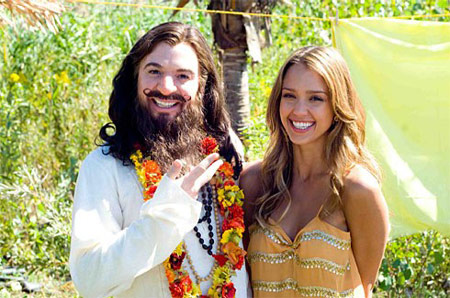
love%20guru.jpgIn his last live action movie Mike Myers played three characters and two of them, the grossly obese and just plain gross Fat Bastard and even the title character, ever-ready-to-party Austin Powers, were one-joke concepts. Myers and the film were best when the focus was on the villainous Dr. Evil. In his latest film, “The Love Guru,” Myers only plays one character but he is the least interesting figure in the movie, or at least the least interesting male. The wonderfully talented Meagan Good and the appealing Jessica Alba have nothing to do but gaze adoringly at whichever male the script asks them to, which they do reasonably well, and look very, very fetching, which they do extremely well. Meanwhile, Myers’ character, the Guru Pitka, has a beard that obscures much of his face and a storyline that underneath all of the gross-out humor is just dull.
Pitka is an American raised in an ashram who always came in second to his rival — Deepak Chopra. Their teacher was cross-eyed Guru Tugginmypudha, played by a slumming Sir Ben Kingsley, whose Indian ancestors are revoking their reincarnation options at this moment. That character name is one of many, many examples of the non-stop naughty-body-part-references. The level of humor would be more appropriate on a 4th grade bathroom wall than a Hollywood screenplay.
Pitka is a best-selling author and popular spiritual leader but still second to Chopra. His chance to move into first place comes when the owner of the Toronto Maple Leafs hockey team (Jessica Alba) hires him to treat the star player (Romany Malco, please, please someone give this handsome and talented actor a part worthy of him) who is distraught because his wide (Meagan Good) has left him for another team’s goalie, Jacques “Le Coq” Grande (Justin Timberlake). The nickname, in case it isn’t clear, is another achingly un-subtle body-part reference and refers to his most impressive physical attribute. With a running time of less than 90 minutes, the movie still finds time to repeat jokes about the size of that attribute but it never gets funny. Ever. This movie has the timing of chilled molasses.
The movie also includes elephant poop, a sort of ashram dodgeball played with pee-soaked mops, a chastity belt (and when he is aroused there’s a clang sound, get it?), references to a little person (“Austin Powers'” Verne Troyer) as a Kebler elf, a gnome, and a hobbit, crotch hits, random musical numbers, and meaningless cameos by embarrassed-looking semi-stars.
Even in a silly comedy the audience has to be able to connect to the characters and care about the story and that never happens here. Myers could have made fun of American susceptibility to spiritual leaders who appear on “Oprah” and write best-sellers filled with gimmicky aphorisms supposedly based on ancient wisdom. But it is evident that he has been genuinely touched by Chopra (they appear together on the Sundance Channel’s Iconoclasts series). This is lovely for him but a real buzzkill for the movie. It is also a mistake to make the task assigned to him the reconciliation of a couple who split up without having us invest in any way in either of the characters or their feelings for each other. Good’s character loses our sympathy immediately for leaving her husband for no particular reason for a man who is completely obnoxious (though Timberlake is very funny in the movie’s only bright spot). And the movie is creepily misogynistic, with Malco’s problems all coming down to his faithless wife and his harridan of a mother (played by Telma Hopkins of Tony Orlando and Dawn!). The movie seems like one long regression therapy session for Myers, who seems to have taken the guru’s messages about how everything he does is wonderful a little too much to heart.

(more…)

Related Tags:


Comedy

Rolling Stone on the State of Comedy

Posted on September 16, 2008 at 8:00 am

The cover of the comedy issue of Rolling Stone has David Letterman, Tina Fey, and Chris Rock and the stories inside include raucous recollections of “notes,” the edits and suggestions from studio and network executives. My favorite is Mel Brooks’ description of carefully writing down all the things that had to be taken out of “Blazing Saddles” and then, after the meeting was over, crumpling it up and throwing it away. Top comedians and comedy writers share their favorite funny movies, their biggest breakthroughs, and their biggest flops. Letterman’s interview has some thoughtful and touching comments on Warren Zevon’s last appearance on the show and his relationships with everyone from Madonna to Johnny Carson and the girls from “The Hills.” rolling stonejpg
Be sure to check out the online extras, including video clips from five comics to watch and nine comedy all-stars have a blast at the photo shoot.

Related Tags:


Comedy Understanding Media and Pop Culture
THE MOVIE MOM® is a registered trademark of Nell Minow. Use of the mark without express consent from Nell Minow constitutes trademark infringement and unfair competition in violation of federal and state laws. All material © Nell Minow 1995-2026, all rights reserved, and no use or republication is permitted without explicit permission. This site hosts Nell Minow’s Movie Mom® archive, with material that originally appeared on Yahoo! Movies, Beliefnet, and other sources. Much of her new material can be found at Rogerebert.com, Huffington Post, and WheretoWatch. Her books include The Movie Mom’s Guide to Family Movies and 101 Must-See Movie Moments, and she can be heard each week on radio stations across the country.

Website Designed by Max LaZebnik