
Meet Me in St. Louis

Posted on October 27, 2008 at 8:00 am

This episodic story of the Smith family in the St. Louis of 1903 is based on the memoirs of Sally Benson.  Its pleasures are in the period detail, the glorious songs (including standards “The Trolley Song” and “Have Yourself a Merry Little Christmas”) and the loving and nostalgic look at a time of innocence and optimism, where a long-distance call was almost as thrilling as having the World’s Fair come to your very own city.  We see the family over the course of a year, celebrating Halloween and Christmas, riding the ice truck in the summer and building snowmen in the winter.  They face the prospect of having to leave St. Louis so that  Mr. Smith can accept a promotion.  They wonder whether the older girl’s two boyfriends will propose.  They treat each other with great loyalty and affectionate tolerance.  And then they live happily ever after.

The Smith’s older daughters are Rose (Lucille Bremer) and Esther (Judy Garland).  Rose is attracted to Warren Sheffield, and a bit impatient because he has not proposed.  Esther has decided to marry “the boy next door,” John Pruitt (Tom Drake), even though they have not yet met.  When the girls have a party, their two little sisters (Joan Carroll and Margaret O’Brien as Agnes and Tootie Smith) creep downstairs.  Tootie is allowed to do one song with Esther (the cakewalk “Under the Bamboo Tree”) before being sent back to bed.  Esther asks John to help her turn out the gas lights before he leaves, to have some time alone with him.  The next day, he joins her as she and her friends ride on the trolley, and when he catches up with them, she sings “The Trolly Song.”  Later, Warren escorts a visiting out-of-town girl (June Lockhart) to another party, and Esther and Rose conspire to fill her dance card with the least appealing partners at the dance.  When she is revealed to be so friendly and tactful that she gets Rose and Warren back together, Esther has to take all of her dances.  Tootie is heartbroken about moving to New York, and while the rest of the family tries to hide it, they are, too.  Mr. Smith gives up, they stay in St. Louis, and when the fair opens, they are there.

http://www.youtube.com/watch?v=BQ2Q8_P_msg

One of the movie’s most evocative scenes is Halloween, celebrated very differently in those days, but like today the one night of the year where children have the power to frighten the grown-ups.  Agnes and Tootie dress up in rags and “kill” the people who answer the door by throwing flour at them.  Director Minnelli skillfully shows how spooky and at the same time thrilling it is for the girls to be out after dark.  When Tootie is successful at “killing” the grouchy neighbor, she is heralded by the other kids, and blissfully announces, “I’m the most horrible!  I’m the most horrible!”

This is one of the most loving of all movie families.  Everyone in it treats all of the other members with trust and affection, even, when it comes to Tootie, indulgence.  They are interested in each other and take each other’s concerns seriously, whether it is the seasoning of a sauce or choice of a future spouse.  Only the poor father is rather left out. He is not told about the long distance call, and no one is pleased with his promotion.  But in a way, that is just a reflection of the family’s devotion to him and to the life they have together in St. Louis.   And the lovely duet he sings with his wife, “You and I,” shows that it is their relationship that is the foundation of the family.

Minnelli began as an art director and designer, and his use of color is always fresh and fun — there isn’t another director in history who would have thought to put Esther in purple gloves for the trolley ride, but once you see it, you can’t imagine any other color.
Related Tags:


Based on a book Comedy Family Issues For Your Netflix Queue Inspired by a true story Marketing to Kids Musical Romance

High School Musical

Posted on October 20, 2008 at 8:00 am

A-
Lowest Recommended Age: All Ages
MPAA Rating: G
Profanity: None
Alcohol/ Drugs: None
Violence/ Scariness: None
Diversity Issues: Diverse characters
Date Released to Theaters: 2006
Date Released to DVD: 2006
Amazon.com ASIN: B000F2BNW2

This week, as the powerhouse franchise that is known as “HSM” moves from television to CD (top-seller of the year), DVD, stage show, video game, ice show, birthday party decoration theme, and now feature film theatrical release, it’s time to take another look at the original that became the unstoppable hit of 2006, the original Disney Channel movie, “High School Musical.”

When Troy (Zac Efron) and Gabriella (Vanessa Anne Hudgens) find themselves singing karaoke together at a resort on New Year’s Eve, they feel a connection. But then it turns out she has transferred to his school. Vacation is one thing, but at school people tend to stick to clearly defined roles. He’s a basketball star. She’s a math whiz. Their friends all think anyone outside their group is not worth talking to, and the idea of liking anything different is not tolerated.

But they still have music in common — and a lot of chemistry (Efron and Hudgens became a real-life couple). Despite the best, or perhaps I should say worst efforts of bother-sister scene-stealers Ryan and Sharpay Evans (Lucas Grabeel and Ashley Tisdale as HSM’s version of Team Rocket) to hold onto the lead roles in the…high school musical, talent and integrity win the day.

My favorite number in the show is the joyous salute to being yourself, “Stick to the Status Quo.” Can’t wait to see HSM3. Go Wildcats!

Related Tags:


Comedy DVD/Blu-Ray Pick of the Week For all ages Musical Romance Series/Sequel

You Don’t Mess With the Zohan

Posted on October 7, 2008 at 8:00 am

Somewhere inside this Adam Sandler slacker silliness there is a fierce and provocative little satire trying to get out. Sandler is so busy with his usual shtick that at times it seems that even he hardly notices the subversive political humor bubbling up around him.

Sandler plays Zohan, a top Israeli assassin, who can slaughter terrorists with one hand while he scoops hummus with the other. He is commando as rock star, universally admired and adored by all women. But Zohan dreams of peace and hairdressing. He decides to fake his own death and move to the United States where he can spend his days making hair shiny and silky. Soon he has transformed himself with an 80’s haircut and has a job sweeping up hair in a beauty salon on the Palestinian side of the street in a middle Eastern neighborhood of New York and is happily having sex with all of the elderly patrons and his landlady (all-purpose ethnic hot mama Lainie Kazan).

Comedians most often rely on ineptitude at work or with women to get laughs, but Sandler’s characters are often very successful in both. That leaves only gross-outs and silliness for humor, and that is what Sandler gives us, over and over. Lots of jokes about sex with old ladies (who are all thrilled with his prowess), bare tushes (male and female), the consternation of his landlady’s nerdy son over his mother’s unabashed sexual encounters, the ability to withstand pain, made-up euphemisms for sex, random pop star cameos, and of course one of Sandler’s theme moves — a sharp implement being thrust into the body of someone who feels no pain. We’ve seen most of this before.

But the movie also has moments of surreal humor, some remarkably adept and surprisingly understated political satire, and better roles than usual for Sandler’s frequent co-stars John Turturro and Rob Schneider. Its (almost) even-handed jibes at just about everyone are refreshing. Of course the real bad guy is a white American, but the movie’s notion that this is a place where people may hate and do crazy things but they can all agree on the importance of shiny hair, good Chinese food, and the other things that really matter in life is sweetly hopeful. All the crotch-rubbing and hummus humor feels tired and shrill when we see would-be terrorists put on hold from the bomb-building line, cheerfully reassured by the recorded voice that “we will resume service as soon as negotiations break down” or a bunch of enemies interrupting a confrontation to speculate on the, uh, appeal of Hillary Clinton.

The outrageous stereotyping and stereotype tweaking of characters on the basis of race, culture, religion, and nationality may be softened or even sanitized by the content that falls into the “normally offensive” category, the stereotyping and stereotype tweaking of old ladies (sexually voracious or addled, often both), the constant vulgarity, Sandler’s annoying idea of an accent. Or it may be that it is just a distraction that lets the political satire sneak in under the radar. But this glimpse of something a little more ambitious, a little more substantive adds a level of freshness and interest that is a welcome change from Sandler’s increasingly stale snigger-fests.

Related Tags:


Comedy Satire

Sleeping Beauty

Posted on October 6, 2008 at 6:00 am

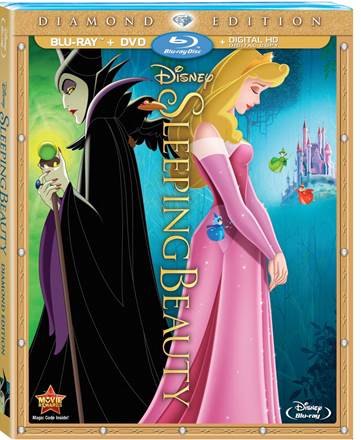
Disney’s gorgeous “Sleeping Beauty” is out in a magnificent new Diamond edition this week. This classic should be in the library of every family and every animation fan.

The King and Queen happily celebrate the birth of their daughter, Princess Aurora. The young Prince who is betrothed to the baby and three good fairies, Flora, Fauna, and Merryweather, join the celebration. But wicked Maleficent, a bad fairy, is enraged when she is not included. She arrives at the party to cast a spell on the baby Princess. When she turns 16, she will prick her finger on the spindle of a spinning wheel, and die.image001

The good fairies cannot remove the spell, but they change it from death to a deep sleep from which Aurora can be awakened only by love’s first kiss. The King and Queen try to protect the princess by sending her off with the good fairies to live in a tiny cottage in the woods until her sixteenth birthday is over. They cannot use their magic powers because it would lead Maleficent to the princess. Aurora (called Briar Rose) grows up. Out in the woods, she meets the Prince, and they fall in love, not knowing they are already engaged. But the fairies prepare for her birthday party and argue about whether the dress they are making for Aurora should be pink or blue, and cannot resist using their magic. Maleficent discovers where they are and is able to make Aurora prick her finger and fall into a deep sleep. Maleficent also captures the prince to make sure he cannot break the spell. After the fairies help him escape, Maleficent turns herself into a dragon to stop him. He kills the dragon and wakes Aurora with a kiss. At her birthday party, they dance, not even noticing that her dress turns from blue to pink as the fairies continue to argue about the color.

In this classic story, as in “Snow White,” a sleeping princess can only be awakened by a kiss from the prince. Psychiatrist Bruno Bettelheim and others have written extensively about the meaning of these stories, and the ways in which they symbolize the transition to adulthood and sexual awakening. Bettelheim’s theory was that such fairy tales begin to prepare children for developments they are not ready to assimilate consciously.

There is no reason to discuss this interpretation with children, of course. But it is worthwhile to talk with them about Maleficent, one of Disney’s most terrifying villains, and why her bitter jealousy makes her so obsessed with vengeance. Is that what she really wants? Isn’t she doing exactly the opposite of what is required to achieve her real goal, acceptance? Children also enjoy the little squabbles of the three good fairies, which may remind them of arguments with their siblings.

image003Extras on this new edition:

· Art of Evil: Generations Of Disney Villains – This legacy piece spotlights Disney’s favorite villain animator, Marc Davis and his infamous creations of characters such as Maleficent and Cruella. Throughout the piece, we will talk to modern day animators like Andreas Deja and also the new generation of Animators (Lino DiSalvo Animation Director of FROZEN) on how Marc’s designs and characters influenced what they do today.

· DisneyAnimation: ARTISTS IN MOTION (Extended Edition) – Join Walt Disney Animation Visual Development artist Brittney Lee as she goes through the process of creating a three dimensional sculpture of Maleficent, completely out of paper. In this extended edition, go deeper into Britney’s process

· Never Before Seen Deleted Scenes:
o The Fair (With Deleted Character – The Vulture) – In this version of the story, the fairies do not take the Princess to live with them in the forest. Convinced that King Stefan’s order to burn all the spinning wheels in the kingdom will not prevent Maleficent’s curse, the good fairies put a magic circle around the castle and cast a spell: “No evil thing that walks or flies or creeps or crawls can ever pass these castle walls.”
o The Curse is Fulfilled – The three good fairies have just returned Aurora to the castle and give her a crown. They leave the room to give Aurora some time alone…but Maleficent pays her a visit.
o Arrival Of Maleficent (Alternate Scene) – Maleficent arrives uninvited to the christening of the Princess Aurora.

https://www.youtube.com/watch?v=XdJpXFVunJ0&list=UU4IEmIzWf_X4lEPtGm7kgzQ

· BEAUTY-OKE “Once Upon A Dream” – Sing along to this kinetic text video of Aurora’s signature song.

· Classic DVD Bonus Features Include:
o The Sound Of Beauty: Restoring A Classic – This featurette covers the creation of the 7.1 mix of the score of Sleeping Beauty that was done for Blu-ray, using the source tapes from the original recording sessions resulting in an audio experience of superior quality with greater detail and fidelity that you have ever heard before.

o Picture Perfect: The Making Of Sleeping Beauty – Discover the behind-the-scenes magic that transformed a beloved fairy tale into a cinematic work of art. Legendary Animators, actors and film historians reveal the secrets behind Disney’s masterpiece.

o Eyvind Earle: A Man And His Art – Early in his career, renowned American Artist Eyvind Earle worked as a background painter at the Walt Disney Studio. Walt Disney liked his work so much that he entrusted him with the assignment to be the Art Director for Sleeping Beauty. This was the first time that one artist was given the responsibility for the entire look on one of Disney’s animated features. This piece follows Earle’s development as an artist and his years at the Studio.
o Audio Commentary by John Lasseter, Andreas Deja and Leonard Maltin

Related Tags:


Animation Based on a book Classic Comedy For Your Netflix Queue Movie Mom’s Top Picks for Families Musical Romance

Nick and Norah’s Infinite Playlist

Posted on October 2, 2008 at 6:04 pm

B+
Lowest Recommended Age: Mature High Schooler
MPAA Rating: Rated PG-13 for mature thematic material including teen drinking, sexuality, language and crude behavior
Profanity: Very strong language for a PG-13
Alcohol/ Drugs: Teen drinking, character gets very drunk
Violence/ Scariness: Comic violence, no one badly hurt
Diversity Issues: Diverse characters
Date Released to Theaters: October 3, 2008

There is no question that Nick (Michael Cera) and Norah (Kat Dennings) are destined for True Love. For one thing, they have the same taste in music. Nick is still making mixes for the girl who dumped him (Alexis Dziena as Tris, who doesn’t want Nick but REALLY doesn’t want him to want anyone else) because that is the best way for him to express how he feels. He does not know that Norah snags them because she may not know who he is, but she knows he is her musical soulmate. When Tris threw the most recent one into the trash (“Road to Closure: Volume XII”), Norah retrieved it and loved it.

And they share names with the most adorable couple in the history of movies, Nick and Nora Charles, played by William Powell and Myrna Loy in the “Thin Man” series. Powell and Loy, who appeared together more than any on-screen team in the sound era, were always magic together (I am especially partial to “I Love You Again”), but what made their “Thin Man” couple so unusual was that they were already married when they began. The original Nick and Nora made marriage look like fun; they were better evidence that there is such a thing as happily ever after than a hundred movies that end with a wedding.

This Nick and Norah have a way to go to get to happily ever after, but it is a journey we enjoy taking with them. First, the characters are played by two of the most endearing young performers in films today, Michael Cera (from “Juno” and “Superbad”) and Kat Dennings (“40 Year Old Virgin” and “The House Bunny”). Second, the script is fresh, funny, and real, and third it is superbly directed by Peter Sollett, whose Raising Victor Vargas showed great skill at telling stories about teenagers that feel true, immediate, and intimate.

It all takes place on one night in the small town that is New York City, or at least the part of New York that is cool for high school seniors, who cruise around and run into each other pretty much constantly except when they are trying to find each other. Nick, Norah, Tris and her new date, Nick’s kind-hearted gay bandmates, and Norah’s very drunk friend Caroline (Ari Graynor, whose dazzling smile almost completely de-tawdrifies her character’s situation, even when she’s barfing into a bus station toilet that was already plenty disgusting enough).

The film adroitly sidesteps the expected teen movie cliches. Nick and Norah are tentative about their feelings for one another but they each know who they are and they both have a level of confidence about interacting in the world and understanding what is important to them. I liked the way Norah talked about “tikkun olam,” the Jewish imperative to heal the world.” It is very nice to see a movie character, especially a young one, who draws something meaningful from religion and to see something Jewish in a movie that is not “oy vay,” bagels, or guilt. The movie also draws from the emerging world of cuddle puddles and technological omni-connectedness to move the story forward without being intrusive or showy or trying too hard to be hip. And it beautifully catches the way that falling in love at the same time transforms us and makes us our most authentic selves.

Related Tags:


Comedy Date movie Movies -- format Romance Teenagers
THE MOVIE MOM® is a registered trademark of Nell Minow. Use of the mark without express consent from Nell Minow constitutes trademark infringement and unfair competition in violation of federal and state laws. All material © Nell Minow 1995-2026, all rights reserved, and no use or republication is permitted without explicit permission. This site hosts Nell Minow’s Movie Mom® archive, with material that originally appeared on Yahoo! Movies, Beliefnet, and other sources. Much of her new material can be found at Rogerebert.com, Huffington Post, and WheretoWatch. Her books include The Movie Mom’s Guide to Family Movies and 101 Must-See Movie Moments, and she can be heard each week on radio stations across the country.

Website Designed by Max LaZebnik