Rated PG-13 for crude and sexual content, language and some drug references.
Profanity:
Strong and crude language for a PG13
Alcohol/ Drugs:
Drinking, drug references
Violence/ Scariness:
Comic peril and violence
Diversity Issues:
Diverse characters, a strength of the movie is the positive portrayal of an inter-racial relationship
Date Released to Theaters:
February 8, 2008
“Family is a 24-7 reality check,” explains one of the parade of nightmare relatives. “This is one hell of a family,” says another. These two statements pretty much summarize the movie. And that’s the good news.
Family reunions on screen create immediate identification. We all know what it feels like to come home to our families of origin and discover how quickly those carefully-assembled grown-up personas disappear and those just-below-the-surface rivalries take over. That is why it is fun to see it happen to someone else. This set-up and a talented cast provide the engine that keeps this movie going even when the screenplay lags behind.
Martin Lawrence plays a therapist/author with a successful talk show. He is engaged to Bianca (Joy Bryant) the gorgeous and intensely competitive champion of the reality show “Survivor.” He brings her to meet his family on his first visit home in nine years, for his parents’ 50th anniversary celebration. Although his son Jamaal wanted to be with the family, R.J. had not planned to go – he sent a giant flat-panel TV instead. But Bianca points out that it would be great publicity to film it for his television show, showing the hometown boy made good, surrounding by adoring relatives.
This movie starts out badly, gets much worse, and then after it is just dull for a while, it veers off into a whole new category of awful. Stay away.
The premise is promising. How do we know? Because it has been done with various levels of success before, first and best in Noel Coward’s Blithe Spirit, where just as a widower is celebrating his new marriage, the ghost of his ex-wife appears to stir things up. Everything that one did right, this one did wrong, however. That one had wit and charm and a storyline that was supple and surprising. This one: none of the above.
Hal (Reece Thompson) has something say but he has a lot of trouble saying it. On the bus, he can practice asking for pizza, but when it comes to the moment and he is standing in the cafeteria line, he can’t quite get it out. He has a stutter, the kind of speech impediment that keeps the words stuck in his throat. People tend to ignore him. Either they are tied up in their own worries and do not realize that he deserves their attention, or they assume that because he does not talk he must not be worth listening to.
And then Ginny (Anna Kendricks) sits next to him on the school bus and invites him to join the debate team. She says she sees greatness in him. And, perhaps because of that, or just because she is hyper-articulate and sure of herself, maybe because his parents have just split up and love seems very confusing to him, all of a sudden Hal begins to feel feelings for Ginny that are seismic and shattering and uncontrollable. And so, his actions become as confused and embarrassing as his speech. He sort of stalks her. He sort of grabs her. And when he feels that she has betrayed him, he goes to any length to try to at the same time let her know he does not need her, defeat her, and win her back at the same time.
Director Jeffrey Blitz showed sensitivity to the throes of adolescence in his award-winning documentary about the national spelling bee for middle schoolers, Spellbound. He got those kids to trust him and here, too, and he gets the most from his talented young cast. Thompson is superb, showing perception and vulnerability without seeming mannered or excessive. Kendricks, a Broadway veteran so good in “Camp,” raps out her complex speeches with devastating effect; completely compelling as someone who would bring a dozen perfectly sharpened number 2 pencils to the SATs and challenge them all the way to the Supreme Court if they tried to give her one point less than a perfect score.
The screenplay wavers at times; the structure is a little ragged, there are a couple of self-consciously quirky indie moments, and the ending a little weak. But Thompson and Kendricks and the debate scenes make this one of the best coming-of-age stories in many months.
Parents should know that there are some crude sexual references and high school situations. Characters use some strong language, a teenager smokes, and there are references to drinking and drug use.
Families who see this movie should talk about how difficult it was for Hal to find someone who could understand or help him. Why were all of the adults around him so clueless?
Families who like this movie will also appreciate Napoleon Dynamite and the award-winning spelling bee documentary directed by Blitz, Spellbound. And they will enjoy this interview with writer-director Jeffrey Blitz.
There is undeniable little girl appeal in this story of a big, selfish meanie of a quarterback who is tamed by the 8-year-old daughter he never knew he had. Some audiences will find it as sugary as a fruit-scented princess pony sticker book, but its intended viewers will be delighted to see a story with a little girl who is smarter and more responsible than many of the adults around her and is adored by every one of them, especially her big, tough daddy.
Rated PG-13 for some language, sexual humor, and partying
Profanity:
Some crude language
Alcohol/ Drugs:
Drinking
Violence/ Scariness:
Tense confrontations, comic peril
Diversity Issues:
Diverse characters, some stereotyping
Date Released to Theaters:
September 21, 2007
This updated fairy tale has some clever riffs on “Snow White” but never makes use of the considerable talents of its star, Amanda Bynes.
Copyright Morgan Creek 2007 Sydney (Bynes) is a college freshman who wants to join Kappa, the most exclusive sorority on campus, though she is more comfortable on a construction site than at a cotillion. “You know how people joke about being raised by wolves? I was raised by construction workers,” she explains and we cut to her devoted father (“The Dukes of Hazzard’s” John Schneider) illustrating the facts of life for her with plumbing supplies. When she knew she was dying, Sydney’s mother wrote her a letter, telling her how much she loved being in the sorority. Now Sydney wants to fulfill her mother’s dream.
But Sydney does not meet the standards of the Kappa president, Rachel Witchburn (Sara Paxton). She is not blonde, she is not a size 2, and, worst of all, Sydney fails to recognize Rachel’s supreme domination over just about everything on campus — especially the handsome Prince Matt Long as Tyler Prince, the campus McDreamy.
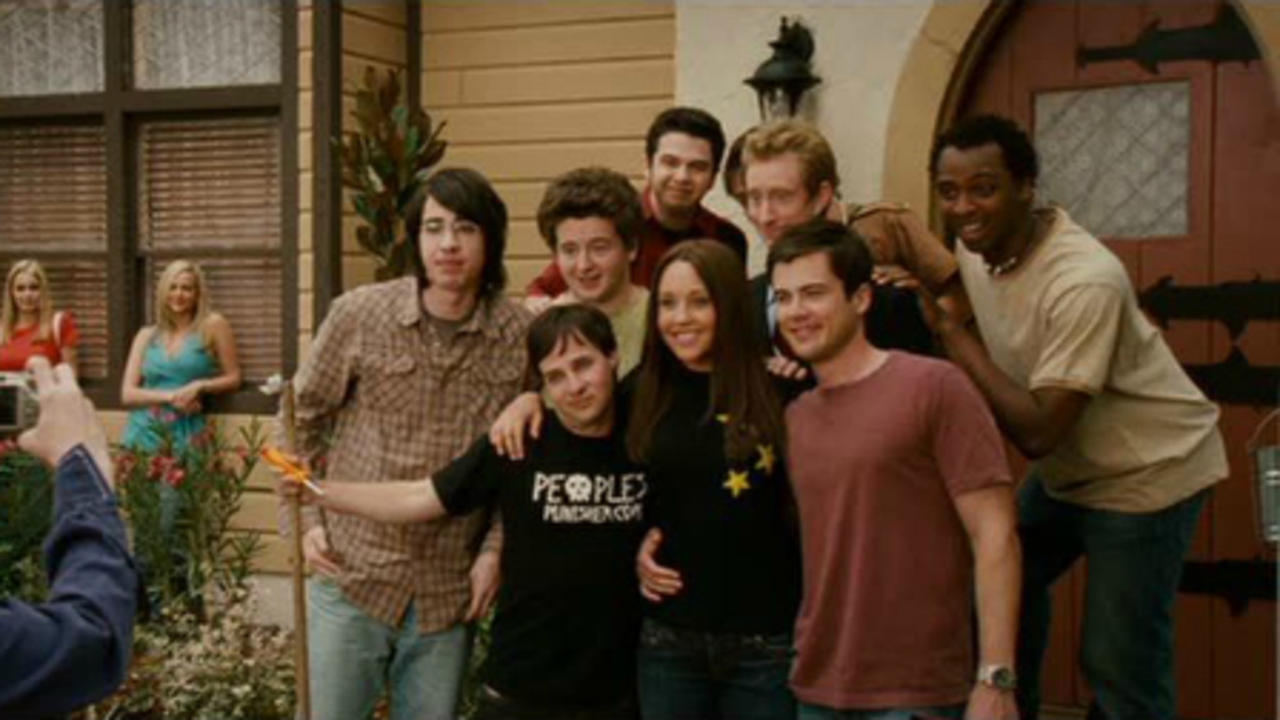
Rachel boots Sydney out of the sorority in a humiliating public ceremony. There is only one place left on campus that will take her in, the ramshackle house occupied by the campus outcasts. There are seven of them. One has allergies and sneezes a lot. One is an exchange student with jet lag who sleeps all the time. One is bashful. One is grumpy. All are nerdy. And Rachel has a plot to tear their house down so her family can build a shiny new rec center for sorority and fraternity members only.
Echoes of the Snow White story provide the movie’s brightest moments. Rachel checks constantly to make she is still considered the fairest in the land, not in a magic mirror but in the campus “hot or not” website. The poisoned apple? An Apple laptop with an important homework assignment gets infected with a virus. And of course in the big moment Sydney is awakened by a kiss from the Prince.
It is less cute when a nasty trick has the seven dorks naked at a campus party and when they march past Rachel with a mean-spirited “Hi, Ho!” It makes it harder for us to stay on the side of the good guys when they descend to the terminology of the bad guys. And it goes overboard on the geek factor; drawing less from fairy tales than from “Revenge of the Nerd”-style caricatures. For a movie that is supposed to be all about inclusion and respecting the dork within each of us, it has a lot of fun at their expense.
Bynes is captivating despite a role that does not give her much to do but display tomboyish good spirit behind some really unfortunate hair and make-up. She looks trapped in a 1970 Yardley ad, all fake tan, shag haircut, and pale eye shadow. She can make a retort sound spirited, not snappish, as when she tells Rachel that she doesn’t “speak priss.” Her best moments are with Long, who has a great smile and a rare ability to listen to what other performers are saying without thinking he has to be doing something every second he is on screen. Newcomer Jack Carpenter as Sneezy/Lenny brings warmth and humanity to a thinly written role as the most sociable of the dorks.
But director Joe Nussbaum does not trust his performers, the material, or the audience. He keeps the tempo so synthetically sitcom-y you expect to hear a rim shot and a laugh track. Everything is exaggerated. Every joke is an elbow in the ribs. Like Rachel, he is checking his “hotness” every couple of minutes. And like Rachel, his score could use some improvement.
Parents should know that this movie has some vulgar humor and strong language (references to “hos,” b-word), implied nudity, and a drinking game at a party. A strength of the movie is its emphasis on inclusion and the importance of treating diverse people respectfully, and Sydney reaches out to all groups on campus, from the Hassids to the band geeks, cross-dressers, and Goths.
Families who see this movie should talk about when they most felt like outsiders or dorks and what they can do to make sure that people around them feel included and appreciated for who they are.
Families who enjoy this movie will also enjoy other takes on classic fairy tales like Ella Enchanted and Shrek. Barbara Stanwyk and Gary Cooper co-starred in an earlier update of Snow White, Ball of Fire.

 “Family is a 24-7 reality check,” explains one of the parade of nightmare relatives. “This is one hell of a family,” says another. These two statements pretty much summarize the movie. And that’s the good news.
 , where just as a widower is celebrating his new marriage, the ghost of his ex-wife appears to stir things up. Everything that one did right, this one did wrong, however. That one had wit and charm and a storyline that was supple and surprising. This one: none of the above.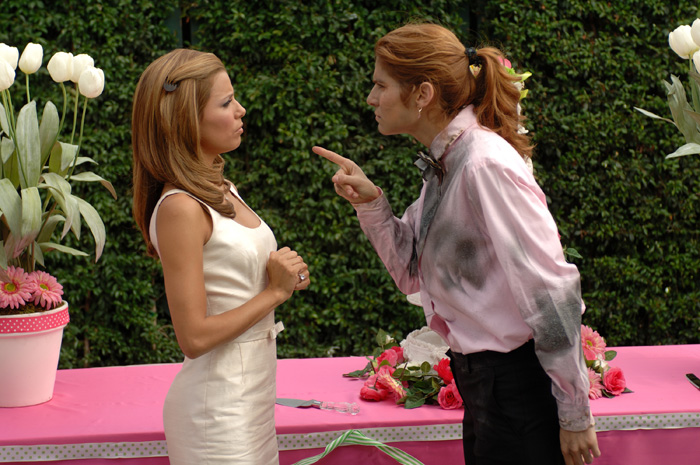

 . He got those kids to trust him and here, too, and he gets the most from his talented young cast. Thompson is superb, showing perception and vulnerability without seeming mannered or excessive. Kendricks, a Broadway veteran so good in “Camp,” raps out her complex speeches with devastating effect; completely compelling as someone who would bring a dozen perfectly sharpened number 2 pencils to the SATs and challenge them all the way to the Supreme Court if they tried to give her one point less than a perfect score.
  and the award-winning spelling bee documentary directed by Blitz,

 and
and  . Barbara Stanwyk and Gary Cooper co-starred in an earlier update of Snow White,
  .
.